

Trading in the Zone Summary: Mark Douglas on Thinking in Probabilities
Want the daily routine? Get the free 15-Minute Swing Trader’s Checklist. Get it free →
The four fears behind most trading errors, the five truths that remove them, and the 20-trade exercise that turns the theory into a habit
Published: 17 October 2026 · Last updated: 17 October 2026 · By Spencer Li, CFTe
What is Trading in the Zone about? Mark Douglas’s book argues that consistent trading results come from your beliefs and state of mind, and that more analysis will not fix them. He says plainly, “I do not offer a trading system.” He assumes you already have an edge and shows you why you do not trust it.
The core idea is that a trader must think in probabilities, the way a casino does. Douglas boils it down to five fundamental truths, starting with “Anything can happen.” Once you believe them, losses stop feeling like a threat, and the four fears behind most trading errors lose their grip. He finishes with a practical drill: trade your system exactly as designed for 20 trades in a row, sized so you could accept losing all 20.
Who is Mark Douglas?
Mark Douglas started trading in 1978, while running an insurance agency outside Detroit. In 1981 he moved to Chicago as a broker at Merrill Lynch, and, in his own words, “within nine months of moving to Chicago, I had lost nearly everything I owned.”
That loss shaped the rest of his career. He wrote his first book, The Disciplined Trader, which took seven and a half years and came out in 1990. In 1983 he founded Trading Behavior Dynamics and spent the following decades coaching traders. Trading in the Zone was published in 2000.
I first read Douglas around 2008, through The Disciplined Trader.
What is the overview of Trading in the Zone?
The book runs in a clear order. Chapters 1 to 3 diagnose the errors traders make. Chapters 4 and 5 explain how the mind produces them. Chapter 6 describes what the market actually is. Chapters 7 and 8 give the five beliefs that fit it. Chapters 9 to 11 explain how to change a belief, and end with the drill.
Douglas’s first distinction is the one most traders skip. Everyone who places a trade takes risk. Almost nobody accepts it. He defines it precisely: “Accepting the risk means accepting the consequences of your trades without emotional discomfort or fear.” And he calls it “the most important skill you can learn.”
What are the four trading fears?
Douglas says that most of the errors traders make come from four fears: being wrong, losing money, missing out, and leaving money on the table.
| The fear | What it makes you do |
| Being wrong | Refuse to take the loss, and look only for information that agrees with you |
| Losing money | Hesitate on a valid signal, or skip the setup altogether |
| Missing out | Jump in before the signal has actually formed |
| Leaving money on the table | Take profits too early, or never take them and let a winner turn into a loser |
You will recognise at least one of these. And his point is that you cannot fix them with courage. “The best traders aren’t afraid.” They are not brave. They simply hold beliefs that leave nothing to fear.
What are the five fundamental truths?
This is the heart of the book. Douglas lists them in Chapter 7:
- Anything can happen.
- You don’t need to know what is going to happen next in order to make money.
- There is a random distribution between wins and losses for any given set of variables that define an edge.
- An edge is nothing more than an indication of a higher probability of one thing happening over another.
- Every moment in the market is unique.
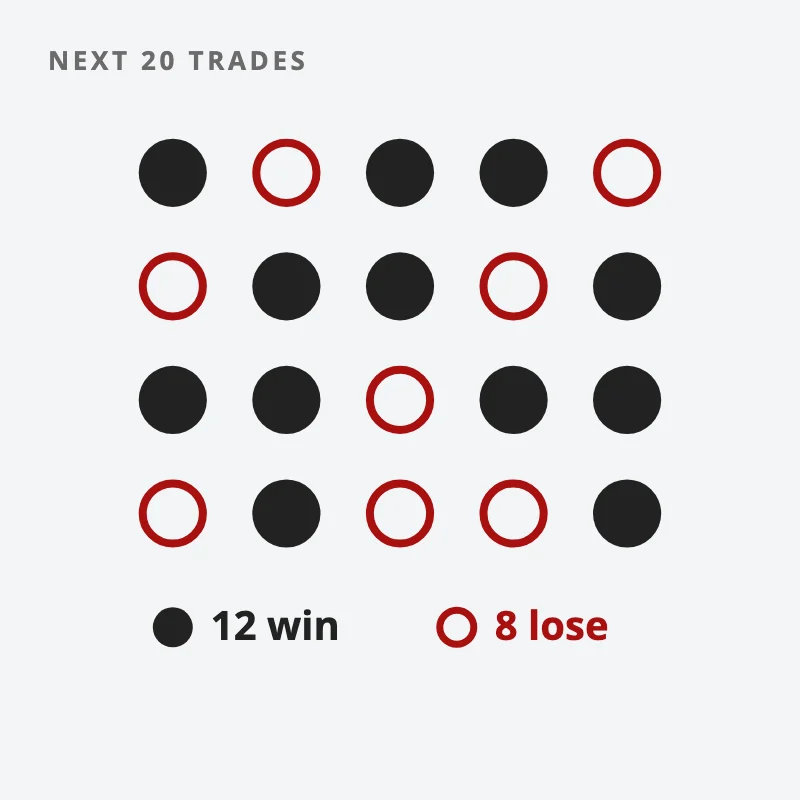
The second truth is the one that changes how a loss feels. Douglas’s example is a system where, out of the next 20 trades, 12 will win and 8 will lose. You know the ratio. You do not know the order. So any single loss tells you almost nothing. As he puts it: “If your edge puts the odds in your favor, then every loss puts you that much closer to a win.”
The fifth truth is the cure for a trap every trader falls into. If you once called the market right, you start hunting for the same picture again, and when you find it, it feels certain. From the market’s side, it is a new moment with a new set of buyers and sellers.
Why does Douglas compare trading to a casino?
Because a casino makes steady profits on games with random outcomes. Douglas puts the blackjack edge at “approximately a 4.5-percent edge” over the player. The casino does not know who will win the next hand. It does not need to. It knows that over enough hands, the edge pays.
His summary of it is the most useful sentence in the book: “Events that have probable outcomes can produce consistent results, if you can get the odds in your favor and there is a large enough sample size.”
Now notice the two conditions. Odds in your favour, and a large enough sample. The casino only collects its edge because it plays every hand. A trader who skips the setups that scared them has broken the second condition, and is no longer running the same system. Our post on the law of large numbers in trading works through why the sample matters as much as the edge.
How do you put the book to work?
Douglas’s ideas turn into a routine in three steps.
- Edge. Define your setup with fixed rules, so you can tell in seconds whether it is present. Douglas warns that adding “other” information to the decision adds random variables to your results.
- Risk. Know the loss on every trade before you enter. Douglas sets the stop by the chart, never by comfort. He tells you not to “change your established risk parameters to satisfy your comfort levels.” If the loss feels too big, trade fewer shares. Our guide on where to put your stop loss and take profit shows how to place it on structure.
- Sample. Judge the system on 20 trades or more, never on the last one. Douglas says “a sample size of at least 20 trades fulfills both of these requirements”: large enough to test the edge, small enough to catch it if it stops working.
What is the 20-trade exercise?
The rule is short: “Trade your system exactly as you have designed it.” You commit to the next 20 occurrences of your edge, all of them, with no changes.
The sizing rule is what makes it survivable. Douglas says to set it up so “you can accept the risk (in dollar value) of losing on all 20 trades.” Do the sum in percent. Risk 1% of your account per trade, and 20 straight losses take you down about 18%. Risk 0.5%, and it is about 9.5%. Pick the number you could live with, and size from there.
The test is not profit. Douglas says you pass when you can get through a full sample of 20 without hesitation or second-guessing. The friction you feel along the way is the reading. It tells you which belief still argues with the five truths.
If you want a daily routine that keeps each trade small enough to accept, our free 15-Minute Swing Trader’s Checklist lays out the rules and the questions to ask before every entry. Get the free checklist →
What else is worth knowing from the book?
Rigid rules, flexible expectations. Douglas asks how a trader can be rigid and flexible at once. His answer: “We have to be rigid in our rules and flexible in our expectations.” The typical trader does the opposite. “He is flexible in his rules and rigid in his expectations.”
The danger of beginner’s luck. A new trader who starts with winners feels the carefree state of a professional “without having developed the attitude itself.” Early wins teach the wrong lesson, and the bill comes later.
The three kinds of trader. Douglas estimates consistent winners at “probably fewer than 10 percent,” consistent losers at “between 30 and 40 percent,” and the rest, “the remaining 40 to 50 percent,” as boom-and-bust traders who make money and then give it back in large losses.
When should you read Trading in the Zone?
Not first. A trader on Reddit put the book’s claim simply this year: “psychology (From Mark Douglas) matters more than predictions.” I agree, and I still tell people to wait.
As I wrote in my reading list: “Reading Mark Douglas before you have lost real money is like reading about heartbreak before your first relationship. The words are there, the meaning is not.”
So read the technical and risk books first, trade small for a while, then come back to Douglas. It ranks third in the ten books I would hand a beginner, on the condition that you read it after some live trades. The full list is in the best investing and trading books of all time.
Concluding thoughts
Trading in the Zone will not give you a setup. It gives you the reason you keep breaking the rules of the setup you already have. If you have ever moved a stop, skipped a valid signal, or cashed out a winner too early, the book names the fear behind it.
For a broader take on the three pillars of mind, method and money, read our summary of Trading for a Living. For the mindset habits we teach, see the trading psychology guide.
So here is Douglas’s test, in one line. Could you take your next 20 setups exactly as your rules say, without skipping one?
FAQ
What is the main idea of Trading in the Zone?
That consistent results come from thinking in probabilities. Douglas argues your beliefs, more than your analysis, decide whether you can follow your own rules.
What are Mark Douglas’s five fundamental truths?
Anything can happen. You don’t need to know what is going to happen next to make money. Wins and losses are randomly distributed for any edge. An edge is only a higher probability. Every moment in the market is unique.
Is Trading in the Zone good for beginners?
It is better after some live trading. The ideas land once you have felt the fears the book describes, so read it after a few months of small, real trades.
What is the 20-trade exercise?
You trade your system exactly as designed for the next 20 setups, with no changes, sized so you could accept losing all 20. You pass when you can do it without hesitation.
Go deeper
Douglas tells you to know your risk before every trade. The free 15-Minute Swing Trader’s Checklist shows you how: the daily scan, the questions to ask before you enter, and the five rules that keep you in the game. Enter your email and we’ll send it over:
We use your email address to send you the checklist, then emails about trading and our courses. Unsubscribe in one click, any time. Privacy policy.
About the author. Spencer Li is The 15-Minute Trader and the founder of Synapse Trading. He is a Certified Financial Technician (CFTe) with 15+ years of trading, run from 70+ countries. He holds a B.Acc and B.BM from SMU. Every trade he takes is public, dated, losses left in. He teaches low-risk swing trading in 15 minutes a day, one system for any market.
Educational content only, not personalised financial advice. Trading carries risk, including loss of capital. Past performance is not indicative of future results. Synapse Trading is not licensed or regulated by MAS.
Want the daily routine? Enter your email for the free 15-Minute Swing Trader's Checklist.
Free 5-page PDF, then occasional trading emails. Education only, not financial advice. Unsubscribe anytime. Kit stores your email in the US: see our privacy policy.
Want to learn the full method? The Trading Mastery Program teaches the 4 strategies I have traded since 2011. It suits beginners and experienced traders.
Rather follow the trades as they happen? Daily Trading Signals is our Telegram channel: my trade ideas with entry, stop and exit, and every trade is public.
Questions about this post? Ask in the free Telegram channel →
Educational content only, not personalised financial advice. Trading carries risk, including loss of capital. Past performance is not indicative of future results. Synapse Trading is not licensed or regulated by MAS.

