

The Psychology of Money Summary: Morgan Housel’s Lessons for Traders
Want the daily routine? Get the free 15-Minute Swing Trader’s Checklist. Get it free →
Twenty short chapters on why behaviour beats intelligence with money, and the three lessons that matter most if you trade
Published: 17 October 2026 · Last updated: 17 October 2026 · By Spencer Li, CFTe
What is The Psychology of Money about? Morgan Housel’s book argues that “doing well with money has a little to do with how smart you are and a lot to do with how you behave.” He describes the subject as “a soft skill, where how you behave is more important than what you know.” The book is 20 short chapters, each a standalone story, and you can read them in any order.
For a trader, three ideas carry the most weight. Survival comes before returns, because compounding only works if you stay in the game. A few outsized wins drive most results, so being wrong often is normal. And room for error, in your sizing and your savings, is what lets you survive the surprises nobody forecasts. This summary walks through those three, plus the other chapters worth your time.
Who is Morgan Housel?
Morgan Housel is a writer and investor at Collaborative Fund, a venture firm he refers to in the book as his own. The book grew out of a 2018 report he wrote on 20 flaws, biases and causes of bad money behaviour, which was read by over one million people. Some short passages from that report appear in the book unchanged.
His style is the reason the book works. He tells a story, draws one point from it, and moves on. There are no formulas to memorise.
What is the overview of the book?
Housel’s premise is that the standard financial curriculum, with its emergency funds and savings rates and correlations, is not wrong. It is beside the point. As he puts it, knowing what to do “tells you nothing about what happens in your head when you try to do it.”
Here are the chapters that matter most to a trader, and the one-line idea in each.
| Chapter | The idea in one line |
| 1. No One’s Crazy | Your own experience shapes how you see markets far more than the data does |
| 2. Luck & Risk | Outcomes are shaped by forces beyond effort, so judge decisions, not results |
| 3. Never Enough | Risking what you need for what you do not need is foolish |
| 4. Confounding Compounding | Time, not the highest return, does the heavy lifting |
| 5. Getting Wealthy vs. Staying Wealthy | Getting money and keeping it are opposite skills |
| 6. Tails, You Win | A small minority of events drives most outcomes |
| 11. Reasonable > Rational | A good plan you can stick with beats a perfect one you abandon |
| 13. Room for Error | Margin of safety lets you survive what you cannot predict |
| 15. Nothing’s Free | Volatility is the fee for returns, not a fine |
| 16. You & Me | Do not take cues from people playing a different game |
The three lessons traders should take
Why is staying in the game the whole point?
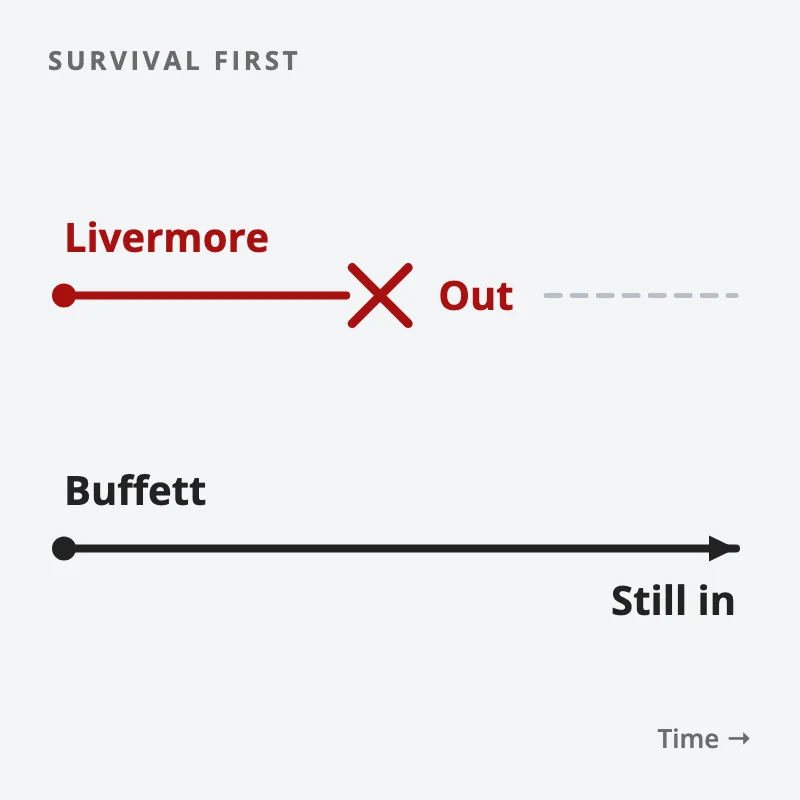
Chapter 5 opens with the story every trader should know. In the 1929 crash, Jesse Livermore, “the greatest stock market trader of his day,” was short. His family met him in tears on October 29th, expecting ruin, and he told them they were rich. Then, overflowing with confidence, he made larger and larger bets, went deep into debt, and lost everything.
Housel’s line on it is simple. There are many ways to get wealthy, but “there’s only one way to stay wealthy: some combination of frugality and paranoia.”
He sets Livermore against Warren Buffett. About 99.6% of Buffett’s net worth, by the book’s numbers, came after his 50th birthday. “His skill is investing, but his secret is time.” And the reason Buffett had the time is that he never blew up. “He survived. Survival gave him longevity.”
So the rule Housel takes from it is the same idea our low-risk approach is built on: “More than I want big returns, I want to be financially unbreakable.” In trading terms, that means sizing every position so that no losing streak can end your account. The risk management guide shows how we do that in practice.
Why is being wrong often normal?
Chapter 6 is the most useful chapter in the book for anyone who hates losing trades.
Housel shows that a tiny share of events drives most results. In one study of more than 21,000 venture financings, 65% lost money, and half a percent earned 50 times or more. In the Russell 3000 index since 1980, 40% of companies lost at least 70% of their value and never recovered. Effectively all of the index’s returns came from the 7% that did extremely well.
Even the best investors live with this. Buffett said he has owned 400 to 500 stocks in his life and made most of his money on 10. Peter Lynch put it bluntly: “If you’re terrific in this business, you’re right six times out of 10.”
For a trader, this is the case for cutting losses fast and letting winners run. Your win rate can be modest if your winners are much larger than your losers. Our post on win rate vs risk reward works through the numbers.
Why does margin of safety matter more than a forecast?
Chapter 13 starts with blackjack card counters. A counter with roughly a 2% edge over the casino still loses 49% of the time, so they need a big enough bankroll to ride out the bad runs. The edge is real. Without room for error, it does not matter.
Housel borrows Benjamin Graham’s line: “the purpose of the margin of safety is to render the forecast unnecessary.” And he draws a hard line on leverage. You must take risk to get ahead, but “no risk that can wipe you out is ever worth taking.”
The book’s starkest example is Rick Guerin, Buffett and Munger’s third partner. He was on margin going into 1973 to 1974, when the market fell almost 70%, and he was forced to sell his Berkshire shares to Buffett. He was just as smart as the other two, Buffett said. He was simply in a hurry.
What else in the book is worth your time?
Chapter 11, Reasonable > Rational. “You’re not a spreadsheet. You’re a person. A screwed up, emotional person.” Housel says to “aim to just be pretty reasonable.” A strategy you can stick with through its lean years beats a perfect one you abandon at the first drawdown.
Chapter 15, Nothing’s Free. The price of market returns “is not dollars and cents. It’s volatility, fear, doubt, uncertainty, and regret.” Treat it as a fee you pay, not a fine for doing something wrong, and you stop trying to dodge it.
Chapter 16, You & Me. “Investors often innocently take cues from other investors who are playing a different game than they are.” A day trader’s opinion on a stock is useless to a long-term holder, and the reverse is true too. Know which game you are in.
Chapter 6 again, on timing. Housel’s example of three savers, Sue, Jim and Tom, from 1900 to 2019 is worth the read. Sue kept investing through every recession. Jim and Tom tried to step aside. Sue ended with about 69% more than Jim and about 86% more than Tom.
What did readers take from it?
The book reaches people well outside trading. A Singapore investor on Reddit, writing in May 2026, said the book taught them about diversification, tail events and rebalancing, and above all about “sleeping well at night.”
That line is close to Housel’s own. In the chapter on room for error, he quotes Buffett: “When forced to choose, I will not trade even a night’s sleep for the chance of extra profits.”
Concluding thoughts
Housel is honest about his own limits. In the last chapter he admits that two of his largest positions, a house with no mortgage and a large cash holding, are hard to defend on paper. He holds them because they let him sleep. His summary chapter puts the whole book in one admission: “I can’t tell you what to do with your money, because I don’t know you.”
For traders, the book will not give you a setup or an entry rule. What it gives you is the reason your rules matter. If you want the theory of value investing that Housel challenges in chapter 12, read our summary of The Intelligent Investor. For a book on spending your money well once you have it, see our summary of Die With Zero. The full list of recommended books is in the best investing and trading books of all time, and the habits behind staying calm are in the trading psychology guide.
So here is the question Housel leaves you with. If your account fell by a third tomorrow, would your plan survive it, and would you?
If you want a daily routine built around surviving first, our free 15-Minute Swing Trader’s Checklist lays it out. Get the free checklist →
FAQ
What is the main message of The Psychology of Money?
That doing well with money depends far more on how you behave than on how smart you are. Housel calls it a soft skill, and builds the case through 20 short stories.
Is The Psychology of Money good for traders?
Yes, for the mindset rather than the method. Its chapters on survival, tail outcomes and room for error map directly onto position sizing and cutting losses.
What does Housel say about risk?
He says no risk that can wipe you out is worth taking, and that margin of safety, not a good forecast, is what lets you survive the surprises.
How long is The Psychology of Money?
It has 20 short chapters plus an introduction and a postscript, and each chapter stands alone, so you can read it in any order.
What is the Livermore story in The Psychology of Money?
Jesse Livermore made a fortune shorting the 1929 crash, then grew overconfident, took ever-larger leveraged bets and lost everything. Housel uses him to show that getting wealthy and staying wealthy are different skills.
Go deeper
Housel explains why survival comes first. The free 15-Minute Swing Trader’s Checklist shows how we build it into every trade: the daily scan, the questions to ask before you enter, and the five rules that keep you in the game.
About the author. Spencer Li is The 15-Minute Trader and the founder of Synapse Trading. He is a Certified Financial Technician (CFTe) with 15+ years of trading, run from 70+ countries. He holds a B.Acc and B.BM from SMU. Every trade he takes is public, dated, losses left in. He teaches low-risk swing trading in 15 minutes a day, one system for any market.
Educational content only, not personalised financial advice. Trading carries risk, including loss of capital. Past performance is not indicative of future results. Synapse Trading is not licensed or regulated by MAS.
Want the daily routine? Enter your email for the free 15-Minute Swing Trader's Checklist.
Free 5-page PDF, then occasional trading emails. Education only, not financial advice. Unsubscribe anytime. Kit stores your email in the US: see our privacy policy.
Want to learn the full method? The Trading Mastery Program teaches the 4 strategies I have traded since 2011. It suits beginners and experienced traders.
Rather follow the trades as they happen? Daily Trading Signals is our Telegram channel: my trade ideas with entry, stop and exit, and every trade is public.
Questions about this post? Ask in the free Telegram channel →
Educational content only, not personalised financial advice. Trading carries risk, including loss of capital. Past performance is not indicative of future results. Synapse Trading is not licensed or regulated by MAS.

