

Is Crypto Still Worth Trading in 2026?
Want the daily routine? Get the free 15-Minute Swing Trader’s Checklist. Get it free →
Published: 6 November 2026 · By Spencer Li, CFTe
If you hold any crypto right now, you have probably noticed that the news does not match your portfolio. Bitcoin sits near $80,000, below what most of the big banks expected by now, and yet every second headline is about new regulation and institutions piling in. So which one is telling the truth?
Both of them, actually. And that is the problem.
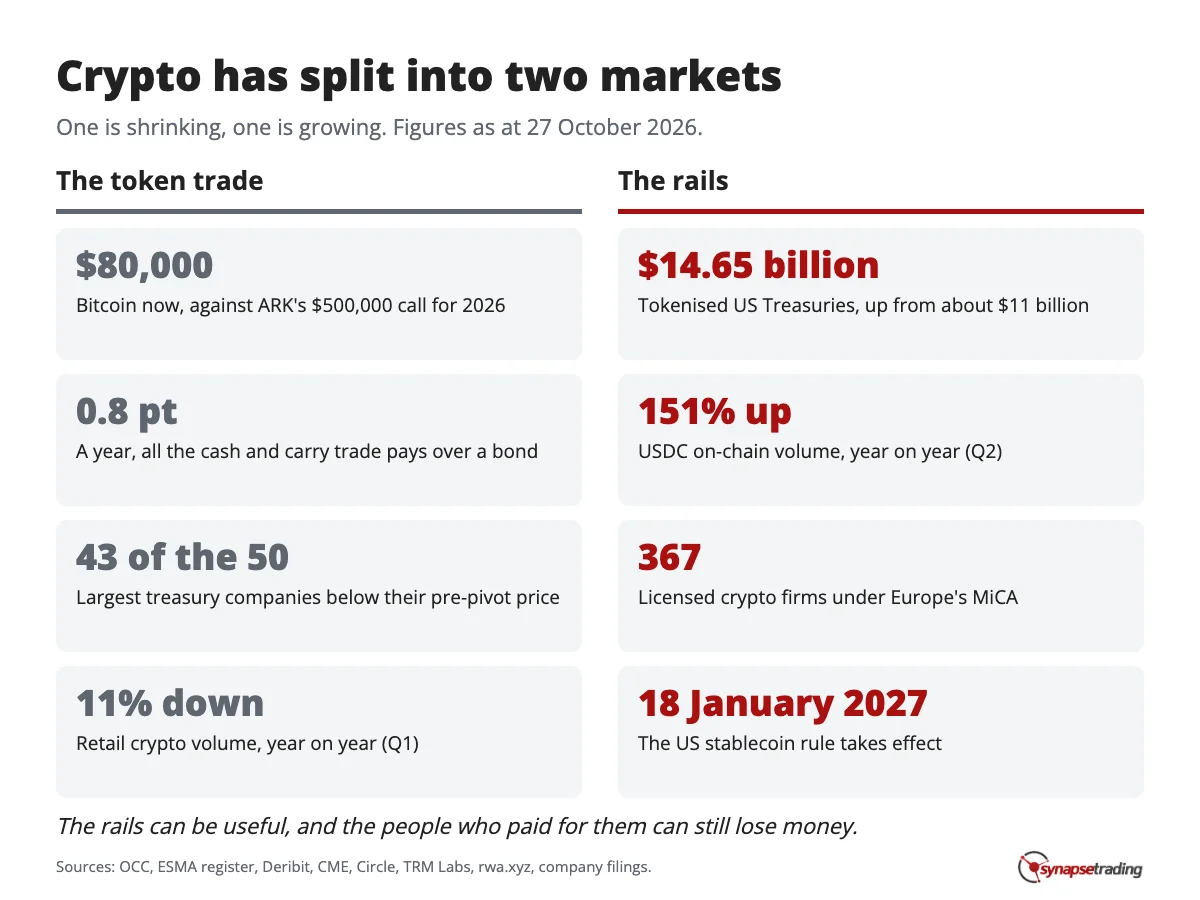
Crypto has split into two markets that are moving in different directions.
So where did the rules end up?
In the US, the stablecoin law has finally started turning into a rulebook. The GENIUS Act passed in 2025, and on 21 October the OCC, one of the main US bank regulators, finalised its rule for stablecoin issuers. It covers reserves, redemption, custody and capital, and it takes effect on 18 January 2027. The anti-money-laundering rules are still being written with the Treasury, so the rulebook is about half done.
The bigger bill went the other way. The CLARITY Act is the one that decides who regulates which tokens, and on 15 September it failed a procedural vote in the Senate, 49 to 50. A second vote is still possible, but the people betting real money are not counting on it. Polymarket has it signed into law this year at about 4%, down from about 30% just before the vote.
Meanwhile, other countries kept moving.
Europe’s MiCA now has 367 licensed firms, up from about 325 in August. The UK opened its licensing gateway on 30 September, and its rules become mandatory in October 2027. Japan moved crypto under its securities law in July, and Australia passed its licensing act in April. Hong Kong granted its first two stablecoin licences in the spring, and 34 applicants are still waiting.
Do you see what that changes for you? You are no longer waiting to find out whether crypto gets regulated, but instead you are choosing which rulebook you trade under.
What did Singapore propose?
On 1 September, MAS published draft amendments to the Payment Services Act. The consultation closed on 16 October, and as I write, no bill has gone to Parliament, so this is still a proposal rather than a rule. The shape of it is full reserve backing, redemption at par, a route for recognising foreign stablecoins here, and a proposed ban on issuers paying interest to holders.
That last point is especially important. Europe has already gone that way and the US is heading there too. So if you have been thinking of a regulated stablecoin as a thing that pays you a yield, that assumption is being written out of the rulebook in three major jurisdictions at once. A regulated stablecoin is becoming a payment instrument, rather than a savings product.
Do note that retail access rules here have not changed. Licensed providers still cannot offer you margin, credit or sign-up incentives, and there is still no spot crypto ETF listed on SGX for retail investors.
Why did the easy crypto income trade stop paying?
This matters most if you actually trade.
For years, the reliable way to earn income in crypto was the cash and carry trade. You buy the coin in the spot market, and then you sell the future against it. The gap between those two prices (the “basis”) is yours as the future converges. It’s a boring trade, and it worked for years because the gap was consistently wide.
Then the gap closed. The CME three month annualised bitcoin basis stayed below the two year Treasury yield for 157 straight days into 7 August, which means the trade paid you less than a government bond did for most of the year. Open interest in those futures fell by about 45% from the peak. The professionals did not take that trade either, which is why the money left.
Since then, the gap has opened again, a little. On Deribit, the March 2027 bitcoin future prices in about 5.4% a year. The two year Treasury pays about 4.7%. So the extra you earn for doing the trade is roughly 0.8 of a percentage point a year.
That 0.8 is the whole reward.
For it, you carry counterparty risk, smart contract risk and liquidation risk. The yield products look the same. Ethena’s sUSDe pays about 4.6 to 5%, and tokenised T-bill funds pay about 3.6%, which is less than the 4.2% you would get from a plain three month Treasury bill.
Who is still buying?
Remember when every small cap company wanted bitcoin on its balance sheet?
By early September, 43 of the 50 largest bitcoin treasury companies traded below their pre-pivot share price, and about $80 billion of market value had gone in 13 months. Strategy, the biggest of them, traded below the value of the coins it holds, and then it sold. It sold at least 6,948 bitcoin this year up to early August, partly to buy back its own preferred shares. In October it started buying again, a few hundred coins a week, which is small next to the 848,517 it holds.
The ETFs went the other way. The US spot bitcoin ETFs were net sellers for 2026 until August, then turned positive for the year in September, and had taken in more than $1.25 billion net by early October.
So the buyer has changed. That bid from treasury companies was real demand in 2024 and 2025, and it is a much smaller bid now. The ETF money has started to come back, which is the one part of the picture that moved in crypto’s favour since September.
Where is the real growth, then?
Now the other market, where the bullish headlines come from. Tokenised US Treasuries are worth about $14.65 billion, up from about $11 billion earlier this year, and Circle reported USDC on-chain volume up 151% year on year in its second quarter. Banks, payment firms and exchanges keep building on this because it settles faster and more cheaply than the plumbing they had, and that’s a good reason to adopt a technology whatever the token price does.
There are three honest caveats. Tokenised Treasuries have gone flat over the past month, a little below the $15.95 billion of early September. Total stablecoin supply has sat near $300 billion since April, so what you’re seeing is money moving between issuers rather than new money arriving. And retail use is falling: TRM Labs counted retail volume down 11% year on year in the first quarter, lower in nine of the top ten countries.
So institutions are wiring crypto into their infrastructure while ordinary users drift away.
What did the railways teach the people who paid for them?
Britain has been here before. The Liverpool to Manchester railway opened in 1830 with a forecast of 250 passengers a day, and it was carrying 1,200 a day within a month. Five years in, it was paying a 10% dividend. So everyone wanted a railway.
After 1844, hundreds of new lines were proposed, and at the peak, railway shares made up more than two thirds of the whole stock market. Within a year the crash had started. By 1850 the market had fallen 66% from its peak, and thousands of investors lost everything.
And the railways stayed. The mania left Britain the outline of a national network, cut London to Edinburgh from days by stagecoach to under 12 hours, and forced the whole country onto one standard clock. The economist Carlota Perez calls this the frenzy phase of a new technology, and she finds it in every big rollout of the last two centuries. The boom does not last, but the track it pays for does (Mustafa Suleyman retells the story in The Coming Wave).
That is the split in crypto, seen from 180 years away. The rails can be useful, and the people who paid for them can still lose money.
But the parallel breaks in one place. A railway shareholder owned the track. A token holder does not own the stablecoin rails or the tokenised funds being built on them, so even if the plumbing wins, it may never pay the people holding the coins.
Where do I think this goes?
First, here’s a base rate. In May 2021, ARK published a $500,000 bitcoin target for 2026, and bitcoin is near $80,000. Citi has cut its 12 month target twice this year, to $82,000. Standard Chartered cut its end-2026 target from $150,000 to $100,000, and pushed its $500,000 call out to about 2030. Every bank revision I could find this year moved the same way, which is down.
So I won’t hand you a price target, because the people who do this for a living keep getting them wrong.
Personally, I trade one system across stocks, forex and crypto, and it takes me about 15 minutes a day. Crypto has to earn its slot the same way any other market does, and right now it doesn’t. The trade pays under a point more than a bond, and I don’t have a chart I can define my risk on. So at the moment, I hold no crypto positions.
What should you do with all this?
There’s one thing to do before anything else, which is to separate the two markets in your head. My blockchain and crypto guide covers the plumbing side if you want the detail. When you next read a bullish story about tokenisation, ask whether it says anything at all about the price of the token you hold. Usually it says nothing.
Then check what you’re actually being paid for the risk you carry. If a yield sits below what a T-bill pays, the extra risk is a donation.
Every number here is as at 27 October 2026, and they will move, so check them before you act. This is education rather than advice, and it’s certainly no recommendation to buy anything.
So, how much is the crypto position you hold actually paying you right now, and what would change your mind about it? Let me know in the comments below.
Go deeper
If you would rather trade one rules-based system across stocks, forex and crypto, start with the free 15-Minute Swing Trader’s Checklist. It is the routine I use: the daily 15 minutes, the questions before every trade, and five rules that keep you in the game. Sign up just below.
About the author. Spencer Li is The 15-Minute Trader and the founder of Synapse Trading. He is a Certified Financial Technician (CFTe) with 15+ years of trading, run from 70+ countries. He holds a B.Acc and B.BM from SMU. Every trade he takes is public, dated, losses left in. He teaches rules-based swing trading in 15 minutes a day, one system for any market.
Educational content only, not personalised financial advice. Trading carries risk, including loss of capital. Past performance is not indicative of future results. Synapse Trading is not licensed or regulated by MAS.
Want the daily routine? Enter your email for the free 15-Minute Swing Trader's Checklist.
Free 5-page PDF, then occasional trading emails. Education only, not financial advice. Unsubscribe anytime. Kit stores your email in the US: see our privacy policy.
Want to learn the full method? The Trading Mastery Program teaches the 4 strategies I have traded since 2011. It suits beginners and experienced traders.
Rather follow the trades as they happen? Daily Trading Signals is our Telegram channel: my trade ideas with entry, stop and exit, and every trade is public.
Questions about this post? Ask in the free Telegram channel →
Educational content only, not personalised financial advice. Trading carries risk, including loss of capital. Past performance is not indicative of future results. Synapse Trading is not licensed or regulated by MAS.

Leave a Reply
Want to join the discussion?Feel free to contribute!