

Staking vs Yield Farming vs Liquidity Mining: Where the Yield Comes From
Want the daily routine? Get the free 15-Minute Swing Trader’s Checklist. Get it free →
Last updated: 16 October 2026 · By Spencer Li, CFTe
Staking, yield farming and liquidity mining all pay you a return on crypto, but the money comes from 3 different places. Staking pays you for helping to secure a proof-of-stake blockchain, out of new coins the network creates. Yield farming means putting crypto into DeFi apps to earn trading fees, interest or reward tokens, often moving between apps to chase the best rate. Liquidity mining is one kind of yield farming, where an app hands out its own tokens to people who supply its trading pools.
The question that matters most is the one in the headline: where does the yield come from? If you can answer that, you can usually see the risk. If you cannot, the yield is probably paying you to carry a risk nobody has explained.
In Singapore, there is one more fact to know first. Since 2023, MAS has restricted licensed crypto service providers from offering lending and staking to retail customers. More on that below.
What is staking?
Staking is how proof-of-stake blockchains such as Ethereum are kept honest. Ethereum.org defines it as “the act of depositing ETH to activate a validator, a participant in Ethereum’s consensus protocol.” Validators propose new blocks and check each other’s work, and the protocol rewards them in ETH for doing it properly.
Running your own validator needs a lot of ETH. Ethereum.org says “Your own validator requires at least 32 ETH and can hold up to 2048 ETH.” Smaller holders can join a pool or use an exchange, but ethereum.org warns that pooled staking is run by third parties who “carry their own risks: the protocol pays rewards to the pool’s validators, not to you directly.”
The main risk built into staking is called slashing. In ethereum.org’s words, provable misbehaviour, such as signing 2 conflicting blocks, “results in slashing: part of the validator’s stake is destroyed and the validator is forcibly removed from the network.”
If proof of stake is new to you, proof of work versus proof of stake covers the basics, and our earlier post on staking crypto goes into more detail.
What is yield farming?
Yield farming is the broader DeFi practice of putting crypto to work in lending and trading apps. Ethereum.org describes DeFi as a world where “you can lend, borrow, long/short, earn interest, and more.”
Most of it runs on pools. In pool-based lending, ethereum.org explains, “lenders provide funds (liquidity) to a pool that borrowers can borrow from.” Decentralised exchanges work the same way: traders swap tokens against a pool of 2 tokens supplied by other users, and pay a fee that goes to those suppliers.
A yield farmer supplies crypto to these pools and collects the interest and fees. The “farming” part is the moving around. Farmers shift funds between apps and pools, chasing whichever one pays the most that week. Every move costs transaction fees and adds another smart contract to trust.
What is liquidity mining?
Liquidity mining is a type of yield farming where the app pays you extra, in its own newly created token, for supplying its pools. It is how many DeFi apps attracted users early on.
That makes liquidity mining the most fragile of the 3. The fees and interest are paid by real users. The reward tokens are paid by the app printing them. If many farmers sell those tokens as soon as they receive them, the token’s price can fall, and the high advertised yield shrinks with it.
If you want a daily routine for trading what you understand, the free 15-Minute Swing Trader’s Checklist is at the end of this post.
Where does the yield actually come from?
Here are the 3 side by side:
| Staking | Yield farming | Liquidity mining | |
| What you do | Lock coins to help secure a network | Supply crypto to DeFi lending or trading pools | Supply crypto to an app’s pools |
| Who pays you | The network, in new coins and fees | Borrowers’ interest and traders’ fees | The app, in its own new tokens, plus fees |
| Main risks | Slashing, the coin’s price, the pool or exchange you stake through | Smart contract bugs, impermanent loss, the coins’ prices | All the yield farming risks, plus a falling reward token |
| How lasting is the source? | Tied to the network’s own rules | Tied to how much real borrowing and trading there is | Often temporary, set by the app |
I call this the source test. Before you chase any yield, name who is paying it. If the answer is “the network,” “borrowers” or “traders,” you can judge whether that demand is real. If the answer is “new tokens the app creates,” the yield depends on someone else wanting to buy them.
[INFOGRAPHIC: the source test, 3 arrows showing where the yield comes from, the network for staking, borrowers and traders for yield farming, the app’s new tokens for liquidity mining, each with its main risk]
What is impermanent loss?
This is the risk most new liquidity providers do not see coming. When you supply 2 tokens to a trading pool and their prices move apart, the pool rebalances your share automatically. You end up with less of the token that rose and more of the one that fell.
Here is a worked example with simple numbers. Suppose you supply 1 ETH and 2,000 USDC (a dollar-linked token) to a pool when 1 ETH is worth 2,000 USDC. Your deposit is worth 4,000 USDC.
Then ETH doubles to 4,000 USDC. In a standard pool of this kind, your share rebalances to about 0.7071 ETH and 2,828 USDC:
0.7071 × 4,000 + 2,828 = about 5,657 USDC
If you had simply held the 1 ETH and 2,000 USDC, you would have 6,000 USDC. The gap is about 343 USDC, or 5.72%. That gap is the impermanent loss. The same 5.72% applies if ETH halves instead of doubling. Fees earned from the pool may cover it, or may not.
It is called “impermanent” because it shrinks if prices return to where they started. If you withdraw while they are apart, it becomes permanent.
What has MAS said about staking and lending?
MAS has acted on this directly. In July 2023, it said it would “restrict DPT service providers from facilitating lending and staking of DPT tokens by their retail customers.” Its reason was that “these activities are generally not suitable for retail public.” It added that providers “may continue to facilitate such activities for their institutional and accredited investors.”
So in Singapore, a licensed provider offering staking to an ordinary retail customer is a warning sign worth checking.
So which one makes sense?
Personally, I think the source test matters more than the rate. A high yield is the price of a risk, and the job is to find out which one. Staking pays for securing a network, with slashing and price risk attached. Yield farming pays for supplying real demand, with code and impermanent loss risk. Liquidity mining often pays in tokens that only hold their value while new buyers keep arriving.
None of these is a way to earn without risk, and the coins underneath can fall a long way in price whatever yield they earn. For the wider picture, decentralised finance (DeFi) explains the apps involved, and the blockchain and cryptocurrencies guide maps the topic.
So the next time you see a high yield, who is paying it? What happens to it if the token price falls? And what would you lose if the smart contract failed?
FAQ
What is the difference between staking and yield farming?
Staking pays you for helping secure a proof-of-stake network, in new coins from that network. Yield farming pays you for supplying crypto to DeFi lending or trading pools, in interest, fees or reward tokens.
Is liquidity mining the same as yield farming?
It is one type of yield farming. Liquidity mining specifically means an app pays you in its own new tokens for supplying its pools.
What is impermanent loss?
The shortfall a liquidity provider can face, compared with simply holding, when the prices of the 2 pooled tokens move apart. If one token doubles against the other, the shortfall is about 5.72%.
Can I stake crypto in Singapore?
MAS has restricted licensed providers from offering staking and lending to retail customers since 2023, saying these activities are generally not suitable for the retail public. Check the current rules with MAS.
Go deeper
The free 15-Minute Swing Trader’s Checklist has the daily routine, the questions to ask before every trade, and the five rules that keep you in the game. Enter your email and we’ll send it over:
We use your email address to send you the checklist, then emails about trading and our courses. Unsubscribe any time. Privacy policy.
About the author. Spencer Li is the founder of Synapse Trading and a Certified Financial Technician (CFTe). His trade log is public: every trade since April 2024, dated, losses left in.
Educational content only, not personalised financial advice. Trading carries risk, including loss of capital. Past performance is not indicative of future results. Synapse Trading is not licensed or regulated by MAS.
Want the daily routine? Enter your email for the free 15-Minute Swing Trader's Checklist.
Free 5-page PDF, then occasional trading emails. Education only, not financial advice. Unsubscribe anytime. Kit stores your email in the US: see our privacy policy.
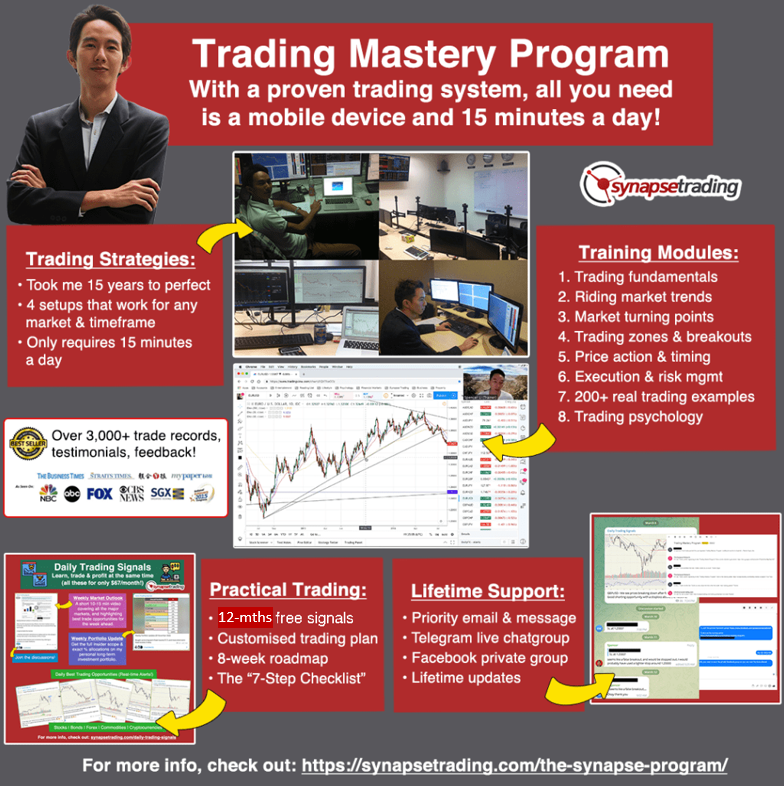 Our flagship mentoring program is suitable for both beginners and advanced traders, covering the 4 strategies which I used over the past 15 years to build up my 7-figure personal trading portfolio.
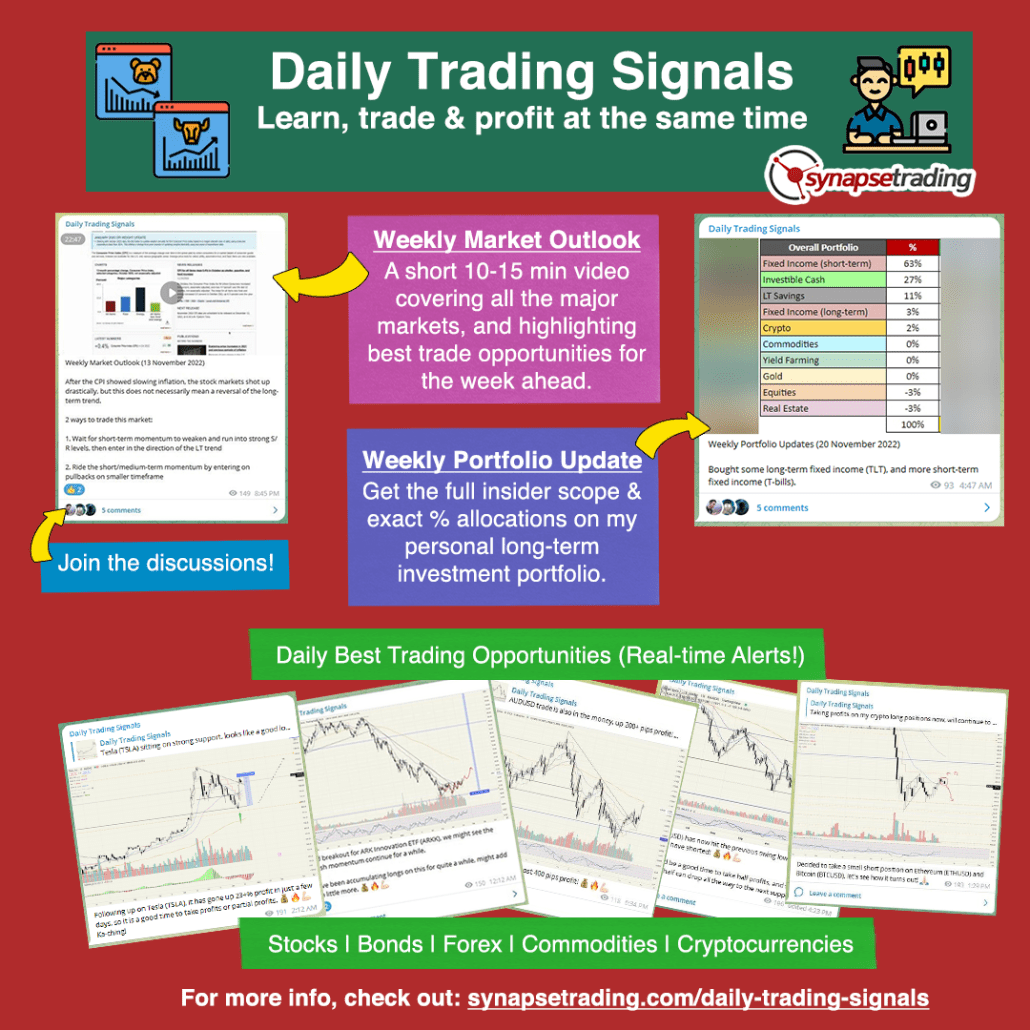 If you're looking for the best trading opportunities every day across various markets, and don't want to spend hours doing the research yourself, check out our private Telegram channel!


Leave a Reply
Want to join the discussion?Feel free to contribute!