

How to Stake on Proof-of-Stake Blockchains for Passive Crypto Income
Want the daily routine? Get the free 15-Minute Swing Trader’s Checklist. Get it free →
What Is Crypto Staking, and How Do You Earn Passive Income From It?
Last updated: 2026-06-14 · By Spencer Li, CFTe
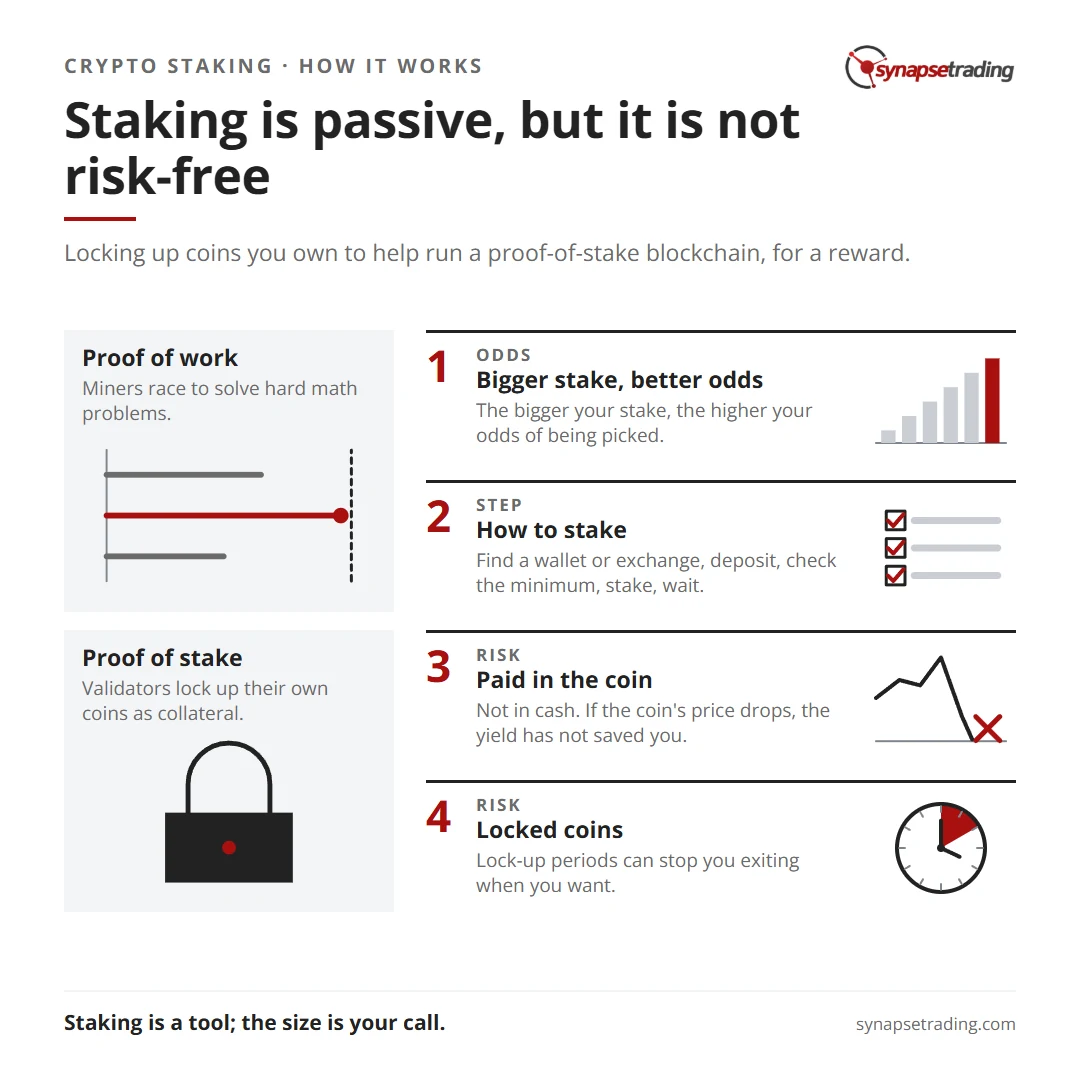
Crypto staking is when you lock up coins you already own to help run a proof-of-stake blockchain, and you get paid a reward for doing it. Think of it as putting your crypto to work instead of letting it sit. You commit your coins to the network, the network uses them to validate transactions, and in return you earn more of that coin, often somewhere in the range of 4 to 8 percent APY (annual percentage yield, the yearly return including compounding). The process is mostly passive once set up: you deposit, you stake, you wait, you withdraw. The catch is that “passive” does not mean “risk-free”, your coins are locked, the yield is paid in a volatile asset, and the underlying network can fail in ways a savings account never will.
So staking is real income, but it is income with strings attached. Here is how it works, how to actually do it, and where it goes wrong.
What is proof of stake, and how is it different from mining?
To understand staking you first need to understand the system it belongs to. A blockchain needs a way for strangers who do not trust each other to agree on which transactions are real. That agreement mechanism is called a consensus algorithm (a shared set of rules everyone in the network follows to validate transactions and block fraud).
The famous one is proof of work (PoW), the system Bitcoin uses. Miners race to solve hard math problems, and the winner earns the right to add the next block. It works, but it burns a lot of electricity and expensive hardware.
Proof of stake (PoS) replaces that race with a stake. Instead of competing on computing power, validators lock up their own coins as collateral. The network then picks who creates the next block based partly on random selection and partly on how much each validator has staked. No mining rigs, no power bill, no math race. You earn by holding and committing coins instead of burning energy.
The term “proof of stake” was coined by a Bitcointalk forum user called QuantumMechanic. The core idea was simple: it is wasteful to make everyone compete on raw processing power, so let people put skin in the game with their coins instead.
| Proof of Work (PoW) | Proof of Stake (PoS) | |
|---|---|---|
| How you qualify | Spend computing power to solve math | Lock up (“stake”) your own coins |
| Who adds the next block | Whoever solves the puzzle first (a miner) | A validator chosen partly by stake size, partly at random |
| Main cost | Hardware plus electricity | The coins you tie up (opportunity cost) |
| Energy use | High | Low |
| Barrier to entry | Expensive rigs | Just hold and stake coins |
| Example chains | Bitcoin | Ethereum, Cardano (ADA), Solana (SOL), Polkadot (DOT), Algorand (ALGO) |
The key line to remember: in PoW you earn by working, in PoS you earn by committing capital. That is why staking feels closer to earning interest than to running a business.
The basic staking terms you need
Before going deeper, here is the vocabulary, defined plainly:
- Stake is the amount of cryptocurrency you have locked into the network.
- Stakeholder is the person doing the staking (you).
- Validator is a node that creates new blocks on the blockchain.
- Block reward is the crypto paid to a validator for creating a new block.
- Delegated proof of stake (DPoS) is a version where you hand your staking power to a validator who stakes on your behalf, so you do not have to run a node yourself.
How does the network decide who earns the reward?
Validators are not picked at random alone. A node has to stake a minimum amount of coins before it can even be considered for the validator role, and the bigger the stake, the higher the odds of being chosen to forge the next block.
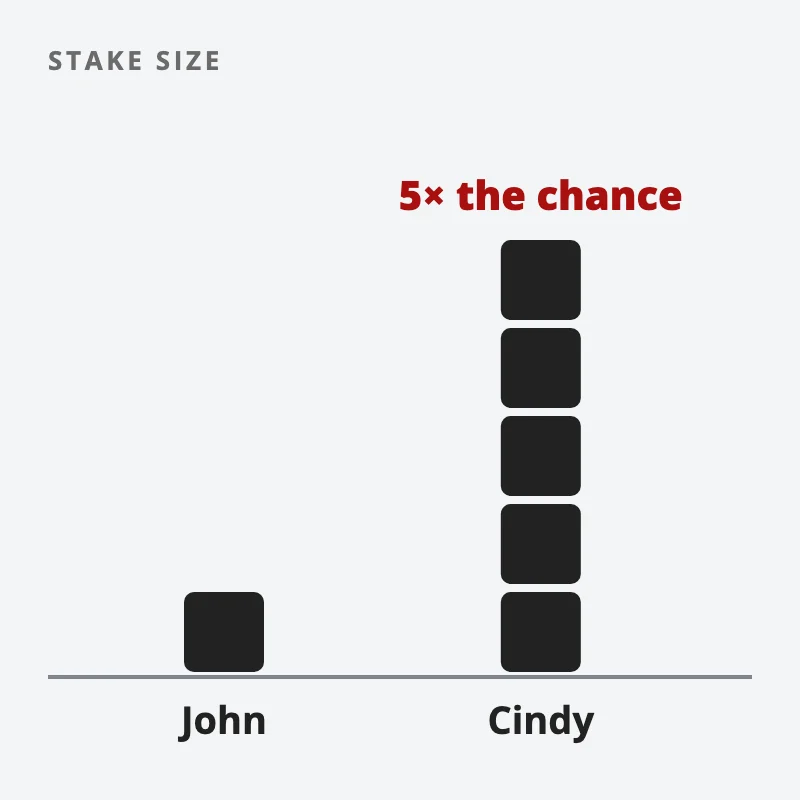
A simple example makes this concrete. Say John contributes $100 to the network and Cindy contributes $500. Cindy’s chance of being picked to forge the next block is five times higher than John’s. More stake, more turns, more rewards. The system is weighted toward those who commit more capital, which is the whole point: it aligns the people securing the network with the people who have the most to lose if it breaks.
Do note that the stake is always worth more than what the validator earns in transaction fees. That gap is deliberate. It keeps the validator financially motivated to behave, because misbehaving puts a larger pile of their own money at risk than they could ever gain by cheating.
How do you actually stake your crypto?
The mechanics are straightforward. Here is the sequence:
- Find a supported wallet or exchange that offers staking for the coin you already hold.
- Deposit your tokens into that wallet or exchange.
- Check the minimum. Some networks require a set amount before you can participate. To stake directly on Tezos you need a minimum of 8,000 Tezos (XTZ). Running your own Ethereum validator calls for 32 ether (ETH). Many exchanges let you stake far smaller amounts by pooling, which is how most beginners start.
- Choose how much to stake and for how long. Your reward depends on the amount staked, how long you stake it, and the specific rules of that network.
- Wait. Once deposited, the process is passive. You earn without doing further work.
- Withdraw when you are done, subject to any lock-up or unbonding period the network enforces.
| Network | Typical minimum to stake directly | Notes |
|---|---|---|
| Tezos (XTZ) | 8,000 XTZ | Lower via delegation or an exchange |
| Ethereum (ETH) | 32 ETH to run a validator | Far less via pooled or exchange staking |
| Many others | None to small | Exchange staking often has no hard floor |
A note on yield: there are coins offering an APY of 4 to 8 percent or higher. That is attractive next to a bank, but read it honestly. The percentage is paid in the coin, not in cash, so if the coin’s price drops 20 percent, your 6 percent yield has not saved you. Lock-up rules vary too. Some networks need a minimum staking period (say 30 days), others have none. As a rule, the longer you stake, the more you earn, but the less flexible you are if the market turns.
Why stake at all?
The appeal is simple. Proof-of-stake chains let you earn passive income just by holding coins in a wallet. There is no mining hardware to buy, no electricity bill, no complex math to solve. That makes staking far more accessible than mining ever was, you can start with what you already own.
There is a structural argument too. PoS networks tend to be more censorship resistant than PoW ones. In a PoW system a small group of miners can, in principle, choose to censor certain transactions. In a PoS system the say is spread across everyone who holds and stakes coins, which makes it harder for any single party to block or refuse transactions.
What are the risks and problems with staking?
This is the part the “earn passive income” headlines skip, so I will not. Staking has real downsides.
- Scale and maturity. No PoS system today scales to the level of Bitcoin or Ethereum’s track record, and many are not yet as decentralized or battle-tested as the most advanced PoW systems. Newer consensus designs (such as Casper) aim to close that gap, but “aim to” is doing work in that sentence.
- Validator downtime. If a validator fails to show up and do its job, that can cause problems. The usual fix is choosing networks or pools that keep a large set of backup validators.
- Security trade-offs. PoS can be less secure than PoW in specific ways. Because the network’s power is spread across all users rather than concentrated in miners, a PoS system can be more exposed to a Sybil attack (where an attacker spins up many fake identities to gain control). It can also be vulnerable to a 51 percent attack, where one entity controls more than half the staked currency.
- Forks. A blockchain is technically at risk of a fork if two valid blocks are created at the same instant and one gets built on before enough validators confirm it. Depending on your setup, that can affect rewards.
- Lock-ups. To manage some of these risks, many projects use vaults that lock stakeholder deposits until they are periodically released and rewarded. That protects the network, but it means your coins are not liquid the moment you want out.
One common workaround for the hassle is delegated proof of stake, where you delegate your stake to another party who stakes on your behalf. It lowers the effort, at the cost of trusting whoever you delegate to.
Where the human edge comes in
Here is the honest framing. A platform will show you a glowing APY number in a second, that part is free and getting freer. What it will not do is tell you whether locking your coins for 30 days is worth giving up the ability to sell into a crash, or whether an 8 percent yield on a coin that could halve is actually a good trade. The percentage is the easy part. Sizing the position, judging the lock-up against your own risk tolerance, and deciding whether this network deserves your capital at all, that is judgment, and it is the first of the Five Edges no dashboard can supply for you.
Staking is a tool. Whether it belongs in your portfolio, and at what size, is a decision only you can make.
FAQ
Is crypto staking really passive income?
Mostly yes, once it is set up. After you deposit and stake your coins, you earn rewards without doing further work. But “passive” is not the same as “safe”. Your coins are usually locked, the yield is paid in a volatile asset, and the network itself carries risk a bank account does not.
How much can you earn from staking crypto?
Many coins offer an annual percentage yield (APY) of 4 to 8 percent or higher. Remember that the reward is paid in the coin you staked, so the real return depends on what that coin’s price does while your funds are locked.
Do you need a minimum amount to stake?
It depends on the network. Staking directly on Tezos needs 8,000 XTZ, and running your own Ethereum validator needs 32 ETH. Most exchanges and pools let you stake much smaller amounts, which is how most beginners start.
Is staking safer than mining?
Staking is easier and cheaper than mining, with no hardware or electricity cost. “Safer” is not the right frame though. Proof-of-stake networks carry their own risks, including Sybil attacks, 51 percent attacks, validator downtime, and lock-up periods that stop you exiting when you want.
What is the difference between staking and delegated proof of stake (DPoS)?
Staking can mean running your own validator, which takes a minimum holding and some setup. Delegated proof of stake lets you hand your staking power to a validator who stakes on your behalf, so you earn rewards with less effort, in exchange for trusting that delegate.
Now that you know how staking works and where it can bite, would you stake your own crypto? And do you think the reward-to-risk profile beats what you can find in traditional finance? Let me know in the comments.
And if you want the bigger picture on crypto and DeFi (decentralized finance, the ecosystem of financial apps built on blockchains), read the pillar: The Ultimate Guide to Blockchain and Cryptocurrencies.
Want a calmer way to approach any market? Grab the free 15-Minute Swing Trading Starter Kit. It is the exact routine I use to scan once a day and trade any market in 15 minutes, the same discipline that keeps me from chasing a shiny yield number.
About the author. Spencer Li is The 15-Minute Trader and the founder of Synapse Trading. He is a Certified Financial Technician (CFTe) with 15+ years of trading, run from 70+ countries. He holds a B.Acc and B.BM from SMU. Every trade he takes is public, dated, losses left in. He teaches low-risk swing trading in 15 minutes a day, one system for any market.
Education, not financial advice. Synapse Trading is not licensed by MAS to advise on investment products. Crypto and trading carry risk of loss; past performance is not indicative of future results.
Related
The Ultimate Guide to Blockchain and Cryptocurrencies · What is DeFi and how does it work · Proof of work vs proof of stake explained
Want the daily routine? Enter your email for the free 15-Minute Swing Trader's Checklist.
Free 5-page PDF, then occasional trading emails. Education only, not financial advice. Unsubscribe anytime. Kit stores your email in the US: see our privacy policy.
Want to learn the full method? The Trading Mastery Program teaches the 4 strategies I have traded since 2011. It suits beginners and experienced traders.
Rather follow the trades as they happen? Daily Trading Signals is our Telegram channel: my trade ideas with entry, stop and exit, and every trade is public.
Questions about this post? Ask in the free Telegram channel →
Educational content only, not personalised financial advice. Trading carries risk, including loss of capital. Past performance is not indicative of future results. Synapse Trading is not licensed or regulated by MAS.

