

What Are dApps and DAOs? Decentralised Apps and Organisations Explained
Want the daily routine? Get the free 15-Minute Swing Trader’s Checklist. Get it free →
Last updated: 16 October 2026 · By Spencer Li, CFTe
A dApp, short for decentralised application, is an app whose core logic runs as a smart contract on a blockchain such as Ethereum, instead of on one company’s servers. A DAO, a decentralised autonomous organisation, is a group that runs by rules written into a smart contract, with a shared treasury that members control by voting. Both promise to remove the middleman. Both also move the risk somewhere new: into the code, and into whoever holds the votes.
In this post, I’m going to explain how each one works, quoting Ethereum’s own documentation, then cover the risks that rarely make the brochure. I will not name any app or DAO to use. The goal is to give you the questions to ask about any of them.
What is a dApp?
Ethereum.org says smart contracts “let anyone create their own digital assets and decentralized applications (dapps) that run 24/7, globally.” It adds that, unlike banks or corporations, “smart contracts are available to anyone with an internet connection.”
The simplest way to picture a smart contract is ethereum.org’s own metaphor, a vending machine, where “specific inputs guarantee predetermined outputs.” A dApp is a friendly screen in front of one or more of those machines. You connect your wallet, press a button, and the contract does the rest.
dApps cover a wide range. Ethereum.org groups them into categories, such as:
- DeFi, “a category of decentralized applications that allow users to lend, borrow, trade, and earn interest on their crypto assets.”
- Social, apps “that allow users to connect with others and share content.”
- Gaming, apps “that allow users to play games and earn rewards.”
Decentralised finance (DeFi) goes deeper on the first group.
How is a dApp different from a normal app?
Here is the comparison in one table:
| A normal app | A dApp | |
| Where the logic runs | The company’s servers | A smart contract on a blockchain |
| Who can block you | The company | Usually nobody at the contract level, though the website in front can |
| How you log in | Username and password | You connect your own wallet |
| If something goes wrong | Customer support, refunds | Often no one to call, and transactions cannot be reversed |
| Who can see the records | The company | Anyone, on the public blockchain |
Ethereum.org puts the main selling point plainly: “dapps on Ethereum are censorship resistant.” The other side of that is the last row but one. With no company in charge, there is also no help desk.
If you want a daily routine for trading what you understand, the free 15-Minute Swing Trader’s Checklist is at the end of this post.
What is a DAO?
Ethereum.org’s definition is short: “A DAO is a collectively-owned organization working towards a shared mission.”
The idea is to replace trust in people with rules in code. In ethereum.org’s words, “There is no CEO who can spend funds on a whim or CFO who can manipulate the books.” Instead, DAOs “have built-in treasuries that no one has the authority to access without the approval of the group.”
Ethereum.org gives a few examples of what a DAO could be used for. One is a charity that accepts donations from anywhere and votes on causes to fund. Others are a group buying an asset together, or a pooled fund that votes on which ventures to back.
How does a DAO make decisions?
Through proposals and votes. Ethereum.org explains that the smart contract “defines the rules of the organization and holds the group’s treasury.” Once it is live, “no one can change the rules except by a vote.”
There are 3 main ways DAOs decide who gets to vote:
| Membership type | How you get a vote | What ethereum.org says |
| Token-based | Hold the DAO’s governance token | “simply holding the token grants access to voting” |
| Share-based | Apply to join, usually with a contribution | “Shares represent direct voting power and ownership” |
| Reputation-based | Earn it by taking part | “Reputation cannot be bought, transferred or delegated” |
Many DAOs also allow delegation, which ethereum.org likens to “representative democracy”. Token holders hand their votes to members who commit to stay informed. And “In many DAOs, transactions will be automatically executed if a quorum of members votes affirmative.”
[INFOGRAPHIC: how a DAO decision works, a proposal, a vote by token holders or delegates, quorum reached, the smart contract releasing funds from the treasury automatically]
What are the risks of dApps and DAOs?
This is the part the enthusiasm tends to skip. I use a single question to sort most of it out. I call it the who-can-change-it test: for any dApp or DAO, who can change the rules, and how?
The 4 risks below all come back to that question.
The code can have bugs
Ethereum.org admits it directly: “Ethereum products, like any software, can suffer from bugs and exploits.” When a bug sits in a contract holding money, the money is what gets taken.
The code is hard to fix
Ethereum.org says “Smart contract code can’t be modified once live, even by its owners.” That is a strength when the code is right. It is a problem when the code is wrong, because a fix may need a new contract and a move of funds. Some projects build in a way to upgrade the contract. If so, ask who holds that power, because that person or group can change the rules too.
Votes can be concentrated
In a token-based DAO, votes follow tokens. If a few holders own most of the tokens, they can decide most votes. Ethereum.org’s own examples include a DAO where a vote passes “as long as it is not vetoed by the founders”. So founders can keep real power inside a “decentralised” structure. Check who holds the tokens before you assume a DAO is run by its community.
The token may be a regulated product
MAS said in 2017 that tokens can fall under securities law. If a token gives you ownership in an issuer’s assets, it “may therefore be considered an offer of shares or units in a collective investment scheme”. A governance token that also pays out a share of income deserves a careful look on that front.
So should you use dApps or join a DAO?
Personally, I think dApps and DAOs are worth understanding even if you never use one, because they show what blockchains are for beyond holding coins. But the who-can-change-it test comes first, every time. If you cannot find out who can change the rules, you do not yet know what you are trusting.
For the background, the blockchain and cryptocurrencies guide maps the topic. What is Ethereum explains the network most dApps run on. And coins, tokens, altcoins and ICOs covers the tokens that DAOs use for votes.
So the next time a dApp or DAO catches your eye, who can change its rules? Who holds most of its votes? And if its code failed tomorrow, who would you call?
FAQ
What is a dApp in simple terms?
An app whose core logic runs as a smart contract on a blockchain, instead of on a company’s servers. You use it by connecting your own crypto wallet.
What is a DAO in crypto?
A group governed by rules written into a smart contract. Members vote on proposals, and the contract releases funds from the shared treasury when a vote passes.
Are DAOs legal in Singapore?
This post does not give legal advice. MAS has said that tokens which act like shares or fund units can be regulated under the Securities and Futures Act, so check the rules before buying any governance token.
Are dApps safe?
They carry risks normal apps do not: smart contract bugs, no customer support, and transactions that cannot be reversed. Check who can change a dApp’s rules before you connect your wallet.
Go deeper
The free 15-Minute Swing Trader’s Checklist has the daily routine, the questions to ask before every trade, and the five rules that keep you in the game. Enter your email and we’ll send it over:
We use your email address to send you the checklist, then emails about trading and our courses. Unsubscribe any time. Privacy policy.
About the author. Spencer Li is the founder of Synapse Trading and a Certified Financial Technician (CFTe). His trade log is public: every trade since April 2024, dated, losses left in.
Educational content only, not personalised financial advice. Trading carries risk, including loss of capital. Past performance is not indicative of future results. Synapse Trading is not licensed or regulated by MAS.
Want the daily routine? Enter your email for the free 15-Minute Swing Trader's Checklist.
Free 5-page PDF, then occasional trading emails. Education only, not financial advice. Unsubscribe anytime. Kit stores your email in the US: see our privacy policy.
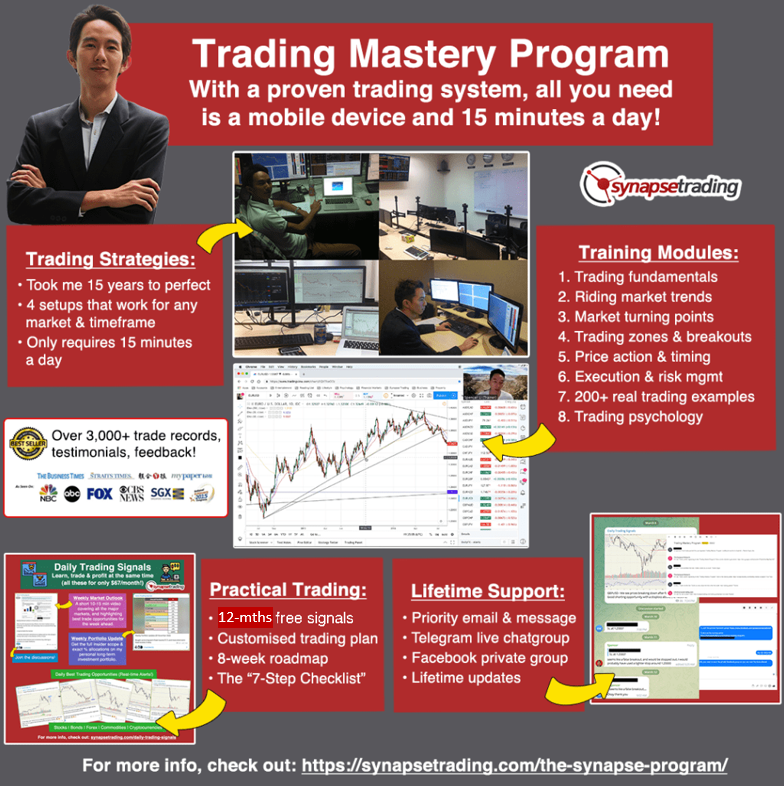 Our flagship mentoring program is suitable for both beginners and advanced traders, covering the 4 strategies which I used over the past 15 years to build up my 7-figure personal trading portfolio.
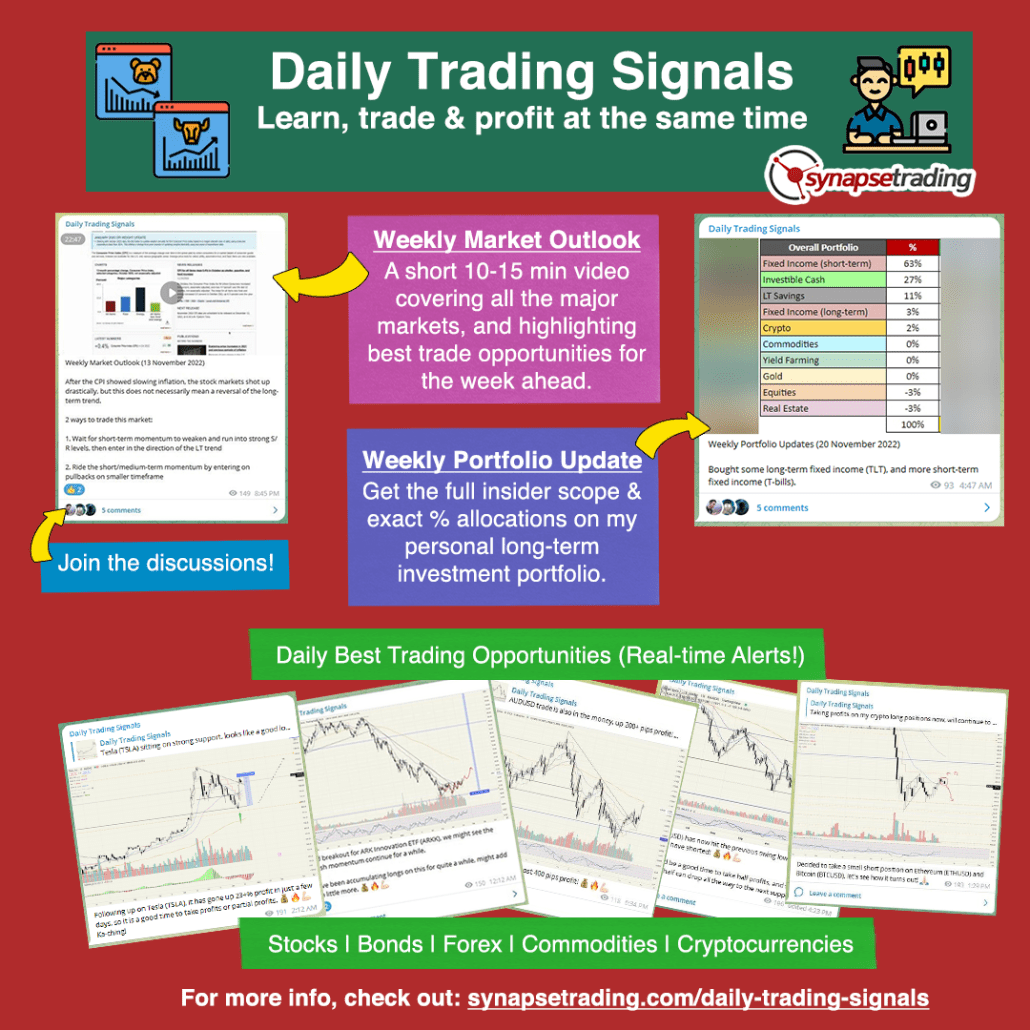 If you're looking for the best trading opportunities every day across various markets, and don't want to spend hours doing the research yourself, check out our private Telegram channel!


Leave a Reply
Want to join the discussion?Feel free to contribute!