

CFTe vs CMT: Which Technical Analysis Certification Is Worth It?
Want the daily routine? Get the free 15-Minute Swing Trader’s Checklist. Get it free →
Levels, format, cost and timing side by side, from someone who sat the CFTe, plus the one thing neither exam can prove
Published: 17 October 2026 · Last updated: 17 October 2026 · By Spencer Li, CFTe
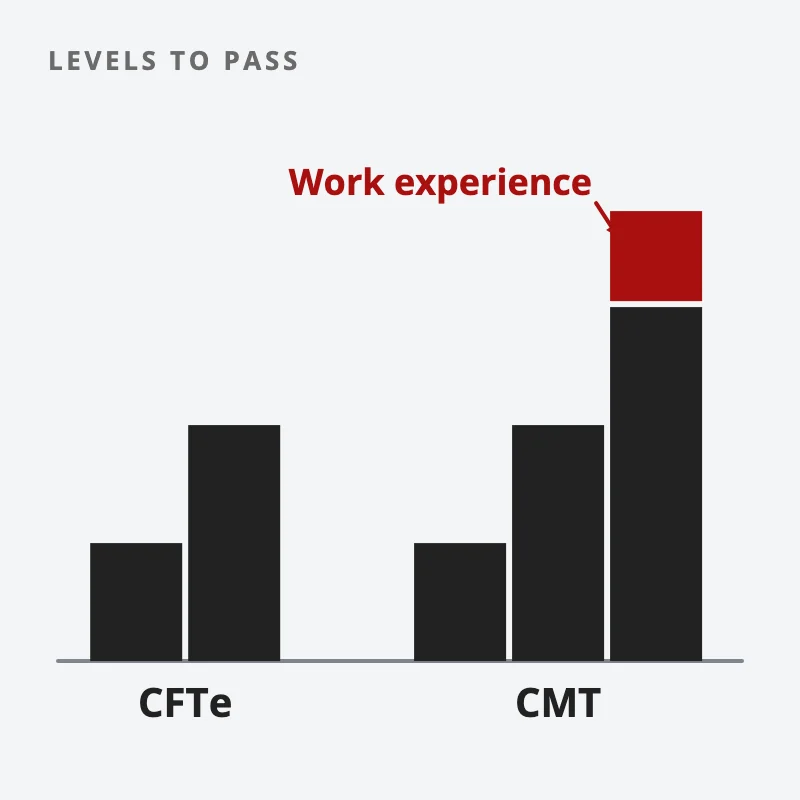
The CFTe and the CMT are the two main professional qualifications in technical analysis. The CFTe (Certified Financial Technician) is awarded by the International Federation of Technical Analysts (IFTA) and has two levels. The CMT (Chartered Market Technician) is awarded by the CMT Association in New York and has three levels, plus a work-experience requirement.
So which is worth it? If you work, or want to work, in the US industry, the CMT is the home-market qualification, and its work requirement is built for people already in a role. If you want an international qualification you can finish faster, on your own schedule, with a final exam where you analyse real charts in writing, the CFTe fits. And if you only want to trade your own money, neither is required. I hold the CFTe, and I will be straight about what it did and did not do for me.
What is the difference between the CFTe and the CMT?
Here they are side by side, from each body’s own pages as of October 2026.
| CFTe | CMT | |
| Awarded by | IFTA, a federation of national societies | CMT Association, New York |
| Levels | 2 | 3 |
| First exam | 120 multiple-choice questions, any time of year at Pearson VUE centres | Level I, in set June and December windows |
| Final exam | Essay-based, analysing current charts on one market “as though for a Fund Manager” | Level III |
| When you can sit | Level I all year, Level II in April and October, online via Zoom | June and December |
| Exam fees | Level I US$550 (members) or US$850, Level II US$850 or US$1,150, plus a US$100 proctor fee | US$875 early to US$1,475 late per registration for December 2026 |
| Extra requirement | None beyond the two exams | Qualifying professional work experience and Professional Membership |
Two rows matter more than the rest.
The first is the final exam. The CFTe’s second level is an essay. You get current charts and write up your analysis the way you would for a fund manager. That is closer to the actual job than another set of multiple-choice questions.
The second is the work requirement. To use the CMT letters, you need to pass all three levels and show qualifying professional work experience. If you trade from home, that can be the deciding row.
How much do the CFTe and the CMT cost?
Now the sums, in US dollars and exam fees only.
For the CFTe, a non-member pays US$850 for Level I, US$1,150 for Level II and the US$100 proctor fee, which comes to US$2,100. A member of an IFTA society pays US$550 and US$850 plus the proctor fee, which is US$1,500, before membership dues.
For the CMT, the December 2026 registration rates run from US$875 early to US$1,475 late. At early rates, three exams come to about US$2,625. Register late each time, and the same three cost about US$4,425.
So the CFTe is cheaper on fees alone, and it is faster to finish because Level I runs all year. The CMT costs more and takes at least three sittings, spread across the June and December windows.
How do you choose between them?
Three questions settle it for most people.
- Desk. Where do you want to work? If you are aiming at a US role, check which of the two the job adverts you want actually ask for, and let that decide. If you will trade your own account or work outside the US, the CFTe’s international recognition does the same job.
- Proof. What do you want the exam to prove? The CFTe’s written final tests whether you can analyse a live market and explain it. Both test knowledge. Neither tests whether you make money.
- Time. How fast do you need it? The CFTe can be done in two sittings inside a year. The CMT needs three, plus the work experience.
If you want the bigger picture of where these letters fit, the career in trading guide maps the four doors into the job, and the older career paths for the trading professional post lists the roles.
What was the CFTe like to sit?
I sat CFTe Level I in 2014 and passed with 86, against a pass mark of 74. I wrote at the time that I was “pretty sure I could have done better if I had studied for it.”
Level II was different. “It took me 2 whole weeks of serious studying/revising” to cover the syllabus, and I wrote about it in my post on passing the second level of the CFTe. IFTA says the programme “is designed for self-study”. There is no class to attend. You read, you practise on charts, you sit it.
Back then I compared it to seeing a doctor. You want to know the person treating you has a medical degree. A certification does the same for anyone teaching or managing money. It shows you studied the field properly.
But does a certification make you a better trader?
A trader on Reddit summed up the doubt in one line: “Tried every cliche setup (Head & Shoulders, CMT course). Read every book.”
That frustration is fair. Our career guide puts it this way: “A professional qualification such as the CFTe, which I hold, signals that you have studied technical analysis properly. It does not make a single trade win.”
The exam teaches you the language. Chart patterns, indicators, market structure, the theory behind each one. The technical indicators guide covers a lot of that same ground for free. What no exam can give you is a record of your own decisions under real risk.
That is why the better proof is a trade log. Ours is public: every trade since April 2024, dated, losses left in. A certificate says you studied. A log says what you did with it. If you want to build your own version, start with a trading journal that shows your edge.
If you are studying for either exam and want a simple daily routine to test what you learn on real charts, our free 15-Minute Swing Trader’s Checklist lays one out. Get the free checklist →
So which one should you take?
Pick by the job you want. For a US institutional desk, the CMT is the home-market qualification, and its work requirement fits people already in the industry. For an international qualification you can finish in under a year, on a written final that mirrors the real job, the CFTe fits. For trading your own account, both are optional, and a journal of real trades will teach you more per dollar.
Whichever you choose, ask yourself one question before you pay the fee. A year from now, what will you be able to show that you cannot show today?
FAQ
Is the CFTe or the CMT better?
Neither is better for everyone. The CMT is the US body’s qualification, has three levels and needs work experience. The CFTe is international, has two levels instead of three, and ends with a written chart analysis.
How long does it take to get the CFTe?
It can be done in two sittings inside a year, because Level I runs all year at Pearson VUE centres and Level II is offered in April and October.
How much does the CMT cost?
For December 2026, exam registration runs from US$875 early to US$1,475 late, so three levels at early rates come to about US$2,625 in exam fees.
Do I need work experience for the CMT?
Yes. Passing all three levels is not enough on its own. The CMT Association also requires qualifying professional work experience and Professional Membership.
Do I need a certification to trade my own money?
No. Neither qualification is required to trade your own account. They are most useful if you work in the industry or teach others.
Go deeper
Exams teach the theory. The free 15-Minute Swing Trader’s Checklist is how we turn it into a daily habit: the scan, the questions to ask before every trade, and the five rules that keep you in the game. Enter your email and we’ll send it over:
We use your email address to send you the checklist, then emails about trading and our courses. Unsubscribe in one click, any time. Privacy policy.
About the author. Spencer Li is The 15-Minute Trader and the founder of Synapse Trading. He is a Certified Financial Technician (CFTe) with 15+ years of trading, run from 70+ countries. He holds a B.Acc and B.BM from SMU. Every trade he takes is public, dated, losses left in. He teaches low-risk swing trading in 15 minutes a day, one system for any market.
Educational content only, not personalised financial advice. Trading carries risk, including loss of capital. Past performance is not indicative of future results. Synapse Trading is not licensed or regulated by MAS.
Want the daily routine? Enter your email for the free 15-Minute Swing Trader's Checklist.
Free 5-page PDF, then occasional trading emails. Education only, not financial advice. Unsubscribe anytime. Kit stores your email in the US: see our privacy policy.
Want to learn the full method? The Trading Mastery Program teaches the 4 strategies I have traded since 2011. It suits beginners and experienced traders.
Rather follow the trades as they happen? Daily Trading Signals is our Telegram channel: my trade ideas with entry, stop and exit, and every trade is public.
Questions about this post? Ask in the free Telegram channel →
Educational content only, not personalised financial advice. Trading carries risk, including loss of capital. Past performance is not indicative of future results. Synapse Trading is not licensed or regulated by MAS.

