

Should You Quit Your Job to Trade Full-Time? Why Your Salary Is Your Best Trading Tool
Want the daily routine? Get the free 15-Minute Swing Trader’s Checklist. Get it free →
Published: 3 November 2026 · By Spencer Li, CFTe
For most people asking, the answer is no, or at least not yet. Quit your job to trade full-time only when three things are true. Your own record shows the method making money on real capital over 100 to 200 trades. You have a year of living costs saved outside the trading account. And the method does not need you at the screen all day. Until then, the job is doing something for your trading that is easy to miss. It pays the rent, so no single trade has to. The research is harsh, too. In a study of everyone who started day trading Brazilian equity futures between 2013 and 2015 and kept at it for at least 300 days, 97% lost money. Personally, I traded professionally for a few years before I went independent, and I would still tell most people to keep the salary and build the record first.
Why does quitting to trade full-time feel so right?
Nobody asks this after a bad month. They ask it after a good run, when the trading account has just had a better quarter than the payslip, and the commute starts to feel like the only thing standing between them and the life they actually want. It’s a lovely feeling. It is also the worst time to decide.
In February 2024, a trader on r/Trading asked it out loud. He had been trading for 3 years, it was going well, and he wrote that he was “struggling to find a reason to continue” with his job. So he asked the people who had already quit whether it had been worth it.
The replies split the way these threads always do. One person wrote back: “What’s the worst that could happen, you have to go back to a 9-5??”
Honestly, that reply is right about one thing. Going back to work is survivable, and plenty of people have tried full-time trading, found it was not for them, and walked back into a job with a dent in their savings and a good story. Another reply in the same thread described exactly that: about 8 months of full-time day trading, not ready, back to work, and swing trading has gone better for him since.
But the 9-to-5 is the small risk. The big one is what full-time trading does to the way you trade while you are doing it.
What changes when your trades have to pay the rent?
With a salary, a losing month is just a losing month. You feel the sting, you go through the journal, you fix what needs fixing, and the rent still gets paid on the 1st of the month whether the trades worked or not. When trading is your only income, a losing month is a bill. The next trade stops being a trade. It becomes this month’s rent.
One reply in that thread put the worry in a single line, wondering “how much trading psychology would change if you depended on the money”.
Another trader in the same thread, getting ready for his third try at going full-time, answered it without meaning to. He described setting a daily quota to match his salary, and then noticed the problem himself. On choppy Monday mornings there was nothing worth trading, and the quota was still sitting there.
That one Monday morning holds the whole problem. The market does not pay salaries. It pays in lumps, with long gaps, and a method that works still spends a lot of its time doing nothing. A quota pushes you to trade in the gaps, and the gaps are where the bad trades live.
Now, let’s put some numbers on it.
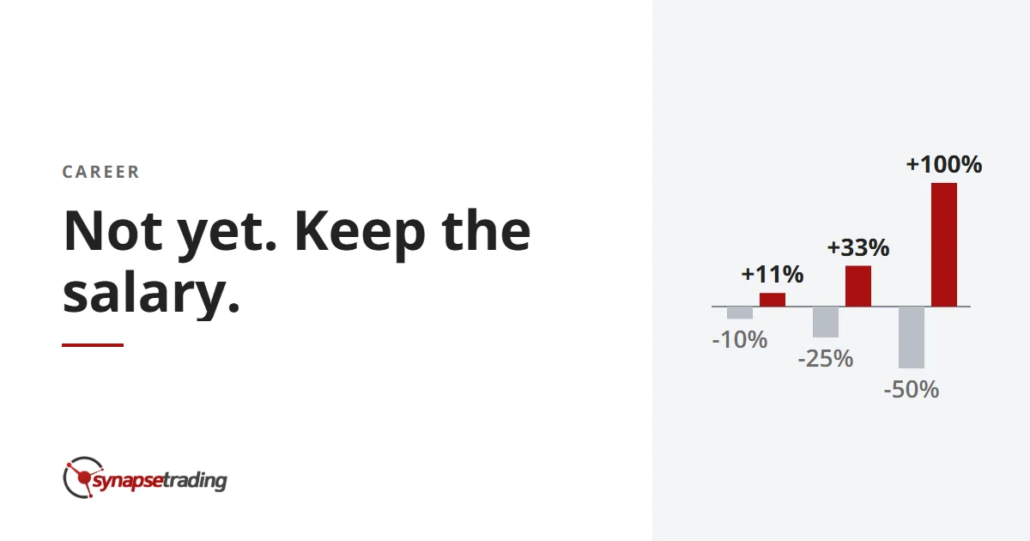
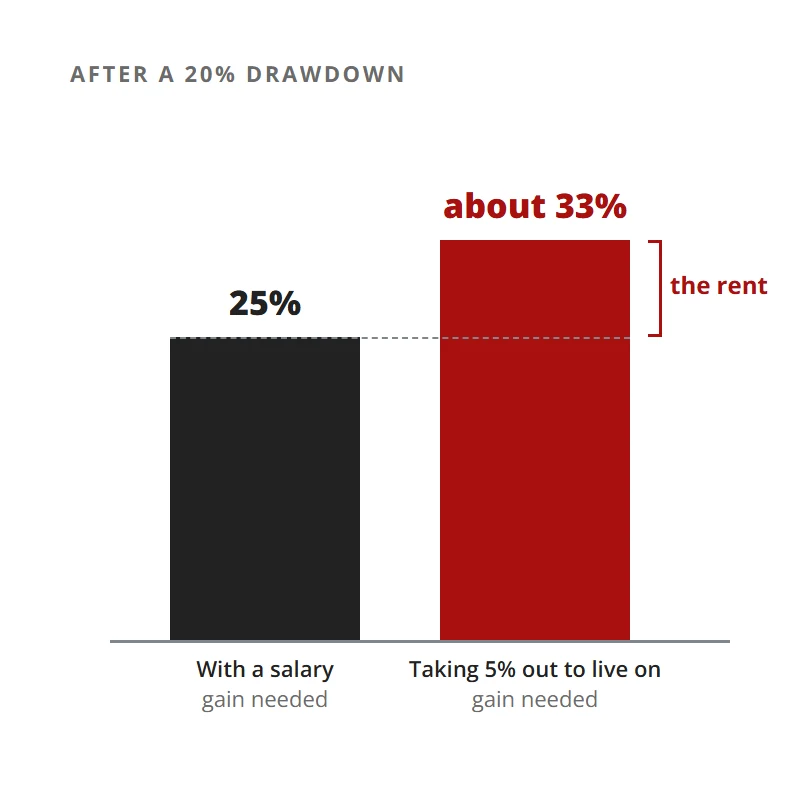
Say your method hits a 20% drawdown, which perfectly sound methods do from time to time. With a salary, you sit through it. A 20% loss needs a 25% gain to get back to where you started, and you can afford to wait for that gain.
Now say the same drawdown arrives while you are also taking out 5% of the account to live on. You are down to 75% of where you began, and getting back now needs a gain of about 33%.
Same method. Same market. The climb back is a third longer, purely because of the rent. Worse, the fear of not making it back arrives right when the method needs you to be patient. That is how a sound method ends in a blown account. The risk of ruin rises with every withdrawal.
If you want a routine built to fit around a job, the free 15-Minute Swing Trader’s Checklist is at the end of this post.
What does the research say about trading for a living?
Two large studies follow real traders through their actual trading records. Neither one is kind.
The first is from Brazil. Fernando Chague, Rodrigo De-Losso and Bruno Giovannetti looked at every individual who started day trading equity futures there between 2013 and 2015 and kept going for at least 300 days. Of those, 97% lost money. Only 0.4% earned more than a bank teller’s daily pay, and the authors found no evidence that the traders got better with practice. They titled the paper, rather pointedly, “Day Trading for a Living?”
The second is from Taiwan. Brad Barber, Yi-Tsung Lee, Yu-Jane Liu and Terrance Odean used the Taiwan Stock Exchange’s records of day traders from 1992 to 2006. The best of them were genuinely skilled. But less than 1% of the whole population of day traders could, in the authors’ words, “predictably and reliably” beat the market after fees.
Do note where I am leaving the literature here. Both studies are about day traders, people who open and close positions inside a single session. Neither one measures a swing trader who holds for days and checks the charts once after the close. So I cannot use them to tell you that swing trading for a living works, or that it fails.
What they do show is where full-time trading tends to drift. Quitting creates a pull towards day trading, because the screen is right there all day, the coffee is free, nobody is watching, and sitting still for a week feels suspiciously like being unemployed. The only stretch of my career when I was glued to the screen all day was on the desk, early on. Every routine I have built since has gone the other way, towards fewer decisions and less screen time.
What does the job actually do for your trading?
| Trading with a salary | Trading for a living | |
| Who pays the bills | The job | The trading account |
| What a losing month means | A bad month in the journal | A bill paid out of capital |
| The climb back from a 20% drawdown | A 25% gain, with nothing withdrawn | About a 33% gain, after 5% withdrawn to live on |
| How often you need to trade | Only when the setup is there | Often enough to cover your costs |
| The pull of the screen | Capped by your working hours | All day, every day |
| What you lose if it fails | Some savings and some pride | Savings, plus the years out of your career |
Even professionals rarely trade for a living with nothing under them. As my career in trading guide lays out, a real prop firm pays a small allowance on top of the profit share. A fund manager draws a base from the management fee, one of several things that change when you trade a fund’s money. The firm gives its traders a floor, so they can afford to wait for the good trades. Your salary is the same floor, and you already have it.
So when does quitting make sense?
When the record says so. Not before. The full test is in the career in trading guide. It comes down to 3 numbers. You need 100 to 200 trades logged on real money, a year of living costs in cash outside the account, and a method that fits the hours you actually want to keep.
I would add one more check, and I call it the rent test. Go back through your last 20 trades and ask, honestly, of each one: would I have taken this trade, at this size, if it had to pay this month’s rent?
Same answer for every trade? Then the salary is not changing your decisions, and you might be ready. If you would have forced trades you skipped, or skipped good ones out of fear, then the salary is doing work your method cannot do yet. Better to learn that while it is still cheap.
And if your record says you have been losing for years, a different question comes first, and I wrote a 3-question audit for whether to quit trading for exactly that.
The free 15-Minute Swing Trader’s Checklist at the end of this post keeps every trade on the record, so the rent test has 20 trades to work with.
What would I do in your seat?
Personally, I would keep the job. Treat the trading as a serious business that happens to run part-time, with a method on daily charts that needs one short session after the close, so it fits around work instead of fighting it. My own routine is about 15 minutes, once a day, after the close. There is a free class on how busy professionals trade in 15 minutes a day, and a page comparing trading courses for people with a full-time job in Singapore.
I would also write the quitting conditions down now, while you are calm: a number of trades, a savings figure in months, and the result the record needs to show. Then a quiet evening makes the call. A good month doesn’t get a vote.
Alexander Elder called his book Trading for a Living, and the title has sold that dream to a lot of people. For most readers, the better goal for the next few years is trading well while something else pays the bills, and letting the living come later, once the record says it can.
So, how would your last 20 trades do on the rent test? How many months of living costs do you have outside the account? And if the market went quiet for 3 months, would you still be trading your method, or trading your bills?
FAQ
Can you really trade for a living?
Some people do, but the measured odds are poor. In Brazil, 97% of individuals who day traded futures for at least 300 days lost money, and in Taiwan less than 1% of day traders reliably beat the market after fees.
How much money do you need to trade full time?
Enough that the trading account never has to pay your bills through a bad stretch. A sensible floor is a year of living costs in cash outside the account, on top of trading capital you can afford to lose.
How long should I trade before going full time?
Count trades, and ignore the calendar. A method needs 100 to 200 recorded trades, including a losing streak you traded through by the rules, before its results mean much.
Go deeper
The free 15-Minute Swing Trader’s Checklist is the routine that fits around a job: the daily 15 minutes, the questions before every trade, and five rules that keep you in the game. Sign up just below.
About the author. Spencer Li is The 15-Minute Trader and the founder of Synapse Trading. He is a Certified Financial Technician (CFTe) with 15+ years of trading, run from 70+ countries. He holds a B.Acc and B.BM from SMU. Every trade he takes is public, dated, losses left in. He teaches rules-based swing trading in 15 minutes a day, one system for any market.
Educational content only, not personalised financial advice. Trading carries risk, including loss of capital. Past performance is not indicative of future results. Synapse Trading is not licensed or regulated by MAS.
Want the daily routine? Enter your email for the free 15-Minute Swing Trader's Checklist.
Free 5-page PDF, then occasional trading emails. Education only, not financial advice. Unsubscribe anytime. Kit stores your email in the US: see our privacy policy.
Want to learn the full method? The Trading Mastery Program teaches the 4 strategies I have traded since 2011. It suits beginners and experienced traders.
Rather follow the trades as they happen? Daily Trading Signals is our Telegram channel: my trade ideas with entry, stop and exit, and every trade is public.
Questions about this post? Ask in the free Telegram channel →
Educational content only, not personalised financial advice. Trading carries risk, including loss of capital. Past performance is not indicative of future results. Synapse Trading is not licensed or regulated by MAS.

