

The Disciplined Trader Summary: Why Discipline Is a Skill You Can Learn
Want the daily routine? Get the free 15-Minute Swing Trader’s Checklist. Get it free →
Mark Douglas’s first book: the trap that turns traders into passive losers, his two rules for losses, and the seven steps to trading without fear
Published: 26 October 2026 · Last updated: 26 October 2026 · By Spencer Li, CFTe
What is The Disciplined Trader about? Mark Douglas’s 1990 book argues that self-discipline is a skill you learn, rather than a trait you are born with. He calls it “a specific thought methodology, a mental resource.”
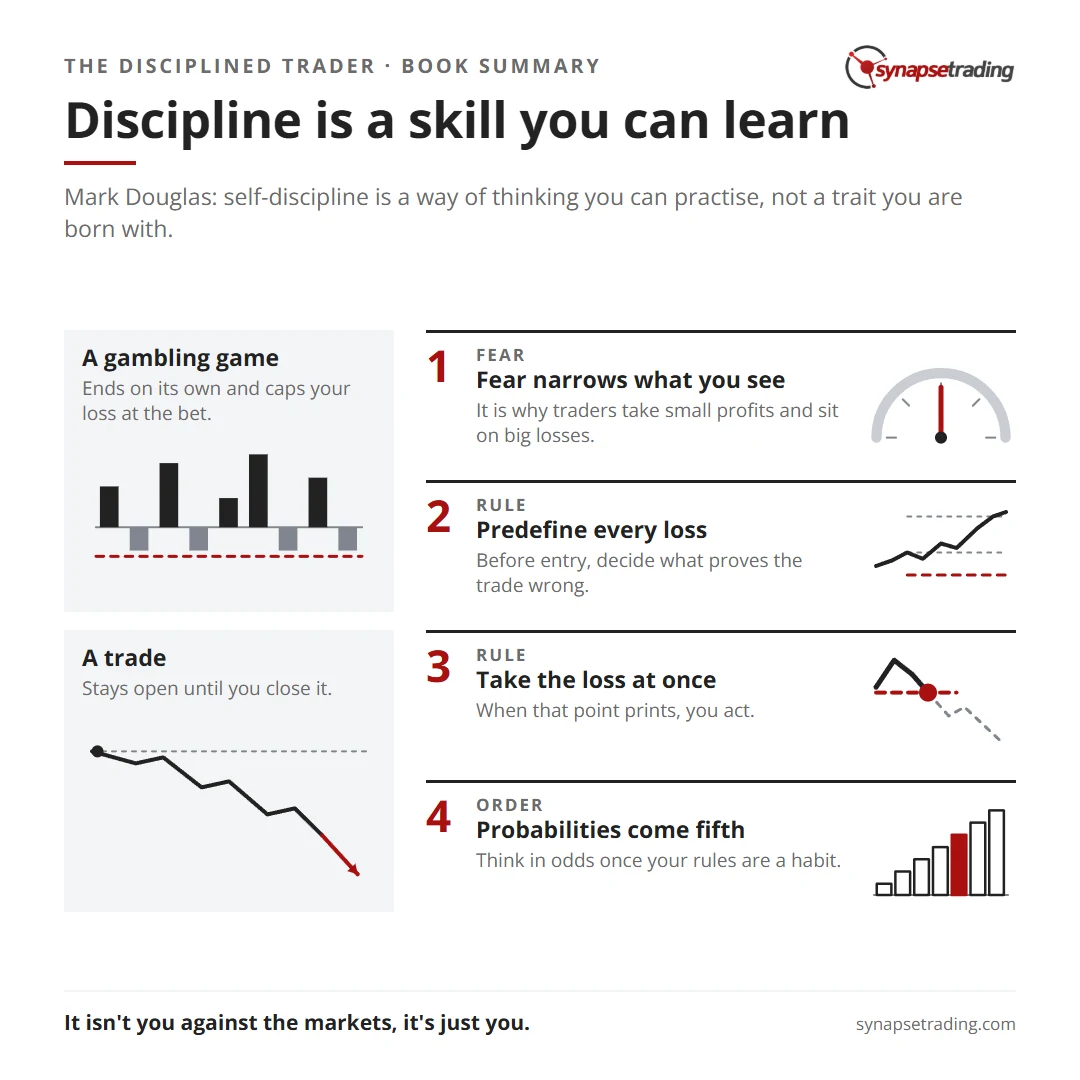
A gambling game ends on its own and caps your loss at the bet. A trade does neither, so a trader who freezes keeps losing without lifting a finger. Fear makes it worse, because it narrows what you can see. Douglas’s answer is a programme of seven steps, built on two rules: define the loss before you enter, and take it the moment it shows up. Thinking in probabilities, the idea he is best known for, only arrives at step five.
Who is Mark Douglas?
Douglas was selling commercial insurance outside Detroit when he moved to Chicago in June 1981 to trade. He joined Merrill Lynch Commodities at the Chicago Board of Trade, “its second largest commodity office, with 38 account executives.” By his count, the typical customer there “lost his original stake within an average of four months.”
He had wiped out his trading account twice before the move. By March 1982 he had filed for bankruptcy, “a mere eight months after moving to Chicago.”
By June 1982 he was making steady money for his customers, and that summer he started this book. His summary of how losing traders turn it around: “the markets didn’t change, the tools that were used didn’t change, the trader did.” He founded Trading Behavior Dynamics in 1983. Trading in the Zone followed in 2000.
I first read Douglas around 2008, while at university, and The Disciplined Trader was the book.
How is it different from Trading in the Zone?
Our Trading in the Zone summary covers the five fundamental truths and the 20-trade exercise. Neither is in this book. The earlier book covers three things the sequel mostly leaves out.
- How a belief changes, with writing drills to drain the old one.
- How price moves, with support and resistance as traders’ beliefs.
- The order of learning, with probabilities fifth.
A trader on Reddit asked this year for psychology books that “actually improved your discipline,” and named both. They pair well. Trading in the Zone is about the market. The Disciplined Trader is about you.
What are the 10 key ideas at a glance?
| # | The idea | What it means for your trading |
|---|---|---|
| 1 | Discipline is learned | A way of thinking you can practise |
| 2 | The market is always right | Arguing with price costs money |
| 3 | You can be a passive loser | Doing nothing keeps a losing trade open |
| 4 | Fear narrows what you see | It is why traders take small profits and sit on big losses |
| 5 | Predefine every loss | Before entry, decide what proves the trade wrong |
| 6 | Take the loss at once | When that point prints, you act |
| 7 | Rules come before money | Profit from broken rules goes back to the market |
| 8 | Master one pattern first | Learn one setup well before you add more |
| 9 | Probabilities come fifth | Think in odds once your rules are a habit |
| 10 | Price levels are beliefs | Support and resistance hold because traders remember them |
Why does the market turn traders into passive losers?
This is the book’s most original argument, and it starts with gambling. Take a hand of blackjack. You choose to play and bet before the cards come out. The hand ends by the rules, and you can lose only the chips on the table.
A trade removes every one of those guard rails. Douglas puts it plainly: “Once you put on a trade, you have to actively participate to end your losses. You don’t need to do anything to continue to lose.”
That is the real job of a stop loss. It puts back the rule the casino gave you for free.
One unplanned loss then sets up the next mistake. Say you meant to risk 5 ticks and lost 20. That is a 4R loss (R is the amount you planned to risk). Now a 10-tick winner shows up, worth 2R. If you are trying to win back the last trade, Douglas says, “You will need at least 15 and preferably 20 to make you whole.” So you hold on too long. Revenge “only allows you to get back at yourself.”
Why does fear make you cut winners and run losers?
It is easy to scold yourself for this. Douglas explains it. Fear pins your attention on whatever feels threatening, or safe, and the rest drops out of view.
In a losing trade, the scared trader watches the comforting signs and waits for break-even. In a winning trade, he watches only what he could lose, so he grabs a small profit. Douglas calls this “an example of why the vast majority of traders cut their profits short and let their losses run.”
The key line: “Fear causes us to act without a perception of choice.” If you cannot see that you are wrong, you cannot choose to cut the loss. So his cure is rules you trust yourself to follow.
What are the seven steps to success?
Chapter 16 is the practical core. “Self-discipline is simply a mental technique to stay focused on what you need to learn, or do, to accomplish your goals,” Douglas writes. The seven steps are what to stay focused on.
- Stay focused on what you need to learn. Set aside some capital “as tuition for your education.”
- Deal with losses. His two trading rules live here.
- Become an expert at one market behaviour. “More is not better,” he warns.
- Learn to execute a trading system flawlessly. Take every signal, exits included.
- Learn to think in probabilities. Trade with whichever side is winning, buyers or sellers.
- Learn to be objective. Make “uncommitted assessments of the probabilities.”
- Learn to monitor yourself. In a trade, keep asking whether anything “has to happen.”
What are Douglas’s two rules for losses?
Step two holds the only two numbered rules in the book.
Trading Rule 1: “Predefine what a loss is in every potential trade.”
Trading Rule 2: “Execute your losing trades immediately upon perception that they exist.”
To predefine a loss, ask one question before entry: “For this trade to be valid or continue to be valid, the market shouldn’t trade to what point?” If the distance to that point is more than you can stand to lose, then “don’t take the trade regardless of how much potential you think it might have.”
The self-check: “If you find yourself considering, weighing, or judging,” you have skipped a rule.
Why do traders abandon systems that work?
Because they want certainty. Traders see themselves as risk takers, Douglas writes, “but what they really want is a guaranteed outcome with some momentary suspense.”
Then comes his most useful number. “Rarely will the typical trader stay with his system beyond two or three losses in a row,” he notes, yet a streak like that “is a very common occurrence for most trading systems.” Run the sum. At 1% risk a trade, three losses in a row cost about 3%. That is routine for a system, and it is still where most traders walk away.
His drill: buy a simple system, so you are not tempted to tinker. Trade it with your tuition money, “keep your contract size light,” and take every signal until the rules feel like habit.
His bottom line is worth printing out: “As a trader it is more important to know that you will always follow your rules than it is to make money, because whatever money you make, you will inevitably lose back to the market if you can’t follow your rules.”
Want rules to practise on? Our free 15-Minute Swing Trader’s Checklist has them. The sign-up box is at the end of this post.
What does the book say about support and resistance?
Chapter 15 turns from the trader to the market. Douglas treats price levels as shared memories. A level holds because enough traders remember the market turned there, and act on it. “All beliefs eventually become self-fulfilling prophecies,” he writes.
That is why old resistance becomes support. Traders who sold there and got burned will not sell there again, and those still short buy back near break-even. Our post on when resistance becomes support shows the flip on a chart.
Where the human edge comes in
A platform can scan for your setup and place the stop. It cannot make you leave that stop alone, or take the fourth signal after three losses. That gap is this book’s subject.
Douglas sums it up in one line: “It isn’t you against the markets, it’s just you.” Discipline is the second of the Five Edges no scanner can trade for you, and The Disciplined Trader is a manual for building it.
What are the book’s weak spots?
Douglas is upfront about the first one: “I do not offer a trading system in this book.” Read it alongside a method that gives you an edge.
Chapter 9 describes memories as energy moving at the speed of light. None of the later rules depend on it, so you can skim it. The worked trades come from the 1990 bond pit, so take the reasoning and leave the numbers. As Douglas says, “Each circumstance will be different.”
When should you read The Disciplined Trader?
After some live trades. As I wrote in my reading list, “Read the psychology books last, because they only make sense once you have felt the emotions they describe.” This book sits in that list’s psychology section. Come to it when you keep breaking rules you already believe in. For the rest of the shelf, see the best investing and trading books of all time.
Concluding thoughts
The Disciplined Trader will not hand you a setup. It explains why you break the rules of the one you have. The passive-loser argument alone makes it worth reading.
So here is Douglas’s test for your next trade. Before you enter, can you name the price where the trade stops being valid, and would you take that loss without a second thought?
FAQ
What is the main idea of The Disciplined Trader?
That self-discipline is a mental skill you can learn, through a seven-step programme.
What are Mark Douglas’s two trading rules?
Predefine what a loss is in every potential trade, and execute your losing trades immediately upon perception that they exist. Both sit in Step Two, “Dealing with Losses.”
What is a passive loser in trading?
It is Douglas’s term for a trader who sits in a losing position and does nothing. A gambling game ends on its own and caps the loss at the bet. A trade stays open until you close it.
Go deeper
Douglas tells you to define every loss before you enter. The free 15-Minute Swing Trader’s Checklist builds that into a daily routine: the scan, the questions to ask before you enter, and the five rules that keep you in the game. Sign up in the box below this post.
More reading:
- The complete guide to trading psychology
- The law of large numbers in trading
- Surviving Myself: What I Learnt in 15+ Years of Trading
- Our summary of Trading for a Living
About the author. Spencer Li is The 15-Minute Trader and the founder of Synapse Trading. He is a Certified Financial Technician (CFTe) with 15+ years of trading, run from 70+ countries. He holds a B.Acc and B.BM from SMU. Every trade he takes is public, dated, losses left in. He teaches rules-based swing trading in 15 minutes a day, one system for any market.
Educational content only, not personalised financial advice. Trading carries risk, including loss of capital. Past performance is not indicative of future results. Synapse Trading is not licensed or regulated by MAS.
Want the daily routine? Enter your email for the free 15-Minute Swing Trader's Checklist.
Free 5-page PDF, then occasional trading emails. Education only, not financial advice. Unsubscribe anytime. Kit stores your email in the US: see our privacy policy.
Want to learn the full method? The Trading Mastery Program teaches the 4 strategies I have traded since 2011. It suits beginners and experienced traders.
Rather follow the trades as they happen? Daily Trading Signals is our Telegram channel: my trade ideas with entry, stop and exit, and every trade is public.
Questions about this post? Ask in the free Telegram channel →
Educational content only, not personalised financial advice. Trading carries risk, including loss of capital. Past performance is not indicative of future results. Synapse Trading is not licensed or regulated by MAS.
