• Link to Facebook
  • Link to X
  • Link to Instagram
  • Link to Youtube
  • Link to LinkedIn
  • Link to Mail
Synapse Trading
  • Home
  • About
    • My Background
    • My Trading Journey
    • My Travel Log
    • Media & Interviews
  • Mentoring
    • Trading Mastery Program
    • Results & Testimonials
  • Signals
    • Telegram (Free to join!)
    • Daily Trading Signals
    • Daily Trading Signals (Results)
  • Resources
    • Free Trading Guides
    • Tools & Resources
    • Blog & Infographics
  • Contact
    • Contact Us
    • Partnership Opportunities
  • Click to open the search input field Click to open the search input field Search
  • Menu Menu

Tag Archive for: singapore

Spencer Li

Did You Manage to Catch the Rare “Ring of Fire” Solar Eclipse?

Travel & Lifestyle
2019 12 26 13.45.00

On 26th December, there was a rare “Ring of Fire” annular solar eclipse, which occurs when the Moon covers the centre of the Sun, giving the appearance of a fiery ring around it.

Here in Singapore, this sight was visible for the first time in two decades, and will next appear in 2063.

As a former member of the Astronomy club (back when I was in school), I was delighted to see the general public take such an interest in this event.

Here are some of the photos I got:

Solar Eclipse

Solar Eclipse 3

Solar Eclipse 5

Solar Eclipse 5

Solar Eclipse 6

Solar Eclipse 7

Solar Eclipse 8


Hope you didn’t miss it, or you will need to wait for another 40 years! ?

0 Comments/by Spencer Li
https://synapsetrading.com/wp-content/uploads/2019/12/2019-12-26-13.45.00.jpg 3024 4032 Spencer Li https://synapsetrading.com/wp-content/uploads/2019/10/logo.jpg Spencer Li2019-12-28 07:13:452022-03-09 13:43:44Did You Manage to Catch the Rare “Ring of Fire” Solar Eclipse?
Spencer Li

SkillsFuture Credit-Eligible Course on Trading & Investing

News & Events
2019 08 24 14.06.04

SkillsFuture Credit

For all those living in Singapore, I have been invited to conduct a ? SkillsFuture Credit-Eligible ? course which you can attend for free by using your $500 government subsidy.

This full-day course will be targeted for a Singapore audience, focusing on trading part-time to provide an additional source of income, and investing to build a long-term portfolio for financial independence.

Highly recommended for beginners who want to get started, and for intermediate and advanced traders who want to achieve consistency and take your results to the next level.

To find out more and receive updates, join our Telegram channel or mailing list:
?? https://synapsetrading.com/trading-guides


0 Comments/by Spencer Li
https://synapsetrading.com/wp-content/uploads/2019/08/2019-08-24-14.06.04.jpg 3024 4032 Spencer Li https://synapsetrading.com/wp-content/uploads/2019/10/logo.jpg Spencer Li2019-08-16 18:25:052022-03-08 19:21:08SkillsFuture Credit-Eligible Course on Trading & Investing
Spencer Li

NDR 2018: High Cost of Living in Singapore A Major Concern?

Market Analysis
ndr 2018
ndr-2018

Image source: Mediacorp

During this year’s National Day Rally, Prime Minister Lee Hsien Loong talked about how Singaporeans will have to make some lifestyle changes and adapt to ease the pressures of the high cost of living in Singapore, as well as some of the government initiatives to help citizens cope.

Here are some of the major issues:

1. Cost of Housing

  • Currently, 80% of Singaporeans live in HDB flats, of which the downpayment can be made using CPF, making it affordable for most people to own a house.
  • The Home Improvement Programme aims to improve flats when they are about 60-70 years old, and will be extended to 230,000 flats in various estates. The new scheme is designed to make it easy for authorities to redevelop old estates over a long period, by subsidizing maintenance and repair costs for aging flats.
  • Owners of older HDB Flats will also get an opportunity to go en bloc before their leases run out as part of a new scheme dubbed Voluntary Early Redevelopment Scheme (VERS). Eligible residents will have a chance to decide whether the government can take back their flats once the leases clock the 70-year mark. This will allow the government to buy back their flats earlier, which can then be redeveloped, and the owners can use the cash from the sale to purchase a new house.
  • A 99-year HDB lease is long enough for flats to retain substantial value, and act as a good retirement nest egg for most Singaporeans.
  • For HDB owners whose lease has ended, the government will help them get a new one. Some of the oldest flats are more than 50 years old, which means that there is still 40+ more years before the lease expires.
  • Cooling measures have been taken to prevent excessive speculation of property prices in the private property market.

2. Cost of Healthcare

  • There will be a new health care package that will cater to the needs of people born in the 1950’s. Dubbed ‘The Merdeka Generation’ Package, the new scheme will cover areas such as outpatient subsidies as well MediSave top-Ups, payouts on long-term care and subsidies for MediShield Life.
  • The Community Health Assist Scheme (CHAS) which provides health care services for middle and lower income people will now also cover chronic medical conditions.
  • There will be new polyclinics in Sembawang, Eunos, Kallang and Bukit Panjang by 2020; and in Nee Soon Central, Tampines North by 2023

3. Cost of Utilities

  • With regard to the recent price hikes in electricity, the current prices are actually still lower as compared to 10 years ago.
  • As Singapore is not an oil producing country, fixing electricity tariffs may incur more cost in the long-run, hence is not a viable solution.
  • Instead, government initiatives such as U-Save will help lower-income Singaporeans with their utility bills.
  • Water prices are not expected to increase as ties with Malaysia are good and the ‘1962 Water Agreement’ remains in place

4. Cost of Food

  • The government is planning to increase the number of hawker centres, which is currently the main source of affordable meal options
  • In recent years, there have been 7 new hawker centres built, and we can look forward to 13 more in the coming years.
  • Will there be a new generation of hawkers to take over from the old retiring hawkers?

According to the EIU annual ranking, Singapore has been dubbed the world’s most expensive city to live in (for expats) for the fifth year running.

This could mean a stable economy and high standards of living, but it could also represent income inequality and a struggling lower income demographic.

It is a good sign that the government does not shy away from discussing such issues, and actively comes up with schemes to help citizens cope.

But the bigger question is whether such initiatives solve the root problem, or are merely stop-gap measures.

0 Comments/by Spencer Li
https://synapsetrading.com/wp-content/uploads/2018/08/ndr-2018.png 529 991 Spencer Li https://synapsetrading.com/wp-content/uploads/2019/10/logo.jpg Spencer Li2018-08-21 07:39:512022-03-15 17:27:04NDR 2018: High Cost of Living in Singapore A Major Concern?
Spencer Li

3 Biggest Financial Regrets of Retirees – And How to Avoid Them!

Investing & Portfolio Management
Elderly Poor Singapore

The 3 Biggest Financial Regrets of Retirees in Singapore (and How to Avoid Them)

Last updated: 3 July 2026 · By Spencer Li, CFTe


The three biggest financial regrets Singapore retirees report are: not saving money when they were young, not investing the time to learn how to invest, and overspending on their children. All three are fixable while you still have time. Start saving early so compounding works for you, because $10,000 saved in your twenties grows far more than the same $10,000 saved in your forties or fifties. Spend a few weeks learning to invest across more than just stocks, because a stocks-only portfolio can fall 60 to 80 percent in a crash like 2008. And spend less on expensive things for your kids and more time with them, because that is the part they actually remember.

The good news: none of these require more money. They require earlier, simpler decisions. Here is each regret, why it happens, and the fix.

Regret #1: Not saving money when young

This is the most common regret, and it is universal. Seniors all over the world say the same thing: I should have started saving earlier.

The reason is compounding. Saving $10,000 in your twenties adds up to a lot more than saving $10,000 in your forties or fifties, because the early money has decades longer to grow. The earlier you start, the more time does the work for you.

It also gets harder with age, not easier. Expenses pile up as you get older. Property, health spending, and raising a family take up most of your money. Saving gets a lot harder when the children are begging you for the latest mobile device for their birthdays.

Gambling and entertainment quietly eat away at your nest egg, so stay clear of them. And if you are reading this past your twenties, do not despair. It is never too late to start getting your money habits sorted out.

Regret #2: Not investing the time to learn

Back in the 1980s, investing was genuinely hard to learn without the internet. Today that excuse is gone. Kids these days build a website from scratch without supervision, so you can certainly find a way to learn something that pays you dividends in the long run.

Most people complain about not knowing what to invest in. That is a reasonable complaint. But here is the deeper problem underneath it.

The reason most people cannot invest money is that they do not even invest time to learn how to invest. Time is sacred. Use it wisely, and use it on what matters.

If your entire financial vocabulary is:

  • buying blue-chip stocks for the long term
  • mutual fund investments
  • investment-linked insurance policies (insurance bundled with an investment fund)

then you are missing a large chunk of the pie. A good diversified portfolio holds much more than just stocks. Holding only stocks can be very risky. In the 2008 financial crisis, most blue-chip stocks plunged 60 to 80 percent. Multi-asset, multi-instrument investing (spreading money across stocks, bonds, forex, commodities, and more) is the norm now. If you are not involved, it is time to start.

One more myth worth killing: people assume learning to trade or invest is hugely time-consuming. It is not. Like any skill, it takes a while to learn at first, but after a few weeks you get the hang of it, and managing your finances then takes only a few minutes a day.

Here is the part the brochures skip. The tools are now nearly free. A screener will find a setup, a robo-advisor will rebalance a portfolio, an app will track everything. What none of them supply is the judgment to know which risk is worth taking and the discipline to sit out the rest. That judgment is the one piece you actually have to build yourself, and it is the first of the Five Edges that no tool can hold for you.

Regret #3: Spending too much on the children

Many parents look back on their years as young parents and say the same thing: we should have spent less. The bad outcomes are familiar. Spoilt children. Children who expect a lot but contribute little.

This is not about being stingy. It is about spending on the things that last instead of the things that get thrown away. Among the many unnecessary expenses, parents could do well to trim any of these:

  • Extra-curricular lessons like ballet, music, or swimming, especially if the child is not enjoying them
  • Tuition lessons, since the school system in Singapore is honestly quite robust
  • Expensive pre-school education, because they will not remember it anyway
  • Expensive holidays, which we do not remember a year later
  • Toys that get thrown away three months later
  • Expensive meals at fancy restaurants, because food is still food
  • Overseas university education, when a local degree can be just as profitable for your child
  • Expensive childcare services, when reasonably priced ones do the same job
  • A domestic helper, when teaching the kids to take care of the house makes more sense

We sometimes put too high a premium on a university degree. Pay what is fair and reasonable. Do not spend half a million dollars on one.

And here is the real point. Many parents have money but very little time for their children. Ask any child and you will find they would much rather spend time with their parents than have an expensive holiday in Paris, Dubai, or Tokyo.

In hindsight you always know better. So take the advice of our seniors: spend on what really matters, which is your time. What use is all the cool stuff, the premium lessons, and the holidays, if we miss the one thing that truly counts?

The three regrets at a glance

RegretWhy it happensThe fixStart when
#1 Not saving youngCompounding is invisible early; expenses pile up with ageSave early and automatically; cut gambling and entertainment leaksToday, at any age
#2 Not learning to invest“I don’t know what to buy” plus the myth that it takes too much timeSpend a few weeks learning; diversify beyond stocks; then a few minutes a dayAfter a few weeks of study
#3 Overspending on kidsConfusing money spent with love shownTrim the throwaway expenses; give time insteadBefore the habits set in

How to avoid all three at once

Notice the thread running through every regret. Each one is a trade of a small, early, slightly boring decision for a large, late, painful one. Saving early is boring. Spending two weeks learning to invest is boring. Choosing an evening at home over a flashy holiday is boring. The regret is what arrives when you skip the boring version.

So pick the version your future self will thank you for. Start the savings habit now. Put in the few weeks to learn investing properly, across more than one asset class. And spend on time with the people who matter, not on things they will forget. None of this needs more money. It needs an earlier decision.

FAQ

What is the most common financial regret of retirees in Singapore?
Not saving money when young. It is the single most common regret reported by seniors worldwide, because compounding rewards early savers and expenses only grow heavier with age.

Why does saving early matter so much?
Because of compounding. Saving $10,000 in your twenties grows into far more than the same $10,000 saved in your forties or fifties, since the early money has decades longer to compound.

Is investing only in stocks risky?
Yes. Holding only stocks can be very risky. In the 2008 financial crisis, most blue-chip stocks plunged 60 to 80 percent. A diversified, multi-asset portfolio spreads that risk.

Does learning to invest take a lot of time?
Not for long. Like any skill it takes a few weeks to get the hang of, after which managing your investments takes only a few minutes a day.

How can I avoid these regrets if I am already past my twenties?
It is never too late. Start the savings habit now, spend a few weeks learning to invest beyond stocks, and redirect spending toward time with the people who matter.


The seniors who shared these regrets are not telling you to earn more. They are telling you to decide earlier. Which of the three regrets is the one you would most want to avoid? Let me know in the comments.

And if regret #2 is the one that stings, that is the most fixable of all. Start with the pillar: How to Start Investing and Trading in Singapore: A Beginner’s Guide.

Want the few-minutes-a-day version? Grab the free 15-Minute Swing Trading Starter Kit. It is the exact routine I use to scan once a day and trade any market in 15 minutes, which is the practical answer to regret #2.


About the author. Spencer Li is the founder of Synapse Trading and a Certified Financial Technician (CFTe) with 15 years of trading across stocks, forex, crypto, commodities, and bonds. His trade log is public, 404 trades, losses left in. He teaches low-risk swing trading in 15 minutes a day, one system for any market.

Education, not financial advice. Synapse Trading is not licensed by MAS to advise on investment products. Trading carries risk of loss; past performance is not indicative of future results.


Related

How to Start Investing and Trading in Singapore (pillar) · Why diversify beyond stocks: multi-asset investing · How to learn trading in 15 minutes a day

0 Comments/by Spencer Li
https://synapsetrading.com/wp-content/uploads/2017/01/Elderly-Poor-Singapore.jpg 427 640 Spencer Li https://synapsetrading.com/wp-content/uploads/2019/10/logo.jpg Spencer Li2017-04-12 05:54:292026-07-06 00:31:563 Biggest Financial Regrets of Retirees – And How to Avoid Them!
Spencer Li

Personal Checklist: The Top 5 Habits of Singaporean Self-Made Millionaires

Living Your Best Life
singapore millionaires

Just last week, I came across this interesting article, talking about some of the prominent millionaires in Singapore, and how they created their wealth.

vulcan-postSource: Vulcan Post

As I read it through, I couldn’t help but think about what they did to make, keep, and grow their wealth. Sure, some of them inherited their wealth, but it takes a different kind of education in order to preserve and grow the inherited wealth.

It is definitely not chance that these people have achieved phenomenal success. There were, in fact, common patterns of behaviour that keep them successful.

The difference lies in just 5 actions they take consistently:

1. THEY CREATE MULTIPLE INCOME STREAMS

The average person lives from paycheck to paycheck, while the average wealthy person receives cash from various sources, so that even if one source were to be temporarily cut off, they can still enjoy the same standard of living they currently have. Here are just some of the commonly known income streams that they have:

Earned Income: working for money

Interest Earned: earning money by lending it

Dividend Income: earning money by share ownership

Profit: Selling something you make or own

Capital Gains: Selling something higher than what you bought it for

Rental Incomes: Money gotten from owning real estate

Royalty Incomes: Money from selling intellectual property or franchise systems

3

Having multiple streams of income is like having many waterfalls flowing into the same ocean. The more streams you have, the more reliable the flow.

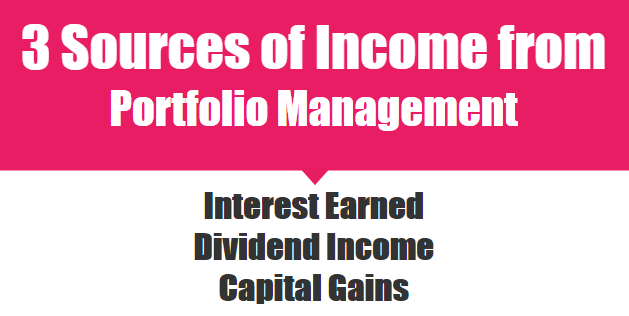
Which do you currently have? The average person struggles to survive because he only has one stream. Personally, I like trading and portfolio management. The great thing about portfolio management is that you can enjoy interest earned, dividend income, and capital gains.

2


2. THEY TREASURE EVERY SECOND OF THEIR TIME

Let’s be honest with ourselves; how many hours a day do you do things that do not contribute to your financial success? Most people would rather procrastinate or spend time on enjoyment rather than on what really matters.

I found this really interesting image of how most people spend their time in a year:

4Source: The Visual Communication Guy

It’s amazing; out of 365 days a year, 183.7 days are spent on media! If we were honest with ourselves, perhaps what we need is to rethink the way we live. Perhaps if we all take some time away from Media and reallocate it to self-improvement, learning, investing, and growing as a person, we could be living a very different life indeed.

How would your life look if you re-arranged your priorities?

Robert Kiyosaki once made a quip about what he noticed of rich and poor dads; he said that poor dad would sit on the couch and watch TV every night, while rich dad would review his investments and upgrade his skills every night. Poor dad would spend the weekends wasting time, while rich dad would build a business during the weekends.

2

Many of you would know that I read more than 200 books before I embarked on my trading journey. Even now, I make it a point to read at least 3 books a week, because I feel that it is important to never stop learning and upgrading oneself. Here are some key pointers:

  • Don’t waste time. Find out what you need to do, and do it.
  • Re-prioritize. Find out which areas of your life you can do away with, and cut them out quickly.
  • Learn. Just because you have graduated doesn’t mean you should stop learning. Successful people get where they are because they have an attitude of lifelong-learning.


3. HAVING A MENTOR MAKES A BIG DIFFERENCE

Mentors are looking for people who are humble, hungry, and hard-pressed for success. No matter where you are in your career or life, it helps to have successful people to reach out to and learn from. They’ll be able to quickly point you in the right direction if you are going off-track.

When I started my trading career at a professional fund, I had wonderful, experienced mentors to guide me in the right direction. I quickly picked up on what worked and what did not. I learnt their habits, their lifestyle, and the difficulties that they went through to get where they were.

Where can you look for mentors if you have no one at the moment? This is what many people ask me from time to time.

  • Build connections: Networks are not built overnight. As you expand your social circle to include successful people, you will start to find people who could potentially guide you to where you want to go.
  • Be inquisitive: People will only want to mentor someone who has the attitude for success. While at the beginning you might lack aptitude, the right mentality and motivation would attract the right people to you.
  • Keep learning: As you learn more, you discover you will have the vocabulary to connect with people. With greater proficiency, you would be able to speak at the same level as industry practitioners, asking smart questions, being able to understand jargon, and make an impression.


4. THEY VISUALIZE THEIR DREAMS IN DETAIL

Goals without dreams are dead; they become mere tasks rather than the exciting outcome that you hope for. It helps to have an idea of what you want; most people want to be wealthy but don’t know what it would look like.

What does a wealthy life look like for you? For YOU personally?

For some, it could mean having to work only 2-3 days a week. Financial goals differ from person to person, and it’s not just the monetary goal, but also the lifestyle goal. For me, I knew I wanted to have the luxury of making passive income even when I am travelling. This may not be everyone’s goal.

“How much money do you want to make exactly, and what would that lifestyle look like exactly?”

Many people want to lose weight. Losing weight isn’t a definite enough goal; Losing 12 kg by the end of 6 months is a definite goal. Many people fail to achieve their goals because they don’t even define their goals!

It’s also important to visualize yourself doing what you hope to be doing. Having a lot of money is pointless if all you are going to do is sit aroud with the cash; it is accomplishing the goals you have, those bucket lists, that make life worthwhile.

So what is it for you?

Grab a piece of paper and start getting your hands dirty. It doesn’t matter if you are old or young, experienced or inadequate; what matters is a willing heart and dilligent hands, and of course, a big enough dream that will knock you off your sofa and get you started.

  • Be specific about your goals. General goals generally don’t work. Specific goals help you to move toward exactly what you want.
  • Keep track of your progress. You never know if you are on the right path if you don’t take stock regularly. Even better, get a mentor to help you evaluate where you are.
  • Focus on the dream with its details. Keep reminding yourself of where you eventually want to be. Otherwise, you’ll just lose steam and burn out, bum around, and end up not getting where you were heading toward.


5. THEY DO NOT GIVE UP OR QUIT

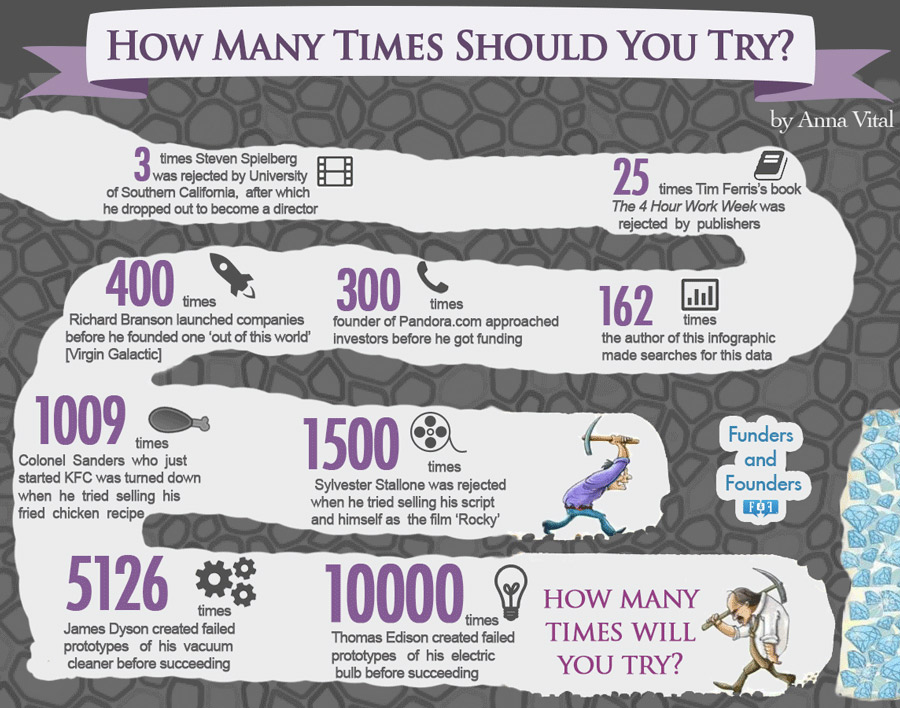
If you’ve got your foot into the investing arena, you would be familiar with financial losses. It is at this point where your mettle is truly tested; is this what you want? Are you willing to sit through heartache and tough lessons to get where you want? Is the life you left behind really worth going back to? Do you still believe in the dream you have?

When that business fails, would you stand up again and start all over? When you family doubts you and the pressure to provide hits you, will you continue to stand by your dream? People want the glory without the trials and training. Just take a look at the infographic below that I found:

33Source: Anna Vital (Founders & Founders)

I also came across this interesting quote, which I thought was very useful in clarifying what we really value. Millionaires invest their money and make investing a priority, while poor people spend their money first and make spending a priority.

5Source: Gecko and Fly

Always, always seek to make investing your primary objective. Invest your time, invest your money, invest in your team if you are running a business. Invest, invest and invest.

Is investing your primary objective, or is spending your primary objective? Would you be willing to delay gratification, in order to enjoy a lot more in the future, far more than you can ever imagine?

  • Do not quit. Ensure that you have made a commitment. Tell your friends, and engage people to keep you on this path.
  • Invest your money, your time, and in your team. Investing is what multiplies your returns in the long-run. Keep at it!
  • Prioritize learning, rather than earning. It pays to be more proficient at what you want to do. When you are starting out, make learning a priority, and the profits will come eventually.

Don’t give up on your dreams!

555

Feel free to share this with people you know who are working hard toward their dreams, and striving to build their first pot of Gold. And with these 5 actionable steps, you’ll be one step closer to your first million! 😀

Bonus: Download free ebook: The 7 Best-Kept Secrets of Professional Traders

RESEARCH SOURCES & REFERENCES

vulcanpost.com/593788/in-forbes-2016-asias-richest-families-list-we-see-some-prominent-singaporean-names
businessinsider.sg/habits-of-self-made-millionaires-2016-3/#rJDS8hCPPhHm5qpK.97
fastcompany.com/3052770/how-to-be-a-success-at-everything/7-habits-of-self-made-millionaires
allbusiness.com/slideshow/9-smart-habits-of-real-millionaire-entrepreneurs-16769866-1.html
huffingtonpost.com/timothy-sykes/top-30-millionaire-habits_b_8260134.html


thumbnail an unofficial guide to living our best life beyond financial freedom

If you are excited to get more life hacks, also check out: “Beyond Financial Freedom: An Unofficial Guide to Living Your Best Life”

0 Comments/by Spencer Li
https://synapsetrading.com/wp-content/uploads/2016/11/singapore-millionaires.jpg 427 816 Spencer Li https://synapsetrading.com/wp-content/uploads/2019/10/logo.jpg Spencer Li2016-11-16 06:17:012021-10-04 22:40:41Personal Checklist: The Top 5 Habits of Singaporean Self-Made Millionaires
Page 1 of 212

Free Trading Guides

Free Trading Guides

Blog Categories

  • Beginner's Guide
  • Blockchain & Crypto
  • Book Summaries
  • Economics & News Trading
  • Investing & Portfolio Management
  • Living Your Best Life
  • Market Analysis
  • Markets & Products
  • News & Events
  • Promotions
  • Risk & Money Management
  • Stock Trading
  • Technical Analysis & Price Action
  • Testimonials
  • Tools & Resources
  • Trading Psychology
  • Trading Strategies
  • Trading Tips
  • Travel & Lifestyle

Free Trading Guides

Free Trading Guides

Contact Us

Synapse Trading Pte Ltd
Registration No. 201316168H

Whatsapp: +65-8897-1204
Telegram: @iamrecneps
Email: info@synapsetrading.com

Links

Disclaimer
Privacy policy
Terms & Conditions
Contact us
Partnerships

© 2012-2024 Synapse Trading | All rights reserved | - powered by Enfold WordPress Theme
  • Link to Facebook
  • Link to X
  • Link to Instagram
  • Link to Youtube
  • Link to LinkedIn
  • Link to Mail
Scroll to top Scroll to top Scroll to top