

Stalled Pattern (Deliberation Pattern): How to Spot an Uptrend Running Out of Breath
Want the daily routine? Get the free 15-Minute Swing Trader’s Checklist. Get it free →
By Spencer Li, CFTe · Last updated: 26 October 2026
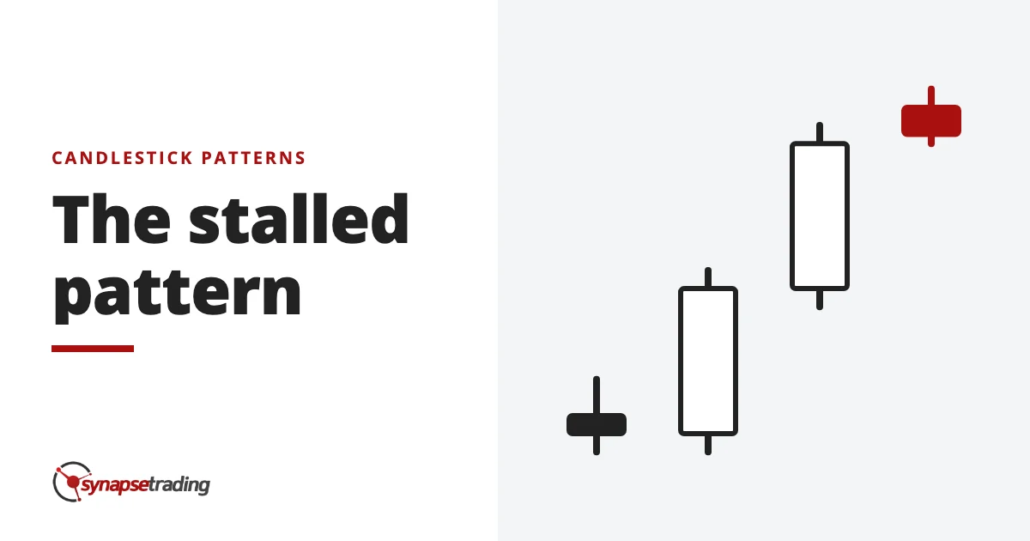
A stalled pattern, also called a deliberation pattern, is three white candles at the top of an uptrend in which the third candle is much smaller than the first two. Each candle opens and closes higher than the one before, so the trend is still climbing, but the small third body says the buyers have lost some of their push. In theory it warns of a top. In practice it is a warning, and a fairly gentle one, because in Thomas Bulkowski’s tests the uptrend carried on after most of them. So the pattern is best read as a reason to look harder at a winning position, rather than a reason to sell it.
What does a stalled pattern look like?
Picture a runner on the last lap who has been pulling away from the pack. The first two strides look as strong as ever, and the third is still forward, but it is shorter. Nobody has overtaken them yet. Still, anyone watching closely can tell something has changed.
That is the stalled pattern, and the books describe it with three checks.
- The market is already in an uptrend. The pattern is about a rally tiring, so there has to be a rally first.
- Three white candles each open and close higher than the one before. It is a staircase going up, which is why it looks bullish at first glance.
- The third candle has a small real body and opens near the second candle’s close. The real body is the thick part of the candle, between the open and the close.
Steve Nison, whose 1991 book Japanese Candlestick Charting Techniques brought these patterns to most Western traders, describes the last candle simply as a small white body. Gregory Morris, in Candlestick Charting Explained, says the pattern makes a new high and is “followed by a small white candlestick or a star”, and adds that “It is best if the last day gaps above the second day.”
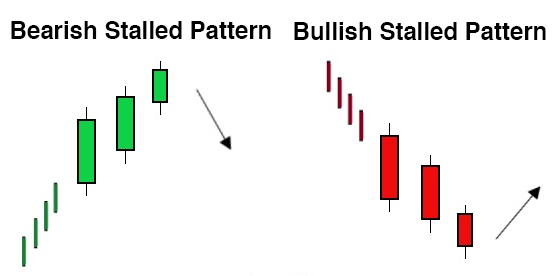
The chart above also shows a mirror version, three black candles at the bottom of a downtrend. Nison, Morris and Bulkowski only describe the stalled pattern at the top of an uptrend, so treat the mirror as a loose cousin rather than the same pattern.
The old version of this post also said the third candle needs a tall upper shadow. That rule belongs to a different pattern, the advance block. Bulkowski is specific that the deliberation has “requirements on body height, but none on the upper shadow like the advance block.”
Why do Japanese candle patterns sound like a battlefield?
Three white soldiers, advance block, counterattack lines, morning attacks. Read a list of candle patterns aloud and it sounds more like a war plan than a price chart.
The names come from where the charts were born. In the 1700s, Osaka was the centre of Japan’s rice trade, and the Dojima Rice Exchange traded coupons that promised rice to be delivered later. Nison calls those coupons “the first futures contracts ever traded”, and his figures from 1749 are hard to beat. In 1749, 110,000 bales of rice coupons were traded, at a time when there were only 30,000 bales of actual rice in all of Japan.
So the first futures market in the world was already trading more than three times the rice that existed, which is a fairly modern problem for a market run on paper and brush.
The traders who charted those prices borrowed their language from the samurai class above them, and the stalled pattern belongs to one of those military families. Morris places it in the san-pei, the “three soldiers” patterns of Sakata’s method. Three white soldiers is the healthy version, three strong candles marching up. The advance block and the stalled pattern are the same soldiers getting tired.
If you want a short daily routine for checking charts like these, my free 15-minute swing trader checklist is the one I use myself.
How is it different from the advance block and three white soldiers?
All three patterns are made of three rising white candles, so the difference sits entirely in how the strength fades.
| Pattern | What the candles do | What it says |
|---|---|---|
| Three white soldiers | Three strong white bodies, each closing near its high | The rally is healthy |
| Advance block | The second and third bodies shrink, or grow long upper shadows | The rally is tiring slowly |
| Stalled pattern | Two strong bodies, then one small one | The rally is tiring all at once |
Morris puts the difference in one line. In the deliberation, the “weakness occurs all at once on the third day.” In the advance block, it creeps in over the second and third.
Morris also notes that the stalled pattern can come before an evening star, a three-candle top in which a small candle sits above a white candle and is followed by a black one. Nison says something similar, that a small final body which gaps away from the second candle “becomes a star”. So one way to read a stalled pattern is as the first two-thirds of a possible evening star, with the third act still unwritten.
Does the stalled pattern actually reverse the trend?
On 5 December 2025, the same day Walmart printed the stall I come to below, a trader on Reddit’s r/Daytrading asked, “How significant are candlestick patterns?” For this pattern, the honest answer is that it matters less than its reputation suggests.
Bulkowski’s figures, read off his site on 26 October 2026, are blunt. The pattern is supposed to be a bearish reversal. In his tests it acted as a bullish continuation 77% of the time, which made it one of the most reliable continuation signals in his whole catalogue, the opposite of its reputation.
He is fair about why. His method counts a breakout as the first close above the top of the pattern or below the bottom, and since the third candle leaves price near the top, “the way I measured it is probably to blame”. Taken as a whole, its overall performance ranks 93rd out of 103 candle patterns.
There is one twist worth knowing. When the pattern did break down, in a bear market, the average move over the next 10 days was a fall of 6.72%. So the reversals were rarer than the textbooks suggest, but some of them were sharp.
Nison never oversold it in the first place. He describes both the advance block and the stalled pattern as warnings rather than true top reversals, and his advice is to “be especially cautious in a mature uptrend”. That last word matters. Three tired candles after a long run mean something, while the same three candles a week into a new trend usually mean the trend is taking a breath.
What does a stall look like in a real trade?
On 11 December 2025, I told viewers of my weekly outlook that we had closed our Walmart position. It had broken out of an ascending triangle, and after that, I said, “it’s been stalling a bit”, so I decided to close it and “take some of the profits”.
I did not call it a deliberation pattern at the time, and I will not pretend I did. But the daily prices, pulled from Yahoo Finance on 26 October 2026, show what that stall looked like a week earlier.
- From its close on 24 November to its close on 4 December, Walmart climbed about 10%.
- On 3 and 4 December it printed two solid white candles, the second opening and closing above the first.
- On 5 December it opened near the 4 December close and printed a third white candle with a body of about 0.3% of the price, a fraction of the 3 December body, while still making a new high.
By Bulkowski’s checks, that is a stalled pattern. Then Walmart kept climbing. On 12 December, the day after my outlook, it closed above the top of the pattern, and on 15 December it made a higher high. Only by 23 December had it closed below the bottom of the pattern, about 4% under the 5 December close.
So the trade-off ran both ways. That is normal for this pattern. Anyone who sold on the stall gave up a few more days of gains, and anyone who held through it gave back more than those gains by Christmas. The stall did not tell anyone what would happen next. It told them the easy part of the move was probably over.
If you would rather do this kind of checking once a day than all day, the free 15-minute swing trader checklist is my own routine.
Where does the stalled pattern go wrong?
The pattern is easy to spot, and that is part of the problem, because three rising white candles with a smaller third one turn up all the time.
- Early in a trend it means little. Nison’s warning is about a mature uptrend, so a stall a few days into a fresh rally is usually just a pause.
- It is easy to mislabel. Long upper shadows on the last two candles make it an advance block, and a small last body that gaps up may be the start of a star.
- It gives no target. It says the push is weakening, and nothing about how far price might fall if it does turn.
- The test results lean the other way. In Bulkowski’s numbers, the uptrend continued after about three stalls in four.
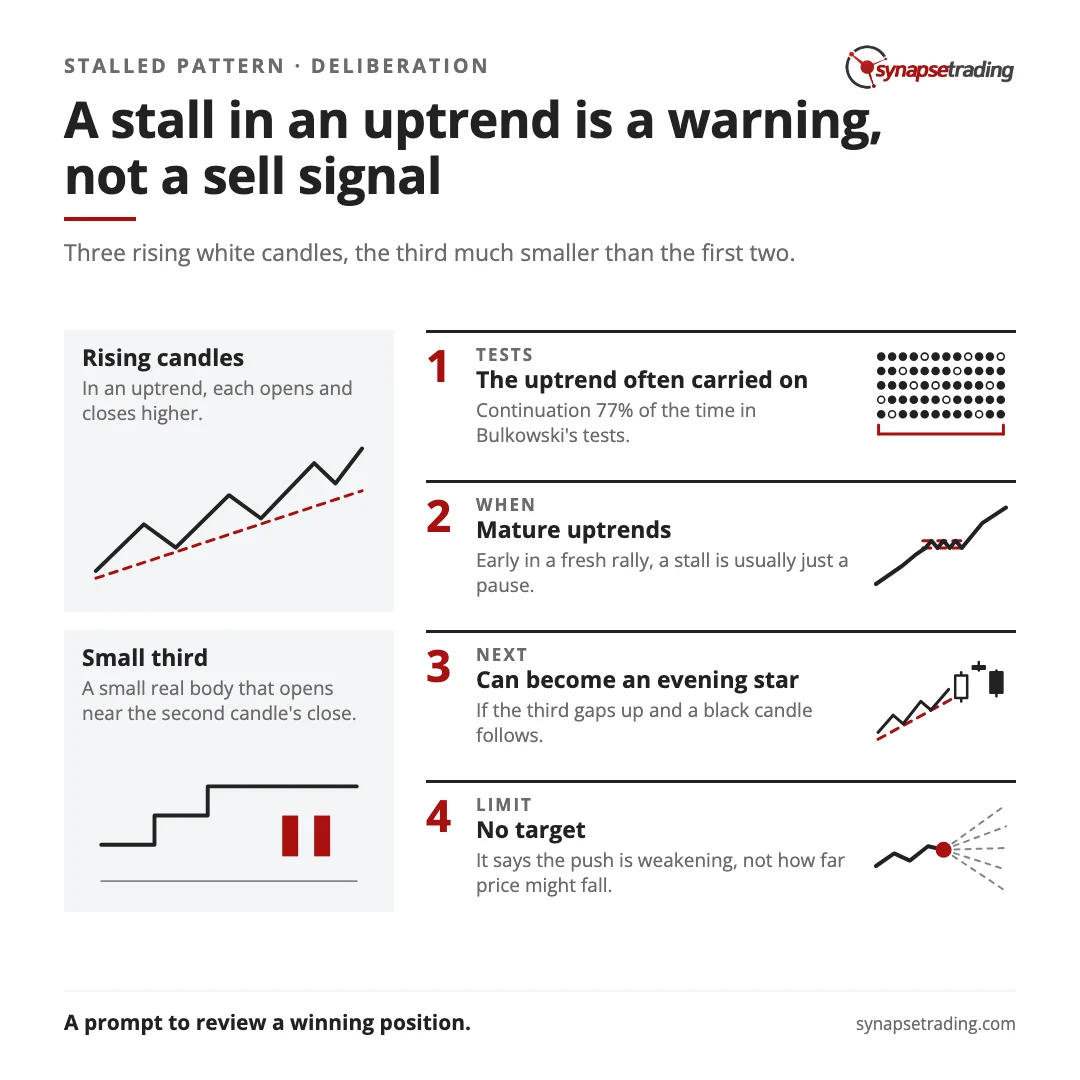
Personally, I read a stall as a prompt to review a winning position, as I did with Walmart, rather than as a sell signal on its own. For more on reading three-candle moves, the side-by-side white lines post covers a pattern that says a trend should keep going.
FAQ
What is a stalled pattern in candlesticks?
It is three white candles at the top of an uptrend, each opening and closing higher, with a much smaller third body. It warns that the buyers are losing their push.
Is the stalled pattern the same as the deliberation pattern?
Yes. They are two names for the same three-candle formation. It is sometimes misspelled as the deliberate pattern.
Is a stalled pattern bullish or bearish?
In theory it is a bearish reversal warning. In Bulkowski’s tests, the uptrend continued after it 77% of the time, so it works better as a caution than as a sell signal.
What is the difference between a stalled pattern and an advance block?
In a stalled pattern, the weakness shows up all at once in a small third body. In an advance block, the bodies shrink or the upper shadows lengthen over the second and third candles.
Can a stalled pattern turn into an evening star?
It can. If the small third candle gaps above the second and a black candle follows, the last three candles may form an evening star.
Have you ever held through a stall that turned out to be the top, or sold one that kept going? Which mistake stings more for you? Let me know in the comments.
For every candle pattern in one place, read The Definitive Guide to Candlestick Patterns. For the wider picture, start with my free trading guides.
And if you want a routine that spots a tiring trend without hours at the screen, grab the free 15-minute swing trader checklist.
About the author. Spencer Li is The 15-Minute Trader and the founder of Synapse Trading. He is a Certified Financial Technician (CFTe) with 15+ years of trading, run from 70+ countries. He holds a B.Acc and B.BM from SMU. Every trade he takes is public, dated, losses left in. He teaches rules-based swing trading in 15 minutes a day, one system for any market.
Education, not financial advice. Synapse Trading is not licensed by MAS to advise on investment products. Trading carries risk of loss, and past performance is not indicative of future results.
Want the daily routine? Enter your email for the free 15-Minute Swing Trader's Checklist.
Free 5-page PDF, then occasional trading emails. Education only, not financial advice. Unsubscribe anytime. Kit stores your email in the US: see our privacy policy.
Want to learn the full method? The Trading Mastery Program teaches the 4 strategies I have traded since 2011. It suits beginners and experienced traders.
Rather follow the trades as they happen? Daily Trading Signals is our Telegram channel: my trade ideas with entry, stop and exit, and every trade is public.
Questions about this post? Ask in the free Telegram channel →
Educational content only, not personalised financial advice. Trading carries risk, including loss of capital. Past performance is not indicative of future results. Synapse Trading is not licensed or regulated by MAS.

