

Top 17 Finance & Investment Books to Read (With Key Ideas)

Join our Telegram channel for more market analysis & trading tips: t.me/synapsetrading
Table of Contents
The Best Finance and Investment Books to Read (and Where to Start)
Last updated: 3 July 2026 · By Spencer Li, CFTe
If you want the single best finance book to start with, read Benjamin Graham’s “The Intelligent Investor” (1949), because it teaches the two ideas the rest of the field is built on: margin of safety (only buy when the price is well below your estimate of value) and treating “Mr. Market” as a moody business partner you can ignore. From there, the right next book depends on what you actually want. To grow real-world wealth and stop leaking money, read John C. Bogle and Dave Ramsey. To understand risk and the rare events that blow people up, read Nassim Taleb. To build the right portfolio rather than pick the right stock, read William Bernstein. To fix the mindset behind the money, read Stanley and Danko, Kiyosaki, and Robin and Dominguez. You do not need to read all seventeen. You need the right six or seven, in roughly the right order, and the patience to apply one idea before reaching for the next.
Below is the short, curated version, grouped by what you are trying to learn, with a one-line note on each so you can pick fast.
Why learn about investing at all?
Investing is putting money into assets (stocks, bonds, funds, property, commodities) with the expectation of earning a return over time. People learn it for a few honest reasons: to grow wealth, to save for long goals like retirement or a child’s education, to diversify so one bad bet does not sink them, and to understand the economy they live and work in.
Personally, I think books are the cheapest way to do that. A good finance book is years of someone else’s expensive mistakes for the price of a coffee or two. The trap is collecting them instead of using them. Reading thirty summaries does nothing. Reading one book slowly and changing one habit does a lot.
What are the best finance and investment books, grouped by what you want to learn?
Here are the genuine standouts from the longer list, sorted so you can find the one that fits.
| Book | Author | Year | What it teaches | Read it if you want to |
|---|---|---|---|---|
| The Intelligent Investor | Benjamin Graham (commentary by Jason Zweig) | 1949 | Value investing, margin of safety, “Mr. Market” | Start with the foundation |
| Security Analysis | Benjamin Graham and David Dodd | 1934 | The deeper, technical roots of value investing | Go one level beneath Graham’s classic |
| The Little Book of Common Sense Investing | John C. Bogle | 2007 | Why low-cost index funds beat most active investors | Stop overpaying and just own the market |
| The Black Swan | Nassim Nicholas Taleb | 2007 | How rare, unpredictable events shape outcomes | Take risk and uncertainty seriously |
| The Intelligent Asset Allocator | William Bernstein | 2000 | Asset allocation and portfolio construction | Build the portfolio, not pick the stock |
| The Millionaire Next Door | Thomas Stanley and William Danko | 1996 | The unglamorous habits of the actually wealthy | See where real wealth comes from |
| Rich Dad Poor Dad | Robert Kiyosaki | 1997 | Financial literacy, assets vs liabilities | Shift how you think about money |
| The Total Money Makeover | Dave Ramsey | 2003 | A step-by-step plan to clear debt and build wealth | Get out of debt and start saving |
| Your Money or Your Life | Vicki Robin and Joe Dominguez | 1992 | Aligning money with your values and time | Spend on what actually matters |
Start here: the foundations of investing
- “The Intelligent Investor” by Benjamin Graham (1949). The classic on value investing and risk. Margin of safety and the Mr. Market parable are the two ideas the rest of the field keeps re-explaining. If you read one book on this list, read this one. The widely sold modern edition carries Jason Zweig’s commentary alongside Graham’s original text. (Full summary: The Intelligent Investor.)
- “Security Analysis” by Benjamin Graham and David Dodd (1934). Graham’s earlier, heavier work. The deep, technical roots of value investing. Read it after “The Intelligent Investor”, not before. (Full summary: Security Analysis.)
- “The Theory of Investment Value” by John Burr Williams (1938). The book that put discounted cash flow analysis (valuing an asset by the future cash it will produce, discounted back to today) on the map. Foundational, and dry. For the genuinely curious, not the beginner.
Index investing and building the portfolio
- “The Little Book of Common Sense Investing” by John C. Bogle (2007). The case for low-cost index funds from the man who built the first one. The argument is simple: most active investors lose to the market after fees, so just own the market cheaply. (Full summary: The Little Book of Common Sense Investing.)
- “The Intelligent Asset Allocator” by William Bernstein (2000). A clear guide to asset allocation and portfolio management. The point that lands: how you split between asset classes matters more than which stock you pick. (Full summary: The Intelligent Asset Allocator.)
Risk, uncertainty, and the rare event
- “The Black Swan” by Nassim Nicholas Taleb (2007). On rare, unpredictable, high-impact events and why we are bad at planning for them. Reads as much like philosophy as finance, and it changes how you size risk.
The mindset and habits behind the money
- “The Millionaire Next Door” by Thomas Stanley and William Danko (1996). The research surprise that most real millionaires live below their means and look nothing like the magazine version. Quietly the most useful book on this list.
- “The Millionaire Mind” by Thomas Stanley (2000). The follow-up, on the habits and decisions of the self-made wealthy. Same vein, more depth on mindset.
- “Rich Dad Poor Dad” by Robert Kiyosaki (1997). On financial literacy and the asset-versus-liability distinction. Light on specifics, but the framing shift it gives beginners is real.
- “Your Money or Your Life” by Vicki Robin and Joe Dominguez (1992). On aligning spending with your values and treating money as life energy you traded for it. The book behind a lot of the modern financial-independence movement.
Debt, personal finance, and wealth building
- “The Total Money Makeover” by Dave Ramsey (2003). A blunt, step-by-step plan for getting out of debt and building savings. Not sophisticated, and that is the point. It works because it is simple enough to follow.
- “The Millionaire Fastlane” by MJ DeMarco (2011). Argues that slow saving alone is not the path, and that entrepreneurship and calculated risk are. A useful counterweight to the index-and-wait crowd, taken with a pinch of salt.
Economics and the big picture
- “The Wealth of Nations” by Adam Smith (1776). The founding text of modern economics: free trade, specialisation, and the market’s “invisible hand”. Historical heavyweight. Read an abridged version unless you are committed.
- “Capital in the Twenty-First Century” by Thomas Piketty (2013). A data-heavy argument about wealth and income inequality over the long run. Important and demanding. Worth knowing the thesis even if you do not finish it.
- “The Paradox of Choice” by Barry Schwartz (2004). Not strictly finance, but it explains why more options can make us worse off and more anxious, which matters the moment you open a brokerage account with ten thousand things to buy.
A note on the entries I trimmed
The original list also carried “The Millionaire Mindset” by Gerry Robert. Do note that, when a “best books” list runs long, the back end fills with general motivation rather than finance. If a book is not in the curated sections above, it is not a knock on the book. It is a vote for your time. I would rather hand you the dozen that actually change how you handle money than seventeen you half-remember.
Where the human edge comes in
Here is the part I care about most. Every book on this list is, underneath, a book about decision-making under uncertainty. So is investing itself. A robo-advisor can build you a perfectly allocated portfolio in a minute, and a screener can rank value stocks in a second. What no tool will do is stop you from panic-selling that portfolio in a crash, or from chasing the hot stock your friend just doubled on. Graham’s margin of safety is not really a formula. It is a discipline. That discipline, and the judgment to know when to sit still, is the first of the Five Edges no tool can trade for you. The book teaches the idea. You still have to be the one who holds the line.
FAQ
What is the best finance book for beginners?
“The Intelligent Investor” by Benjamin Graham is the most recommended starting point, because it teaches margin of safety and the “Mr. Market” mindset that underpins almost everything else in investing. If it feels dense, start with “Rich Dad Poor Dad” by Robert Kiyosaki or “The Total Money Makeover” by Dave Ramsey, which are simpler and more immediately practical.
What is the single best investing book of all time?
Most investors point to “The Intelligent Investor” by Benjamin Graham (1949). Warren Buffett, Graham’s most famous student, has called it the best book on investing ever written. For low-cost index investing specifically, “The Little Book of Common Sense Investing” by John C. Bogle is the standard recommendation.
Which finance book should I read to build wealth, not just understand it?
“The Millionaire Next Door” by Thomas Stanley and William Danko shows the real, unglamorous habits of wealthy people, and “Your Money or Your Life” by Vicki Robin and Joe Dominguez reframes spending around your values. For a step-by-step debt and savings plan, “The Total Money Makeover” by Dave Ramsey is the most actionable.
Do I need to read all the famous finance books?
No. A focused six or seven, read slowly and applied, will do more for you than seventeen skimmed. Pick one foundation book, one on portfolio building, and one on mindset, and start there.
What is the difference between investing and trading books?
Investing books, like the ones on this list, focus on owning assets for the long term and on valuation, allocation, and risk. Trading books focus on shorter-term price action, charts, and execution. For the trading-focused companion list, see “Best Investing and Trading Books of All Time” linked below.
So, which one are you starting with? Tell me in the comments, and if there is a finance book that changed how you handle money that I left off, I want to hear it.
If you want the trading-focused cousin of this list, with the charts-and-execution side covered, read the companion roundup: Best Investing and Trading Books of All Time.
Want to put the investing principles to work? Grab the free 15-Minute Swing Trading Starter Kit. It is the exact once-a-day routine I use to stay consistent and keep emotion out of the decision in any market.
About the author. Spencer Li is the founder of Synapse Trading and a Certified Financial Technician (CFTe) with 15+ years of trading across stocks, forex, crypto, commodities, and bonds. His trade log is public: every trade since April 2024, dated, losses left in. He has taught a 15-minute daily trading routine since 2014, one system for any market.
Education, not financial advice. Synapse Trading is not licensed by MAS to advise on investment products. Trading carries risk of loss; past performance is not indicative of future results.
Related
Best Investing and Trading Books of All Time · The Intelligent Investor (book summary) · The Little Book of Common Sense Investing (Bogle) · The Intelligent Asset Allocator (Bernstein) · Best Psychology Books to Read
Want our free trading resources by email? Leave your address below.
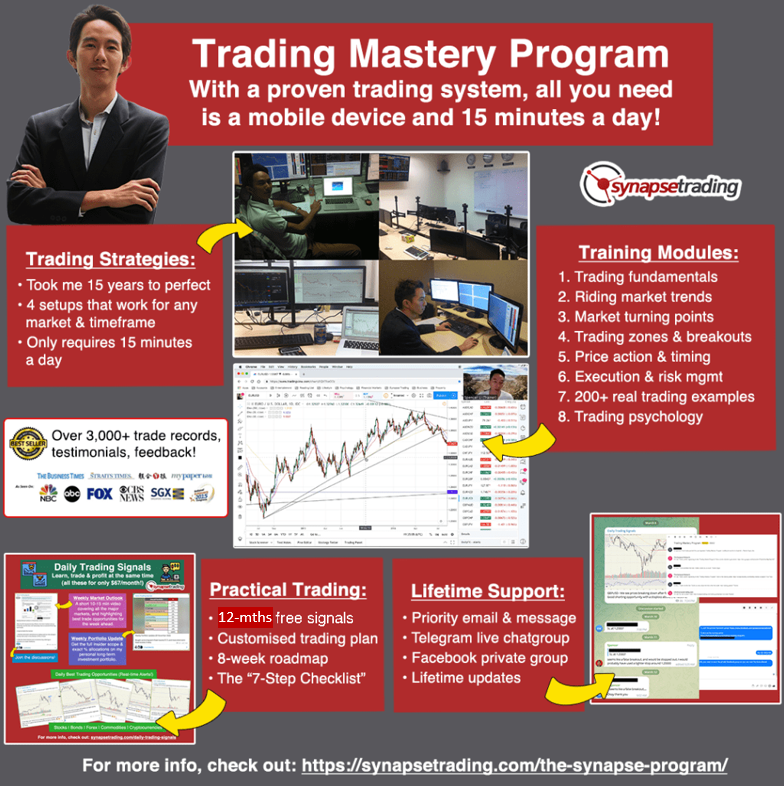 Our flagship mentoring program is suitable for both beginners and advanced traders, covering the 4 strategies which I used over the past 15 years to build up my 7-figure personal trading portfolio.
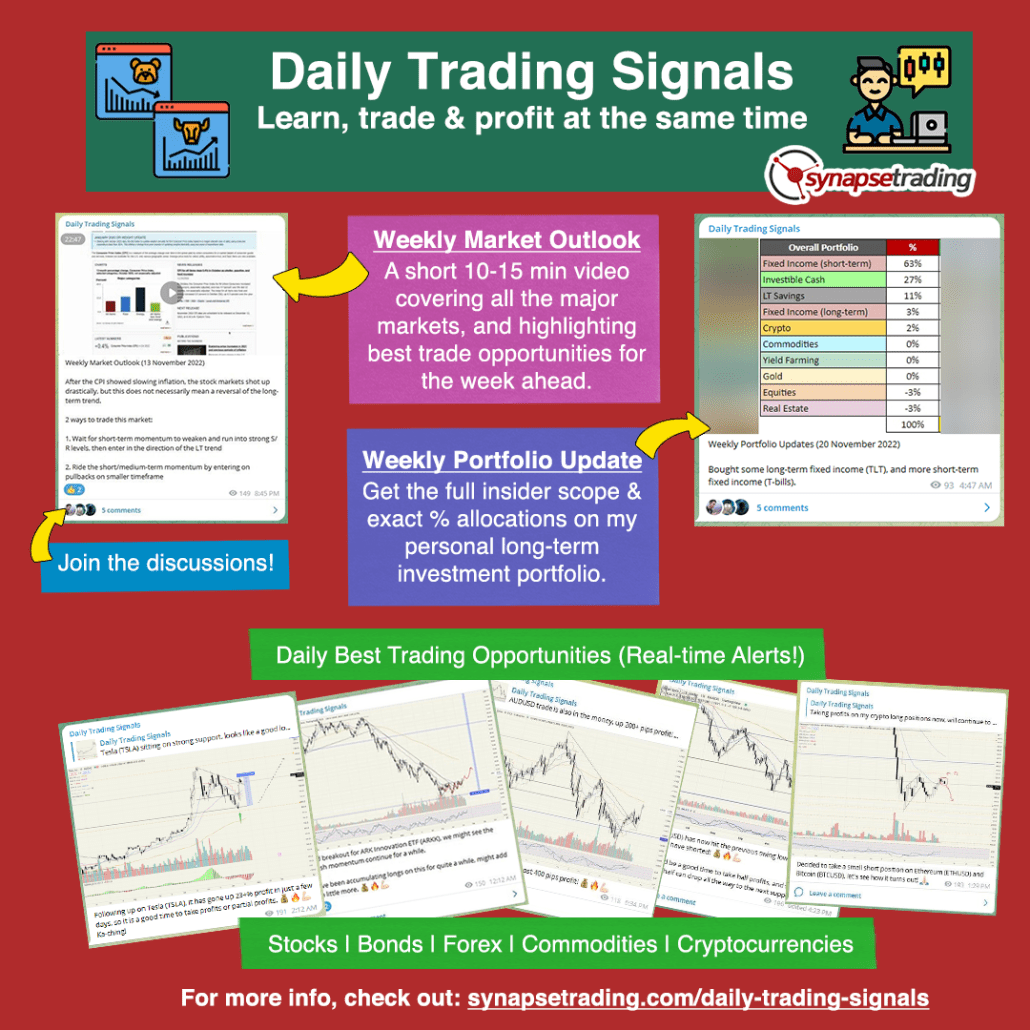 If you're looking for the best trading opportunities every day across various markets, and don't want to spend hours doing the research yourself, check out our private Telegram channel!


Leave a Reply
Want to join the discussion?Feel free to contribute!