

Continuation vs Reversal Patterns: How to Tell a Pause From a Turn
Want the daily routine? Get the free 15-Minute Swing Trader’s Checklist. Get it free →
By Spencer Li, CFTe · Last updated: 16 September 2026
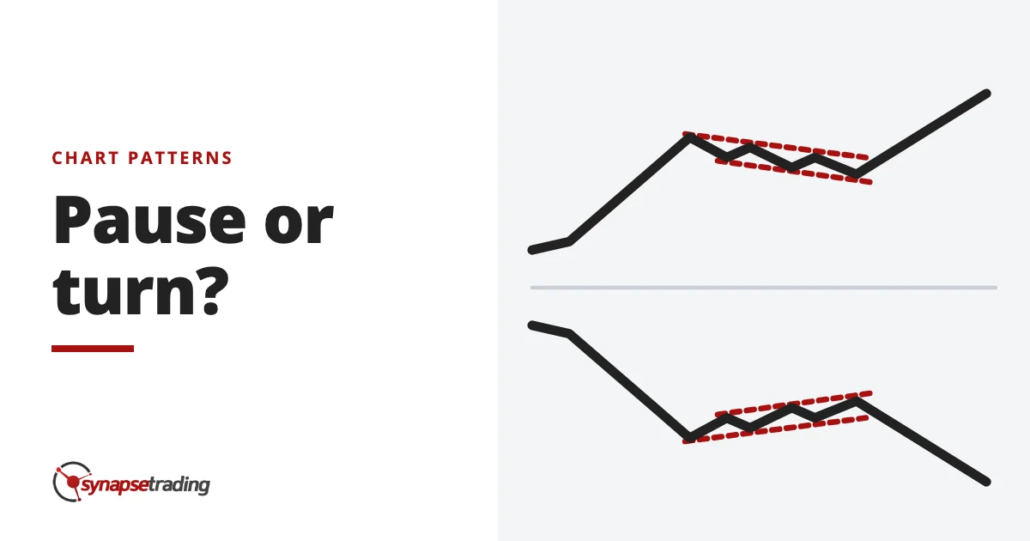
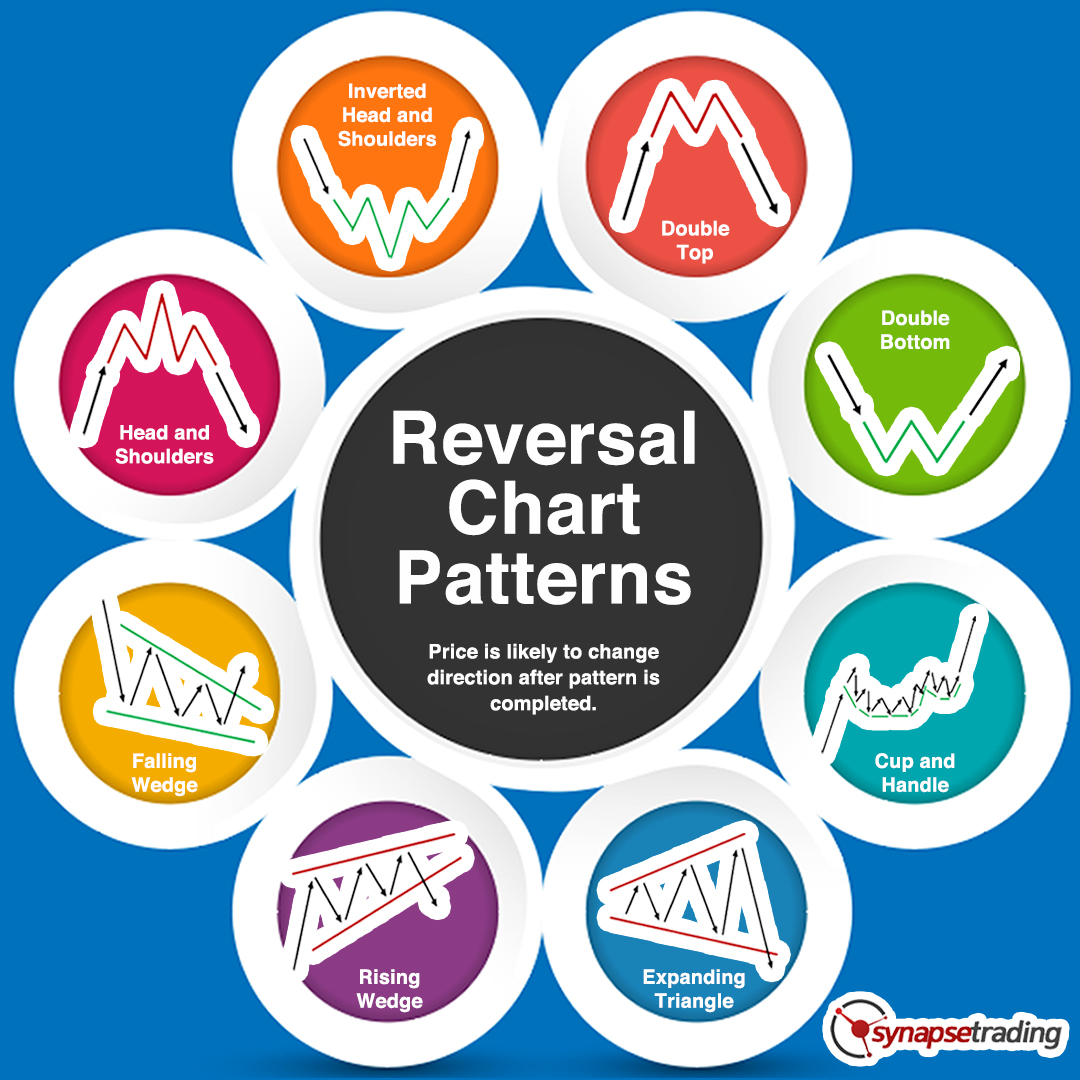
A continuation pattern is a pause in a trend, after which the same trend carries on. A reversal pattern marks the end of a trend and the start of a move the other way. Flags, pennants, rectangles and most triangles are continuation patterns, while the head and shoulders, double tops and bottoms, wedges and the cup and handle are reversal patterns.
The quickest way to tell them apart on a live chart is to ask how old the trend is. Small patterns early in a strong trend are almost always pauses, and large patterns at the end of a long, tired move are the ones that turn. And if a reversal pattern points the same way as the trend it sits in, treat it as a continuation pattern instead.
What is the difference between a continuation and a reversal pattern?
In September 2026 I had 288 recent posts on Reddit’s r/Daytrading counted by topic, out of curiosity about what new traders actually worry about. Psychology or discipline came up 49 times. The head and shoulders came up once, double tops and bottoms twice, and flags not at all, which is a little sad for shapes traders have argued about for decades.
I still think chart patterns are worth learning. Why? Nearly every one of them belongs to one of only two families, and once you know the family, you already know what the pattern is trying to tell you.
Continuation patterns lead to a continuation of the trend that came before them, and you usually find them mid-trend, when price takes a breather and moves sideways to build up strength for the next leg. So a downtrend goes into the pattern and comes out as a downtrend, and an uptrend comes out as an uptrend.
Reversal patterns lead to a change in the existing trend, and you usually find them after a long trend that has a good chance of ending, when price is exhausted in one direction and getting ready to turn. A downtrend goes in. An uptrend comes out.
Do note that it is much harder to change the direction of a trend than to pause it. Think of driving on a busy road. Stopping at a traffic light takes a few seconds, while a U-turn needs space, time and a gap in the traffic. Hence reversal patterns tend to be larger, and they take longer to form and complete.

How does the age of a trend decide which pattern you get?
In my weekly outlook on 27 April 2026, the S&P 500 was making new all-time highs, and it had formed what I called “a very clear small tight bull flag”. It was so strong that price did not even pull back to the 10-day or 20-day EMA, the exponential moving averages that give recent days more weight. I said on the video that this kind of flag rarely happens, but when it does, it is very bullish. QQQ did much the same, with a flag only two or three bars long.
That is what a strong trend looks like.
The type of pattern that forms depends on how far the trend has already travelled. Early on, buyers or sellers are confident, so price only needs a short rest, and you get small patterns like the bull flag, the bear flag and the pennant. As the trend ages and weakens, the rests get longer, and larger patterns like rectangles and triangles start to appear. In the late stage the trend runs low on conviction, uncertainty and volatility both pick up, and that is when reversal patterns show up.
| Trend stage | Trend strength | Typical patterns | What it usually means |
|---|---|---|---|
| Early | Strong | Bull flag, bear flag, pennant | A short pause, then the trend resumes |
| Middle | Weakening | Rectangle, ascending, descending and symmetrical triangles | A longer pause, and the trend usually resumes |
| Late | Exhausted | Head and shoulders, double top or bottom, wedges, expanding triangle | The trend is running out of road |
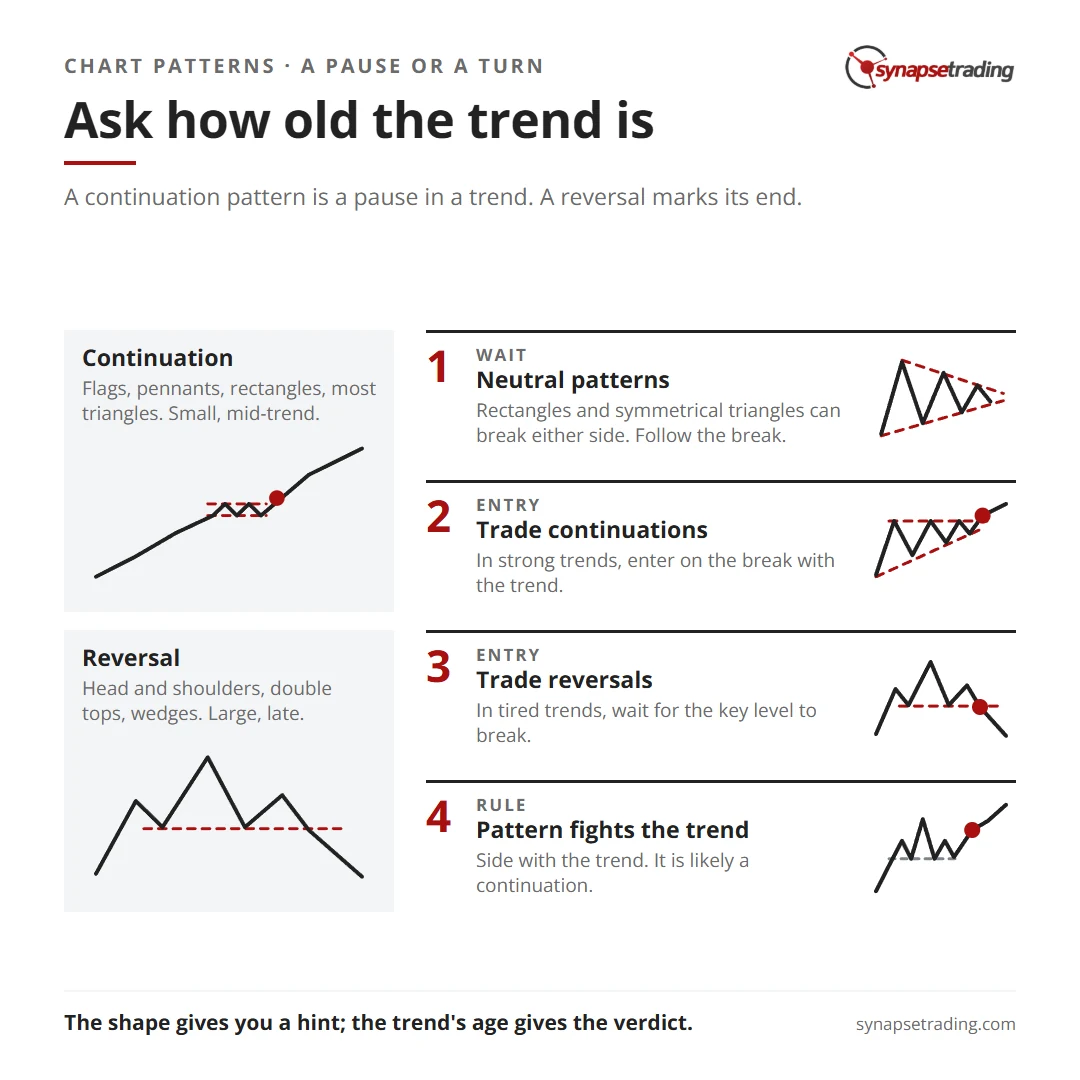
A scanner will happily tag every triangle on your watchlist in a second. Whether this particular triangle is a mid-trend pause worth trading or a late-trend warning to stand aside is still a call you make yourself, by looking at what came before it.
For a short daily routine that fits around a full-time job, my free 15-minute swing trader checklist is the one I run myself.
Which patterns lean bullish, bearish or neither?
Can a pattern tell you which way it leans before it breaks? Some can. Others refuse to pick a side until the very end.
| Bias | Continuation patterns | Reversal patterns |
|---|---|---|
| Bullish | Bull flag, ascending triangle | Double bottom, inverted head and shoulders, cup and handle, falling wedge |
| Bearish | Bear flag, descending triangle | Double top, head and shoulders, expanding triangle, rising wedge |
| Neutral | Rectangle, symmetrical triangle | None |
The rectangle and the symmetrical triangle are neutral, which means price can break out of either side once the pattern completes. Guessing those early is close to a coin toss, so I wait for the break and follow it. The other patterns give you a lean before the break.
A few patterns also refuse to stay in one box. I file the cup and handle under reversals, because it usually kicks off a new uptrend out of a ranging market. Plenty of chartists call it a continuation when it forms partway up an existing uptrend, and they have a point. What matters more than the label is whether the trend before the pattern is still alive.
Why is a rising wedge a reversal but an ascending triangle a continuation?
On 12 November 2018, a trader on Reddit’s r/technicalanalysis asked exactly this, and added that “the explanations for each case can be applied to either or it seems”.
It is a fair complaint. Both patterns slope upwards and squeeze price into a narrowing space, and most textbooks describe them in nearly the same words.
The difference sits in the top line. An ascending triangle has a flat top, so sellers keep defending one price while buyers pay a little more on every dip, and each rally presses against the same wall until it gives way. A rising wedge has both lines sloping up and closing in, and each push to a new high gains less ground than the one before, so price is still climbing while every step costs more effort and buys less height.
The stage of the trend settles the rest. The ascending triangle tends to show up mid-trend, while the rising wedge usually forms late, after a long run has already used up most of the willing buyers. So the shape gives you a hint, and the age of the trend gives you the verdict. Suppose you see a rising wedge three weeks into a fresh uptrend. I would be slow to call that a top.
How do you trade continuation patterns?
What are you really betting on here? You are betting that a trend you already like will keep going after a short rest, which is a much smaller bet than calling a turn.
So the approach is to look for continuation patterns in the middle of strong trends, and to wait for price to break out of the pattern in the direction of the trend before you enter. Getting in before the break saves a little on price. It costs a lot more in false starts.
The odds also lean your way, which is the main reason I like these trades for people starting out. Al Brooks, the price-action trader and author, estimates in his book on reversals that a trading range inside a trend breaks out with the trend in about 80% of cases. That is his estimate from experience rather than a published backtest, so hold it loosely. Even so, it beats a coin toss.
Personally, I find these the calmer trades to hold, because the trend does most of the work and the pattern hands you a clear place to admit you were wrong. Patient trading like this is what the free 15-minute swing trader checklist is built around.
How do you trade reversal patterns?
On 30 October 2025, the day after Meta’s earnings, I pulled up its chart in my weekly outlook and could not quite decide what I was looking at. Meta had gapped down, and I said it looked like “a double top and a head and shoulders at the same time”, a sort of four-pronged top. My conclusion on the video was that whatever the shape was, the chart looked bearish.
Real reversal patterns tend to be that messy. The name matters much less than where the shape sits and what price does next.
You look for reversal patterns in the late stage of an exhausted trend, and you wait for the old trend to end and a new one to begin before you enter. In practice that means waiting for price to break the pattern’s key level. On a head and shoulders, that level is the neckline, the line joining the two lows on either side of the head.
Reversal trades are also where fear and hope do the most damage. Calling the top feels clever. It is also the trade most likely to get you stopped out again and again while the trend carries on without you, and each small loss makes the next top look even more certain.
What should you do when the pattern and the trend disagree?
Al Brooks makes a striking argument in Trading Price Action: Reversals. A market has inertia, he writes, so while a trend is in force every pattern is really a continuation pattern, and the ones that fail get labelled reversals afterwards.
The US stock market gave me a live example in November 2025. In my outlook on 27 November, it had pulled back to its 100-day moving average and then climbed back above all its moving averages. A mini head and shoulders had formed on the chart, and I said on the video that it had “kind of failed”. A pattern that is supposed to end an uptrend turned out to be a pause inside one.
That is why I put a simple filter into the first version of this post in July 2021. A reversal pattern is meant to change the trend, so a bullish reversal pattern belongs in a downtrend, and a bearish one belongs in an uptrend. When you see a contradicting pattern, say a bullish reversal pattern in an uptrend, it is far more likely to be a continuation pattern.
I will admit the filter is much clearer in hindsight. That same week in November 2025, I had not gone into positions aggressively. While the correction was still going on it was not clear whether the trend would resume, so I waited for more confirmation. The price of that caution was a later entry.
Personally, when the pattern and the trend disagree, I side with the trend. Arriving a little late is the cost of not fighting it.
FAQ
What is the difference between a continuation and a reversal pattern?
A continuation pattern, such as a flag, forms during a trend and the trend carries on. A reversal pattern, such as a double top, forms at the end of a tired trend and the direction changes.
How can I tell if a pattern is a continuation or a reversal?
Look at where it sits in the trend. Small patterns early in a strong trend are usually continuations, and large patterns after a long move are more likely reversals.
Which chart patterns are continuation patterns?
The bull flag, bear flag, pennant, rectangle, and the ascending, descending and symmetrical triangles.
Which chart patterns are reversal patterns?
The head and shoulders and its inverted version, double tops and bottoms, the expanding triangle, rising and falling wedges, and the cup and handle.
Is the cup and handle a continuation or a reversal pattern?
It can be either. I class it as a reversal because it usually starts a new uptrend out of a ranging market, but many traders call it a continuation when it forms partway up an existing uptrend.
Which family do you trade more often, and has a top you were sure about ever turned out to be just a pause? Let me know in the comments.
If you want every pattern covered in detail, read my Guide to Trading Price Chart Patterns. The bull flag and bear flag, the ascending and descending triangle, the rectangle pattern, the expanding triangle and the cup and handle each have a page of their own. The rest of my free trading guides are collected in one place.

If you would like to learn all the different price chart patterns, also check out: “The Definitive Guide to Trading Price Chart Patterns”
And if you want a daily routine that does not need hours at the screen, grab the free 15-minute swing trader checklist.
About the author. Spencer Li is The 15-Minute Trader and the founder of Synapse Trading. He is a Certified Financial Technician (CFTe) with 15+ years of trading, run from 70+ countries. He holds a B.Acc and B.BM from SMU. Every trade he takes is public, dated, losses left in. He teaches low-risk swing trading in 15 minutes a day, one system for any market.
Education, not financial advice. Synapse Trading is not licensed by MAS to advise on investment products. Trading carries risk of loss, and past performance is not indicative of future results.
Want the daily routine? Enter your email for the free 15-Minute Swing Trader's Checklist.
Free 5-page PDF, then occasional trading emails. Education only, not financial advice. Unsubscribe anytime. Kit stores your email in the US: see our privacy policy.
Want to learn the full method? The Trading Mastery Program teaches the 4 strategies I have traded since 2011. It suits beginners and experienced traders.
Rather follow the trades as they happen? Daily Trading Signals is our Telegram channel: my trade ideas with entry, stop and exit, and every trade is public.
Questions about this post? Ask in the free Telegram channel →
Educational content only, not personalised financial advice. Trading carries risk, including loss of capital. Past performance is not indicative of future results. Synapse Trading is not licensed or regulated by MAS.

