

Why Traders Fail: The 5 Real Reasons Most Traders Lose Money
Want the daily routine? Get the free 15-Minute Swing Trader’s Checklist. Get it free →
Published: 10 November 2026 · By Spencer Li, CFTe
Most traders lose money for 5 reasons, and every one of them can be measured. They trade so often that costs eat the return. They size each trade so big that one bad week does lasting damage. They sell their winners quickly and sit on their losers. They judge a method on far too few trades, so a lucky stretch passes for skill. And after a losing run, they carry on doing the same thing. All 5 show up in studies of real brokerage records, from 66,465 American households to every day trader in Taiwan over 15 years. Bad chart reading barely features. So the useful question is less “why do traders fail?” and more “which of the 5 is in my own record?”, and most people can answer that in an afternoon.
In May 2026, a trader on r/Daytrading asked a version of this that I hear often: “Why do more than 90% people fail despite spending considerable time in the market”. He went on to list the courses, the books and the groups he had joined, and said the question was meant for people who were still trying.
That last detail matters. He was asking about the people who put in the hours and still lose, so before the reasons, it is worth checking whether 90% is even the right number.
How many traders actually lose money?
It depends on who is being measured, and over what period. Every serious study I have read lands on the same word, though. Most.
| Study | Who was measured | What it found |
| ESMA, March 2018 | Retail CFD accounts, from national regulators’ analyses across several EU countries | 74% to 89% of retail accounts typically lose money |
| IG and Saxo UK risk warnings, read 25 October 2026 | Each provider’s own retail CFD accounts | 70% (IG) and 61% (Saxo) lose money |
| Barber and Odean, 2000 | 66,465 US households at a large discount broker, 1991 to 1996 | The fifth who traded most earned 11.4% a year, against 17.9% for the market |
| Barber, Lee, Liu and Odean, 2011 | Every day trader in Taiwan from 1992 to 2006, about 360,000 in an average year | About 13% made money after fees in a typical year, and under 1% did it consistently |
| Chague, De-Losso and Giovannetti, 2020 | Everyone who started day trading Brazilian index futures in 2013 to 2015 and kept going for at least 300 days | 97% lost money, and 0.4% earned more than a bank teller |
So the 90% on Reddit is roughly right for day traders and leveraged products, and too gloomy for ordinary stock investors. Most of Barber and Odean’s households made money in a strong market, and simply made less than an index fund would have paid them for doing nothing. The hardest numbers come from day trading and leverage, where all 5 reasons run at full strength.
So why do most traders lose money?
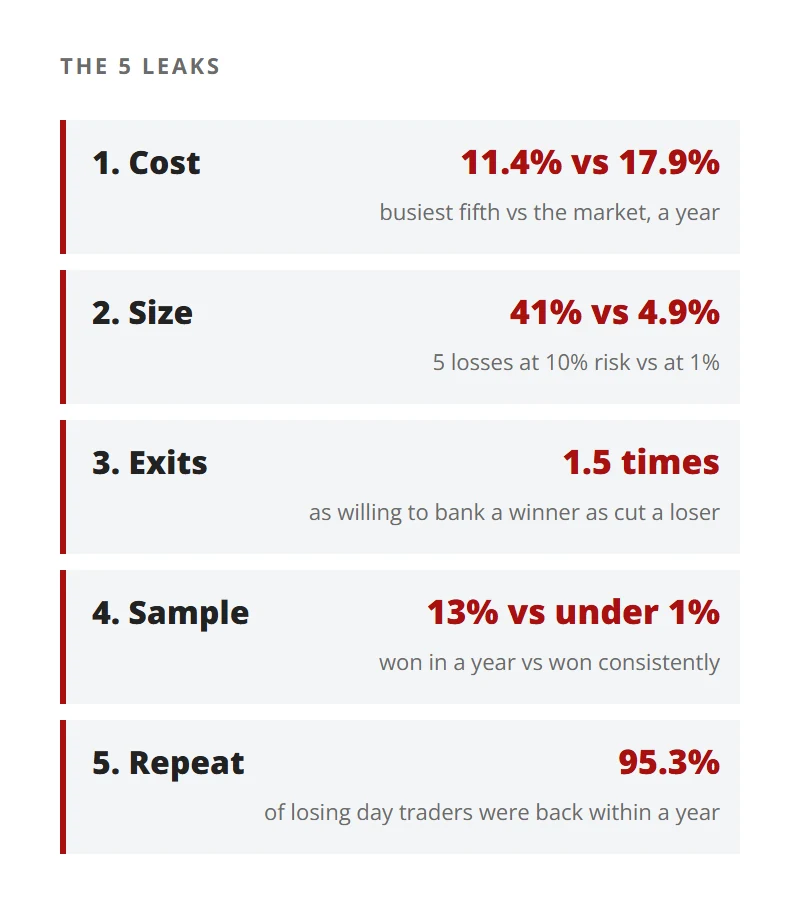
I call them the 5 leaks, because each one drains an account slowly before it drains it fast. One word each: Cost, Size, Exits, Sample, Repeat.
1. Cost: are you trading more often than your edge can pay for?
Barber and Odean’s result still surprises people. The busiest households picked stocks about as well as everyone else. Before costs, every group earned roughly the same, between 18.5% and 18.7% a year, but after commissions and the bid-ask spread the busiest fifth was down to 11.4%, while the quietest fifth kept 18.5%. The busy group turned over its whole portfolio more than twice a year.
Now, 7 percentage points a year can sound like a rounding error, until you compound it. Over 10 years, 100 growing at 11.4% a year becomes about 294. At 18.5% it becomes about 546. Same stock-picking skill, a little over half the money, and the only difference was how often they pressed the button.
Day traders feel it even harder. In the Taiwan data, the 500 best day traders earned 49.5 basis points a day before fees and 28.1 after, so fees took about 43% of what the very best of them made.
This is why overtrading tops most lists of day trading mistakes beginners make. My own log runs at about 15 trades a month. Personally, I treat a quiet week as the system working, because the fee meter only runs when I do.
2. Size: is each trade small enough to survive being wrong?
Leverage leaves your analysis exactly as good as it was and makes every mistake bigger. ESMA’s own standard warning says CFDs carry “a high risk of losing money rapidly due to leverage”.
Here is the arithmetic. Suppose you risk 10% of the account on each trade, and you are right half the time. Any run of 5 trades has about a 1 in 32 chance of being 5 losses in a row. After those 5, the account is down 41%, and it needs a 69% gain just to get back to where it started. Risk 1% a trade instead, and the same streak costs you 4.9%. Same trader. Same calls. Only the 1% version gets to keep playing. That gap is why risk management matters more than your strategy, and why risk of ruin is the first number I would calculate.
I had to learn this one again in June 2026, after more than 15 years of trading. My book was heavy in semiconductor and memory names when the June jobs report gapped the whole sector overnight, and in 2 sessions the year’s gains went from about 7.5% to about 0.5%. My analysis of the names had been fine, and the damage came from how much of the book sat in one theme. Hold that thought.
If you want a daily routine that keeps your size and your trade count in check, the free 15-Minute Swing Trader’s Checklist is at the end of this post.
3. Exits: do you sell your winners faster than your losers?
Terrance Odean studied 10,000 accounts at a discount broker from 1987 to 1993. When a stock was up, investors took the gain on 14.8% of their chances, and when it was down, they sold on only 9.8%, which made them about 1.5 times as willing to bank a winner as to cut a loser. And the winners they sold went on to beat the losers they kept.
It is easy to see why. Banking a win feels like relief. Selling a loser means admitting the call was wrong, and the regret arrives the moment you click, so the account fills up with losers held on hope, while the winners get cashed before they can do much.
I know which side of this I need to be on, because I am wrong about half the time. My trade log is public, every trade since April 2024, dated, losses left in. Measured to June 2026, the win rate is about 50%, and the record still grows because the average winner is about 3.3 times the size of the average loser. I should also say the uncomfortable bit. The average gain per trade has shrunk every year since 2024, and 2026 has been the weakest stretch so far.
Win rate versus risk reward goes deeper on that maths. Managing losing trades covers the exits.
4. Sample: how many trades is your verdict based on?
Nobody notices this leak. It feels like success. In the Taiwan data, about 13% of day traders made money after fees in a typical year, but fewer than 1% did it year after year, which works out to roughly 1,000 people out of 360,000. So of all the traders who had a winning year, only about 1 in 47 turned out to be the consistent kind.
Imagine you take 20 trades and 14 of them win. It feels like proof. It is very close to nothing. A strategy with no edge at all can do that over 20 trades, and a good one can lose money over 30. I want 100 to 200 recorded trades before I judge a system, and the reasons are in the law of large numbers post.
The trap cuts both ways: one good quarter gets a trader sizing up at the worst moment, and one bad quarter gets a working method thrown out. Is trading skill or luck walks through how to tell them apart.
5. Repeat: what did you change after your last losing streak?
Losing should teach people to stop or to change. It mostly does neither. In Taiwan, among day traders with 50 or more days of experience and a record of losses, 95.3% were day trading again within the next 12 months. For the profitable ones, the figure was 96.4%. The Brazil study put it bluntly: no evidence of learning by day trading.
Now back to June 2026. That night my journal verdict was “discipline lapse, not strategy failure”. The rule to trim existed, and I simply did not fire it. Then, about 10 days later, I built the book straight back up into a Fed meeting, from about 0.43 times my capital to about 1.06 times, with the same concentration that had just cost me. The relapse taught me more than the loss did.
What changed after that was the form of the rule. It had lived as a sentence in a trading plan, and a sentence is easy to argue with at 10pm. A standing order on the book, or a calendar block that says cut exposure, is an object, and objects fire on time. If you have read should I quit trading after years of losses, this is the same split between a method that fails and a trader who breaks it.
Which leak should you check first?
Take your last 100 trades, or as many as you have, and measure 5 things:
| Leak | What to measure in your records | What a leak looks like |
| Cost | Fees and spreads as a share of gross profit | Gross profit is positive, net profit is not |
| Size | The account after 5 straight losses at your usual size | A 5-loss streak costs more than 10% |
| Exits | Average winner against average loser | Winners are cut early, losers held past the stop |
| Sample | The number of trades behind your verdict | A conclusion drawn from fewer than 100 |
| Repeat | What you changed after your last losing streak | Nothing written down, the same mistake twice |
Personally, I check Size first, because it is the only leak that can end the game in a week. Repeat comes second, because it decides whether the other 4 ever get fixed.
The Reddit poster had done the courses and the books, so he deserves a straight answer. I run a trading course, so I have a stake in this. A course can teach you the 5 leaks, and it cannot fire the rule for you. I knew every one of them in June 2026 and still broke one.
The free 15-Minute Swing Trader’s Checklist turns the 5 leaks into a short daily routine. It is at the end of this post.
So, which leak is in your record?
Judge your own account on its record over many trades.
The research says most traders lose, and it also says why. The trading psychology guide covers the habits behind the 5 leaks.
So, how much of your gross profit went to costs last year? What would 5 losses in a row do to your account today? And after your last bad month, what did you actually change?
FAQ
What percentage of traders lose money?
Most of them, and the exact share depends on the product and the period. EU regulators found 74% to 89% of retail CFD accounts lose money, and 97% of Brazilian day traders who lasted 300 days lost money.
Why do traders fail even after taking courses?
Because knowing the 5 leaks and acting on them are different skills. In Taiwan, losing day traders kept trading at almost the same rate as winning ones.
Do most day traders lose money?
Yes. In Taiwan, about 13% of day traders made money after fees in a typical year, and fewer than 1% did it consistently, across 15 years of data.
How many trades do you need to know if a strategy works?
Roughly 100 to 200 recorded trades. Fewer than that, and luck can make a bad method look good or a good one look broken.
Go deeper
The free 15-Minute Swing Trader’s Checklist has the daily routine, the questions to ask before every trade, and the five rules that keep you in the game. Enter your email in the box below this post.
About the author. Spencer Li is The 15-Minute Trader and the founder of Synapse Trading. He is a Certified Financial Technician (CFTe) with 15+ years of trading, run from 70+ countries. He holds a B.Acc and B.BM from SMU. Every trade he takes is public, dated, losses left in. He teaches rules-based swing trading in 15 minutes a day, one system for any market.
Educational content only, not personalised financial advice. Trading carries risk, including loss of capital. Past performance is not indicative of future results. Synapse Trading is not licensed or regulated by MAS.
Want the daily routine? Enter your email for the free 15-Minute Swing Trader's Checklist.
Free 5-page PDF, then occasional trading emails. Education only, not financial advice. Unsubscribe anytime. Kit stores your email in the US: see our privacy policy.
Want to learn the full method? The Trading Mastery Program teaches the 4 strategies I have traded since 2011. It suits beginners and experienced traders.
Rather follow the trades as they happen? Daily Trading Signals is our Telegram channel: my trade ideas with entry, stop and exit, and every trade is public.
Questions about this post? Ask in the free Telegram channel →
Educational content only, not personalised financial advice. Trading carries risk, including loss of capital. Past performance is not indicative of future results. Synapse Trading is not licensed or regulated by MAS.
