• Link to Facebook
  • Link to X
  • Link to Instagram
  • Link to Youtube
  • Link to LinkedIn
  • Link to Mail
Synapse Trading
  • Home
  • About
    • My Background
    • My Trading Journey
    • My Travel Log
    • Media & Interviews
  • Mentoring
    • Trading Mastery Program
    • Results & Testimonials
  • Signals
    • Telegram (Free to join!)
    • Daily Trading Signals
    • Daily Trading Signals (Results)
  • Resources
    • Free Trading Guides
    • Tools & Resources
    • Blog & Infographics
  • Contact
    • Contact Us
    • Partnership Opportunities
  • Click to open the search input field Click to open the search input field Search
  • Menu Menu

Tag Archive for: investment portfolio

Spencer Li

Market Crash: Is it Better to Sell Everything or Hold On? (For Your Long-Term Investment Portfolio)

Investing & Portfolio Management
market crash hold or sell

Recently in this stock market crash I have been getting this question a lot, and I think it applies not just to this market crash, but to all large market corrections in general.

So, is it better to sell everything in your investment portfolio, or to hold on till the market recovers?

In this video, I share my thought process on how I make my investment decisions for my long-term investment portfolio, and I offer you two important pieces of advice which you can use to strategize your own investment portfolio.

In deciding whether to cash out, you need to determine if you are using an active or passive investing strategy.

If your portfolio strategy is passive investing like dollar-cost averaging, or annual rebalancing of an all-weather portfolio, then whether the market is up or down should not have an impact on your strategy, and there is no reason to change your portfolio strategy and panic sell just because there is a market crash.

If your investing strategy is more active, such as value investing, or asset rotation, and you are good at it, then by all means follow your strategy of rotating your assets into safe haven products like cash or bonds.

The problem that most people face is that they do not have a portfolio strategy in the first place. And if this is the case, then should you hold on to what you have, or sell it in case it goes lower?

In the past 50 years, the market has only corrected 30% or more about 5 times, and only 50% or more about twice. So we need to think about this in terms of a trade-off between upside vs. downside potential.

If the market has already corrected 30%, and you did not manage to liquidate your portfolio earlier, at this very point in time, how much lower can it go? Another 20-30% more?

But if you sell off and it recovers to the previous highs before you can buy back in, the gains you will miss out are 40-50%.

So you need to decide if the downside risks you are avoiding is worth the potential gains that you could miss out on.

Another major consideration is whether you are currently adding to your portfolio (cash inflow), or drawing out from your portfolio (cash outflow). This will determine how aggressive your portfolio strategy is, and I will talk more about it in the video.

Enjoy the video, and remember to “like” and “subscribe”!

0 Comments/by Spencer Li
https://synapsetrading.com/wp-content/uploads/2020/03/market-crash-hold-or-sell.png 522 1012 Spencer Li https://synapsetrading.com/wp-content/uploads/2019/10/logo.jpg Spencer Li2020-03-18 22:45:462022-12-21 03:05:58Market Crash: Is it Better to Sell Everything or Hold On? (For Your Long-Term Investment Portfolio)
Spencer Li

How to Profit from a Stock Market Crash (Panic Sell or Buy the Dip?)

Investing & Portfolio Management
profit from market crash

What Should You Do in a Stock Market Crash?

Last updated: 3 July 2026 · By Spencer Li, CFTe


In a stock market crash, the best thing most people can do is follow a plan they wrote before the crash, not react to the one happening in front of them. Modern corrections are sharp and vicious, partly because so much volume now comes from momentum-based algorithms that all sell in the same direction at once. That speed is exactly why panic decisions go wrong. So the answer is not a clever trade. It is three calm steps: protect what you have first (cut risk, raise cash, respect your stops), then wait for the selling to exhaust itself instead of catching the falling knife, then scale in slowly once price stabilises rather than going all-in on day one. A crash is one of the few moments where good assets go on sale, but only the prepared trader gets to treat it as an opportunity. Everyone else is busy being shell-shocked.

Here is how to think about it, step by step.

Why do market crashes feel so fast and brutal now?

Years ago a correction could grind lower over weeks. Today a lot of the market is traded by momentum-based algorithms (automated systems that buy strength and sell weakness). When price breaks, these systems all lean the same way at the same time, so selling feeds on selling. The move that used to take a month can happen in a few days.

This matters for you in one practical way: there is far less time to think mid-crash than there used to be. If your plan only exists in your head, the move will be over before you have finished deciding. Hence, the real work happens before the crash, not during it.

What is the best strategy in a falling market?

Personally, I split it into three jobs, in order. Defence first, patience second, offence last.

StepWhat you doWhy it mattersCommon mistake
1. ProtectCut risk, raise cash, honour your stopsYou cannot buy the bottom if you are wiped out before itAveraging down into a position that keeps falling
2. WaitLet the selling exhaust itself before actingSharp crashes overshoot, then snap backCatching the falling knife on day one
3. Scale inAdd slowly as price stabilises, not all at onceA crash puts good assets on sale, but the bottom is only clear laterGoing all-in too early, with nothing left to add

Notice that two of the three steps are about not acting. That is deliberate. In a fast market the trader who does less, but does it on purpose, usually beats the one who is reacting to every red candle.

Do note that, this is a framework, not a signal. The specific levels, stops, and sizing depend on your system and your timeframe. The point is to have those rules written down before you need them.

How do you turn a crash into an opportunity?

A crash is the rare moment when quality goes on discount. The catch is that “cheap” can always get cheaper, so opportunity only exists if you have kept the means to act: cash in reserve, a clear shopping list, and the patience to buy in stages instead of betting everything on calling the exact low.

So the opportunity is real, but it belongs to the prepared. If you spent the whole drop fully invested and frozen, there is nothing to take advantage of with. That is the quiet difference between traders who dread crashes and traders who wait for them.

Where the human edge comes in

An algorithm can sell faster than you, and in a crash it will. It is not trying to outrun the machines on speed. The edge is judgment and discipline: deciding in advance how much risk you will carry, sitting on your hands while the knife falls, and scaling in on a plan instead of on adrenaline. The machine supplies the panic. You supply the patience. That is the first of the Five Edges, and it is the part no system can trade for you.

FAQ

What should you do during a stock market crash?
Protect your capital first (cut risk, raise cash, honour your stops), wait for the selling to exhaust itself rather than buying on the first big down day, then scale in slowly as price stabilises. Decide these rules before the crash, because modern corrections move too fast to plan mid-drop.

Why are stock market crashes so sharp these days?
A large share of volume is driven by momentum-based algorithms that all sell weakness at the same time. That clustering makes corrections faster and more violent than older, slower sell-offs.

Should you buy during a crash?
A crash can put good assets on sale, but only if you have kept cash in reserve and buy in stages instead of going all-in at once. “Cheap” can get cheaper, so scaling in beats trying to pick the exact bottom.

Should you sell everything when the market crashes?
Panic-selling the whole portfolio at the lows is usually the costliest move. A planned approach, trimming risk on the way in and keeping rules-based stops, tends to beat an all-or-nothing reaction.


That is the short version: in a crash, the plan you wrote in calm beats any move you invent in panic. Which of the three steps is weakest for you right now?

For the full routine behind this, read the pillar: The Definitive Guide to Swing Trading.

Want a plan ready before the next drop? Grab the free 15-Minute Swing Trading Starter Kit. It is the exact routine I use to scan once a day and trade any market in 15 minutes, crash or calm.


About the author. Spencer Li is the founder of Synapse Trading and a Certified Financial Technician (CFTe) with 15 years of trading across stocks, forex, crypto, commodities, and bonds. His trade log is public, 404 trades, losses left in. He teaches low-risk swing trading in 15 minutes a day, one system for any market.

Education, not financial advice. Synapse Trading is not licensed by MAS to advise on investment products. Trading carries risk of loss; past performance is not indicative of future results.


Related

Definitive Guide to Swing Trading (pillar) · How to manage risk in trading · Trading psychology and discipline

0 Comments/by Spencer Li
https://synapsetrading.com/wp-content/uploads/2020/02/profit-from-market-crash.png 522 1012 Spencer Li https://synapsetrading.com/wp-content/uploads/2019/10/logo.jpg Spencer Li2020-02-28 21:14:532026-07-06 03:04:32How to Profit from a Stock Market Crash (Panic Sell or Buy the Dip?)
Spencer Li

Is Your Portfolio Anti-Fragile? (Does it Fare Well During a Market Crash?)

Investing & Portfolio Management
does your portfolio fare well in crisis

In a bull market, everyone is a genius because it does not take any skill to get great returns.

However, the real test of your portfolio is during a market crash or crisis. How will it fare if the stock market drops 50%?

If your portfolio is anti-fragile, it will actually benefit from such market volatility, and give you opportunities to buy assets on discount.

Enjoy the video, and remember to “like” and “subscribe”!

0 Comments/by Spencer Li
https://synapsetrading.com/wp-content/uploads/2020/02/does-your-portfolio-fare-well-in-crisis.png 521 1014 Spencer Li https://synapsetrading.com/wp-content/uploads/2019/10/logo.jpg Spencer Li2020-02-25 13:04:342022-12-21 03:15:01Is Your Portfolio Anti-Fragile? (Does it Fare Well During a Market Crash?)
Spencer Li

Tesla Shares Spike 21% on Earnings Surprise

Market Analysis
usdjpy 092210

Tesla recently posted a cash balance increase to $5.3 billion and reported a profit of $1.86 per share, shattering analyst expectations for a loss of 42 cents per share.

Elon Musk promised a 2020 rollout of a cheaper SUV and more self-driving technology to stay ahead of larger rivals rushing into the premium electric vehicle market he created.


Tesla Shares Spike 21% on Earnings Surprise


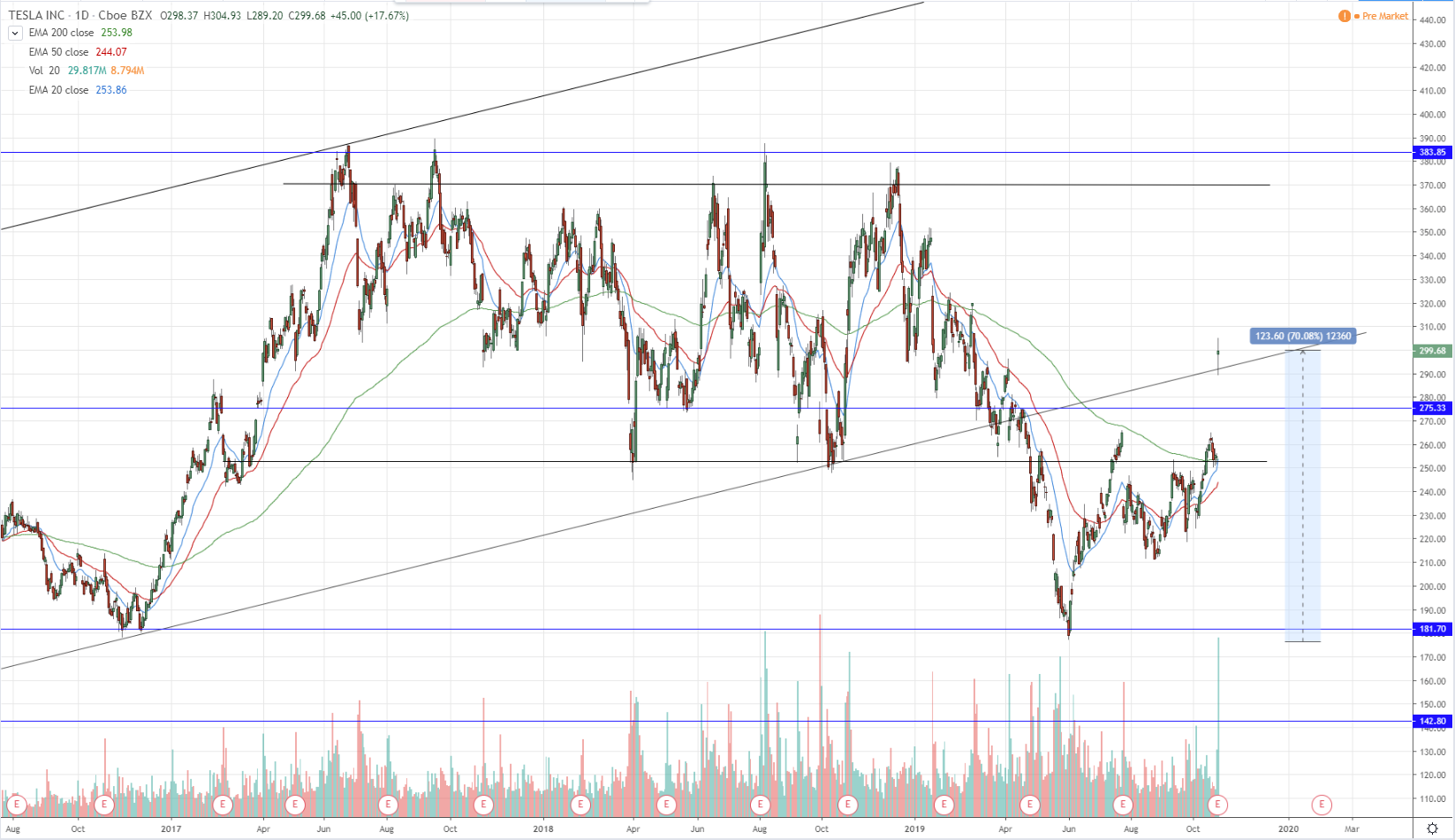
Looking at the chart of Tesla, we can see that it traded between the range of $250-$390 for almost 2 years (mid 2017 to mid 2019), before breaking to test a major support level at $180.

From there, it has made a strong recovery, with a whooping 70% gain from its June 2019 bottom.

Now, prices are close to $300, and it looks poised to test the highs of $390 again.

I will continue to hold and look for opportunities to accumulate more again.

0 Comments/by Spencer Li
https://synapsetrading.com/wp-content/uploads/2010/09/usdjpy-092210.png 308 400 Spencer Li https://synapsetrading.com/wp-content/uploads/2019/10/logo.jpg Spencer Li2019-10-25 18:59:352022-03-07 16:11:18Tesla Shares Spike 21% on Earnings Surprise
Spencer Li

Guest Speaker at the SMART Expo 2017 – How to Build a Solid Investment Portfolio

News & Events
SMART Expo Mar 2017 40

Yesterday, I got invited as a guest speaker at the SMART Expo to share about my investment portfolio and trading strategies.

Check out our event photos below:

Thanks for the invitation, and a big thanks to all those who came down to support! 😀

0 Comments/by Spencer Li
https://synapsetrading.com/wp-content/uploads/2017/03/SMART-Expo-Mar-2017-40.jpg 2448 3264 Spencer Li https://synapsetrading.com/wp-content/uploads/2019/10/logo.jpg Spencer Li2017-03-26 19:24:232018-09-05 02:49:06Guest Speaker at the SMART Expo 2017 – How to Build a Solid Investment Portfolio
Page 1 of 212

Free Trading Guides

Free Trading Guides

Blog Categories

  • Beginner's Guide
  • Blockchain & Crypto
  • Book Summaries
  • Economics & News Trading
  • Investing & Portfolio Management
  • Living Your Best Life
  • Market Analysis
  • Markets & Products
  • News & Events
  • Promotions
  • Risk & Money Management
  • Stock Trading
  • Technical Analysis & Price Action
  • Testimonials
  • Tools & Resources
  • Trading Psychology
  • Trading Strategies
  • Trading Tips
  • Travel & Lifestyle

Free Trading Guides

Free Trading Guides

Contact Us

Synapse Trading Pte Ltd
Registration No. 201316168H

Whatsapp: +65-8897-1204
Telegram: @iamrecneps
Email: info@synapsetrading.com

Links

Disclaimer
Privacy policy
Terms & Conditions
Contact us
Partnerships

© 2012-2024 Synapse Trading | All rights reserved | - powered by Enfold WordPress Theme
  • Link to Facebook
  • Link to X
  • Link to Instagram
  • Link to Youtube
  • Link to LinkedIn
  • Link to Mail
Scroll to top Scroll to top Scroll to top