
• Link to Facebook
  • Link to X
  • Link to Instagram
  • Link to Youtube
  • Link to LinkedIn
  • Link to Mail
Free PDF: The 15-Minute Swing Trader's Checklist, the daily routine of a trader since 2007
  • Shopping Cart Shopping Cart
    0Shopping Cart
Synapse Trading
  • Mentoring
    • Trading Mastery Program
    • All mentoring options
  • Signals
    • Daily trading signals
    • Signals trade log
  • Results
    • Student results and testimonials
    • Public trade log, losses left in
  • Free guides
    • Start here
    • Trading foundations
    • Technical analysis
    • Strategies and systems
    • Risk and money
    • Trading psychology
    • Markets and products
    • Free trading guides
    • Tools and resources
    • Blog
  • About
    • My background
    • My trading journey
    • Media and interviews
    • Travel log
  • Contact
    • Contact me
    • Partnerships
  • Start free
  • Student login
  • Click to open the search input field Click to open the search input field Search
  • Menu Menu

Tag Archive for: inflation

Spencer Li

How to Profit from Inflation? (With 33 Types of Asset Investments)

Markets & Products
How to profit from inflation - investing

How to Profit from Inflation: The Best Assets to Protect Your Money

Last updated: 9 September 2026 · By Spencer Li, CFTe


To profit from inflation, you hold assets whose value or income rises alongside prices, instead of holding cash that quietly loses purchasing power. The most reliable inflation hedges fall into three buckets: real assets (real estate, commodities, gold, agricultural land, infrastructure), inflation-linked bonds (TIPS and floating-rate notes, whose payouts move with rates), and equities with pricing power (companies that can pass higher costs on to customers, plus REITs, resource and infrastructure stocks). No single asset is a guaranteed win, and many of these only preserve your purchasing power rather than grow it. The honest goal here is defence first: stop inflation from eroding what you have, then look for the assets that genuinely benefit when prices rise.

Here is what inflation actually is, why it hits some people harder than others, and the full menu of assets people use to hedge it.
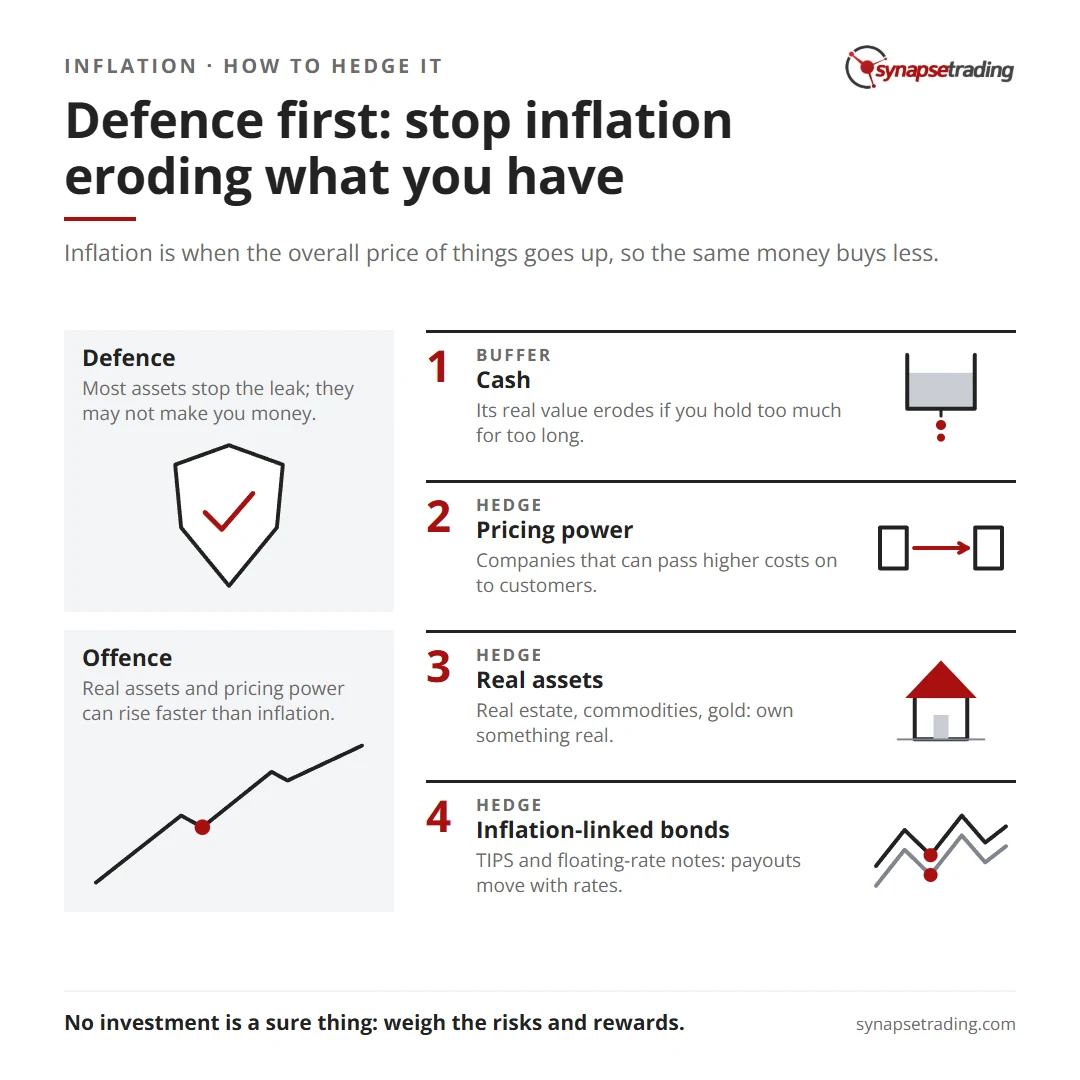
Defence first: stop inflation eroding what you have. Summary card for the post: How to Profit from Inflation? (With 33 Types of Asset Investments).

What is inflation?

Inflation is when the overall price of things goes up over time, so the same amount of money buys less. If a basket of groceries that cost you $100 last year costs $107 this year, that is inflation, and your $100 note is now worth less in real terms.

A few things can drive it: more demand chasing the same goods, higher production costs, or simply more money in the system. It can also show up when supply shrinks, for example during a war or a supply shock.

We measure it with the consumer price index (CPI, a tracked basket of things households typically buy). The percentage change in that basket over a period is the inflation rate. The Federal Reserve (the central bank in the US) leans on that rate when setting monetary policy.

Economists usually split inflation into three types:

  • Demand-pull (more demand than supply can meet)
  • Cost-push (rising production costs get passed on)
  • Structural (deeper problems in the economy, like poor resource use or chronic shortages)

Is inflation good or bad for the economy?

It is genuinely both, which is why it is so often misunderstood.

On the upside, mild inflation can nudge growth. If people expect prices to rise, they spend and invest sooner rather than later. It also quietly shrinks the real burden of debt, because the dollars you repay later are worth less than the ones you borrowed.

On the downside, inflation breeds uncertainty. When prices are hard to predict, people hesitate to make long-term plans, and that hesitation is its own drag on the economy. It also lands unevenly. People on low or fixed incomes feel it most, because their income does not stretch to cover the rising cost of living.

To keep prices stable, central banks use monetary policy, which means controlling the supply of money and credit. The Federal Reserve has three main levers: interest rates, reserve requirements, and open market operations.

How to profit from inflation: the asset menu

There is no single “inflation trade.” What works is owning the right mix of assets that either hold their value, pay income that keeps up with rising prices, or directly benefit when the cost of living climbs.

I have grouped the full menu below into four buckets so you can see the logic instead of staring at a flat list. Read the “Why it hedges” column carefully, because the reasoning is what tells you whether an asset fits your situation.

AssetBucketWhy it hedges inflation
CashDefensivePreserves purchasing power short term, but its real value erodes if you hold too much for too long. Reassess the amount you hold.
High-yield savings accountsDefensivePay more interest than a standard savings account. Rarely fully offset inflation, but soften the erosion.
Fixed deposits (term deposits)DefensiveFixed term, fixed rate, low risk. A parking spot.
Stocks (general)Equities with pricing powerVolatile short term, but have historically performed well over the long run. Companies can pass higher costs to customers.
Small cap stocksEquities with pricing powerSmaller companies are more sensitive to the economy and can outperform large caps in inflationary periods.
Emerging market stocksEquities with pricing powerMarkets like China and India may be less affected by rising domestic costs at home.
High dividend-yielding stocksEquities with pricing powerA steady income stream that helps offset the hit to purchasing power.
Infrastructure stocksEquities with pricing powerUtilities and transport firms can pass higher costs through to consumers.
Natural resource stocksEquities with pricing powerOil, gas, and mining firms benefit when commodity prices rise and demand stays steady.
International stocksEquities with pricing powerForeign firms may dodge domestic cost pressure. Mind currency risk and political risk.
Preferred stocksEquities with pricing powerFixed dividend, priority over common stock in a wind-up. Steadier income, less inflation-sensitive than common stock.
Real estateReal assetsProperty values tend to rise over time, and as living costs climb, so can the asset.
Agricultural landReal assetsLand values tend to rise, and food demand stays stable even in hard times.
TimberlandReal assetsSteady demand for wood products, and the land itself can appreciate.
Commodities (gold, oil, agriculture)Real assetsPrices tend to rise directly with the cost of living. A classic hedge.
Infrastructure bondsInflation-linked / incomeFund roads, bridges, airports. Steady income, and the underlying assets can appreciate.
Floating rate bonds / notes (FRNs)Inflation-linked / incomePay a variable rate tied to a benchmark, so income rises as market rates rise.
Treasury Inflation-Protected Securities (TIPS)Inflation-linked / incomeUS government bonds engineered to return above the inflation rate.
Inflation-linked bonds (linkers)Inflation-linked / incomeReturns are tied directly to the inflation rate. Issued by governments or corporates.
Corporate bondsInflation-linked / incomeSteady income, but check the issuer’s creditworthiness. Value can still be dented by inflation.
Municipal bondsInflation-linked / incomeOften tax-free income from state and local government projects. Check the issuer’s credit.
Index funds (general)FundsTrack an index like the S&P 500. Diversified, good for long-term holders.
Real asset fundsFundsHold physical assets (property, commodities, infrastructure) that can appreciate with inflation.
Balanced fundsFundsA mix of stocks, bonds, and other assets for diversification and steadier results.
Infrastructure fundsFundsHold utilities, transport, and infrastructure bonds. Steady income plus appreciation potential.
Commodity fundsFundsHold a basket of commodities, so they ride rising commodity prices.
Real estate investment trusts (REITs)FundsOwn and operate property. Steady income, and real estate tends to appreciate.
Floating rate loan fundsFundsHold variable-rate loans, so income rises with rates and inflation bites less.
Municipal bond fundsFundsA basket of munis. Often tax-free income, less inflation-sensitive than other bonds.
Collectible assets (art, antiques, rare coins)AlternativesCan appreciate, especially in inflationary times. Hard to value and price; expect big swings.
Alternative investments (hedge funds, private equity)AlternativesPotential for higher returns and lower inflation sensitivity. Illiquid and riskier; not for everyone.
Cryptocurrencies (e.g. Bitcoin)AlternativesSome see them as a hedge because they are not tied to fiat currency. Highly volatile.
Master limited partnerships (MLPs)AlternativesOwn energy assets like pipelines. Steady income, and energy demand stays stable.

The pattern under all of this is simple. The assets that hedge inflation best are the ones that either own something real, lend at a rate that floats up with inflation, or sell something whose price they can raise. The assets that lose to inflation are the ones with a fixed payout and nothing real behind them.
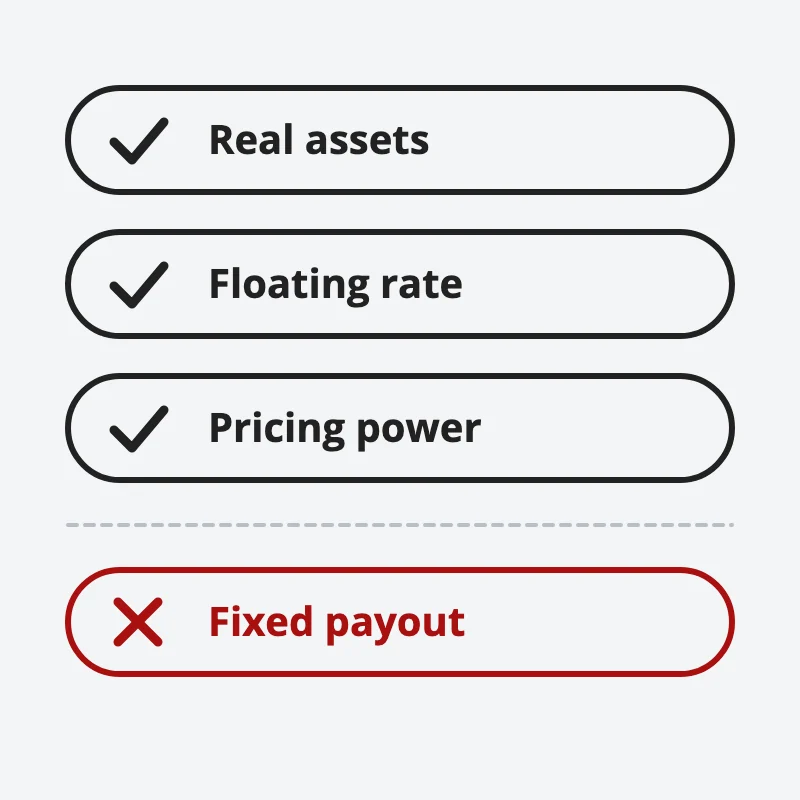
Three ticked rows, real assets, floating rate and pricing power, above one red crossed-out row, fixed payout
Assets that own something real, float with rates or can raise prices hedge inflation best.

Defence versus offence: an honest distinction

Here is the part most “profit from inflation” articles skip.

Most of the assets above defend your purchasing power. They stop the leak. They do not necessarily make you money. Holding cash in a high-yield account or buying TIPS is defence: you are trying not to fall behind.

A smaller set can actually outperform. Real assets and equities with genuine pricing power can rise faster than inflation, not just keep pace with it. That is offence.

Do note that, the two are different jobs, and you size them differently. Mixing them up is how people convince themselves a savings account is an “inflation strategy” when it is really just a slower way to lose.

Where the human edge comes in

A screener will hand you a list of “inflation hedges” in a second. That part is now free. What it will not do is tell you how much cash you can stand to hold without bleeding real value, which of these assets actually fits your time horizon and risk tolerance, or when an inflation theme is already priced in and the crowd is late. The list is the easy part. Judgment, sizing each position for the volatility it carries, and knowing which hedge the moment actually calls for is the work. That is the first of the Five Edges that no tool can trade for you.

Concluding thoughts

Inflation cuts both ways for an economy, and it quietly cuts into your personal finances whether you act or not.

Once you understand the menu, holding the right cash buffer, owning real assets and quality equities, or adding inflation-linked bonds, you can take real steps to protect the purchasing power of your wealth. Just keep two things in mind. Some of these strategies only minimise the damage rather than turn a profit. And no investment is a sure thing, so weigh the risks and rewards before you commit a single dollar.

FAQ

What is the best investment during inflation?
There is no single best one. Over the long run, real assets (real estate, commodities, gold) and equities with pricing power tend to perform well, while inflation-linked bonds like TIPS are built specifically to return above the inflation rate. The right mix depends on your time horizon and risk tolerance.

Is cash a good hedge against inflation?
Cash preserves purchasing power in the very short term and gives you flexibility, but its real value erodes the longer you hold it during inflation. A high-yield savings account softens the erosion, but rarely offsets inflation fully. Treat cash as a buffer.

How do TIPS protect against inflation?
Treasury Inflation-Protected Securities (TIPS) are US government bonds engineered to deliver a return above the rate of inflation, so their payout rises as inflation rises. That makes them one of the few assets designed from the ground up to hold real value when prices climb.

Why does real estate hedge against inflation?
Property values and rents tend to rise over time, often in line with the rising cost of living, so the asset and its income can keep pace with inflation. REITs (real estate investment trusts) give you similar exposure without owning a building directly.

Can stocks beat inflation?
Historically, stocks have outperformed inflation over the long run, because companies can pass higher costs on to customers through higher prices. They are volatile in the short term, so they suit long-term holders rather than anyone who needs the money soon.


Now that you have the full menu, which of these assets are you planning to add to your portfolio? And is there an inflation hedge I have missed? Let me know in the comments.

If you want the bigger picture on building a portfolio that holds up across different market conditions, read the pillar: The Definitive Guide to Investing and Building Wealth.

Want a simple system instead of a 30-item shopping list? Grab the free 15-Minute Swing Trading Starter Kit. It is the exact routine I use to scan once a day and trade any market in 15 minutes.


About the author. Spencer Li is The 15-Minute Trader and the founder of Synapse Trading. He is a Certified Financial Technician (CFTe) with 15+ years of trading, run from 70+ countries. He holds a B.Acc and B.BM from SMU. Every trade he takes is public, dated, losses left in. He teaches rules-based swing trading in 15 minutes a day, one system for any market.

Education, not financial advice. Synapse Trading is not licensed by MAS to advise on investment products. Trading carries risk of loss; past performance is not indicative of future results.


Related

The DIY Guide to Building Your Investment Portfolio · The 5 Major Types of REITs to Have in Your Portfolio · How to Split Stocks and Bonds · Should You Own Gold? What It Does in a Portfolio, and How to Hold It From Singapore

by Spencer Li
https://synapsetrading.com/wp-content/uploads/2026/10/invest-profit-inflation-card.webp 630 1200 Spencer Li https://synapsetrading.com/wp-content/uploads/2026/10/synapse-logo-horizontal-light.png Spencer Li2022-12-20 22:46:542026-10-26 16:56:16How to Profit from Inflation? (With 33 Types of Asset Investments)
Spencer Li

Why 14% of Young Singaporeans Expect Never to Retire, and What Has Changed Since 2016

Singapore Money & Lifestyle
Young Singaporeans doubt retirement - personal finance

By Spencer Li, CFTe · Last updated: 26 October 2026

In 2016, 14% of young working Singaporeans told a ManpowerGroup survey that they expected to work until the day they die. Bloomberg reported it in May that year, and the figure put Singapore in a three-way tie for 4th among the countries shown, behind Japan, China and Greece. My guess at the time was a mix of inflation, spending habits and the cost of living. Ten years on, prices in Singapore are up about 19%, and CPF LIFE now puts a floor under retirement of roughly $950 to $3,440 a month from age 65, depending on how much you set aside at 55.

That is a long way from “never”, but it is also not the whole answer, so let me go through what the survey actually said and what has changed since.

What did the survey actually find?

I first saw the story at the gym in May 2016. My trainer was taking a break, I was scrolling the news, and a Bloomberg headline about millennials working themselves to death caught my eye. I wrote it up the next day.

The study behind it was a report called “Millennial Careers: 2020 Vision” from ManpowerGroup, the workforce company. A research firm called Reputation Leaders ran the fieldwork between February and April 2016, surveying 19,000 working millennials across 25 countries, all born between 1982 and 1996 and aged 20 to 34 at the time.

Across the whole survey, 12% said they would likely work until the day they die, and 27% expected to work past 70.

CountryExpect to work until they die
Japan37%
China18%
Greece15%
Canada14%
India14%
Singapore14%
United Kingdom12%
United States12%
Spain3%

In my original post I wrote that “Singapore ranks 4th in world!” That was fair, though it is more accurate to say Singapore tied for 4th with Canada and India. The other thing worth knowing is who was asked. The report says the 19,000 included an independent sample of 11,000 working millennials, plus more than 8,000 of ManpowerGroup’s own millennial staff, so it is a big survey with a slightly unusual mix.

Why did so many young Singaporeans say never?

Back in 2016 I put it down to three things: “a combination of inflation, spending habits, and cost of living.” Of the three, inflation is the easiest to underestimate, because you never see it happen on a single day.

Singapore’s Department of Statistics keeps a consumer price index going back decades. On its current series, the all-items index stood at 84.6 in 2016 and 100.9 in 2025, a rise of about 19% over nine years.

Now put that into your own money. Say you kept $1,000 in cash in 2016 and never touched it.

By 2025, that same $1,000 bought only about $838 worth of the same things.

Nothing was stolen. The balance never moved, which is exactly why it is so easy to miss. A millennial who was 25 in 2016 and saving hard into a near-zero account was quietly falling behind, and some of the “never” in that survey may well have been people doing this sum in their heads. I wrote more about how different assets behave when prices rise in my post on inflation hedges.

Spending habits and the cost of living are harder to pin to one number, and they look very different from one household to the next. What they share with inflation is that they eat the gap between what comes in and what stays.

What does CPF actually pay you in retirement?

Here is the odd thing about the word “never” in Singapore. For most working Singaporeans, CPF is already building a retirement income in the background, whether they think about it or not.

CPF LIFE turns the savings in your Retirement Account into a monthly payout for life, starting from age 65. According to the CPF Board’s page, last updated on 21 September 2026, someone turning 55 in 2026 can expect roughly the following.

Set aside at 55 (2026)Estimated monthly payout from 65
Basic Retirement Sum, $110,200about $950
Full Retirement Sum, $220,400about $1,780
Enhanced Retirement Sum, $440,800about $3,440

Do note that these are CPF’s own estimates for a male member on the CPF LIFE Standard Plan, and your figure depends on your plan and your savings. The point is that the floor is real, and it lasts as long as you do. For many people the honest answer to “will I ever retire?” is probably “yes, but on less than I would like”, which is a very different problem from “never”, and one you can work on.

In October 2026, a trader on Reddit’s r/singaporefi asked a question that cuts straight through all of this: “retirement if I may never earn more than 2.8k per month.”

That is a fair challenge, and my 2016 post did not answer it. I listed spending habits as one of the causes, and for someone earning $2,800 a month that framing was too easy. At that income the gap between what comes in and what goes out is thin, and no budgeting trick turns a thin gap into a thick one. What still helps is that CPF keeps contributing alongside your pay, that a small gap invested early has more years to grow, and that skills which raise your income over time widen the gap from the other side. If you want to see how the monthly sums stack up, I worked through them in how much you need to save each month to reach $1M.

If you want a short routine to go with the long-term plan, the free 15-minute swing trader checklist is the one I use myself.

Why is it so hard to save for your future self?

In 1971 the philosopher Derek Parfit wrote about personal identity over time, and about the idea that we may not fully identify with the people we will become. It sounds like a seminar room idea, but it turns out to have a price tag.

In 2011, a team led by the psychologist Hal Hershfield published four studies in the Journal of Marketing Research. One of the co-authors was William Sharpe, the Sharpe of the Sharpe ratio. They let people meet realistic, age-progressed computer images of their own faces, some of them in virtual reality, and then gave them choices between money now and money later. In every study, the people who had met their older selves leaned more towards the later reward.

It offers one more way to read that 2016 survey. Some of the 14% may simply have been unable to picture a 65-year-old version of themselves who stops working, so the honest answer felt like “never”. Saving for retirement is, in a sense, a gift to someone you have not met yet, and it is much easier to give when that person feels real.

What can you actually control?

My one-line conclusion in 2016 was that saving and investing, along with financial literacy, were “so important in this time and age.” That still holds up, so here is a little more detail on each part.

  • Saving the gap. You cannot control inflation, and you have limited control over the cost of living. You can decide what happens to the difference between what you earn and what you spend, and move it somewhere safe the day you are paid.
  • Investing the gap. Cash that earns close to nothing loses buying power over the years, as the price index showed. Putting long-term money to work in assets you understand is how you try to stay ahead of it, with the risk of loss that comes with that.
  • Building the literacy. You do not need to become a full-time trader. You need enough understanding to avoid the expensive mistakes, such as products you cannot explain or advice you cannot check. My free trading guides are a good place to start.

It also helps to keep two pots apart, an emergency fund for life and a war chest for opportunities, which I explained in my three practical tips for early financial freedom.

If you want a routine that keeps these habits going without hours at the screen, the free 15-minute swing trader checklist is the one I run every day.

FAQ

What percentage of young Singaporeans expect never to retire?
In ManpowerGroup’s 2016 survey, 14% of working millennials in Singapore said they would likely work until the day they die. The global figure was 12%, and Japan was highest at 37%.

Where did Singapore rank in the ManpowerGroup survey?
Singapore tied for 4th with Canada and India at 14%, behind Japan at 37%, China at 18% and Greece at 15%.

Who counted as a millennial in the survey?
People born between 1982 and 1996, who were 20 to 34 when the survey ran in early 2016. In 2026 that group is 30 to 44.

How much will CPF LIFE pay me in retirement?
For someone turning 55 in 2026, the CPF Board estimates about $950 a month from 65 on the Basic Retirement Sum, $1,780 on the Full Retirement Sum and $3,440 on the Enhanced Retirement Sum. These are estimates for a male member on the Standard Plan.

How much has inflation reduced the value of cash since 2016?
Singapore’s consumer price index rose about 19% from 2016 to 2025, so $1,000 held as cash in 2016 bought roughly $838 worth of goods in 2025.

Is it possible to retire in Singapore on a normal income?
For most people, CPF LIFE provides a base income for life from 65. Retiring on more than that depends on the gap between what you earn and spend, and on how early that gap starts working for you.


So, would you have answered “never” in 2016, and would you answer it the same way today? Let me know in the comments.

If you want a closer look at why retirement keeps slipping for many Singaporeans, I covered it in 5 reasons you may never retire despite working harder.

And if you want a daily routine that fits around a full-time job, grab the free 15-minute swing trader checklist.


About the author. Spencer Li is The 15-Minute Trader and the founder of Synapse Trading. He is a Certified Financial Technician (CFTe) with 15+ years of trading, run from 70+ countries. He holds a B.Acc and B.BM from SMU. Every trade he takes is public, dated, losses left in. He teaches rules-based swing trading in 15 minutes a day, one system for any market.

Education, not financial advice. Synapse Trading is not licensed by MAS to advise on investment products. Trading carries risk of loss, and past performance is not indicative of future results.

by Spencer Li
https://synapsetrading.com/wp-content/uploads/2026/10/bloomberg-report-around-14-singaporean-young-adults-dont-expect-able-ever-retire-one-card.webp 630 1200 Spencer Li https://synapsetrading.com/wp-content/uploads/2026/10/synapse-logo-horizontal-light.png Spencer Li2016-05-27 02:11:582026-10-27 09:56:03Why 14% of Young Singaporeans Expect Never to Retire, and What Has Changed Since 2016

Free checklist

The 15-Minute Swing Trader’s Checklist

The daily and weekly routine I use to find, manage and review trades in about 15 minutes a day, trading since 2007.

Get the free checklist

Topics

  • Trading foundations
  • Technical analysis
  • Strategies and systems
  • Risk and money
  • Trading psychology
  • Markets and products

Synapse Trading

Swing trading for busy professionals, in 15 minutes a day.

Start free

Learn

  • Start here
  • Free trading guides
  • Blog
  • Tools and resources

Programs

  • Trading Mastery Program
  • Daily trading signals
  • Student results
  • Public trade log

Company

  • About
  • Contact me
  • Partnerships
  • Disclaimer
  • Privacy policy
  • Terms & Conditions

Synapse Trading Pte Ltd
Registration No. 201316168H
WhatsApp +65-8897-1204
info@synapsetrading.com

Contact Us

Synapse Trading Pte Ltd
Registration No. 201316168H

Whatsapp: +65-8897-1204
Telegram: @iamrecneps
Email: info@synapsetrading.com

Links

Disclaimer
Privacy policy
Terms & Conditions
Contact us
Partnerships

© 2012-2026 Synapse Trading | All rights reserved. Educational content only, not personalised financial advice. Trading carries risk, including loss of capital. Past performance is not indicative of future results. Synapse Trading is not licensed or regulated by MAS.
  • Link to Facebook
  • Link to X
  • Link to Instagram
  • Link to Youtube
  • Link to LinkedIn
  • Link to Mail
Scroll to top Scroll to top Scroll to top
Manage Consent
To provide the best experiences, we use technologies like cookies to store and/or access device information. Consenting to these technologies will allow us to process data such as browsing behavior or unique IDs on this site. Not consenting or withdrawing consent, may adversely affect certain features and functions.
Functional Always active
The technical storage or access is strictly necessary for the legitimate purpose of enabling the use of a specific service explicitly requested by the subscriber or user, or for the sole purpose of carrying out the transmission of a communication over an electronic communications network.
Preferences
The technical storage or access is necessary for the legitimate purpose of storing preferences that are not requested by the subscriber or user.
Statistics
The technical storage or access that is used exclusively for statistical purposes. The technical storage or access that is used exclusively for anonymous statistical purposes. Without a subpoena, voluntary compliance on the part of your Internet Service Provider, or additional records from a third party, information stored or retrieved for this purpose alone cannot usually be used to identify you.
Marketing
The technical storage or access is required to create user profiles to send advertising, or to track the user on a website or across several websites for similar marketing purposes.
  • Manage options
  • Manage services
  • Manage {vendor_count} vendors
  • Read more about these purposes
View preferences
  • {title}
  • {title}
  • {title}