

The 5 Major Types of REITs to Have in Your Portfolio
Join our Telegram channel for more market analysis & trading tips: t.me/synapsetrading
Table of Contents
The 5 Major Types of REITs to Have in Your Portfolio (Singapore Guide)
Last updated: 3 July 2026 · By Spencer Li, CFTe
The 5 major types of REITs (Real Estate Investment Trusts, listed property companies that pay out most of their rental income as dividends) in Singapore are Retail, Office, Hospitality, Industrial, and Health Care. Each one behaves differently. Retail and Health Care REITs are the steadiest and best suited to the core of an income portfolio. Office, Hospitality, and Industrial REITs are more cyclical, so they swing harder with the economy and deserve a higher target yield before you buy. A balanced REIT portfolio holds a mix across these five, pairing the stable types for reliable passive income with the cyclical types for capital appreciation when you catch them cheap.
REITs let you own a slice of the Singapore property market without the capital to buy a whole unit. Here is how to evaluate them, and what makes each of the five types tick.
How do you evaluate a REIT before buying?
Before you sort REITs by type, you need a way to judge any single one. I watch four things.
Gearing. This measures financial leverage, how much of the REIT’s operations are funded by lenders versus shareholders. You want low gearing. A heavily geared REIT has less room to survive a downturn or a rate hike.
NAV (net asset value). A quick calculation of what the REIT’s actual assets are worth. You want a high NAV relative to price. Do note that, these numbers can sometimes be misleading, so I do not lean on NAV alone.
Distribution yield. This is my favourite, because it is the most direct measure of your potential returns. Yield rises when price falls, assuming the payout holds. So the best time to buy is when prices are depressed and yields are high.
Payout consistency. A high yield only counts if the REIT keeps paying it. A yield that looks great because the distribution is about to be cut is a trap. Check the track record.
The “target yield shopping list” method
Here is the method I actually use. Keep a shopping list of REITs you would happily own. Set a preset target yield for each one, for example above 8%. Then wait. As prices drop, yields climb. When a REIT on your list hits your target yield, that is your signal to look closer.
The market moves in cycles, so this is mostly a patience game. You are not chasing. You are setting a price, then letting the cycle bring it to you. A scanner can rank every REIT by yield in a second. What it will not do is tell you whether an 8% yield is a gift or a warning that the payout is about to be cut. That judgment is the part worth learning.
The 5 major types of REITs in Singapore
To help you build that shopping list, here are the five major types, from steadiest to most cyclical.
| Type | What it owns | Stability | Driven by | Target yield | Example REITs |
|---|---|---|---|---|---|
| Retail | Shopping centres and malls | Safest | Population growth, tourist numbers | Lower | CapitaMall, Suntec, FCT, SPH, Starhill Global |
| Health Care | Hospitals, medical assets | Most stable | Long leases, new acquisitions | Lower | First REIT, Parkway REIT, Religare (India) |
| Office | Office buildings | Cyclical | The broader economy | Higher | CapitaComm, K-REIT, MCT, Soilbuild |
| Hospitality | Hotels, serviced residences | Cyclical | Tourism, the economy | Higher | CDL Hospitality, Ascott, Far East, OUE |
| Industrial | Factories, warehouses, business parks | Cyclical | The economy, with capped rents | Higher | Ascendas, MLT, MIT, Cache, AIMS AMP, Sabana |
1. Retail REITs
Retail REITs own shopping centres and malls. These are the safest type, and the easiest to research. You can literally take a trip to the mall and see how it is faring with your own eyes.
Supply is tight, because malls need a lot of land, and land in Singapore is indirectly controlled by the government. These REITs track population growth and tourist numbers closely.
Some examples include: CapitaMall, Suntec, LippoMalls Indon, CapitaRetail China, FCT, SPH, Croesus (Japan), Fortune (HK), Perennial (China), Starhill Global.
2. Office REITs
In land-scarce Singapore, office space is limited and supply is controlled by the government. That makes the sector cyclical, with the occasional over-supply.
Offices are commodity-like in nature. They do not have unique features that set one apart from another, so companies can easily switch buildings if rents climb too much. These REITs are correlated to the economy and can be volatile. Hence, I set a higher target yield before buying them.
Some examples include: CapitaComm, K-REIT, FCoT, Forterra (China), MGCT, MCT, Soilbuild.
3. Hospitality REITs
Hospitality REITs hold hotels and serviced residences. They are very dependent on tourism and the general economy. If you want exposure to the tourism market, this is a useful vehicle.
These REITs are cyclical too, so a higher target yield is recommended here as well.
Some examples include: CDL Hospitality, Ascott Hospitality, Far East Hospitality, OUE Hospitality, Saizen (Japan).
4. Industrial REITs
Industrial REITs are the most varied. The category covers light industrial, factory space, warehouse distribution centres, business parks, and more.
Their leases are typically short, between 30 and 60 years, so there is limited capital appreciation on the assets. That means the bulk of your return has to come from yield. On the plus side, it also means they do not need heavy Capex or asset-maintenance spending.
Because they fluctuate with the economy but cannot raise rents much, a higher target yield is expected for this kind of REIT.
Some examples include: Ascendas, MLT, MIT, Cache, Cambridge, AIMS AMP, Sabana REIT.
5. Health Care REITs
Health Care REITs are the most stable of all. They do not usually offer much capital appreciation, but they make up for it with high, dependable yields.
The rent they collect is steady, because hospitals typically sign very long leases. Their growth comes mostly from acquiring new properties, rather than from rising rental income. In a way, a Health Care REIT behaves like a long-term bond with some inflation protection.
Some examples include: First REIT, Parkway REIT, Religare Health Trust (India).
How should you mix the 5 types in a portfolio?
The point of knowing all five types is the mix. Pair the stable types (Retail, Health Care) for reliable passive income, and add the cyclical types (Office, Hospitality, Industrial) for capital appreciation when the cycle hands them to you cheap.
The two jobs are different. Stable REITs are what you hold through the cycle. Cyclical REITs are what you buy on the dip, which is exactly why a higher target yield matters there. Build the shopping list across all five, set a target yield for each, and let patience do the rest.
FAQ
What are the 5 types of REITs in Singapore?
The five major types are Retail (malls), Office, Hospitality (hotels and serviced residences), Industrial (factories, warehouses, business parks), and Health Care (hospitals). Retail and Health Care are the most stable; Office, Hospitality, and Industrial are more cyclical.
Which type of REIT is the safest?
Health Care REITs are generally the most stable, because hospitals sign very long leases and the rental income is steady. Retail REITs are the next safest, since mall supply is tight and demand tracks population and tourism.
What should I look for when buying a REIT?
Watch four things: low gearing (leverage), a high NAV relative to price, a high distribution yield, and a consistent payout history. A high yield only counts if the REIT can keep paying it.
What is a good distribution yield for a REIT?
There is no single right number, it depends on the type. Because cyclical REITs (Office, Hospitality, Industrial) carry more risk, many investors set a higher target yield for them, for example above 8%, before buying. Stable REITs can justify a lower target yield.
When is the best time to buy a REIT?
When prices are depressed and yields are high, assuming the payout holds. The practical method is to keep a shopping list with a preset target yield for each REIT, then wait for the cycle to push prices down to your level.
Now that you have the five types and the four metrics, the next step is building your own shopping list and setting a target yield for each name. Which types are you weighting toward, income or appreciation? Let me know in the comments.
And if you want the full framework for sizing positions and building an income portfolio, read the pillar: Portfolio Strategies: How to Build an Investment Portfolio.
Want a simple system to put this into practice? Grab the free 15-Minute Swing Trading Starter Kit. It is the exact routine I use to scan once a day and trade any market in 15 minutes.
About the author. Spencer Li is the founder of Synapse Trading and a Certified Financial Technician (CFTe) with 15+ years of trading across stocks, forex, crypto, commodities, and bonds. His trade log is public: every trade since April 2024, dated, losses left in. He has taught a 15-minute daily trading routine since 2014, one system for any market.
Education, not financial advice. Synapse Trading is not licensed by MAS to advise on investment products. Trading carries risk of loss; past performance is not indicative of future results.
Related
Portfolio Strategies (pillar) · How to invest in dividend stocks for passive income · Distribution yield vs total return: what actually matters
Want our free trading resources by email? Leave your address below.
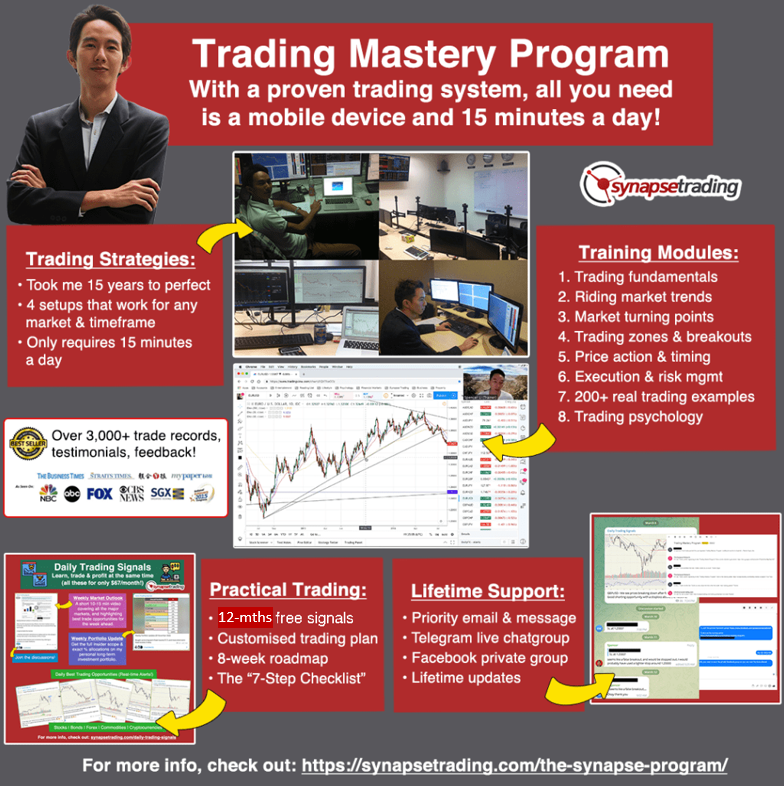 Our flagship mentoring program is suitable for both beginners and advanced traders, covering the 4 strategies which I used over the past 15 years to build up my 7-figure personal trading portfolio.
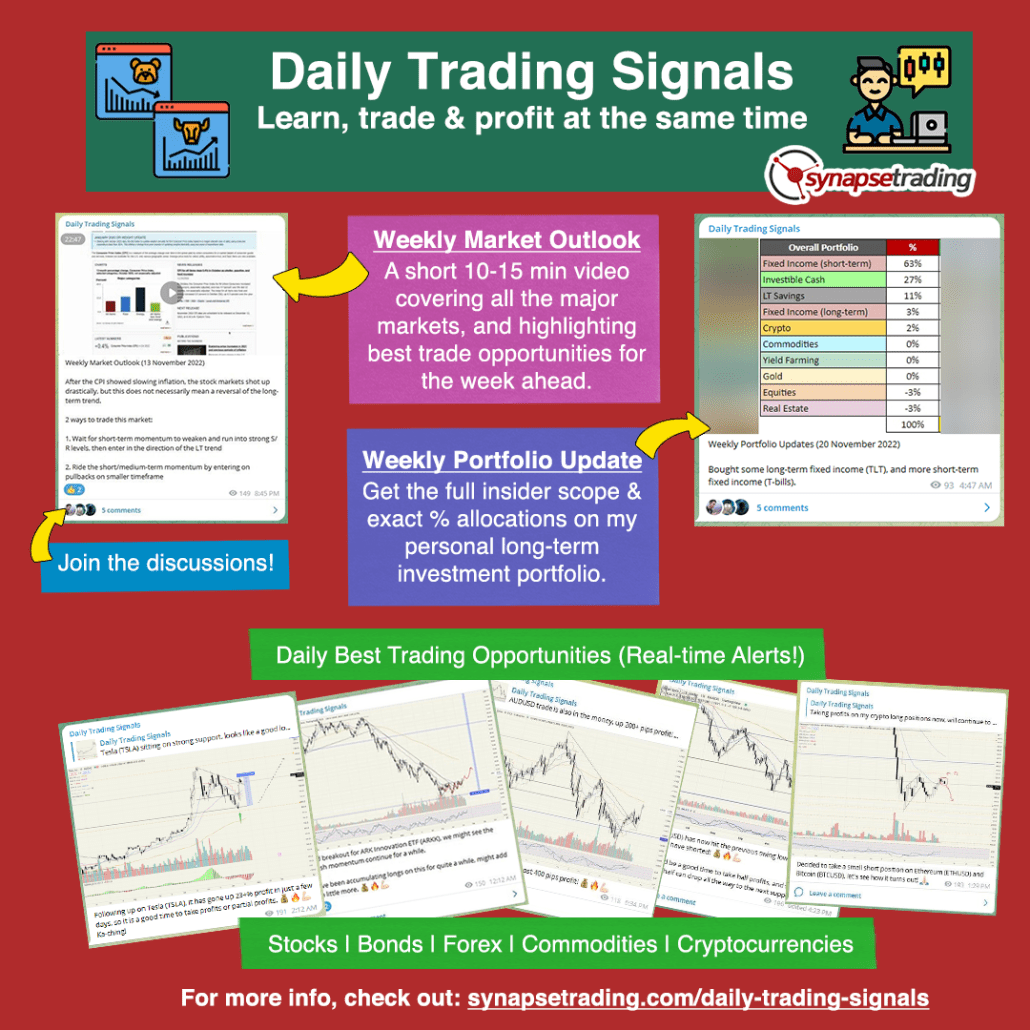 If you're looking for the best trading opportunities every day across various markets, and don't want to spend hours doing the research yourself, check out our private Telegram channel!




Leave a Reply
Want to join the discussion?Feel free to contribute!