

Hedged vs Unhedged: Should a Singapore Investor Hedge Currency Risk?
Want the daily routine? Get the free 15-Minute Swing Trader’s Checklist. Get it free →
What a currency hedge costs, what the 2020 and 2022 sell-offs showed, and a simple 3-step way to decide
Published: 17 October 2026 · Last updated: 17 October 2026 · By Spencer Li, CFTe
From January to October 2022, the S&P 500 fell 25.4% in US dollars. For a Singapore investor holding the same stocks, the fall was 20.9%, because the US dollar rose about 6% against the Singapore dollar on the way down.
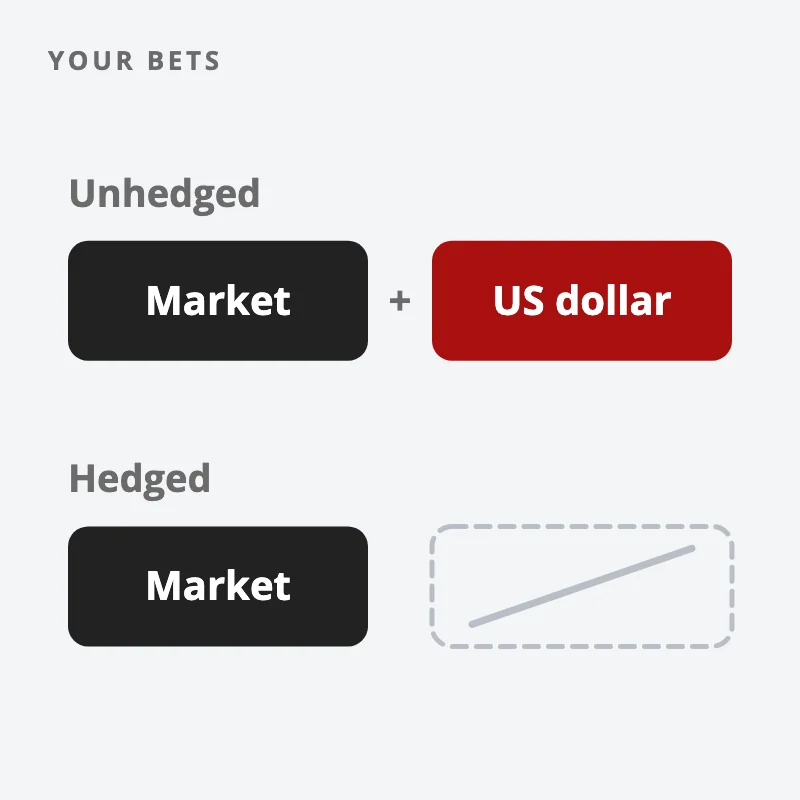
That is currency risk at work. If you live in Singapore and own US funds, you hold 2 bets at once: the market and the US dollar. A currency hedge removes the second bet, so the fund tracks the market as if it were priced in Singapore dollars.
Should you hedge? For most long-term stock investors in Singapore, the evidence leans towards leaving stocks unhedged, because the US dollar rose in the 2020 and 2022 sell-offs and cushioned the fall. Bonds and money you will need soon are a different case. The rest of this post shows why, what hedging costs, and a simple 3-step check.
What is currency hedging, in plain terms?
A currency hedge locks in today’s exchange rate for money you will convert later.
Say you hold USD 10,000 of US stocks. If the US dollar falls 6% against the Singapore dollar, your holding is worth about 6% less in Singapore dollars, even if the stocks did not move. A hedge offsets that. You agree now to sell your US dollars at a fixed rate in the future, so a falling dollar no longer hurts you, and a rising dollar no longer helps.
Some funds do this for you. These are “currency-hedged” share classes, usually marked “SGD Hedged” in the fund name. The fund holds the same stocks and runs the hedge inside, renewing it every month or so. An unhedged fund does nothing about the currency, so you get the market return plus or minus the exchange rate.
A reader on a Singapore investing forum put the problem simply: “USD lost 6% against SGD in the last year.” His US funds had done well in US dollars, but his portfolio, counted in Singapore dollars, had done noticeably worse.
What does currency hedging cost?
The main cost is not a fee. It is the gap between the 2 countries’ interest rates.
The Bank for International Settlements calls the rule behind this “the closest thing to a physical law in international finance.” It “holds that the interest rate differential between two currencies in the cash money markets should equal the differential between the forward and spot exchange rates.”
In plain terms, the exchange rate you can lock in for the future is set by the interest-rate gap. Here is a hypothetical example. If US dollar rates are 4% a year and Singapore dollar rates are 2%, a Singapore investor hedging US assets gives up roughly the 2% gap every year. If US rates were lower than Singapore rates, the hedge would instead earn roughly the gap.
So check the 2 rates on the day you decide, because they change. Then add the small extras:
- The fund’s fee. A hedged share class often charges a little more than the unhedged one.
- Trading costs inside the fund. The hedge is rolled over again and again.
- The basis. The BIS paper notes that since the 2008 crisis the law “has failed to hold” exactly, so real hedges cost a little more or less than the textbook figure.
If you want a simple routine for checking a trade before you place it, our free 15-Minute Swing Trader’s Checklist covers it. Get the free checklist →
What happened to unhedged investors in 2020 and 2022?
The 2020 and 2022 sell-offs tell the same story. In both, the US dollar rose against the Singapore dollar, which softened the fall for an unhedged Singapore investor.
| US sell-off | S&P 500 fall in USD | Same fall in SGD | USD/SGD move |
| Feb to Mar 2020 | -33.9% | -30.8% | +4.7% |
| Jan to Oct 2022 | -25.4% | -20.9% | +6.1% |
Price index only, closing values. Sources: FRED series SP500 (S&P 500) and DEXSIUS (Federal Reserve USD/SGD), read 17 October 2026. Peak and trough: 19 Feb to 23 Mar 2020, and 3 Jan to 12 Oct 2022.
The reason is that investors around the world tend to buy US dollars when they are scared. A hedge would have removed that cushion, right when it helped most.
But the cushion does not last. It reverses as fear fades. In 2022, the US dollar gave back its whole gain within weeks: USD/SGD went from 1.4356 on 12 October to 1.3404 on 30 December.
So the honest summary is a cushion at the bottom and a drag on the way back up. Staying unhedged does not remove the currency risk. It moves the pain from the crash to the recovery.
There is also a Singapore-specific reason the currency has been steady. The Monetary Authority of Singapore runs policy differently from most central banks. In its own words, “Monetary policy in Singapore is centred on managing the trade-weighted exchange rate with the objective to ensure price stability over the medium term.” The Singapore dollar is managed against a basket of its trading partners’ currencies, which tends to keep it from swinging wildly.
When does hedging make more sense?
There are 3 common cases where the argument for hedging gets stronger.
Bonds. A bond fund might return a few percent a year. A single year’s currency move of 6%, like the one the forum reader saw, can wipe that out. Bonds are there for stability, so it can make sense to hedge the bond part of a portfolio and leave the stock part unhedged.
Money you need soon. If you will spend the money in Singapore within a year or two, a currency swing has no time to even out. Holding it in Singapore dollars, or hedging it, removes a risk you did not choose.
A currency you do not want to bet on. Another reader on the same forum wanted a global fund “without the FX risk.” That is a fair aim. A hedged share class does it, at the cost of the rate gap.
To be fair to the hedgers, the dollar has not always helped. In the 12 months to September 2024 that the first reader described, an unhedged Singapore investor lost about 6% to the currency, by his count. A hedge would have saved most of that. The trouble is that nobody knows in advance which kind of year is coming, and the crash years are the ones that hurt most.
Ray Dalio makes the wider point in Principles for Dealing with the Changing World Order: “Most people don’t pay enough attention to their currency risks.” Our post on how to hedge a portfolio against a market crash covers the other tools, and what each one costs.
A 3-step check before you choose
Here is a simple way to decide, holding by holding:
- The spending currency. Which currency will you spend this money in? If the answer is Singapore dollars and the holding is in US dollars, you have a currency bet. Write it down as chosen or accidental.
- The time span. How long until you need it? Within 2 years, lean towards hedging or holding Singapore dollars. Over 10 years or more, currency swings matter less than the market itself.
- The rate gap. What is the interest-rate gap today? That is roughly what a hedge costs, or earns, each year. Compare it with the fee difference between the hedged and unhedged versions of the fund.
Our guide on how to choose an index ETF puts currency alongside the other 6 checks for a fund. If you park spare US dollars in cash, the post on buying US T-bills shows one way to earn the US dollar rate while you wait. And once you have chosen, a rebalancing plan keeps the currency mix from drifting.
Often the bigger risk is not choosing at all. It is easy to end up holding US dollars simply because a broker or fund is priced that way, without ever deciding to. That kind of bet tends to surprise people at the worst time.
So, which currency will you actually spend this money in? And if the US dollar fell 10% against the Singapore dollar next year, would that change your plans? For more on building a portfolio around questions like these, see the guide to building an investment portfolio.
FAQ
What is currency hedging?
It is a way to remove the effect of exchange-rate changes on an investment held in a foreign currency, usually by agreeing today on the rate at which you will convert later.
Should I buy a hedged or unhedged ETF?
It depends on what you will spend the money in and when. For long-term stock holdings, the 2020 and 2022 US sell-offs favoured unhedged for a Singapore investor, because the US dollar rose as stocks fell. For bonds and money needed within a year or two, hedging is easier to justify.
Does currency hedging cost money?
Yes, usually. The main cost is roughly the interest-rate gap between the 2 currencies, plus a slightly higher fund fee. If your home currency has the higher interest rate, the hedge can earn the gap instead.
Is the Singapore dollar stable?
It has been less volatile than many currencies, partly because the Monetary Authority of Singapore manages it against a basket of trading partners’ currencies. It still moves several percent a year against the US dollar. For the basics of how currencies trade, see what the forex market is.
What does “SGD Hedged” mean in a fund name?
It means the fund holds foreign assets but hedges the currency back to Singapore dollars, so its return tracks the assets as if they were priced in Singapore dollars, minus the hedging cost.
Go deeper
Currency is one of the bets most investors make without noticing. The free 15-Minute Swing Trader’s Checklist has the daily routine, the questions to ask before every trade, and the five rules that protect your account. Enter your email and we’ll send it over:
We use your email address to send you the checklist, then emails about trading and our courses. Unsubscribe in one click, any time. Privacy policy.
About the author. Spencer Li is The 15-Minute Trader and the founder of Synapse Trading. He is a Certified Financial Technician (CFTe) with 15+ years of trading, run from 70+ countries. He holds a B.Acc and B.BM from SMU. Every trade he takes is public, dated, losses left in. He teaches low-risk swing trading in 15 minutes a day, one system for any market.
Educational content only, not personalised financial advice. Trading carries risk, including loss of capital. Past performance is not indicative of future results. Synapse Trading is not licensed or regulated by MAS.
Want the daily routine? Enter your email for the free 15-Minute Swing Trader's Checklist.
Free 5-page PDF, then occasional trading emails. Education only, not financial advice. Unsubscribe anytime. Kit stores your email in the US: see our privacy policy.
Want to learn the full method? The Trading Mastery Program teaches the 4 strategies I have traded since 2011. It suits beginners and experienced traders.
Rather follow the trades as they happen? Daily Trading Signals is our Telegram channel: my trade ideas with entry, stop and exit, and every trade is public.
Questions about this post? Ask in the free Telegram channel →
Educational content only, not personalised financial advice. Trading carries risk, including loss of capital. Past performance is not indicative of future results. Synapse Trading is not licensed or regulated by MAS.

