
Book Summary: The Little Book of Common Sense Investing by John C. Bogle
Want the daily routine? Get the free 15-Minute Swing Trader’s Checklist. Get it free →
The Little Book of Common Sense Investing (Bogle): Summary and Key Ideas
Last updated: 23 August 2026 · By Spencer Li, CFTe
“The Little Book of Common Sense Investing” by John C. Bogle argues that the surest way for an ordinary investor to build wealth is to buy a low-cost index fund (a fund that simply tracks the whole market instead of trying to beat it), hold it for decades, and stop trying to be clever. Bogle, who founded Vanguard and created the first index fund for everyday investors, makes one core case across the whole book: most investors, professionals included, cannot beat the market consistently, and the fees they pay trying to do so quietly eat their returns. So the rational move is to own the market cheaply and let compounding do the work. The book is short, plain, and almost boring on purpose. That is the point. It is a manual for getting out of your own way.
I read this as a trader, not as a passive investor, and I still think it is one of the most important investing books ever written. Here is why, what is actually in it, and how a trader should read it.
Who is John Bogle, and why listen to him?
John C. Bogle (1929 to 2019) founded the Vanguard Group in 1975 and launched the first index mutual fund available to the public the following year. At the time, the idea of a fund that deliberately did not try to outperform was treated as a joke. Today index funds hold trillions of dollars, and Bogle is often called the “godfather of index funds.”
What makes him credible is that he spent a career arguing against his own industry’s profit centre. Fund companies make money from fees. Bogle’s whole message was that those fees are the enemy of the investor. He built Vanguard as a client-owned structure so it could keep costs low. Hence the no-nonsense tone of the book: he is not selling you a product. He is telling you to buy the cheapest, dullest thing on the shelf.
What is the book actually about?
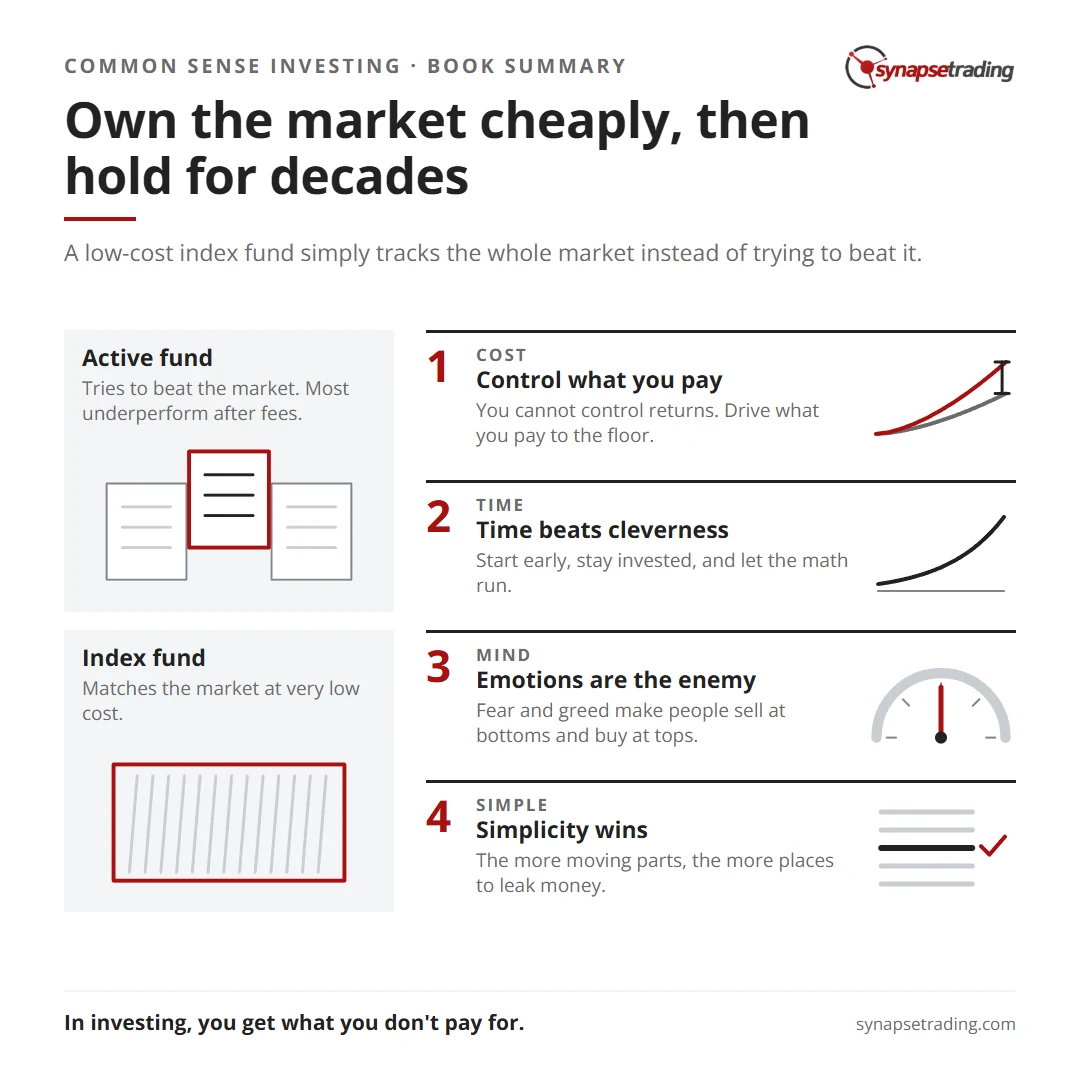
The book makes one argument and defends it from several angles: own the entire market through a low-cost index fund, hold for the long term, and refuse to be talked out of it.
Bogle’s reasoning runs like this. The stock market, over a long enough horizon, delivers a return that reflects the real growth of the businesses inside it. That return is there for the taking. The problem is that investors keep subtracting from it: trading costs, management fees, taxes from churn, and bad timing decisions driven by fear and greed. An index fund minimises every one of those leaks. You capture close to the full market return because you are not paying anyone to try (and usually fail) to beat it.
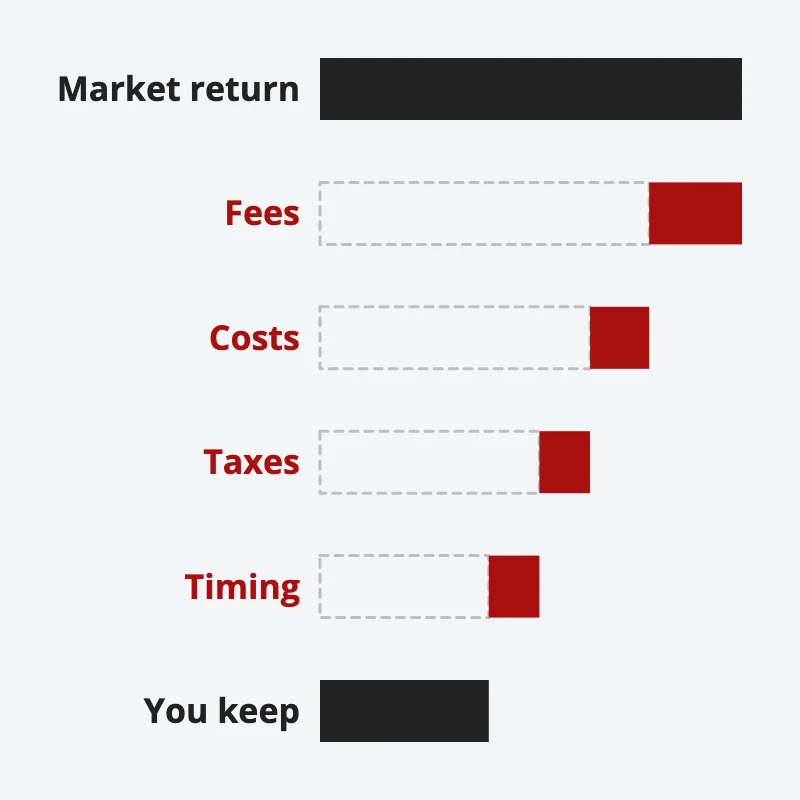
The villain of the book is cost. Bogle’s most quotable idea is simple: in investing, you get what you don’t pay for. A 2% annual fee sounds small. Over 30 years of compounding, it can quietly consume a large slice of your final wealth. That is the engine behind everything else he says.
The core ideas, without the repetition
The source material for this book lists the same handful of points many times over. Stripped down, Bogle is really making six arguments:
- Own the whole market. A broad index fund gives you instant diversification (spreading money across many holdings so no single one can sink you) at almost no cost.
- You probably can’t beat the market, and neither can the pros. The majority of actively managed funds underperform their index over the long run, especially after fees.
- Cost is the thing you can actually control. You cannot control returns. You can control how much you pay, so drive it to the floor.
- Compounding rewards time more than cleverness. Start early, stay invested, and let the math run. Trying to get rich quickly usually does the opposite.
- Your emotions are the other enemy. Fear and greed make people sell at bottoms and buy at tops. A simple plan you can hold through a crash beats a brilliant plan you abandon in a panic.
- Simplicity wins. The more moving parts, the more places to leak money and nerve. Boring is a feature.
Active funds vs index funds, over time
Here is the comparison at the heart of Bogle’s case, laid out plainly:
| Active fund | Low-cost index fund | |
|---|---|---|
| Goal | Beat the market | Match the market |
| Typical cost | High (management fees, trading, taxes from churn) | Very low |
| Long-run record vs index | Most underperform after fees | Tracks the market by design |
| What you rely on | A manager’s skill staying hot for decades | The market’s long-term growth |
| Effort to run | Picking and switching funds | Buy, hold, ignore |
| Bogle’s verdict | A bet against the odds | The rational default |
Do note that this is the long-horizon picture. Over a single year, plenty of active funds beat the index. The trouble is that the winners rarely repeat, and you cannot know in advance which ones they will be. Across decades, the cost drag compounds and the odds tilt hard toward the cheap, simple option.
How should a trader read this book?
This is the part people get wrong. They see “index funds win” and assume Bogle is telling everyone to never trade. That is not the lesson I take.
The mistake is mixing the two, treating your serious savings like a casino, or treating your trading capital like it should be left alone for 30 years.
So read Bogle as the floor. He is right that most people who try to beat the market lose to it. He is also describing exactly why a disciplined, low-cost, rules-based approach matters whether you are indexing or trading. The discipline is the same. Cut costs, control emotions, think in decades, and do not confuse activity with progress.
Here is the one honest caveat. If you are going to trade actively, Bogle’s data is a warning shot worth taking seriously. It tells you the bar is high and the average participant is below it. That should make you more rigorous about edge, sizing, and process. A fund manager with a research team usually fails to beat a dumb index. That is the company you are choosing to keep when you decide to trade, so bring a real system or don’t bother.
Where the human edge comes in
An index fund is the ultimate “let the machine do it” investment. You hand the whole job to a rules-based vehicle and walk away, and for most people that is the right call. The judgment is not in running it. It is in deciding which money belongs there and which money you are willing to actively manage, sizing each bucket to your real life, and then having the discipline to leave the long-term bucket alone through a 30% drawdown. The fund captures the market return. Whether you actually keep it is down to your behaviour, and that is the first of the Five Edges no fund can supply for you.
FAQ
What is the main message of The Little Book of Common Sense Investing?
Buy a low-cost index fund that owns the whole market, hold it for the long term, and stop trying to beat the market. Bogle argues that low cost and simplicity, not stock-picking skill, are what actually drive long-term investing success.
Is The Little Book of Common Sense Investing worth reading?
Yes, especially if you are new to investing or want to simplify a portfolio that has drifted into too many funds and fees. It is short, plain, and built around one durable idea. Experienced traders also benefit from it as a reminder of how much cost and emotion quietly cost you.
What does Bogle mean by “you get what you don’t pay for”?
He means that in investing, lower cost directly raises your net return. Because you cannot control the market’s return, the fees you avoid are the most reliable way to keep more of what the market gives. Over decades of compounding, even a small annual fee can consume a large share of your final wealth.
Does Bogle say you should never trade or pick stocks?
He argues that most investors, including professionals, fail to beat the market consistently, so for the bulk of your money, indexing is the rational default. He does not claim it is impossible to trade well, only that the odds are against the average participant, which is a reason to be disciplined rather than reckless.
Are index funds really safer than active funds?
Index funds are not immune to market crashes, since they fall with the market they track. What they remove is the extra risk of a single manager underperforming and the steady drag of high fees. Bogle’s point is about reliability and cost; you still carry market risk.
Now that you have Bogle’s case for the boring, low-cost, long-term approach, the real question is which of your money it should govern, and which money you are willing to actively trade with a real system. Have you read this one? Let me know your key takeaway in the comments.
For more, browse the full shelf: Best Investing and Trading Books of All Time.
Want a system for the active side of the ledger? Grab the free 15-Minute Swing Trading Starter Kit, the exact routine I use to scan once a day and trade any market in 15 minutes.
About the author. Spencer Li is The 15-Minute Trader and the founder of Synapse Trading. He is a Certified Financial Technician (CFTe) with 15+ years of trading, run from 70+ countries. He holds a B.Acc and B.BM from SMU. Every trade he takes is public, dated, losses left in. He teaches rules-based swing trading in 15 minutes a day, one system for any market.
Education, not financial advice. Synapse Trading is not licensed by MAS to advise on investment products. Trading carries risk of loss; past performance is not indicative of future results.
Related
Best Investing and Trading Books of All Time · The Intelligent Investor summary
Want the daily routine? Enter your email for the free 15-Minute Swing Trader's Checklist.
Free 5-page PDF, then occasional trading emails. Education only, not financial advice. Unsubscribe anytime. Kit stores your email in the US: see our privacy policy.
Want to learn the full method? The Trading Mastery Program teaches the 4 strategies I have traded since 2011. It suits beginners and experienced traders.
Rather follow the trades as they happen? Daily Trading Signals is our Telegram channel: my trade ideas with entry, stop and exit, and every trade is public.
Questions about this post? Ask in the free Telegram channel →
Educational content only, not personalised financial advice. Trading carries risk, including loss of capital. Past performance is not indicative of future results. Synapse Trading is not licensed or regulated by MAS.

