• Link to Facebook
  • Link to X
  • Link to Instagram
  • Link to Youtube
  • Link to LinkedIn
  • Link to Mail
Synapse Trading
  • Home
  • About
    • My Background
    • My Trading Journey
    • My Travel Log
    • Media & Interviews
  • Mentoring
    • Trading Mastery Program
    • Results & Testimonials
  • Signals
    • Telegram (Free to join!)
    • Daily Trading Signals
    • Daily Trading Signals (Results)
  • Resources
    • Free Trading Guides
    • Tools & Resources
    • Blog & Infographics
  • Contact
    • Contact Us
    • Partnership Opportunities
  • Click to open the search input field Click to open the search input field Search
  • Menu Menu
Spencer Li

The 2% Money Management Rule for Trade Position-Sizing

Trading Tips
MG 9839

The 2% Rule: Money Management and Position Sizing for Traders

Last updated: 3 July 2026 · By Spencer Li, CFTe


The 2% rule is the one money management rule professionals follow and most retail traders skip: on any single trade, you risk no more than 2% of your account. For a $10,000 account that caps your loss at $200 per trade, no matter how good the setup looks. The point of money management is not to make the most money on your best idea. It is to make sure no single trade, or even a bad streak of them, can take you out of the game. Stick to 2%, and the only way to lose your whole account is to lose 50 trades in a row, which is so unlikely it rounds to zero. Break it, and one oversized loss can erase months of work. That is the line between a trader who is still here next year and one who blew up.

To size a trade under the rule, you work backwards from your stop. Risk per trade equals (entry price minus stop price) times quantity, and you choose the quantity so that number lands at or under 2% of your account.

So how do you actually apply it? Let me walk through the maths the way I first understood it.

Why risking too much blows up accounts

We all know the goal of trading is to make money, and as long as you have an edge (a strategy that wins more than it loses over many trades), you will be profitable in the long run.

So the next question is the one that actually matters: how do you maximise your profit without blowing up your account?

Let me use a simple betting example. You start with $10,000. You have a 60% hit rate (your chance of winning any single bet), and on each bet you either double your stake or lose all of it. How much should you bet each time?

If you bet the whole $10,000, you have a 60% chance of doubling your money. But you also have a 40% chance of losing everything in one shot. That is exciting for a gambler. It is no way to stay profitable in the long run.

Now watch what happens when you split the same $10,000 into smaller bets. Your edge does not change. Your odds of ruin collapse.

How you split $10,000Bet sizeChance of losing every bet in a row
1 bet$10,00040%
2 bets$5,00016% (40% × 40%)
10 bets$1,0000.01%

Same edge, same starting capital. The only thing that changed is how much you put on the line at once. That is position sizing, and it is doing all the work here.

The lesson: in trading, good money management is not about making the most money on a single trade. It is about making sure you do not lose your capital. As Warren Buffett put it, rule number one is never lose money. Rule number two is never forget rule number one.

How does the 2% rule work in practice?

When you take a trade, you risk only 2% of your capital on it. For a $10,000 account, that is $200, and $200 is the most you can lose on that trade, full stop.

Risk is calculated as the difference between your entry price and your stop-loss price, multiplied by the quantity you trade. You flip that around to size the position: decide where your stop goes first, then buy only as many shares (or contracts, or lots) as keeps your risk inside $200.

Here is the same account at work across three setups with different stop distances.

AccountRisk cap (2%)Stop distance (entry − stop)Position size you can take
$10,000$200$1.00200 shares
$10,000$200$2.00100 shares
$10,000$200$0.50400 shares

Do note that, the wider your stop, the smaller your position. That is the rule working as intended. It forces a volatile, far-stop trade to be smaller, so a single loss still costs you the same fixed $200.

What happens if you stick to the 2% rule?

With the 2% rule, the only way to lose all your trading capital is to lose 50 trades in a row. The probability of that is less than 0.000000000000000001%. In plain terms, it does not happen to a trader who follows the rule.

We have all heard the horror stories of traders blowing up their accounts. That happens when they break this rule, not when they follow it. One trade sized at 20% or 50% of the account, one “sure thing” that was not sure, and the damage is permanent. Stick to 2%, and blowing up becomes almost mathematically impossible, and you will see a real improvement in your results simply because no single mistake is fatal.

Where the human edge comes in

A position-size calculator will do the arithmetic for you in a second. That part is free now. What it will not do is stop your hand when the setup looks so good you want to bet 10% “just this once.” It will not keep you at 2% through a four-loss streak when every instinct says to size up and win it back. The maths of sizing is the easy part. The discipline to apply it on the one trade you are sure cannot lose, that is the judgment, and it is one of the Five Edges no tool can trade for you.

Tips from the trading desk

  • Size from the stop, not the entry. Place your stop where the trade is wrong, then let the 2% cap tell you the position size. Never the other way around.
  • 2% is a ceiling, not a target. On a weaker setup, risk less. You are never obligated to use the full 2%.
  • Cap your total open risk too. Five trades each risking 2% is 10% of the account at risk at once if they are correlated. Watch the sum, not just the single trade.
  • Smaller account, same rule. The 2% is a percentage for a reason. It scales down with a $2,000 account and up with a $200,000 one without any change in logic.

FAQ

What is the 2% rule in trading?
The 2% rule means you risk no more than 2% of your account balance on any single trade. For a $10,000 account, your maximum loss per trade is $200. It is a money management rule designed to keep any one trade, or a losing streak, from blowing up your account.

How do I calculate position size using the 2% rule?
Work backwards from your stop. Risk per trade equals (entry price minus stop-loss price) times quantity. Pick the quantity so that figure is at or below 2% of your account. Example: a $10,000 account (2% = $200) with a $2.00 stop distance lets you buy 100 shares.

Is 2% too much or too little to risk per trade?
2% is a common professional ceiling, not a target. Many traders risk 1% or less, especially on lower-conviction setups or larger accounts. Risking more than 2% per trade is where most account blow-ups come from.

Does the 2% rule guarantee I won’t lose money?
No. It controls how much you lose on any single trade, not whether you win. You still need an edge (a strategy that wins over many trades). The 2% rule simply ensures no one loss can take you out before your edge plays out.

What is the difference between money management and position sizing?
Money management is the broader discipline of protecting your capital, including how much you risk per trade and in total. Position sizing is the specific calculation of how many shares or contracts to buy so your risk stays inside that limit. The 2% rule connects the two.


So, which trader are you today? The one who bets the whole account on a feeling, or the one who risks a fixed 2% and lives to trade tomorrow? Let me know in the comments.

And if you want the full framework for protecting your capital, read the pillar: The Complete Guide to Risk Management in Trading.

Want the system that uses this rule by default? Grab the free 15-Minute Swing Trading Starter Kit. It is the exact routine I use to scan once a day and trade any market in 15 minutes, with sizing baked in.


About the author. Spencer Li is the founder of Synapse Trading and a Certified Financial Technician (CFTe) with 15 years of trading across stocks, forex, crypto, commodities, and bonds. His trade log is public, 404 trades, losses left in. He teaches low-risk swing trading in 15 minutes a day, one system for any market.

Education, not financial advice. Synapse Trading is not licensed by MAS to advise on investment products. Trading carries risk of loss; past performance is not indicative of future results.

Related

The Complete Guide to Risk Management in Trading (pillar) · How to set a stop-loss · Risk-reward ratio explained · Trading psychology and discipline

0 Comments/by Spencer Li
https://synapsetrading.com/wp-content/uploads/2015/05/MG_9839.png 1380 1980 Spencer Li https://synapsetrading.com/wp-content/uploads/2019/10/logo.jpg Spencer Li2015-05-29 04:36:372026-07-06 02:43:32The 2% Money Management Rule for Trade Position-Sizing
Spencer Li

Testimonials: “Very Informative and Provided Many Insights to Trading”

Testimonials

2015-03-23 14.05.57

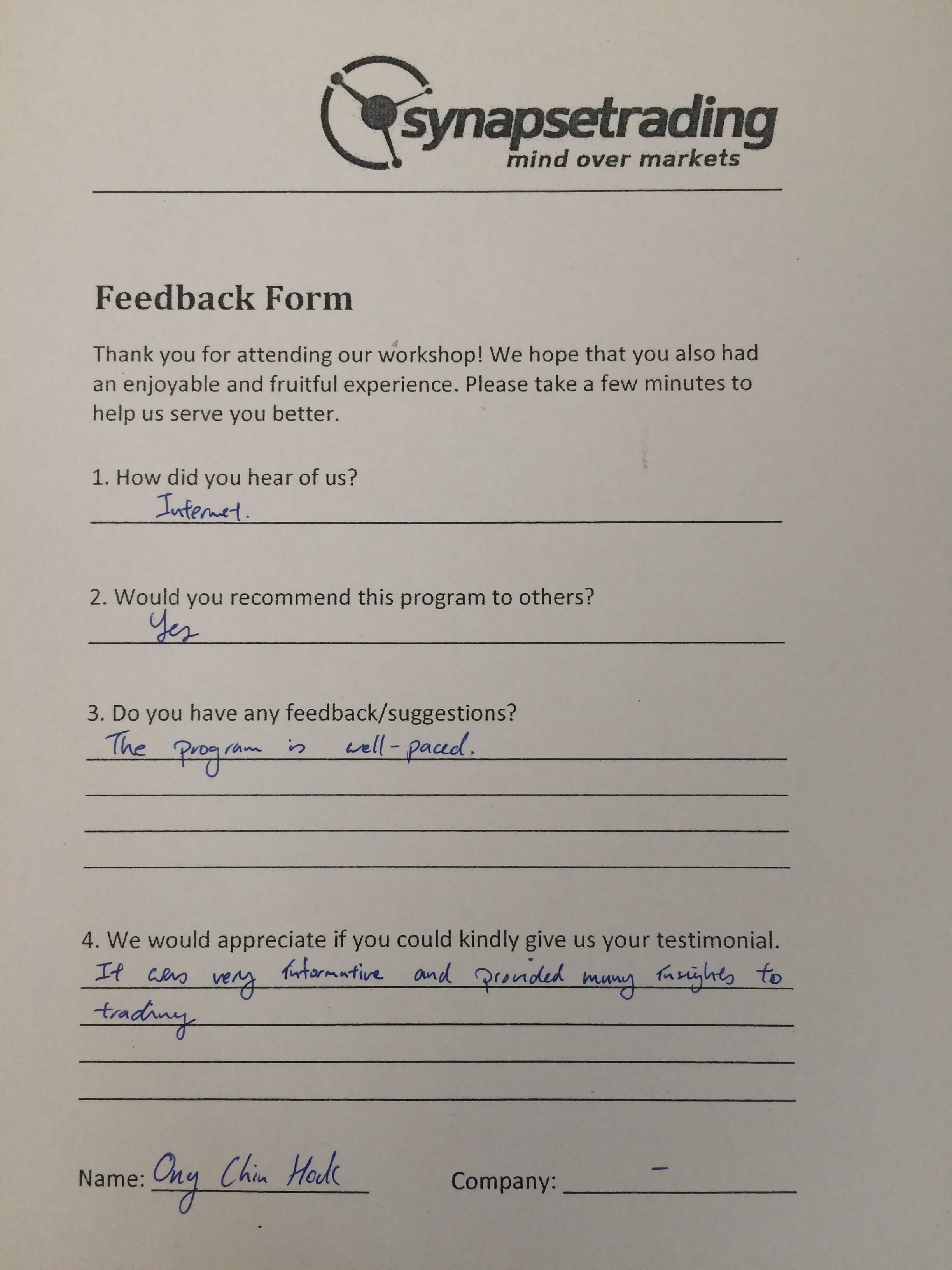
“It was very informative and provided many insights to trading.” – Ong Chin Hock

Thank you Chin Hock for your kind testimonial, and we wish you all the best in your trading!

Here at Synapse Trading, our goal is not to sell you some magical blackbox software, but to impart real professional trading skills which can stand the test of time and work under all market conditions. Our head trainer, Spencer Li, has traded professionally at private equity and proprietary funds, and is an internationally certified CFTe under the IFTA.

Every quarter, we accept only one selective batch of new aspiring traders, and share with them the secrets of behavioral analysis and how professional traders time the market! And so far, we have 100% positive reviews and a strong YES! when asked if they would recommend their friends and family.


DSC_0021

Would you like a taste of success too?

The next intake will only be in June 2015, but we allow advanced reservations, so email us before the limited slots get filled up to avoid disappointment! See you at the top! 😀
Email: info@synapsetrading.com

To see more testimonials, please visit https://synapsetrading.com/testimonials/
To find out more about our training program, please visit https://synapsetrading.com/the-synapse-program/
For program dates in 2015, click here.

0 Comments/by Spencer Li
https://synapsetrading.com/wp-content/uploads/2019/10/logo.jpg 0 0 Spencer Li https://synapsetrading.com/wp-content/uploads/2019/10/logo.jpg Spencer Li2015-05-26 08:00:362016-02-07 18:32:59Testimonials: “Very Informative and Provided Many Insights to Trading”
Spencer Li

Techniques for Identifying Market Trends

Trading Tips
identifying market trends

If you want to make money by timing the stock market you need to follow the trends.

Buying and selling creates its own momentum and a market that’s moving up or down is likely to keep moving in that direction for a certain period of time.

What this means is that you should avoid trading against the current trend.

For example, when the market is bearish and heading down, don’t try to predict which stocks have hit bottom, that would be like trying to catch a falling knife.

Instead, find an objective way to both identify the current trend and decipher when that trend has changed too, because just like the saying goes, “the trend is your friend, except at the end”.

So, let’s explore two simple techniques for identifying market trends.

The most common ways to look at the nature of a trend’s movement. As a stock moves up or down, it rarely does so in a straight line, rather it zigzags forming a series of highs and lows.

If the highs keep getting higher and the lows keep getting higher that stock is in an uptrend. If the highs get lower and the lows get lower, you’re looking at a downtrend. And if the highs and lows are consistent over a certain period, it’s in a sideways trend.

Another way to identify the market trend is to look beyond the daily price fluctuations and determine the general direction of a stock.

You do this by calculating an average. For example, a 20-day simple moving average or an SMA, is an average of the past 20 days of closing prices, which moves or updates on a daily basis by incorporating the latest prices.

If the SMA is sloping upwards, that’s an uptrend; sloping down downtrend and sideways, means flat.

A 20-day SMA gives a good picture of the short-term trend but you can also use other periods like the 50-day SMA and the 200-day SMA for the long-term trend. Those aren’t the only moving averages, however, there’s the exponential moving average or EMA, and the weighted moving average or WMA, which gives more weight to recent prices.

As a trader, you can use any of these techniques individually, but for the most accurate picture of market trends, you should use them all.

Because when it comes to behavioral analysis, the best way to increase your chances of success, is to consider as much data as possible.

So that’s market timing! Next, let’s cover support and resistance zones.

0 Comments/by Spencer Li
https://synapsetrading.com/wp-content/uploads/2015/05/identifying-market-trends.png 715 1279 Spencer Li https://synapsetrading.com/wp-content/uploads/2019/10/logo.jpg Spencer Li2015-05-22 08:00:242021-02-15 00:20:10Techniques for Identifying Market Trends
Spencer Li

First Sharing Session in Chinese – Full-house Event with over 130 Registrants!

News & Events
MG 9264

Last week, I paired up with my friend Rieve to conduct our very first sharing session in Chinese, and it was a great full-house event!

Following our LIVE! radio feature, there was an over-whelming registration for this session, with over 130 people messaging and calling in to register without a few hours.

Due to the limited number of seats, we could only allow the first 80 to register, but we will be having another session next week on 29 May 2015, to cater for those who missed it the first round.

If you are keen to attend this sharing session in Chinese, or want to attend The Synapse Program in Chinese (6 & 7 June 2015), please drop us an email at info@synapsetrading.com.

Thanks, and see you there! 😀

_MG_9264

_MG_9229

_MG_9394

_MG_9494

_MG_9582

0 Comments/by Spencer Li
https://synapsetrading.com/wp-content/uploads/2015/05/MG_9264.png 1380 1980 Spencer Li https://synapsetrading.com/wp-content/uploads/2019/10/logo.jpg Spencer Li2015-05-22 05:02:462018-10-30 13:28:44First Sharing Session in Chinese – Full-house Event with over 130 Registrants!
Spencer Li

Swing Trading Strategies: How to Profit from the Stock Market with 15 minutes a day

News & Events
MG 0096

swing trading strategiesLast Saturday, I was invited as a guest speaker and panelist to share my swing trading strategies and stock picks, alongside other SGX Academy veterans such as Wong Kon How and Robin Ho.

Being the youngest certified SGX trainer at 28, I was honoured for this opportunity, and excited at the same that Synapse Trading is taking the next leap forward by working closely with SGX to help raise the level of financial education in Singapore, and ensure quality training.

_MG_9698

_MG_0096

_MG_0229

_MG_0242


Stock Picks in front of a LIVE! Audience:

During the event, I explained my strategies and used it to pick out the best stocks in less than 5 minutes. Here are some of the things we looked out for:

_MG_9820

_MG_9839


This counter (YuuZoo) was featured in my portfolio, and during the lunch break, one lady asked me why I recently acquired this counter. I told her that I was expecting a bounce very soon, and true enough, we saw that bounce on Monday morning!

afc 180515 yuuzoo


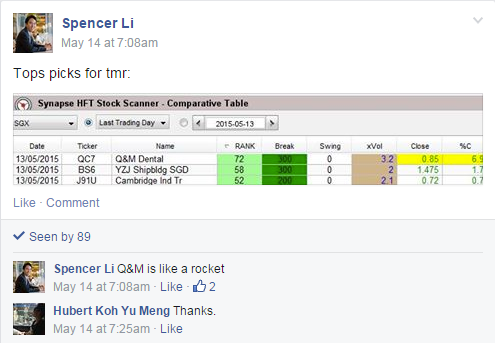
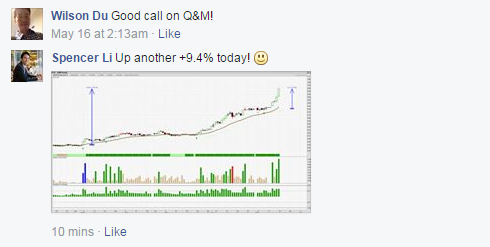
Q&M Dental was another counter that I have been advocating in all my seminars, including at Invest Global 2015 where I shared the stage with Jim Rogers, and I have also been posting it in my private forum for my students. I will let the results speak for itself! 😀

synapse forum 180515 1

synapse forum 180515 2

qc7 180515 Q&M

0 Comments/by Spencer Li
https://synapsetrading.com/wp-content/uploads/2015/05/MG_0096.png 1380 1980 Spencer Li https://synapsetrading.com/wp-content/uploads/2019/10/logo.jpg Spencer Li2015-05-19 05:45:002019-04-06 17:20:41Swing Trading Strategies: How to Profit from the Stock Market with 15 minutes a day
Page 136 of 184«‹134135136137138›»

Free Trading Guides

Free Trading Guides

Blog Categories

  • Beginner's Guide
  • Blockchain & Crypto
  • Book Summaries
  • Candlestick Patterns
  • Economics & News Trading
  • Investing & Portfolio Management
  • Living Your Best Life
  • Market Analysis
  • News & Events
  • Price Chart Patterns
  • Promotions
  • Risk & Money Management
  • Stock Trading
  • Testimonials
  • Tools & Resources
  • Trading Psychology
  • Trading Strategies
  • Trading Tips
  • Travel & Lifestyle

Free Trading Guides

Free Trading Guides

Contact Us

Synapse Trading Pte Ltd
Registration No. 201316168H

Whatsapp: +65-8897-1204
Telegram: @iamrecneps
Email: info@synapsetrading.com

Links

Disclaimer
Privacy policy
Terms & Conditions
Contact us
Partnerships

© 2012-2024 Synapse Trading | All rights reserved | - powered by Enfold WordPress Theme
  • Link to Facebook
  • Link to X
  • Link to Instagram
  • Link to Youtube
  • Link to LinkedIn
  • Link to Mail
Scroll to top Scroll to top Scroll to top