

Understanding Contracts for Difference (CFDs)
Join our Telegram channel for more market analysis & trading tips: t.me/synapsetrading
Table of Contents
What Are CFDs (Contracts for Difference) and How Do They Work?
Last updated: 3 July 2026 · By Spencer Li, CFTe
A CFD (Contract for Difference) is an agreement between you and a broker to exchange the difference in an asset’s price from when you open the trade to when you close it, without ever owning the asset itself. If the price moves your way, the broker pays you the difference; if it moves against you, you pay the broker. You can go long (buy, betting the price rises) or short (sell, betting it falls), and because CFDs are traded on margin (you put up a small fraction of the position’s value), a small amount of capital controls a large position. That leverage cuts both ways: it magnifies your gains and your losses in equal measure. CFDs let you trade stocks, indices, forex, commodities, and crypto from one account, which is the real draw. The catch is that the same leverage that makes them attractive is what blows up most beginners. So they suit experienced traders who already have risk management down, not someone learning on a live account.
Here is how they actually work, the markets you can trade, the trade-offs, and two worked examples.
What is a CFD, in plain terms?
A CFD is a financial derivative (a contract whose value is derived from something else) that lets you speculate on an asset’s price without buying the asset. You never hold the shares, the gold, or the coins. You hold a contract that tracks the price.
Think of it like betting on the outcome of a football match without buying the team. You agree with the bookmaker (the broker) on a price now. When the match ends (you close the trade), whoever was right collects the difference. That is the whole idea.
Four things happen in every CFD trade:
- Opening a position. If you think the price will rise, you open a long (buy) position. If you think it will fall, you open a short (sell) position. The ability to short easily is a big part of why traders like CFDs.
- Leverage. CFDs trade on margin, so a small deposit controls a much larger position. This amplifies profits, and it amplifies losses by exactly the same factor. Do note that this is the part that hurts people.
- Spread and costs. Your cost includes the spread (the gap between the buy price and the sell price) plus any holding cost charged for keeping a position open overnight.
- Closing a position. To bank the profit or loss, you do the opposite of what you did to open: you sell if you bought, and you buy if you sold. The difference between your open and your close is your result.
Where did CFDs come from?
CFDs were created in the early 1990s in London, developed by two investment bankers at UBS Warburg, Brian Keelan and Jon Wood. They were not built for retail traders at all. They started as an equity swap that institutions used to hedge positions on the London Stock Exchange cheaply, mostly to sidestep the UK stamp duty tax on buying physical shares.
Three things made them useful from the start:
- Tax efficiency. They let big institutional players avoid stamp duty on large share purchases.
- Leverage. They let traders control large positions with a small amount of capital (amplifying profit and loss alike).
- Flexibility. They made it easy to go both long and short, in any market condition.
Through the late 1990s and early 2000s, online brokerages and trading platforms put CFDs in front of retail traders for the first time. The product spread out of the UK into Europe and Australia, with each region adapting it to its own rules.
That popularity brought scrutiny. Regulators like the Financial Conduct Authority (FCA) in the UK and the Australian Securities and Investments Commission (ASIC) stepped in to protect retail investors. They imposed leverage limits to cap the risk, and they required brokers to give clear risk warnings so clients understand what they are getting into. That regulatory tightening is also why CFDs are restricted or banned outright in some countries.
What can you trade with CFDs?
This is the genuine appeal. One CFD account gives you access to a wide range of markets:
- Stocks. Shares of companies like Apple, Google, and Tesla.
- Indices. The S&P 500, FTSE 100, Nikkei 225, and other market indices.
- Forex. Currency pairs like EUR/USD and GBP/JPY.
- Commodities. Precious metals like gold and silver, and energy like oil and natural gas.
- Cryptocurrencies. Bitcoin, Ethereum, and others.
- ETFs. Exchange-traded funds, for exposure to whole sectors or asset classes at once.
Pros and cons of trading CFDs
CFDs come with real advantages and real risks, and you need both halves of the picture before you decide whether they fit you.
| CFDs | |
|---|---|
| Leverage | Pro: higher potential returns from a smaller deposit. Con: the same leverage can produce losses that exceed your initial outlay. |
| Market access | Pro: stocks, forex, commodities, indices, and crypto from one platform. |
| Direction | Pro: profit from falling markets (short) as easily as rising ones (long). |
| Ownership | Pro: no need to custody or handle the underlying asset. Con: you own nothing, so no dividends-in-kind, no voting, no shares to hold long term. |
| Entry cost | Pro: lower capital required than buying the asset outright. |
| Trading costs | Con: spread, overnight holding costs, and sometimes commission. |
| Regulation | Con: not available in some countries; restricted in others. |
| Complexity | Con: managing leveraged positions takes real understanding of markets and risk. |
| Counterparty risk | Con: if the broker defaults, your positions are exposed. |
Personally, the line I would underline is counterparty risk and leverage. A CFD is a contract with your broker, not a share you hold in your own name, so the broker’s health matters. And leverage is the single feature that turns a manageable mistake into an account-ending one. Respect it, or it will teach you the hard way.
CFD vs owning the shares: what is the difference?
A common question is how a CFD differs from just buying the stock. The core difference: with a CFD you own a contract that tracks the price, not the asset.
| CFD | Owning the shares | |
|---|---|---|
| What you hold | A contract with the broker | The actual asset in your name |
| Capital required | A margin deposit (a fraction of position size) | The full value of the position |
| Short selling | Easy, built in | Hard or restricted for retail |
| Leverage | Yes, magnifies gains and losses | Usually no |
| Overnight cost | Holding cost charged daily | None |
| Time horizon it suits | Short-term speculation | Long-term investing |
| Counterparty risk | Yes, exposed to the broker | No |
The short version: CFDs are a tool for short-term, leveraged speculation. If your goal is to buy and hold for years, owning the asset is usually the cleaner choice.
Two worked examples
Numbers make this concrete. Here is one long trade and one short trade, costs excluded for clarity.
Long example (stocks). You think Apple will rise. You buy 100 CFD shares of Apple (AAPL) at $150. The price rises to $160, and you close.
- Opening position: 100 shares x $150 = $15,000
- Closing position: 100 shares x $160 = $16,000
- Profit: $16,000 minus $15,000 = $1,000 (excluding costs)
Short example (commodities). You think gold will fall. You sell 10 CFDs of gold at $1,800 per ounce. The price drops to $1,750, and you close.
- Opening position: 10 ounces x $1,800 = $18,000
- Closing position: 10 ounces x $1,750 = $17,500
- Profit: $18,000 minus $17,500 = $500 (excluding costs)
Side by side, so the long-vs-short mechanics are clear:
| Long (Apple) | Short (Gold) | |
|---|---|---|
| Your view | Price will rise | Price will fall |
| Action to open | Buy at $150 | Sell at $1,800 |
| Action to close | Sell at $160 | Buy at $1,750 |
| Result | +$1,000 | +$500 |
Notice the short trade: you sold first and bought back lower, and you still made money. That is the part new traders find counterintuitive, and it is exactly what CFDs make easy.
Where the human edge comes in
Leverage and one-click access to every market are now free. Any broker hands them to you on signup. What no platform hands you is the discipline to size a leveraged position so a single bad trade cannot end your account, or the judgment to skip a market you do not actually understand. The leverage is the easy part. Knowing how much of it to use, and when to use none at all, is the part worth learning. That is discipline and sizing, the second of the Five Edges no broker can supply for you.
FAQ
What is a CFD in simple terms?
A CFD (Contract for Difference) is an agreement with a broker to exchange the difference in an asset’s price between when you open and close the trade, without owning the asset. If the price moves your way you profit; if it moves against you, you lose.
Are CFDs good for beginners?
Generally no. CFDs use leverage, which magnifies losses as much as gains, so they are best suited to experienced traders who already have risk management in place. A beginner is better off learning position sizing and a tested system first.
Can you lose more than you invest with CFDs?
Yes. Because CFDs are leveraged, losses can exceed your initial deposit. This is why regulators impose leverage limits and require risk warnings, and why sizing matters more than the entry.
What is the difference between a CFD and buying the stock?
With a CFD you hold a contract that tracks the price, not the share itself. CFDs require less capital, allow easy shorting, and use leverage, but carry overnight costs and broker counterparty risk. Owning the stock suits long-term investing; CFDs suit short-term speculation.
What can you trade as CFDs?
Stocks, indices (like the S&P 500 and FTSE 100), forex pairs, commodities (gold, silver, oil), cryptocurrencies, and ETFs, all from a single account.
Now that you know how CFDs work, the question is not really “what is a CFD,” it is “how do I keep leverage from blowing me up.” That answer is the same in every market: a tested system and disciplined sizing. Which leads naturally to the next thing to learn.
If you want the full foundation, start with the pillar: The Beginner’s Guide to Trading.
Want a system that controls the risk for you? Grab the free 15-Minute Swing Trading Starter Kit. It’s the exact routine I use to scan once a day and trade any market in 15 minutes, with sizing baked in so leverage works for you, not against you.
About the author. Spencer Li is the founder of Synapse Trading and a Certified Financial Technician (CFTe) with 15 years of trading across stocks, forex, crypto, commodities, and bonds. His trade log is public, 404 trades, losses left in. He teaches low-risk swing trading in 15 minutes a day, one system for any market.
Education, not financial advice. Synapse Trading is not licensed by MAS to advise on investment products. Trading carries risk of loss, including the risk of losing more than your initial deposit with leveraged products; past performance is not indicative of future results.
Related
The Beginner’s Guide to Trading (pillar) · Leverage and margin explained · Long vs short selling · Forex trading basics
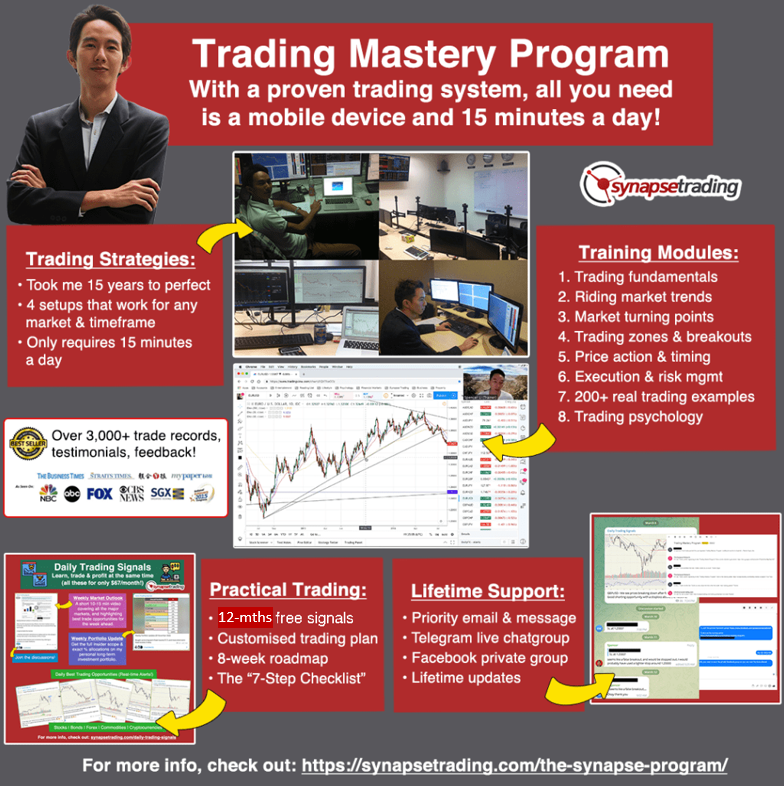 Our flagship mentoring program is suitable for both beginners and advanced traders, covering the 4 strategies which I used over the past 15 years to build up my 7-figure personal trading portfolio.
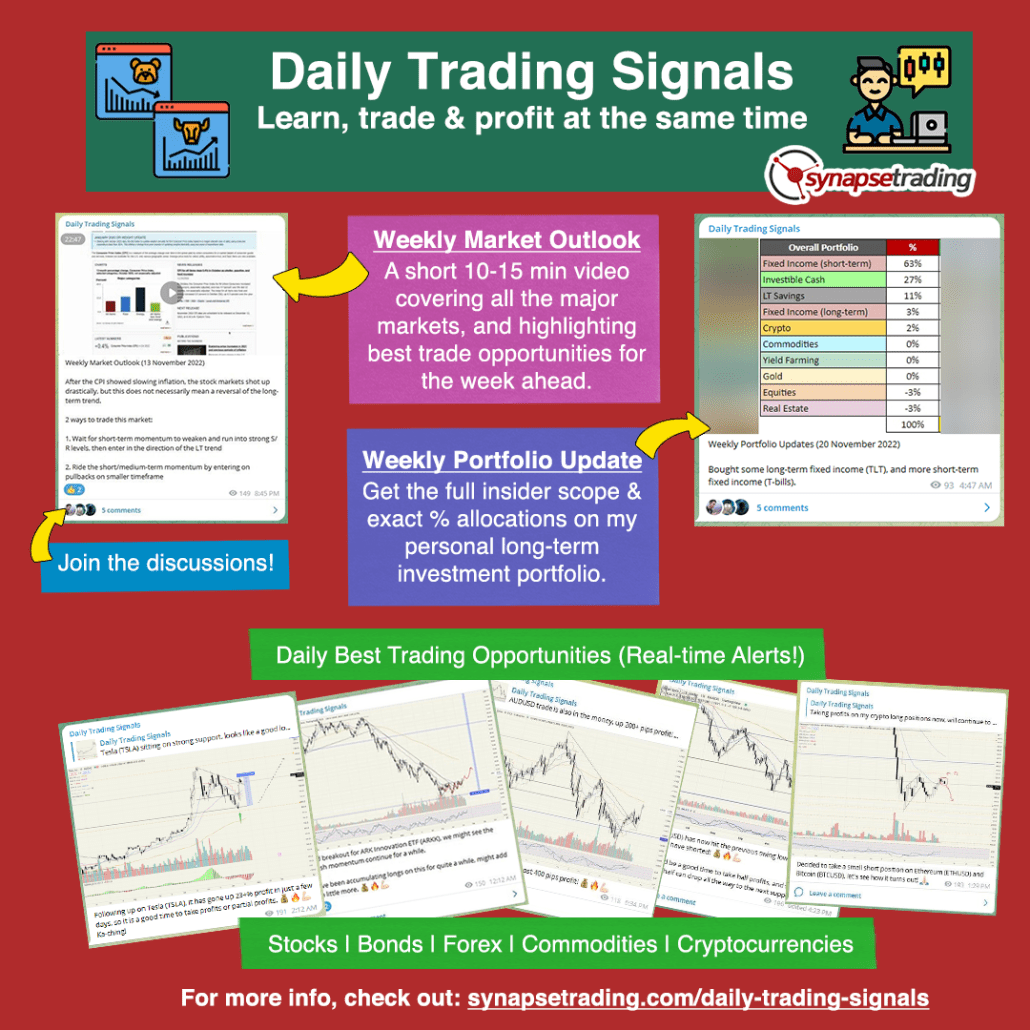 If you're looking for the best trading opportunities every day across various markets, and don't want to spend hours doing the research yourself, check out our private Telegram channel!

Leave a Reply
Want to join the discussion?Feel free to contribute!