

Book Summary: Die with Zero (How to Maximise Your Life)

Join our Telegram channel for more market analysis & trading tips: t.me/synapsetrading
Table of Contents
Die With Zero: The Book That Made Me Rethink Money, Time, and Why I Stopped Chasing More
Last updated: 3 July 2026 · By Spencer Li, CFTe
“Die with Zero” by Bill Perkins argues that the goal of money is not to accumulate as much as possible, but to convert it into life experiences before you run out of time to enjoy them. The core idea: if you die with a large pile of unspent money, you sacrificed hours of your life earning money you never used, which means you effectively wasted those hours. The book flips the usual retirement advice. Instead of hoarding a big sum to live off the interest and dying with the capital intact, Perkins says you should aim to spend down to (close to) zero, peak your net worth earlier in life, give your money away while you are alive, and time each experience for the age when you can actually enjoy it. I read it recently, and it put words to something I had already been living. Here is what it actually says, and why it changed how I think about working harder.
How much time should you exchange for money?
Perkins starts with a simple reframe: money is stored life energy.
Life energy is all the hours you are alive to do things. Whenever you work, you spend some of that finite life energy. So any amount of money you have earned represents the life energy you spent earning it.
Follow that logic and something uncomfortable falls out. If you die with extra money, you sacrificed hours of your life for money you never spent. You wasted those hours.
That means there is an optimal amount of work, enough to fund the lifestyle you actually want, and anything beyond that is unnecessary. But most people work and save far past that point, usually out of fear or habit.
Perkins is blunt about why. Our culture’s focus on work is like a seductive drug. It takes all your yearning for discovery and wonder and experiences, and promises to give you the means (money) to get those things. Then the focus on the work and the money becomes so single-minded that you forget what you were yearning for in the first place. The poison becomes the medicine.
Once you are in the habit of working for money to live, the thrill of making money quietly exceeds the thrill of actually living. That is the trap.
What should you spend money on for maximum value?
Spend on experiences, not things.
Many psychological studies have shown that spending money on experiences makes us happier than spending it on material possessions. Things feel exciting at first, then depreciate. Experiences do the opposite. They gain value over time, because they pay what Perkins calls a memory dividend (the ongoing happiness you get from recalling and re-sharing an experience long after it happened).
The frame underneath this: your life is the sum of your experiences. Everything you do, the daily, weekly, annual, and once-in-a-lifetime experiences, adds up to who you are.
So the practical move is to actively think about the life experiences you want and how many times you want to have them. They can be large or small, free or costly. The point is to decide deliberately rather than drift.
Three questions Perkins keeps asking, which are worth sitting with:
- What is the best way to spend our money for maximum enjoyment and maximum memories?
- What is the best way to allocate our life energy before we die?
- What are the life experiences you would like to have in this lifetime?
What are the biggest regrets people have at the end of life?
The biggest deathbed regret is wishing you had lived a life true to yourself, not the life others expected of you. Perkins draws on the five most common regrets recorded by people near the end of life, and almost all of them are about experiences not had and feelings not expressed, not about money not earned.
| # | The regret | What it is really about |
|---|---|---|
| 1 | I wish I’d had the courage to live a life true to myself, not the life others expected of me | Other people’s script over your own |
| 2 | I wish I hadn’t worked so hard | Over-working past the optimal point |
| 3 | I wish I’d had the courage to express my feelings | Withheld emotion |
| 4 | I wish I had stayed in touch with my friends | Neglected relationships |
| 5 | I wish that I had let myself be happier | Delayed permission to enjoy life |
Notice what is missing from that list: nobody wishes they had earned more.
And here is the part most people miss. This regret does not only strike once, at the very end. It strikes at every stage of life. The bookworm teenager who skipped the fun of high school for a supposedly brighter future. The middle-aged dad who kept skipping irreplaceable moments with his teens while chasing one more promotion.
Perkins calls these mini-deaths. The teenager in you dies. The college student in you dies. The single unattached version of you dies. The parent-of-an-infant version of you dies. Once each of those passes, there is no going back. You can delay some experiences for only so long before the window shuts forever.
When the end is near, people suddenly think, “What the hell am I doing? Why did I wait this long?” Until then, most of us live as if we had all the time in the world.
Why does timing matter as much as the money?
Because some experiences can only be enjoyed at a certain age, and your ability to enjoy them declines.
There is a sweet spot in everyone’s lifetime when they can most enjoy the fruits of their wealth. The problem is that people keep saving well past that point. That is the senselessness of indefinitely delayed gratification.
When you are young, Perkins argues you should focus more on building good experiences than on earning money, because your earning power will rise over time anyway. Your dollar earned per unit of time goes up as you get older, so the cheapest time (in life-energy terms) to buy experiences is when you are young.
The constraint shifts with age, and the research bears it out. People asked what stopped them from taking a trip gave different answers by age group:
| Age group | What constrains them most |
|---|---|
| Under 60 | Time and money |
| 75 and older | Health problems |
That is the whole argument in one table. When you are young you have health but not money. When you are old you have money but not health. Dying with zero is not only about money. It is about time. Start thinking about how you use your limited time, your life energy, and you are well on your way to living the fullest life you can.
What are “time buckets” and how are they different from a bucket list?
A bucket list is a flat list of things to do before you die. Time buckets are the same idea, but sorted into the life decades when each experience can actually be enjoyed.
The reason this matters: your declining health and narrowing interests mean your list of doable activities shrinks as you age. So your spending rate should not stay constant. If you want to die with zero and make the most of whatever health you have at each point, you will need to spend more in your fifties than your sixties, and more in your sixties than your seventies, let alone your eighties and nineties.
Perkins makes the trade-off vivid. Many people will spend tens or hundreds of thousands of dollars to prolong life by a few weeks. That is money they gave up years, even decades, of healthy and vibrant life to earn, traded for a few extra weeks when they are sick and immobile. The key is to strike the balance between spending on the present (on what you actually value) and saving smartly for the future.
How do you actually plan to die with zero?
It is simpler than it sounds. Estimate the maximum age you might live to, then work out how much cash you will need to get there.
Do note that your expenses (except medical) will be much lower as you age. They can be covered with a combination of annuities, insurance, savings, plus a buffer. And for nearly anything you might worry about in your future, there is an insurance product designed to protect against it.
The result of this approach: your net worth should peak earlier, in your 50s or 60s, instead of peaking on the day you die. Which means you can retire earlier, because you do not need to hoard as much.
Why give your money away while you are still alive?
Because giving it after you die leaves the timing, the amount, and even the recipient to chance.
Most people wait until they pass away to give wealth to their kids or to charity. But why not give it to your children when they can make the most of it?
Perkins ran an informal Twitter poll asking people the ideal age to receive an inheritance windfall. Of more than 3,500 voters, the answers were telling:
| Ideal age to inherit | Share of votes |
|---|---|
| 18 to 25 | 12% |
| 26 to 35 | More than half (the clear winner) |
| 36 to 45 | 29% |
| 46 or older | 6% |
Why does 26 to 35 win? Some pointed to the time value of money and compound interest: the earlier you get it, the more it can grow. Others pointed to the immaturity problem of getting it too young. Perkins adds a third factor, health: you always get more value out of money before your health declines. The 26-to-35 range combines all three. Old enough to be trusted with money, young enough to fully enjoy it.
The alternative, waiting until you die, is what Perkins calls the three Rs: giving random amounts of money, at a random time, to random people (because who knows which of your heirs will still be alive when you go?).
What do you actually want to give your kids?
Memories, not just money.
Just as you are trying to form memories of time with your kids, it makes sense to want them to form memories of you. Both sets of memories pay a memory dividend, one stream for you and one for them. So the real question is: how do you want your kids to remember you?
Your kids only have their childhood for a certain number of years. What experiences do you want to have with them, or rather, what experiences do you want them to have with you? Does each extra hour of work really serve your legacy, or quietly deplete it?
My views: why am I not working harder?
I get this question often. People wonder why I am not working harder, trading more, scaling the business, making more money.
My question back to them is, “what is the point of making more money?”
I have more than enough money to create the experiences I want, to give to the people and charities I support, and to retire and die with zero.
So I choose to spend my time doing the things I enjoy. Playing sports. Hanging out with my friends and family. Reading (2000+ books and counting). Travelling around the world (70+ countries to date).
I probably will start a family at some point, which is why I have travelled to the more challenging places first, and left the family-friendly places for later. That is time-bucketing in practice.
And I look forward to creating more memories and experiences across the next two-thirds of my life.
Personally, the book did not convert me so much as confirm a bet I had already made. Money is the easy part to grow. Time is the part you cannot earn back.
FAQ
What is the main idea of “Die with Zero” by Bill Perkins?
The main idea is to convert your money into life experiences before you run out of time and health to enjoy them, rather than dying with a large unspent pile. Money you never spend represents wasted hours of your life energy.
Does “die with zero” mean spending all your money recklessly?
No. It means planning so your net worth peaks in your 50s or 60s and is drawn down deliberately over your remaining years, using annuities, insurance, savings, and a buffer to cover later-life expenses. It is intentional spending, not reckless spending.
What is the “memory dividend”?
The memory dividend is the ongoing happiness you keep getting from recalling and re-sharing a past experience. Unlike material things that depreciate, experiences gain value over time because you draw on the memory again and again.
What is the best age to give your children their inheritance?
In Perkins’ poll of 3,500+ people, the clear winner was ages 26 to 35: old enough to be trusted with money, young enough to enjoy it and let it compound. Giving while you are alive also lets you control the amount, timing, and recipient instead of leaving it to chance.
What are time buckets in “Die with Zero”?
Time buckets are your bucket list sorted into the decades of life when each experience can actually be enjoyed, since health and interests narrow with age. They help you schedule experiences for the right age rather than indefinitely postponing them.
If this resonated, the next book worth your time is Morgan Housel’s “The Psychology of Money,” which sits right next to this one on the same shelf. And if you want my full reading list, see the pillar below.
For more book summaries and recommendations, read the pillar: Best Investing and Trading Books of All Time.
About the author. Spencer Li is the founder of Synapse Trading and a Certified Financial Technician (CFTe) with 15+ years of trading across stocks, forex, crypto, commodities, and bonds. His trade log is public: every trade since April 2024, dated, losses left in. He has taught a 15-minute daily trading routine since 2014, one system for any market. He has also read 2000+ books and travelled to 70+ countries.
Education, not financial advice. Synapse Trading is not licensed by MAS to advise on investment products. Trading carries risk of loss; past performance is not indicative of future results.
Related
Best Investing and Trading Books of All Time (pillar) · The Psychology of Money (book summary) · How I Retired Early Through Trading
Want our free trading resources by email? Leave your address below.
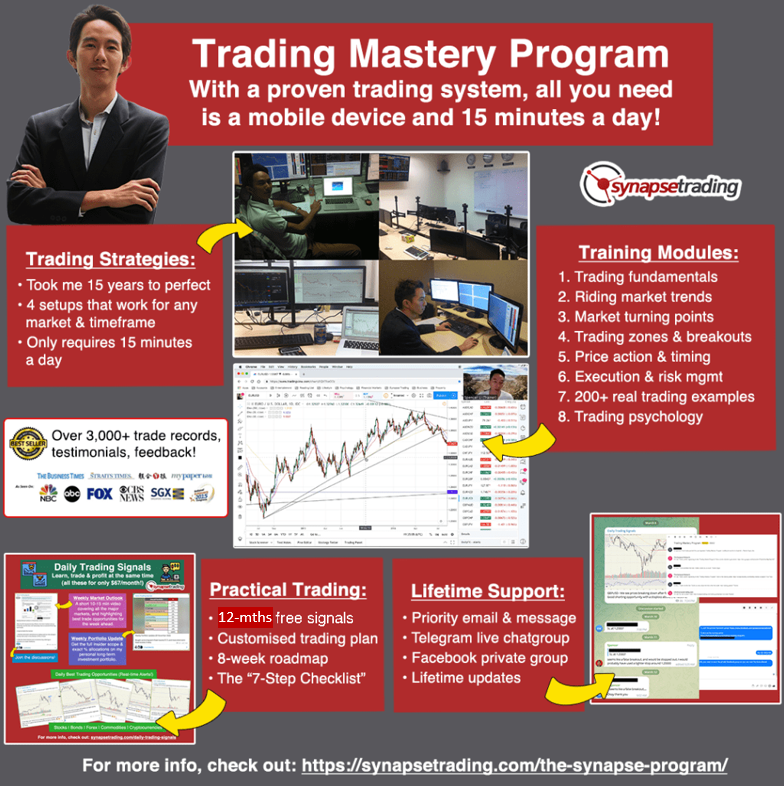 Our flagship mentoring program is suitable for both beginners and advanced traders, covering the 4 strategies which I used over the past 15 years to build up my 7-figure personal trading portfolio.
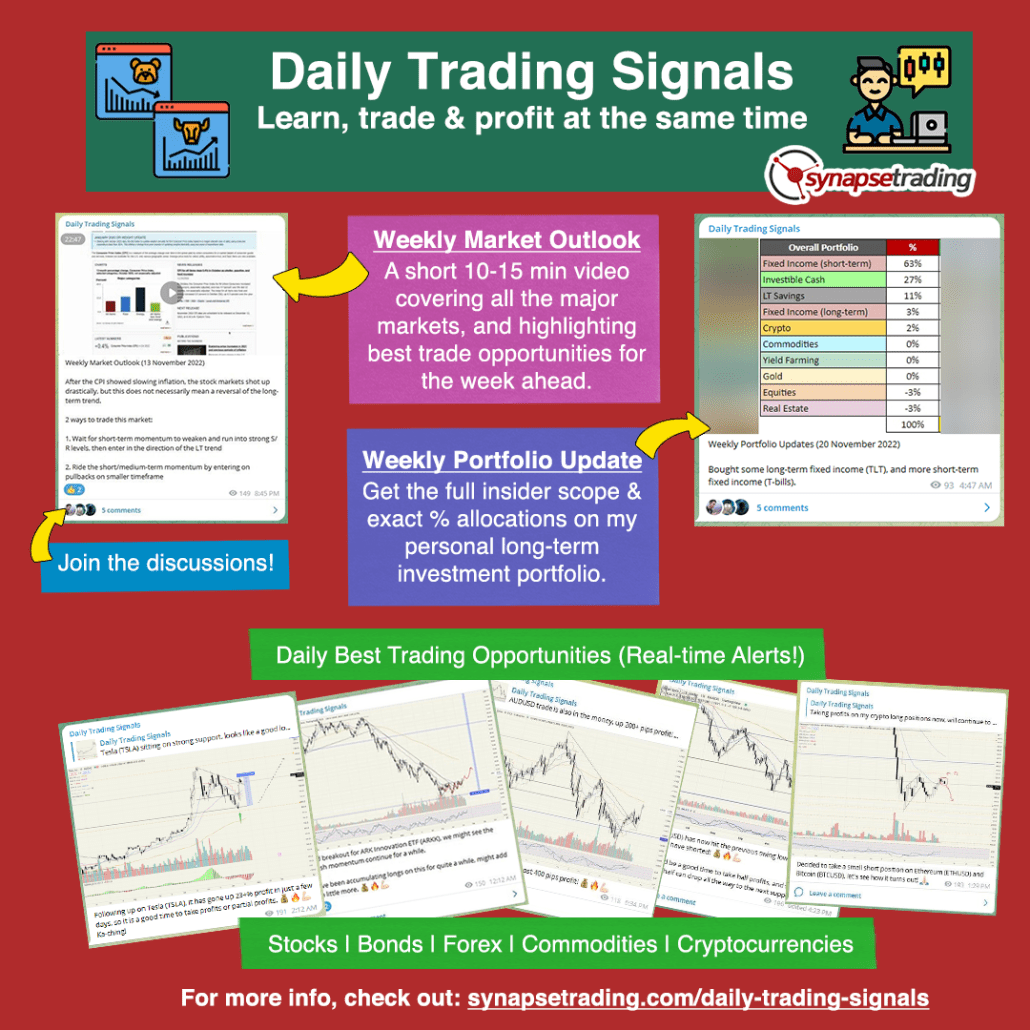 If you're looking for the best trading opportunities every day across various markets, and don't want to spend hours doing the research yourself, check out our private Telegram channel!


Leave a Reply
Want to join the discussion?Feel free to contribute!