

Volume Spread Analysis: How to Read Price Action and Volume Together to Spot Hidden Clues
Want the daily routine? Get the free 15-Minute Swing Trader’s Checklist. Get it free →
By Spencer Li, CFTe · Last updated: 26 October 2026
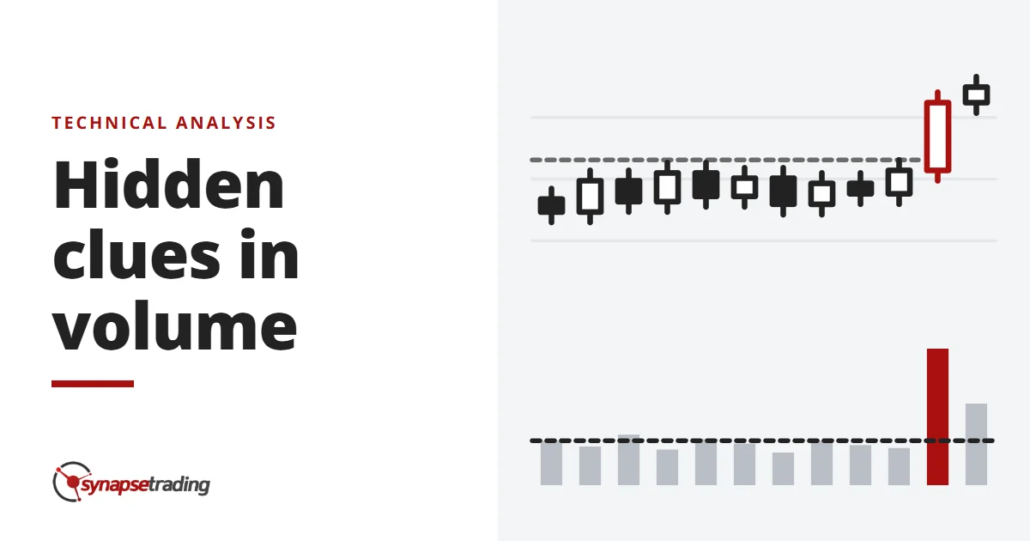
Volume spread analysis, usually shortened to VSA, reads three things on every bar of a chart: how much volume traded, how wide the bar was from its high to its low, and where price closed inside that range. Put the three together and they tell you whether real buying or selling stood behind a move, or whether price simply drifted because hardly anyone was trading. It matters because price action and volume are the only raw data a chart has, and almost everything else on your screen is cooked from them.
I first wrote about price and volume on this blog in January 2010. The building blocks have not changed since, even if the charting apps have become a lot prettier.
Why does every chart come back to price and volume?
Open any charting app and count the tools, from moving averages to RSI, MACD and a hundred more if you keep scrolling. It looks like a lot of different information, and it is really the same information, rearranged.
Every one of those indicators is calculated from price, sometimes with volume mixed in. Chart patterns and candlestick patterns are shapes that price makes, and even Elliott Wave is a way of counting price swings. So when a trader says they trade price action, they mean they read the raw material instead of a processed version of it.
Once you can read the raw material, the indicators stop being black boxes and become shorthand for something already on the chart. My beginner’s guide to technical analysis covers the wider toolkit, and this post stays with the two raw inputs.
What does reading price action actually mean?
At the most basic level, price action is the movement of a security’s price. That covers swings, trends, support and resistance, breakouts, and every pattern traders have bothered to name over the past century. The best known of those names are the candlestick patterns.
The chart below holds a fair number of them, from the hammer to the evening star doji, and my guide to candlestick patterns covers each one in turn.

The names are the easy part, though. Plenty of new traders memorise every shape on that chart and still struggle, because the crux of price action is understanding what buyers and sellers were doing when the shape printed. A bullish engulfing bar at the end of a clean pullback says something quite different from the same bar in the middle of a choppy range. The shape is identical, and the context changes the message.
That is why no two traders read a chart in exactly the same way. There is no lookup table, and a surprising amount of screen time goes on learning which shapes to ignore.
What is volume, and why do traders call it energy?
Volume is the number of shares or contracts that change hands in a period. If one trader buys 100 shares from another, volume for that period goes up by 100. Every trade has a buyer and a seller, so volume never tells you who won. It tells you how many people turned up to the argument.

Volume Spread Analysis – Spotting the Hidden Clues in Volume
Hence the old habit of calling volume energy. A move on heavy volume has a lot of commitment behind it, from both sides, which makes it an indirect read on supply and demand. The same move on thin volume is a question mark, because very few people were willing to put money behind it.
Do note that heavy is relative. Edwards and Magee, whose Technical Analysis of Stock Trends first came out in 1948, put it plainly: heavy volume “means heavy only with respect to the recent volume of sales in the stock you are watching.” A thousand shares can be a crowd in a thinly traded stock and a quiet morning in a busy one. So you compare a bar’s volume with the same market’s recent volume, never with some other chart.
If you would rather read the market once a day than all day, the free 15-minute swing trader checklist is the routine I use myself.
Where did volume spread analysis come from?
In 1888, a teenager called Richard Wyckoff took a job as a messenger boy for a firm of brokers. He founded a magazine called The Ticker in 1907 and spent much of his career teaching readers to find the footprints of large operators on the stock tape.
There is a dry footnote to that story. Some of his own contemporaries accused Wyckoff of being one of those large operators, running exactly the kind of churning and tape-painting he taught readers to watch for. So the man who taught the public to spot manipulation was, by some accounts, unusually well placed to know what it looked like.
Later traders, with Tom Williams the best known of them, built Wyckoff’s ideas into what is now called volume spread analysis. It rests on an idea Wyckoff called effort versus result. Volume is the effort, while the spread of the bar and the place it closes are the result. When a huge effort produces a tiny result, something is quietly absorbing it, and that is worth a closer look.
A few of the bar types VSA names, in plain words:
- Upthrust. Price pushes to a new high on heavy volume, then closes near the low of the bar. Buyers turned up and got swamped.
- No demand. A narrow up bar on lower volume than the bars before it. Price rose, but hardly anyone wanted to pay up for it.
- Test. Price dips into an area where heavy selling happened before, then closes near the high on light volume. The sellers seem to have left the building.
- Stopping volume. A heavy-volume down bar in a downtrend that closes in its upper half. Someone large was buying what the panic offered.
Each of these is read against the background around it, so an upthrust after a long rally carries far more weight than the same bar in a sleepy range.
How do price and volume work together?
A breakout, a gap or a break of key support means more on heavy volume than on light volume, because heavy volume shows that many people, large ones included, took part.
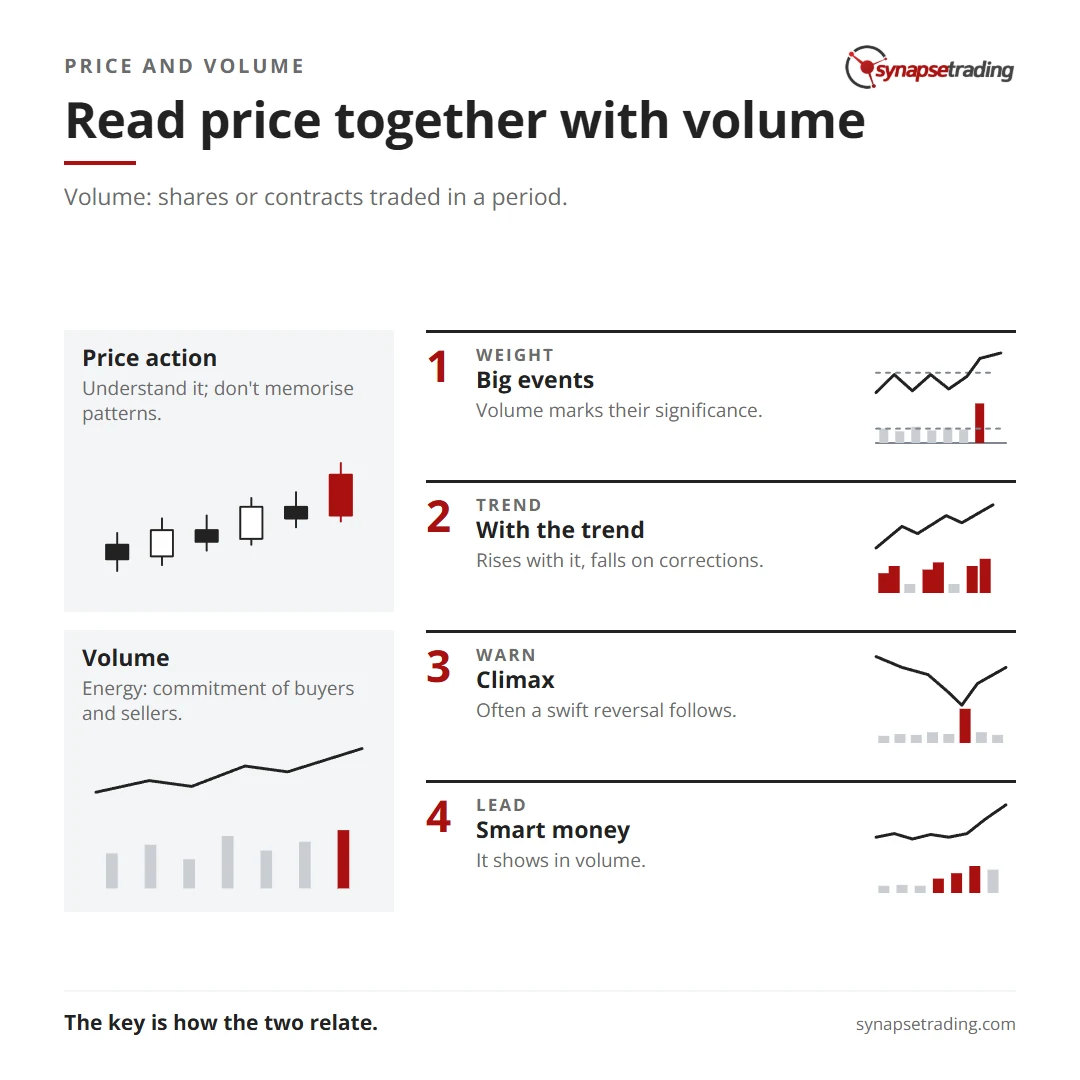
The usual rule of thumb is that volume rises in the direction of the trend and falls on corrections. In an uptrend you want the rallies busy and the pullbacks quiet, and that one relationship helps you tell a healthy pause from the start of a reversal.
| Price | Volume | What it usually means |
|---|---|---|
| Rising | Rising | A healthy uptrend with real buying behind it |
| Rising | Falling | A tired rally, with buyers thinning out |
| Falling | Rising | Real selling pressure |
| Falling | Falling | A quiet pullback, often normal inside an uptrend |
| A sharp move | A sudden spike | A possible climax, and a swift reversal often follows |
The last row needs care. Edwards and Magee warned that a sudden jump in volume can mark “EITHER the beginning (breakout) OR the end (climax) of a move”, and only the price pattern around it tells you which. They also passed on an old Wall Street saying, that prices can fall of their own weight while it takes buying to push them up. That is why an upside breakout on light volume deserves more suspicion than a breakdown on light volume, and why volume is the quiet test inside most of the setups in my guide to trading price chart patterns.
What does a volume clue look like in a real market?
In my weekly outlook on 7 May 2026, I talked about IGV, a fund that holds US software stocks. It had fallen a long way, and I called it “more of like a rebound play right because it has dropped so much and there’s this high volume over here right which kind of suggests there might be some accumulation”. Price had also made a false break to the downside and then quickly recovered.
A week later, on 14 May, I came back to it. I pointed to “a huge volume” near the lows and said “this might be like capitulation”. Capitulation is the moment sellers give up in a rush, and the heavy volume is everyone heading for the exit at once. I reminded viewers of what I teach in the course, that “when we see a huge volume” it “kind of signals a potential turning point”, and I had taken a long position on that read. I also said, quite honestly, “time will tell”.
Volume can warn you off a trade as well. On 9 June 2026, after a sharp sell-down in chip stocks, I told viewers that “on the day that the sell down happened the volumes actually quite large”. So I was more cautious, even though price looked ready to make new highs again.
Heavy volume near a low after a long fall can be sellers finally giving up. Heavy volume on a sharp drop near the highs can be big holders quietly leaving, and only the background tells you which story a bar belongs to.
Does volume spread analysis still work?
In October 2023, a trader on Reddit’s r/Daytrading who had been testing VSA said they were “starting to question how effective it is”. They found it worked best on very popular stocks and wondered whether their data, taken from one exchange, was the problem.
They had a point on both counts. US stocks trade on many venues at once, so volume from a single exchange shows only part of the trading, and in a thin stock one large order can make a bar look like a crowd. Volume reads are cleanest where lots of people trade every day, which is exactly what that trader found.
My own concession has a date on it. When I took the IGV trade on 14 May 2026, the most I could say was “time will tell”, because one volume read is one trade, and one trade proves nothing about a method. Edwards and Magee wrote much the same in 1948, that volume cannot be used as a technical guide by itself. So VSA works best as a second witness for what price is already hinting at.
Reading that background every day is a habit, and habits are easier to keep with a routine. The free 15-minute swing trader checklist is the one I run.
Why does one price carry so much information?
In 1945 the economist Friedrich Hayek published an essay called The Use of Knowledge in Society. His argument was that the knowledge an economy runs on is scattered across millions of people, each holding a small piece, and that prices are how those pieces get passed along. Nobody needs to know why a metal has become scarce. The price rises, and people start using less of it anyway.
A chart is that idea at its most raw. Each bar is the price at which thousands of people, with different information and different fears, agreed to trade, and the volume is how many of them did. A price set by a handful of trades is closer to a rumour. A price set by a crowd is closer to a verdict, and VSA is the habit of checking which one you are looking at.
FAQ
What is volume spread analysis?
Volume spread analysis, or VSA, is a way of reading charts that compares each bar’s volume with its spread, the distance from high to low, and with where it closed. The aim is to judge whether real buying or selling sits behind a price move.
Who invented volume spread analysis?
It grew out of Richard Wyckoff’s work on reading the stock tape in the early 1900s. Later traders, Tom Williams the best known among them, developed it into the method now called VSA.
What is the difference between price action and VSA?
Price action reads how price moves. VSA adds volume and the shape of each bar, to judge whether the effort behind a move matched its result.
Does high volume mean price will go up?
High volume only tells you that many people traded. Every share bought was sold by someone, so the direction comes from the price pattern around the volume, never from the volume alone.
What does it mean when price rises on falling volume?
It usually means fewer buyers are willing to pay higher prices, so the rally is tiring. It is a warning to watch rather than a signal.
Which volume clue do you look for most on your own charts, and has a high-volume bar ever fooled you completely? Let me know in the comments.
If you want to see where volume fits among the trades I actually take, read the 4 types of trading strategies, and my free trading guides collect the rest.
And if you want a routine that reads price and volume in 15 minutes a day, grab the free 15-minute swing trader checklist.
About the author. Spencer Li is The 15-Minute Trader and the founder of Synapse Trading. He is a Certified Financial Technician (CFTe) with 15+ years of trading, run from 70+ countries. He holds a B.Acc and B.BM from SMU. Every trade he takes is public, dated, losses left in. He teaches rules-based swing trading in 15 minutes a day, one system for any market.
Education, not financial advice. Synapse Trading is not licensed by MAS to advise on investment products. Trading carries risk of loss, and past performance is not indicative of future results.
Want the daily routine? Enter your email for the free 15-Minute Swing Trader's Checklist.
Free 5-page PDF, then occasional trading emails. Education only, not financial advice. Unsubscribe anytime. Kit stores your email in the US: see our privacy policy.
Want to learn the full method? The Trading Mastery Program teaches the 4 strategies I have traded since 2011. It suits beginners and experienced traders.
Rather follow the trades as they happen? Daily Trading Signals is our Telegram channel: my trade ideas with entry, stop and exit, and every trade is public.
Questions about this post? Ask in the free Telegram channel →
Educational content only, not personalised financial advice. Trading carries risk, including loss of capital. Past performance is not indicative of future results. Synapse Trading is not licensed or regulated by MAS.

