

What are the Major Currency Pairs?
Want the daily routine? Get the free 15-Minute Swing Trader’s Checklist. Get it free →
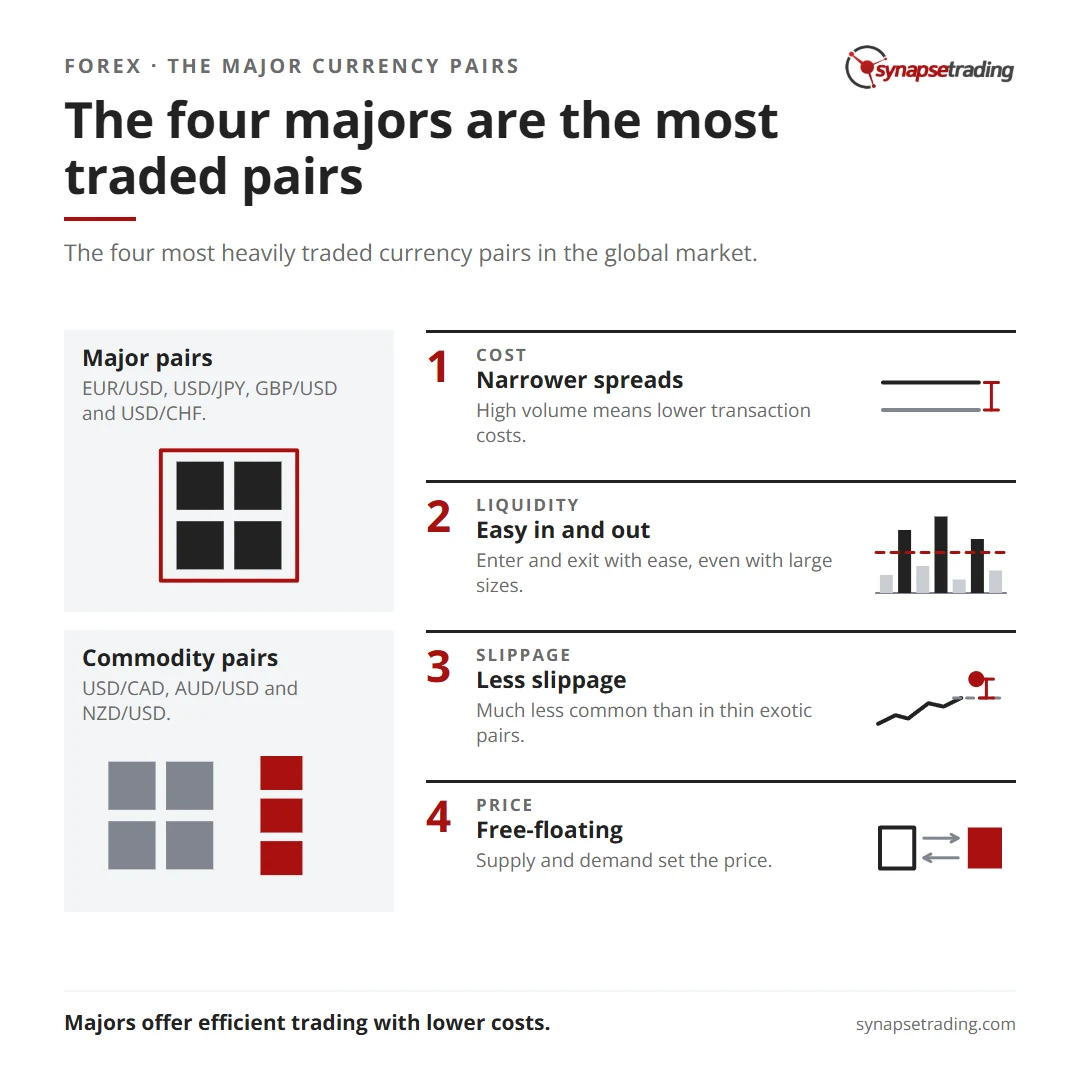
The major pairs in forex (FX) trading are the four most heavily traded currency pairs in the global market. These pairs are:
– EUR/USD (Euro/US Dollar)
– USD/JPY (US Dollar/Japanese Yen)
– GBP/USD (British Pound/US Dollar)
– USD/CHF (US Dollar/Swiss Franc)
These major currency pairs are all deliverable currencies and are part of the Group of Ten (G10) currency group. They not only facilitate significant economic transactions but are also among the most traded pairs for speculative purposes.
Understanding the Major Pairs
The major pairs are considered the driving force behind the global forex market, attracting the most trading volume. Although traditionally, the major pairs consist of four pairs, some traders also include USD/CAD, AUD/USD, and NZD/USD, known as “commodity pairs,” due to their significant trading volumes.
The five currencies that make up the major pairs—the U.S. dollar, euro, Japanese yen, British pound, and Swiss franc—are among the top seven most traded currencies as of 2021.
The EUR/USD pair is the world’s most traded currency pair, accounting for more than 20% of all forex transactions. The USD/JPY pair comes in second, followed by GBP/USD and USD/CHF.
More than half of all forex trades involve the U.S. dollar, highlighting its central role in the global economy. Due to the commodity-based economies of Canada, Australia, and New Zealand, trading volumes in USD/CAD, AUD/USD, and NZD/USD often surpass those in USD/CHF and sometimes even GBP/USD.
Why Traders Trade the Major Pairs
The high trading volume of the major pairs attracts more traders, creating a cycle that maintains high volume levels. This high volume leads to narrower spreads between the bid and ask prices, making these pairs more attractive to traders. Narrower spreads mean lower transaction costs, which is a significant advantage for active traders.
High volume also ensures greater liquidity, allowing traders to enter and exit the market with ease, even with large position sizes. In contrast, lower-volume pairs may experience more significant price movements when large positions are traded, making it harder to execute trades without affecting the market.
High volume also reduces the risk of slippage, where trades are executed at a price different from the expected price. While slippage can still occur in major pairs, it is much less common than in thinly traded exotic pairs.
How Are Prices of the Major Pairs Determined?
The currencies of the major pairs are free-floating, meaning their prices are determined by supply and demand. Central banks may intervene to control currency prices, but typically only to prevent extreme price movements that could cause economic harm.
Supply and demand for these currencies are influenced by various factors, including economic conditions, interest rates, future expectations for the country’s economy, and current market positions.
Example of a Major Pair Price Quote and Fluctuation
Currency prices are constantly fluctuating, especially for the major pairs due to the high volume of orders. The current rate is shown via a currency quote.
For example, the price of the EUR/USD could be 1.15, meaning it costs $1.15 to buy €1. If the rate rises to 1.20, the euro has appreciated because it now costs more dollars to buy €1. Conversely, if the rate drops to 1.10, it costs less USD to buy a euro, indicating that the US dollar has appreciated or the euro has depreciated.
A currency chart can visually represent these price fluctuations, showing whether the base currency (euro in this case) is appreciating or depreciating relative to the quote currency (US dollar).
Concluding Thoughts
The major pairs in forex trading play a pivotal role in the global financial market due to their high trading volumes and liquidity. Understanding these pairs is essential for traders, as they offer opportunities for efficient trading with lower transaction costs and reduced risk of slippage. Whether for economic transactions or speculative trading, the major pairs are the cornerstone of the forex market, influencing currency movements worldwide.
Want the daily routine? Enter your email for the free 15-Minute Swing Trader's Checklist.
Free 5-page PDF, then occasional trading emails. Education only, not financial advice. Unsubscribe anytime. Kit stores your email in the US: see our privacy policy.
Want to learn the full method? The Trading Mastery Program teaches the 4 strategies I have traded since 2011. It suits beginners and experienced traders.
Rather follow the trades as they happen? Daily Trading Signals is our Telegram channel: my trade ideas with entry, stop and exit, and every trade is public.
Questions about this post? Ask in the free Telegram channel →
Educational content only, not personalised financial advice. Trading carries risk, including loss of capital. Past performance is not indicative of future results. Synapse Trading is not licensed or regulated by MAS.

