

What is a Base and Quote Currency?
Want the daily routine? Get the free 15-Minute Swing Trader’s Checklist. Get it free →
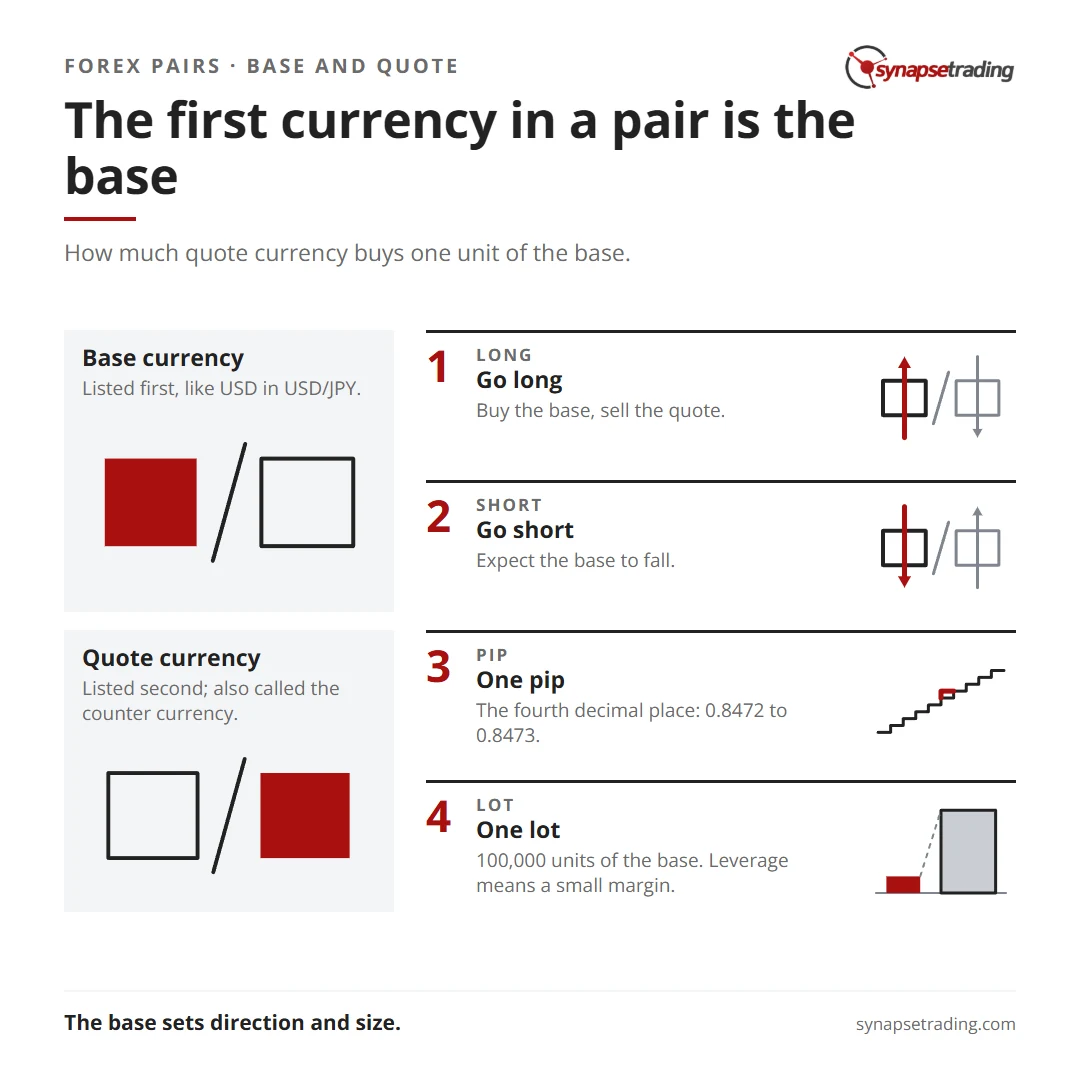
The base currency is the first currency listed in a currency pair, such as USD/EUR, where the U.S. dollar (USD) is the base currency. The second currency in the pair is known as the quote or counter currency. If you are “long” on the currency pair, you are betting that the base currency will increase in value relative to the quote currency. Conversely, if you are “short” on the pair, you expect the base currency to decrease in value relative to the quote currency.
Definition and Examples of Base Currency
The base currency is always the first currency listed in a currency pair, while the second currency is referred to as the quote or counter currency. The currency pair quote indicates how much of the quote currency is needed to purchase one unit of the base currency.
Currency pairs are essential in forex trading because you are simultaneously selling one currency and buying another. When you take a long position in a currency pair, you are effectively betting that the base currency will strengthen against the quote currency.
Currency pairs are usually represented by three-letter abbreviations of the base currency followed by the counter currency. Among the most commonly traded pairs is USD/EUR, where the U.S. dollar is the base currency, and the euro is the counter currency. A quote of 0.8472, for example, means that it takes 0.8472 euros to buy one U.S. dollar.
The U.S. dollar serves as the base currency in most major currency pairs, including USD/JPY (Japanese yen), USD/CHF (Swiss franc), and USD/CAD (Canadian dollar).
However, there are notable exceptions where the U.S. dollar is not the base currency, such as in GBP/USD (British pound as the base currency) and AUD/USD (Australian dollar as the base currency), even though the U.S. dollar is still part of the pair.
How a Base Currency Works
In currency trading, when you go long on a currency pair, you are buying the base currency and selling the quote currency. Factors like local interest rates, trade balances, and economic growth can influence the preference for one currency over another.
Currency trading occurs both on regulated exchanges, known as Forex (short for “foreign exchange”), and in off-exchange markets.
Currency pairs are quoted in small increments called “pips,” with one pip representing the fourth decimal place in most currency pair quotes (equal to 0.01% of one currency unit). For example, a quote of 0.8472 would increase to 0.8473 or decrease to 0.8471 with a one-pip movement.
Like stocks, currency pairs have bid-ask prices. The buyer pays the ask price, while the seller receives the bid price, with the market maker earning the difference, known as the spread. More frequently traded currency pairs typically have lower spreads due to higher trading volumes, allowing exchanges to profit from the sheer volume of trades.
Trades are typically conducted in “lots,” which represent 100,000 units of the base currency. While this may seem like a significant investment, forex trading can involve leverage, meaning that traders might only need a small percentage of the lot’s value as margin. For example, with a 2% margin requirement, a trader would only need $2,000 in their account to control a $100,000 trade.
What It Means for Individual Investors
Understanding the base currency is crucial when trading currency pairs. The base currency not only determines the direction of the trade—whether you expect it to rise or fall relative to the quote currency—but also affects the size of the trade. For instance, if you trade with the U.S. dollar as the base currency, the trade is based on a $100,000 lot size. If you trade with a currency significantly stronger or weaker than the U.S. dollar, it can substantially impact the margin requirements for your account.
Concluding Thoughts
The base currency plays a pivotal role in forex trading, as it defines the direction and scale of trades within a currency pair. Understanding the concept of base currency is essential for making informed trading decisions, particularly when considering the impact of lot sizes and margin requirements. For individual investors, mastering this concept is key to successful forex trading, as it directly influences the potential for profit or loss in the market.
Want the daily routine? Enter your email for the free 15-Minute Swing Trader's Checklist.
Free 5-page PDF, then occasional trading emails. Education only, not financial advice. Unsubscribe anytime. Kit stores your email in the US: see our privacy policy.
Want to learn the full method? The Trading Mastery Program teaches the 4 strategies I have traded since 2011. It suits beginners and experienced traders.
Rather follow the trades as they happen? Daily Trading Signals is our Telegram channel: my trade ideas with entry, stop and exit, and every trade is public.
Questions about this post? Ask in the free Telegram channel →
Educational content only, not personalised financial advice. Trading carries risk, including loss of capital. Past performance is not indicative of future results. Synapse Trading is not licensed or regulated by MAS.

