

Understanding Price Action Summary: Bob Volman on Which Breakouts to Trade
Want the daily routine? Get the free 15-Minute Swing Trader’s Checklist. Get it free →
How Volman reads the 5-minute chart: the buildup test, five setups, a fixed 1:2 bracket, and the trades he skips
Published: 22 October 2026 · Last updated: 22 October 2026 · By Spencer Li, CFTe
Every breakout trader knows the feeling. Price pokes through a level, you buy, and ten minutes later the stop is gone.
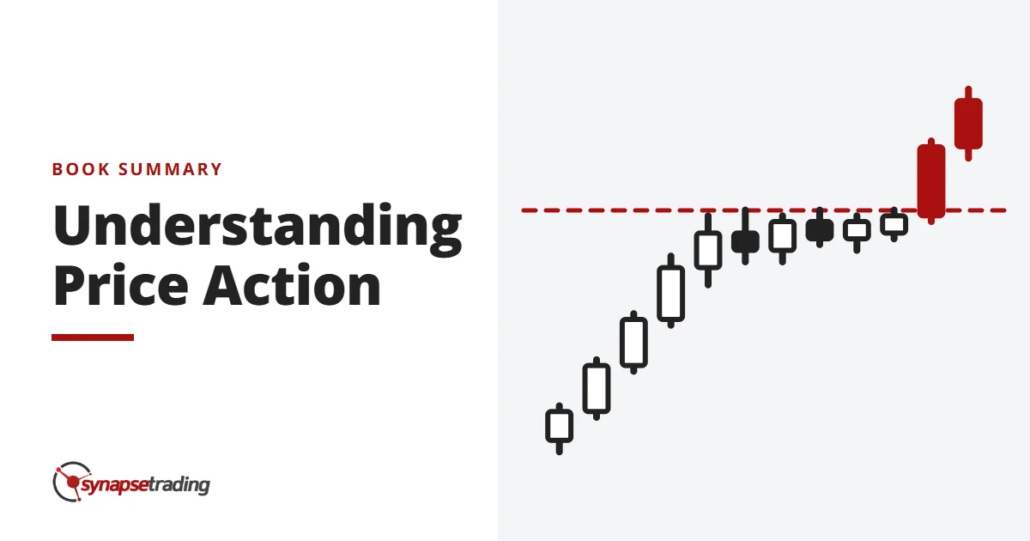
Understanding Price Action, Bob Volman’s 2014 book, is about telling those breaks apart before you take them. He trades the 5-minute EUR/USD chart with plain bars and one moving average. His answer fits in three words: “conditions are king.” A break is worth taking when bars have fought at the level first, when it runs with the side in control, and when nothing blocks the road to target. The rest he skips.
The book turns that into seven principles, five setups and one fixed exit, a 20 pip target against a 10 pip stop. Then it spends close to half its length on six months of annotated sessions.
Who is Bob Volman?
In the book’s own words, Volman is “an independent trader working solely for his own account.” He was born in 1961. His first book, Forex Price Action Scalping, came out in 2011. This is his second, signed off in July 2014. The book prints no track record and no win rate.
How is it different from Forex Price Action Scalping?
Our summary of Volman’s first book, Forex Price Action Scalping covers a very fast 70-tick chart. Readers kept asking whether its ideas worked on slower charts. The Preface says yes, because the principles “bear within them the universal laws of supply and demand,” in futures, indices, stocks, commodities and bonds too.
So the changes are practical. The chart slows to 5 minutes, with a 25-bar exponential moving average as the one tool. The setups become a closed list of five. And Part 2 walks through 132 consecutive trading days from March to August 2012.
What are the 10 key ideas at a glance?
| Key idea | What it means at the screen |
|---|---|
| 1. Conditions are king | Judge the bars before the break, never the break alone |
| 2. Trade with dominance | Go the way of the side making new highs or lows |
| 3. Double pressure | The best breaks force the losing side out in your direction |
| 4. False, tease and proper breaks | Only a fight at the barrier allows a tight stop |
| 5. The 25ema is a filter | Let price come back to the average before you enter |
| 6. Round numbers are magnets | The 00 and 50 levels pull price toward them |
| 7. Five named setups | Pattern break, pattern break pullback, combi, pullback reversal, trade-for-failure |
| 8. A fixed 1:2 bracket | 20 pip target, 10 pip stop, so one winner in three breaks even |
| 9. Skip far more than you trade | Clear high-odds trades come once or twice a session |
| 10. Size by percentage | Risk 1 to 2% per trade and let size follow the balance |
What does “conditions are king” mean in practice?
Imagine a level price has hit three times this morning. Now the bars shrink and huddle just under it, their highs tapping the same price. Volman calls that huddle buildup, and most of the book is about reading it.
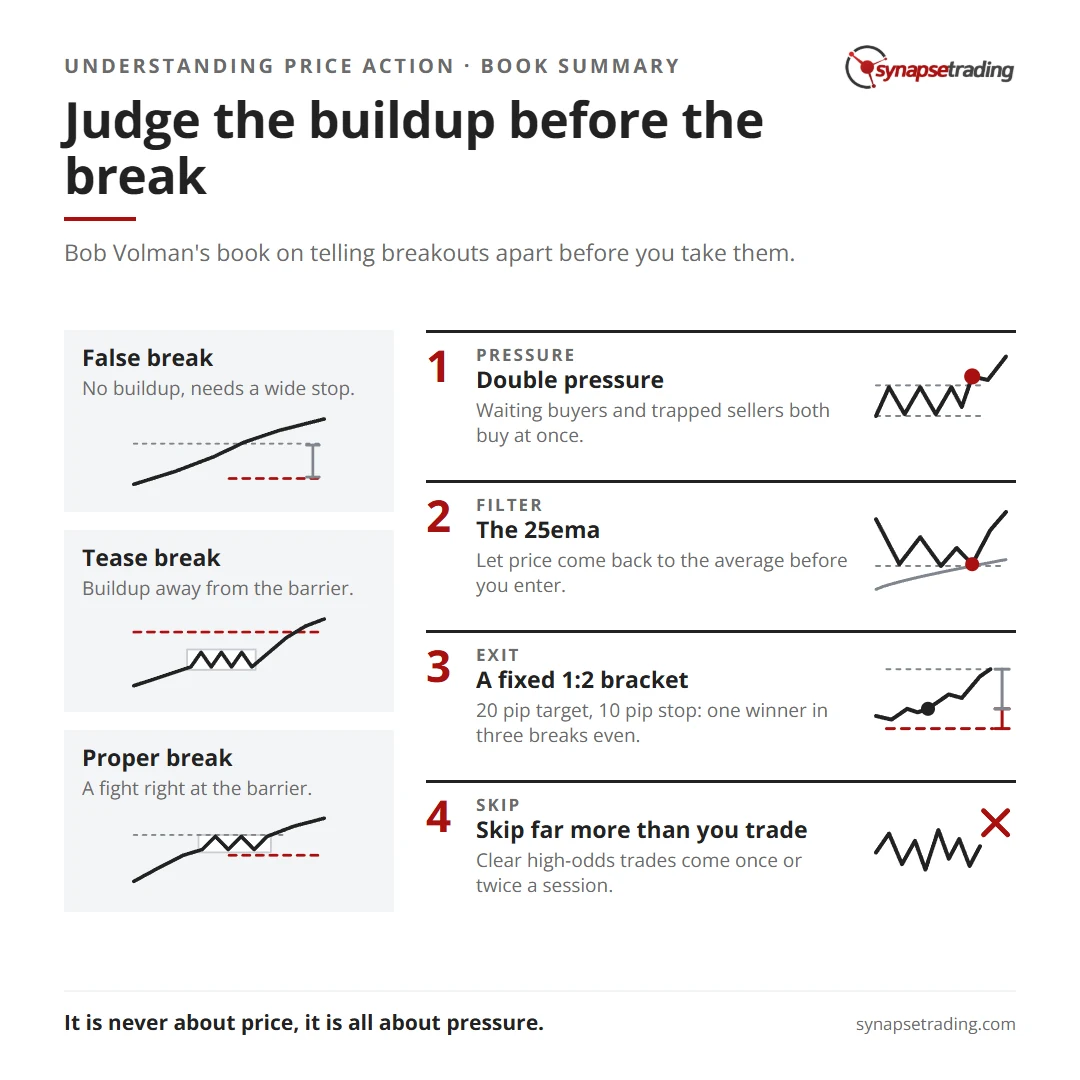
The reason is who sits inside that cluster. Buyers are waiting to jump in on the break. Sellers who shorted the level have their stops just above it. When the barrier gives way, both groups buy at once, one out of greed and one out of fear. He calls it double pressure, and it is what carries a break far enough to pay.
A straight run that slices through the level has none of that. Nobody was trapped, and the nearest sensible stop is a long way off. His rule is short: “If we don’t find buildup there, the offer is best declined.”
So he grades every break three ways. A false break has no buildup and needs a wide stop. A tease break has buildup away from the barrier, and often works only “second time around.” A proper break comes out of a fight right at the barrier, so the stop can sit just behind the cluster.
A proper break can still fail, since “it is never the outcome that determines these labels.” In his words, “it is never about price, it is all about pressure.” Our guide to false breakouts runs the same test on daily charts.
What are the seven price action principles?
Chapter 2 lists seven: double pressure, support and resistance, false, tease and proper breaks, false highs and lows, pullback reversals, the ceiling test, and the round number effect.
The 25ema sits over all seven as a filter. “The 25ema by itself never provides support or resistance, it is just an average.” Price keeps returning to it, which “turns the average into a perpetual magnet,” so an entry far from it has that magnet pulling the wrong way. For one average on a slower chart, see the best indicators for swing trading.
What are the five trade setups?
Each setup fires the same way. A signal bar forms in the right spot, and the trade goes on when the next bar takes out its high or low “by a pip.”
- Pattern break. A break out of a tight cluster at a barrier, often squeezed against the 25ema.
- Pattern break pullback. The first break was missed or badly built, so you wait for price to return to the broken level.
- Pattern break combi. A powerbar, then a small inside bar. Volman calls the pattern “just a tool with which to time an entry.”
- Pullback reversal. An orderly pullback of roughly 50 to 60% that reaches the 25ema and turns.
- Trade-for-failure. A break against the dominant side falls apart, and you trade the counterbreak with dominance.
The fifth looks contrarian, but it runs with the trend.
Why a fixed 20 pip target and a 10 pip stop?
Because the bracket takes the exit out of your hands. A trader prone to fear or greed, Volman says, “is probably better off putting faith in his bracket rather than in his own perceptions.”
A winner is +2R and a loser is -1R. Take 30 trades and say only 10 reach target:
10 winners × 2R = +20R, and 20 losers × 1R = -20R. You are flat.
Win 12 of the 30 and it becomes +24R against -18R, a gain of 6R. The selection rules only have to beat one winner in three.
The settings “do not claim to represent the ideal target and stop,” and in quiet markets he cuts the target to 8 to 10 pip. The habit underneath is deciding the exit before the entry, as in our guide on where to put your stop loss and take profit.
When does Volman say to skip a trade?
Far more often than he says to take one. Clear high-odds trades come “maybe once or twice a session in any one market.”
His seven typical errors make a pre-click check:
- Trading against a strong trend.
- Trading straight into support or resistance.
- Mistaking a range for a trend.
- Entering far from the 25ema, or near a round number.
- Trading a frantic market of oversized bars.
- Reversing a pullback full of aggressive powerbars.
- Front-running a break with too little buildup.
Suppose you catch yourself counting bars to talk yourself into a trade. That effort is the answer: “if we have to look hard for a trade, it is probably not there.” On news he says to “shun the news rather than try to trade it,” and on EUR/USD he stands aside at 14:30 CET.
What does the book say about position size?
Chapter 10 calls sizing “an accounting matter.” You risk a fixed percentage on each trade, so size grows and shrinks with the account. He suggests 1 to 2%, and says “it is strongly advised not to risk more than 2 percent on a single wager.”
The shrinking half is what keeps an account alive. Every losing run is traded smaller, so he argues it is “virtually impossible to blow up an account” under the rule. Lose 1% on 20 trades in a row with size following the balance, and you are down about 18% rather than 20%. Our post on risk of ruin shows why bet size moves that number most.
Then he undercuts his own tables. A steady weekly score, he admits, is “virtually untenable in practice.” His advice: “Much more useful is to concentrate on improving consistency first.”
What does the book not tell you?
There is no win rate. Volman shows close to 400 charts but never totals the trades. Whether six months rules out cherry-picking can be argued, he grants, “but there is a limit to what a trading book can do.”
The charts are from 2012. By July 2014 he wrote of “record-low volatility” intraday and moved to a faster chart with smaller targets. So the 20/10 settings belong to a normally active market.
And there is no journal or scoring system. He asks you to backtest a year of data yourself.
Where the human edge comes in
Much of this book is easy to turn into rules. Distance from the 25ema, a round number inside your stop, a news release due, oversized bars. A scanner can flag all of them.
It cannot flag the rest. Is that cluster real buildup, or a dead market “trading into nothingness”? Is the pullback in proportion to the move before it, what Volman calls the harmony principle? He admits the line between a tease and a proper break “can be rather thin at times.”
His answer is study, a library in your head of situations “that you have seen fail or succeed many times before.” Then he warns against the belief that a repeating market can be called in advance. “It can’t. It can only be anticipated.”
The filters say when a trade is allowed. Turning down an allowed trade because the fight looks thin is a person’s judgement, built one session at a time.
Concluding thoughts
Understanding Price Action is a long book about one question: was this break built well enough to take? Volman answers with a short set of tests and a fixed exit, then shows hundreds of sessions where the tests decide.
For his faster, earlier method, read our Forex Price Action Scalping summary. For the probability thinking behind a fixed stop, see our Trading in the Zone summary. For the wider shelf, see the best investing and trading books of all time.
So think back to your last three losing breakouts. Was there a fight at the level first, or did you buy a straight run into the barrier?
FAQ
What is Understanding Price Action by Bob Volman about?
It is a 2014 manual for trading breakouts on the 5-minute EUR/USD chart. Volman teaches you to judge the buildup before a break, trade with the dominant side, and exit on a fixed 20 pip target and 10 pip stop.
What moving average does Bob Volman use?
A 25-bar exponential moving average, the only tool on his chart. He uses it as a filter, never as support or resistance.
Does Volman’s method work outside forex?
He says the principles apply to futures, indices, stocks, commodities and bonds. The settings may need adjusting for each market’s range and speed.
Go deeper
Volman decides his exit before he enters. The free 15-Minute Swing Trader’s Checklist builds the same habit into a daily routine: the scan, the questions to ask before you enter, and the five rules that keep you in the game. You can get it at the end of this post.
About the author. Spencer Li is The 15-Minute Trader and the founder of Synapse Trading. He is a Certified Financial Technician (CFTe) with 15+ years of trading, run from 70+ countries. He holds a B.Acc and B.BM from SMU. Every trade he takes is public, dated, losses left in. He teaches rules-based swing trading in 15 minutes a day, one system for any market.
Educational content only, not personalised financial advice. Trading carries risk, including loss of capital. Past performance is not indicative of future results. Synapse Trading is not licensed or regulated by MAS.
Want the daily routine? Enter your email for the free 15-Minute Swing Trader's Checklist.
Free 5-page PDF, then occasional trading emails. Education only, not financial advice. Unsubscribe anytime. Kit stores your email in the US: see our privacy policy.
Want to learn the full method? The Trading Mastery Program teaches the 4 strategies I have traded since 2011. It suits beginners and experienced traders.
Rather follow the trades as they happen? Daily Trading Signals is our Telegram channel: my trade ideas with entry, stop and exit, and every trade is public.
Questions about this post? Ask in the free Telegram channel →
Educational content only, not personalised financial advice. Trading carries risk, including loss of capital. Past performance is not indicative of future results. Synapse Trading is not licensed or regulated by MAS.
