• Link to Facebook
  • Link to X
  • Link to Instagram
  • Link to Youtube
  • Link to LinkedIn
  • Link to Mail
Free PDF: The 15-Minute Swing Trader's Checklist, the daily routine of a trader since 2007
  • Shopping Cart Shopping Cart
    0Shopping Cart
Synapse Trading
  • Mentoring
    • Trading Mastery Program
    • All mentoring options
  • Signals
    • Daily trading signals
    • Signals trade log
  • Results
    • Student results and testimonials
    • Public trade log, losses left in
  • Free guides
    • Start here
    • Trading foundations
    • Technical analysis
    • Strategies and systems
    • Risk and money
    • Trading psychology
    • Markets and products
    • Free trading guides
    • Tools and resources
    • Blog
  • About
    • My background
    • My trading journey
    • Media and interviews
    • Travel log
  • Contact
    • Contact me
    • Partnerships
  • Start free
  • Student login
  • Click to open the search input field Click to open the search input field Search
  • Menu Menu

Tag Archive for: lifestyle trader

Spencer Li

Swing Trading vs Intraday Trading: Which Is Better If You Have a Day Job?

Trading Strategies & Systems
Swing or intraday trading? - trading styles

By Spencer Li, CFTe · Last updated: 26 October 2026

For most people who trade around a job, swing trading is the better choice. Intraday trading means opening and closing every position within the same day, so it needs you at the screen for the whole session. Swing trading means holding a position for days to weeks to catch a medium-term move, which you can run in about 15 minutes a day. Neither style is more profitable by default. But the best study I know of on people who tried to day trade for a living makes for grim reading, and I tried it myself for a couple of years before it started to cost me my health.

I first wrote about this in June 2018. Everything I have seen since has pushed me further the same way.

What is the difference between swing trading and intraday trading?

Ask most people what trading looks like and they describe a scene from a film. Someone sits in front of six screens, prices flashing, shouting orders and firing off trades at lightning speed. It is very much dramatised, but the person in that scene does exist, and he is a day trader.

The real difference between the styles is how long you hold a position, and everything else follows from that. Scalpers hold for seconds to minutes. Day traders hold for minutes to hours and close everything before the market shuts, so they carry nothing overnight. Swing traders take tactical positions to capture the medium-term trend and hold them for days to weeks. Position traders hold for months or years, which is closer to timing the market to build a long-term portfolio, as I described in how to build a $1M portfolio by 30.

Intraday tradingSwing trading
Holding periodSeconds to hours, nothing overnightDays to weeks
Screen timeThe whole sessionAbout 15 minutes a day
DecisionsMany, fast, under pressureFew, made when the market is closed or quiet
Income patternSmoother, more frequentLumpier, from fewer and larger moves
Fits a full-time job?RarelyYes
Main riskBurnout, costs and fast mistakesOvernight gaps, and impatience

The table hands neither side a profit edge, because the holding period does not create one. What it changes is how much of your time and nerve each trade asks for.

Why did I stop day trading?

The honest reason had nothing to do with strategy. I tried day trading for a couple of years, and the money was actually pretty good. But it started to take a toll on my health, and I decided that was a trade I did not want to keep making.

The only time in my career I was glued to the screen was when I was trading for a fund, and that was very early on. Being switched on for the whole session, every session, suits some people, and it did not suit me. Once I moved to swing trading, 15 minutes a day turned out to be more than enough to place and manage my trades, which left the rest of the day for the things that matter more.

The slower style also changed what I was trying to do. In my weekly outlook on 4 December 2025, I told viewers I had been deliberately taking fewer positions, because “the purpose is not really to take a lot of trades in a short amount of time. That will be more like day trading.” The aim with swing trading is to find a few good-quality positions and hold them.

If you want that routine without the screen time, my free 15-minute swing trader checklist is the one I run each day.

What happens to most people who try to day trade for a living?

Three economists in Brazil had something most researchers never get, which is the full record of every trader in a market. They looked at every individual who started day trading Brazilian equity futures between 2013 and 2015 and kept at it for at least 300 days. In their working paper, published in February 2020 as “Day trading for a living?”, Fernando Chague, Rodrigo De-Losso and Bruno Giovannetti report that 97% of them lost money.

The rest of the abstract does not cheer things up. Only 0.4% earned more than a bank teller. Even the best individual in the whole group earned a small daily sum, and the day-to-day swings around it, measured as a standard deviation, were about eight times larger, which is a lot of risk for that pay. And they found no evidence that people got better by day trading for longer.

They also wrote that day trading for a living is virtually impossible, “contrary to what course providers claim”. As a course provider, I read that line with some discomfort, and then agreed with it.

Do note the limits. This is one market, one product and one period, and nobody has run the same full census on swing traders, so I cannot show you an equivalent number for the slower style. What the study does show is how the fast game treats the typical person who plays it with real money.

Why do fast decisions go wrong more often?

I played a lot of competitive chess in school, and anyone who has played blitz knows the feeling. You can see the right idea, but the clock does not let you check it, so you play the move that looks right and find out a few seconds later that it was not.

The psychologists Christopher Chabris and Eliot Hearst measured this with the best players in the world. They took games from the Monaco tournaments, where top grandmasters played rapid games at under 30 seconds a move and classical games at about 3 minutes a move, and had a strong chess program flag every blunder. In their 2003 paper in Cognitive Science, the same grandmasters made 6.85 blunders per 1,000 moves in rapid games and 5.02 in classical games.

So less time meant about 36% more blunders. The psychologist Fernand Gobet, replying to the paper, made a fair point that the gap is small next to the total number of moves, and grandmasters do not turn into beginners when the clock speeds up. I agree with him. The blunder rate creeps up rather than explodes.

Now carry that over to trading, where the count matters. Suppose a day trader makes 20 decisions a day and a swing trader makes 20 a month. Even if each fast decision were only slightly worse, the day trader takes about 20 times as many chances to make one, and every mistake is paid for in money and in fees, with no draw on offer. Time pressure does not make you a bad trader. It just hands you more chances to be one.

Isn’t swing trading stressful too?

On 28 August 2025, a trader on Reddit’s r/swingtrading posted that they were quitting swing trading altogether. Their complaint was a fair one: “Even swing trading, you have to constantly monitor your stocks and stressing out daily.”

Reading their post, two things stood out. They described spending 4+ hours on research, and the final straw was two stocks that beat earnings and then fell. Both are choices about the routine, more than about the style. A swing routine that takes four hours a day has turned into day trading with longer holds. And earnings are where a swing trader is most exposed, because a stock can gap overnight on the result and skip straight past your stop. The only news rule in my own daily checklist is to not hold through earnings, for exactly that reason.

But I will concede the point that swing trading is not calm in every market. In my weekly outlook on 24 March 2026, with the market nervous, I said it gets “a bit harder to hold on to positions” at times like that. You might shorten the holding period, maybe do a bit of day trading, or wait for the trend to be clear. Some weeks, the slow style is uncomfortable too, and the honest answer is that waiting is part of the job.

That waiting is the real cost of swing trading. Your income is lumpier than a day trader’s, because it comes from fewer and larger moves. You need a ton of patience, first to wait for a clean setup, then to sit on your hands while the trade plays out. If watching a position do nothing for a week drives you up the wall, that is worth knowing about yourself early. A free 15-minute swing trader checklist helps here, because it gives the waiting a shape.

So which one should you choose?

The best style depends on your personality and how much free time you really have, and there is no universal winner. Two plain questions settle most of it.

  1. How much time can you give the market every day, on a normal week rather than your best one?
  2. Do fast decisions sharpen you or fray you? Be honest here, because most of us picture the calm version of ourselves, and the one who actually turns up is the one who slept badly.

If you can sit through the whole session and fast decisions energise you, intraday trading can suit you, and you go in knowing what the Brazil numbers say about the typical outcome. If you trade around a job, a business or a family, swing trading fits the life you already have, which is the reason I use it. Personally, I prefer the swing trading approach because it gives me the best return on my time and effort, and I have yet to meet anyone who regrets getting their afternoons back.
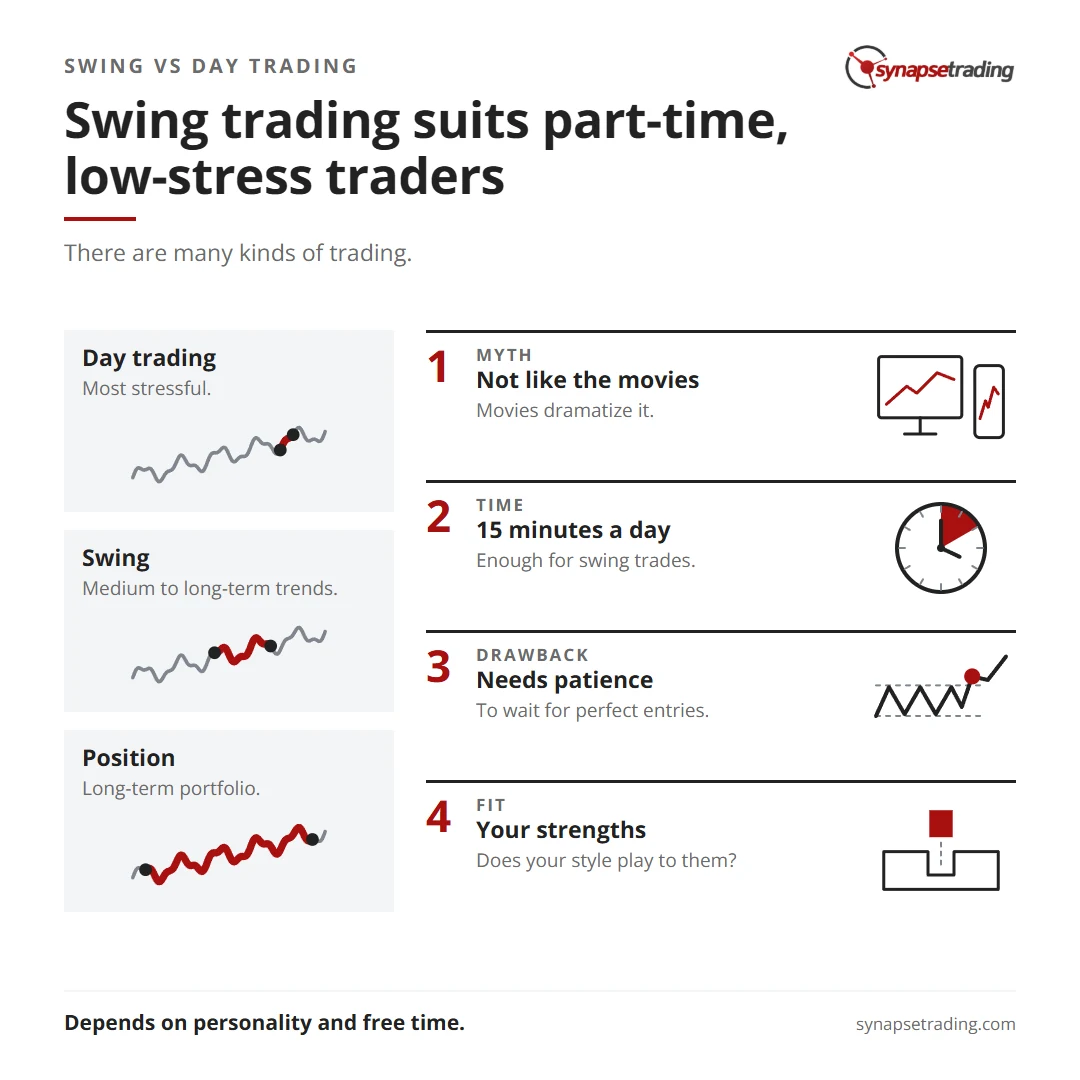
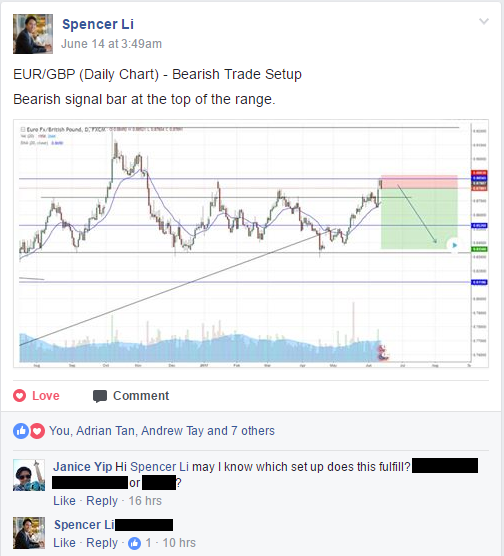
Swing trading suits part-time, low-stress traders. Summary card for the post: Swing Trading vs. Intraday Trading: Which is Better?.

If you are still sorting out which kind of trade you even want to take, the 4 types of trading strategies is a good next read. And if the fast end still tempts you, read what 0DTE options are before you try them.

FAQ

Is swing trading or day trading more profitable?
Neither is more profitable by default. A day trader takes more, smaller trades and a swing trader takes fewer, larger ones. A full census of Brazilian day traders who kept going for at least 300 days found that 97% lost money, published in a working paper in February 2020.

Is swing trading better for beginners?
For most beginners, yes. It needs about 15 minutes a day, fits around a job, and the slower pace gives you time to think through each decision rather than react under a clock.

Can I swing trade with a full-time job?
Yes. Swing trades are held for days to weeks and can be managed outside office hours, so you never need to watch the market while you work.

What are the drawbacks of swing trading?
Your income is lumpier, because it comes from fewer and larger moves. You hold positions overnight, so a gap on news or earnings can skip past your stop. And it asks for a lot of patience.

What is the difference between scalping and day trading?
Both close every position within the same day. Scalpers hold for seconds to minutes and take many tiny profits, while day traders hold for minutes to hours.


Which style do you trade now, and if you have tried both, which one did your health and your evenings prefer? Let me know in the comments.

If you are new to all of this, my free trading guides walk you through the basics in order.

And if you want a routine that fits around a full-time job, grab the free 15-minute swing trader checklist.


About the author. Spencer Li is The 15-Minute Trader and the founder of Synapse Trading. He is a Certified Financial Technician (CFTe) with 15+ years of trading, run from 70+ countries. He holds a B.Acc and B.BM from SMU. Every trade he takes is public, dated, losses left in. He teaches rules-based swing trading in 15 minutes a day, one system for any market.

Education, not financial advice. Synapse Trading is not licensed by MAS to advise on investment products. Trading carries risk of loss, and past performance is not indicative of future results.
by Spencer Li
https://synapsetrading.com/wp-content/uploads/2026/10/swing-trading-vs-intraday-trading-which-is-better-card.webp 630 1200 Spencer Li https://synapsetrading.com/wp-content/uploads/2026/10/synapse-logo-horizontal-light.png Spencer Li2018-06-13 23:21:092026-10-27 09:56:05Swing Trading vs Intraday Trading: Which Is Better If You Have a Day Job?
Spencer Li

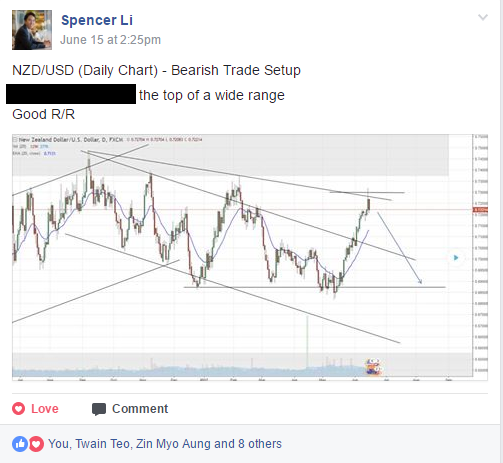
An Exciting Week of Trades – AUD/CHF, EUR/USD, NZD/USD, etc!

Market Analysis
Forex trades: AUD, EUR, NZD - forex

Last week, we had some pretty decent trades in, netting close to US$2,000 in profits for a handful of quick trades, riding on the strength of the USD after the FOMC.


An Exciting Week of Trades

An Exciting Week of Trades 2

An Exciting Week of Trades 3


Also took the chance to check out my new house:


Dropping by to check out my new #penthouse and do some measurements. With the recent hot weather, can’t wait another 2 weeks to try out my new #Jacuzzi! ? A big thanks to my #property agent and advisor @edwinjf18 for bringing me to view over 50 units in the last few weeks. Now I need to continue to work hard and study hard to farm more ? from the forex market for my next property! ?

A post shared by Spencer Li ?? Synapse Trading (@iamrecneps) on Jun 16, 2017 at 11:45pm PDT

For those who are keen to join our private network for timely trade calls, you can reserve your spot here, but do so early, as we only allow 20 new people to join each quarter!
Register: https://synapsetrading.com/the-synapse-program/

by Spencer Li
https://synapsetrading.com/wp-content/uploads/2026/10/exciting-week-trades-audchf-eurusd-nzdusd-etc-card.webp 630 1200 Spencer Li https://synapsetrading.com/wp-content/uploads/2026/10/synapse-logo-horizontal-light.png Spencer Li2017-06-20 06:19:082026-09-12 12:02:46An Exciting Week of Trades – AUD/CHF, EUR/USD, NZD/USD, etc!
Spencer Li

Dubai, South Africa and Lesotho: 3,000 km by Road in 2 Weeks

Travel & Lifestyle
Spencer at the Cape of Good Hope sign

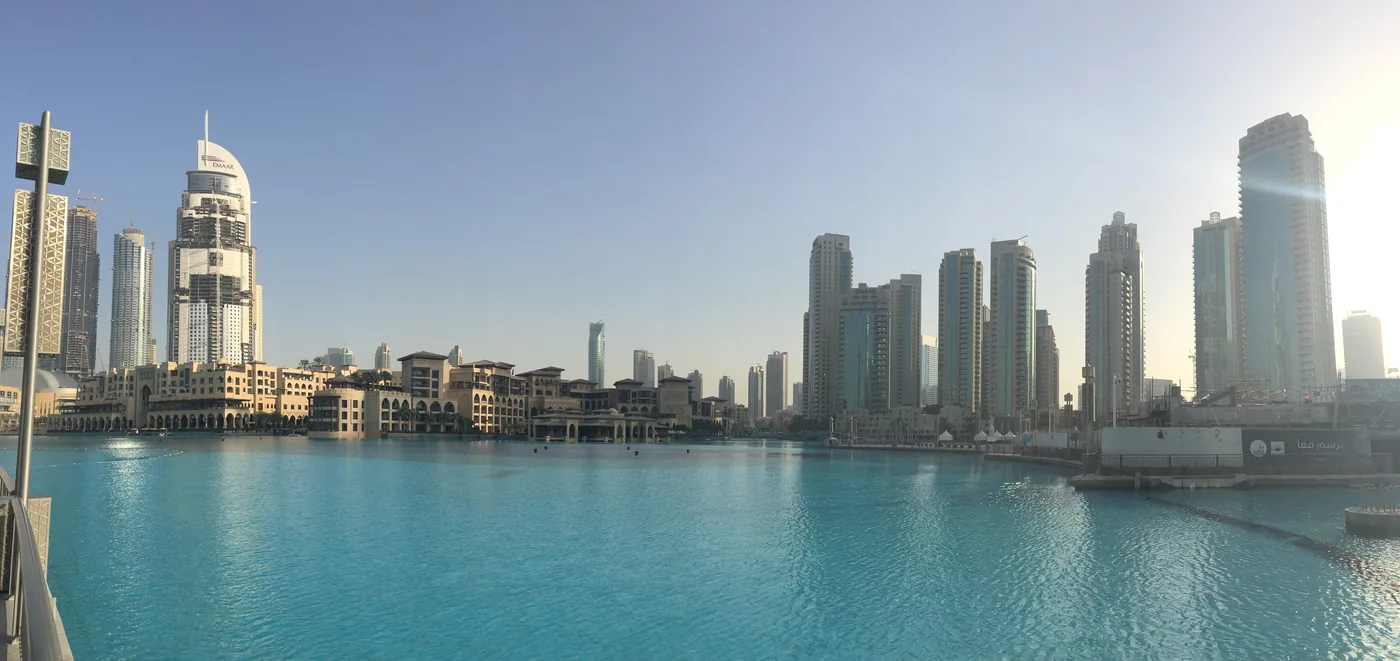
Over Christmas 2016 and into the New Year, a friend and I drove more than 3,000 km across South Africa and into Lesotho, with a stop in Dubai on the way.

It was my first time in Africa. In 2 weeks we went shark-cage diving, rode an ostrich, did a safari in our own car, and crossed into a country that many people have never heard of.

Downtown Dubai across the Burj Lake

How far is 3,000 km, really?

Spencer at the Cape of Good Hope sign
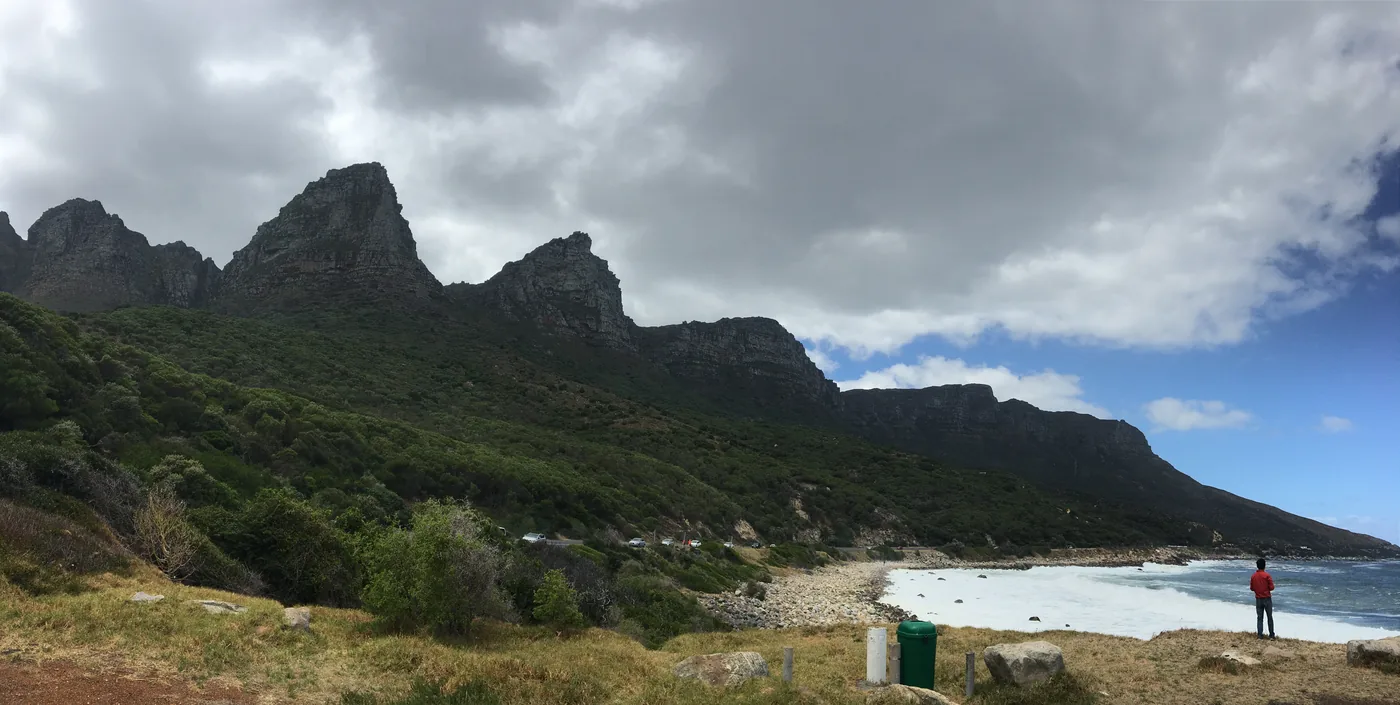
The coast road under the Twelve Apostles

Let me put the number in Singapore terms. 3,000 km over about 14 days works out to roughly 210 km a day, every day, on average. The drive from Singapore to Kuala Lumpur is about 350 km, so it is like doing more than half of that trip daily for 2 weeks straight.

The timing helped. December is midsummer in South Africa, so the days are long, with the sun setting in Cape Town at around 8pm, which matters a lot when you still have 200 km to cover after a late lunch.

So why drive at all, when a tour bus could do the work? South Africa drives on the left, the same side as Singapore, so the steering wheel sits on the side a Singaporean driver expects. And with our own car, we could stop for a view, a farm stall or a herd of something on the roadside whenever we wanted.

What is shark-cage diving actually like?

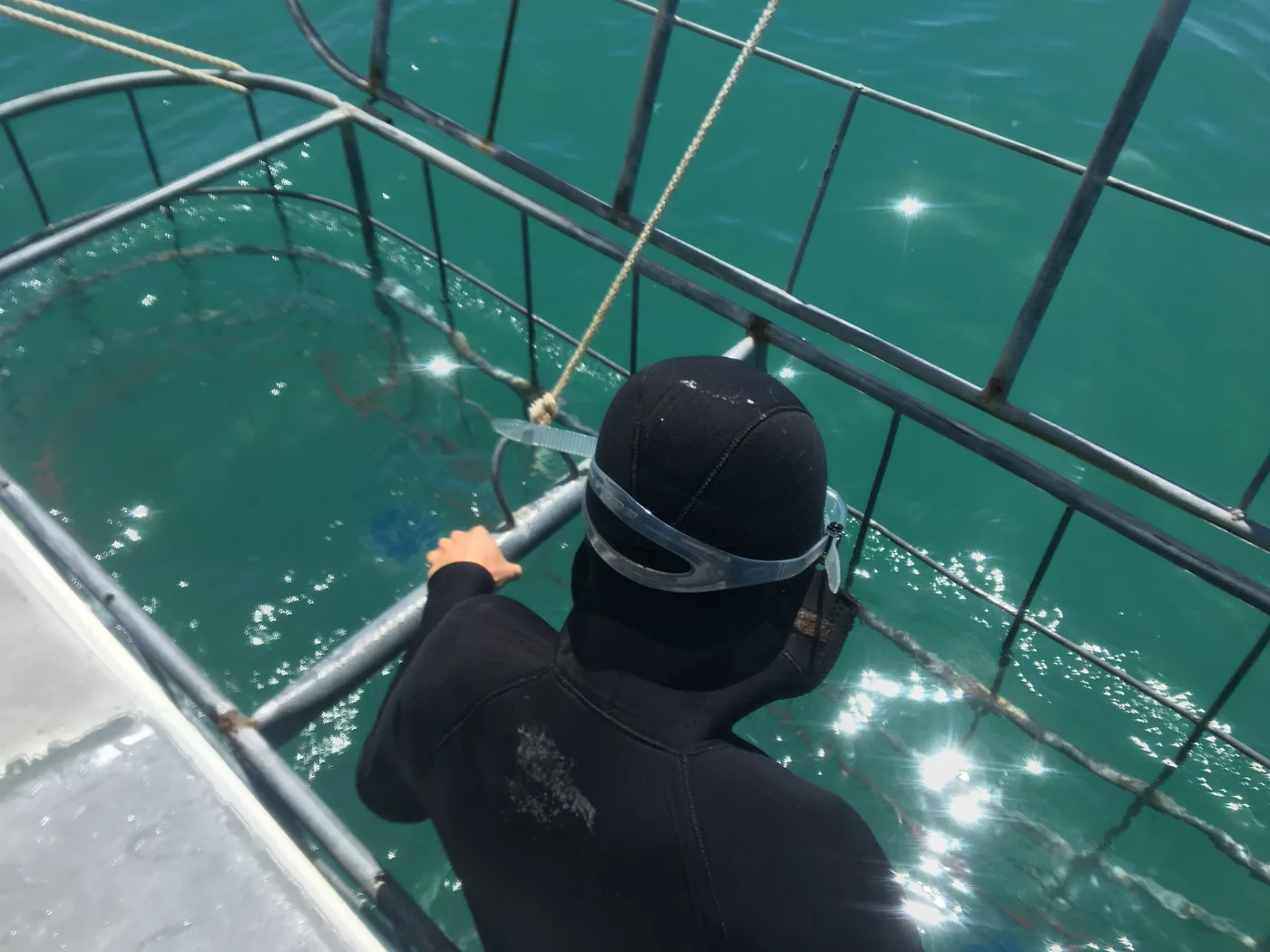
A diver in the shark cage
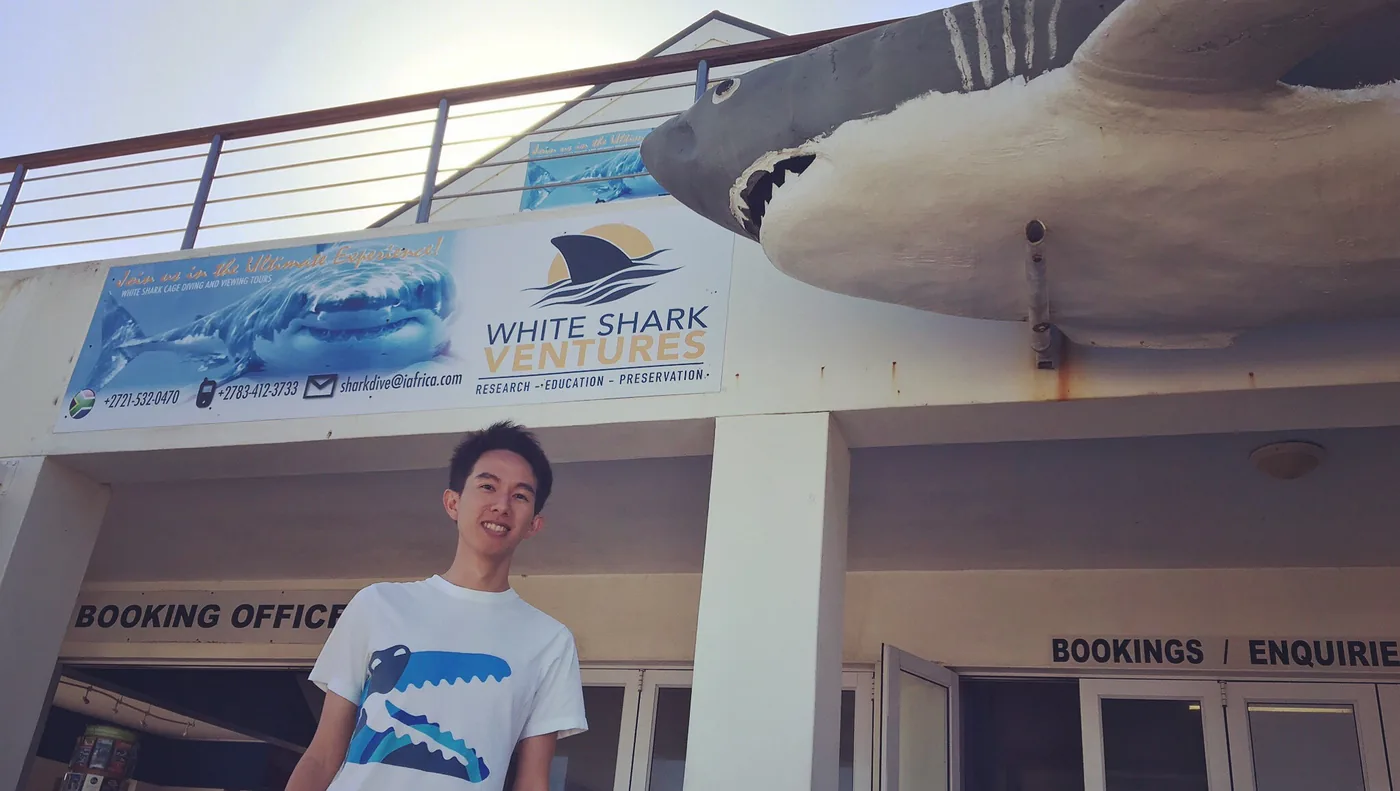
Spencer at the shark cage diving office

Here is how it works. A boat takes you out to where great white sharks feed, and a steel cage is tied to its side. You climb in wearing a wetsuit and a mask, the crew throws fish bait into the water to bring the sharks closer, and when one swims past, you hold your breath and duck under to watch it. You need no scuba licence for this, which suited me, because I snorkel and do not dive.

Did I really ride an ostrich?

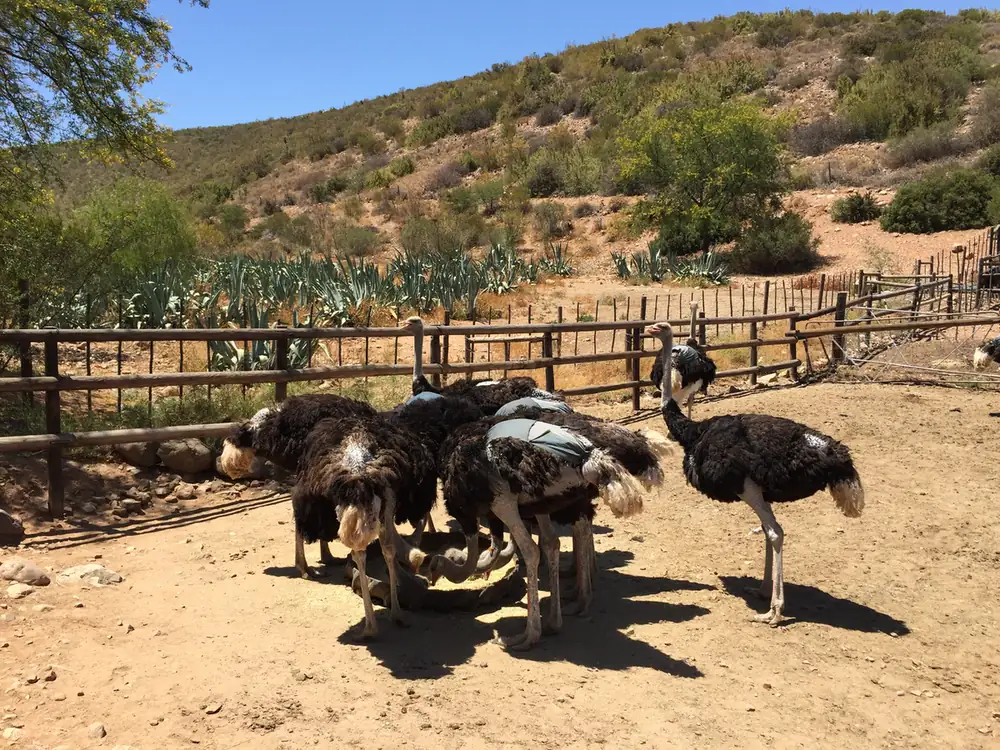
Ostriches at a feeder
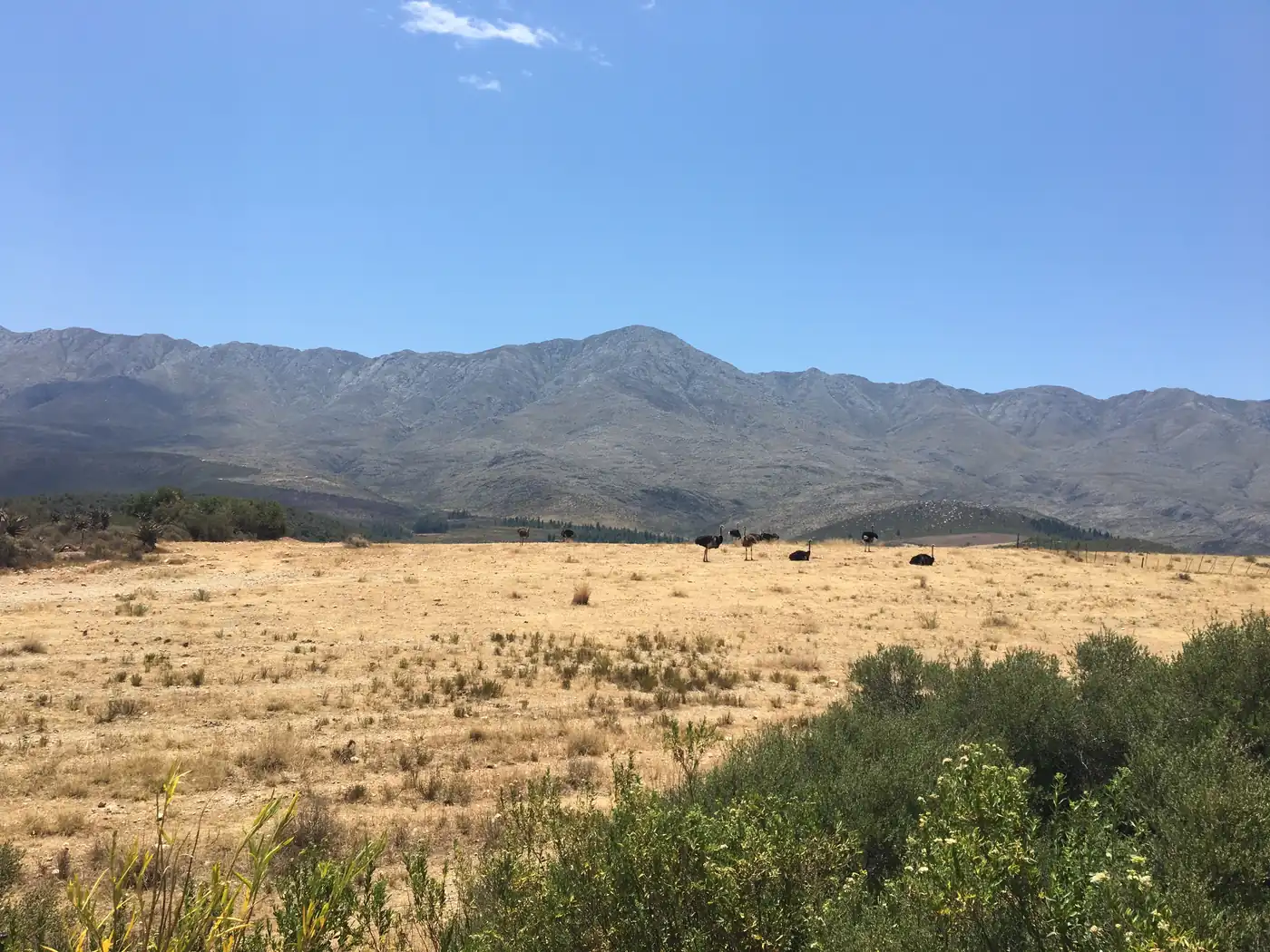
Ostriches on the Karoo veld

Yes, I did. It sounds like a joke, but the farms there offered rides to visitors.

The ostrich farms are around Oudtshoorn, in the Little Karoo, a town that got rich from ostrich feathers in the late 1800s, when every fashionable hat in Europe needed one.

How does a self-drive safari work?

A lone elephant by the road
An elephant mother and calf at a waterhole

Most people picture a safari as an open jeep with a ranger. In parks like Kruger, you can also do it yourself. We did ours in Addo Elephant National Park, near Gqeberha (Port Elizabeth). You drive your own car on the park roads, you stay inside it the whole time, you get out of the park before the gates close at sunset, and the animals are wherever they happen to be that day.

That last part is the whole game. You drive slowly, you scan the bush, and you watch for other cars stopped at odd angles, because that usually means someone has found something.

Is Lesotho really a country?

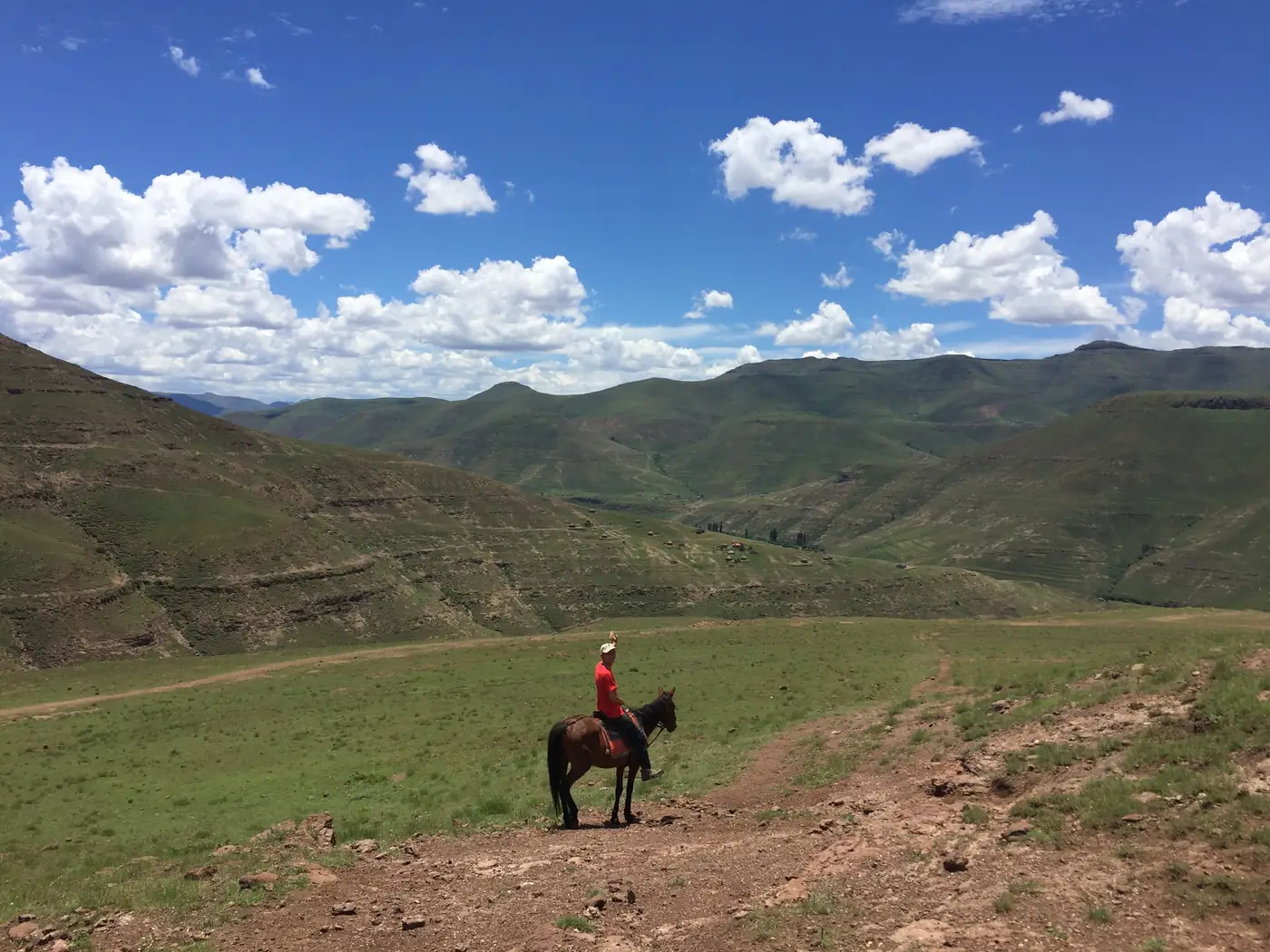
Spencer above a green valley in Lesotho
A tiny rider in a green valley

When I first told people I was going to Lesotho, I had to add, “Yes, this is a country!”

Lesotho is an independent kingdom completely surrounded by South Africa. Only 3 countries in the world sit entirely inside another one, and the other 2 are San Marino and the Vatican. The difference is altitude. The whole of Lesotho sits above 1,000 m, and its lowest point is around 1,400 m, which is why it calls itself the “Kingdom in the Sky”.

How did the trading fit in?

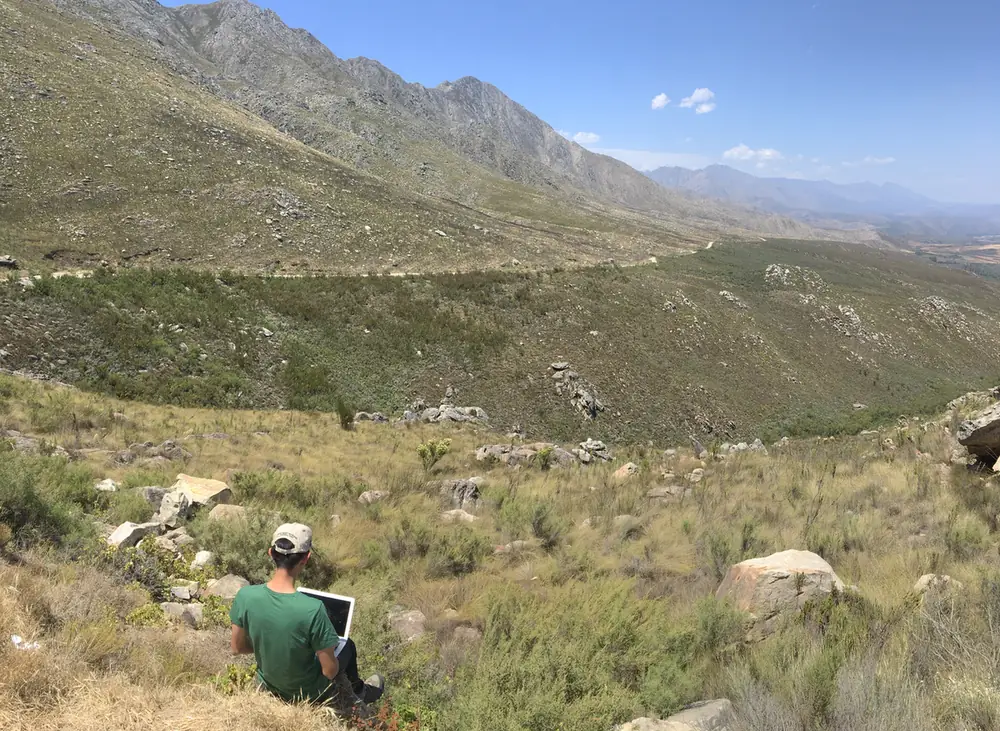
Working on a laptop on a hillside, South Africa

I kept trading the whole time, for about 15 minutes a day, just as I do at home.

That routine is the reason a 2-week drive across a continent is possible at all. I wrote up how it works, the watchlist, the alerts and the time zones, in how I trade while travelling.

What would I tell a friend planning this trip?

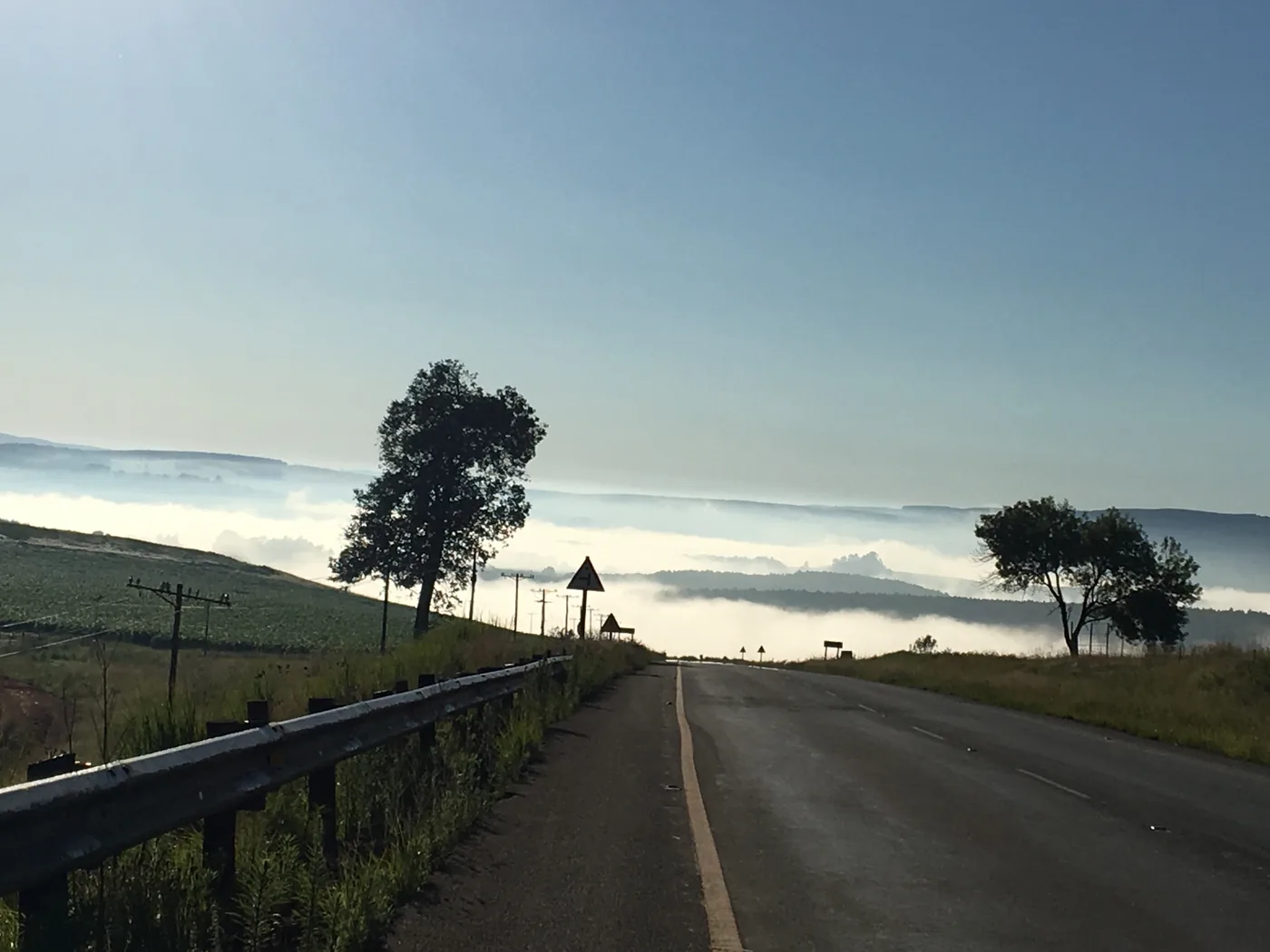
An empty dawn road, mist in the valley

If you are planning a South Africa road trip, the one thing I would tell a friend is to count the kilometres before you count the sights. The country is huge, the sights are far apart, and 210 km a day adds up fast when you also want time to stop.

This trip came 2 months after my trip to Ireland, Iceland and the UK, so I went from Iceland in October to South Africa in its midsummer.

Have you driven in South Africa? Would you get in the shark cage? Let me know in the comments.

All my other trips are on the travel log, country by country, and more photos are on Instagram, @iamrecneps.

Spencer Li

by Spencer Li
https://synapsetrading.com/wp-content/uploads/2026/10/dubai-south-africa-2017-spencer-at-the-cape-of-good-hope-sign.webp 783 1400 Spencer Li https://synapsetrading.com/wp-content/uploads/2026/10/synapse-logo-horizontal-light.png Spencer Li2017-01-29 02:47:142026-08-22 20:20:11Dubai, South Africa and Lesotho: 3,000 km by Road in 2 Weeks
Spencer Li

Iceland, Ireland and the UK: 18 Days from Dublin to London, with a Week in Iceland in Between

Travel & Lifestyle
A blue iceberg in Jökulsárlón

In October 2016, my sister and I spent 18 days in three countries: Ireland, Iceland and the UK. Iceland was on my bucket list, and this trip ticked it off.

The route was simple. We flew into London, went straight on to Dublin for 4 days, then flew to Reykjavík for 8 days, and finished with 4 days back in London before the long flight home to Singapore. So it went city, then a week of nature, then city again.

What do you do with 4 days in Dublin?

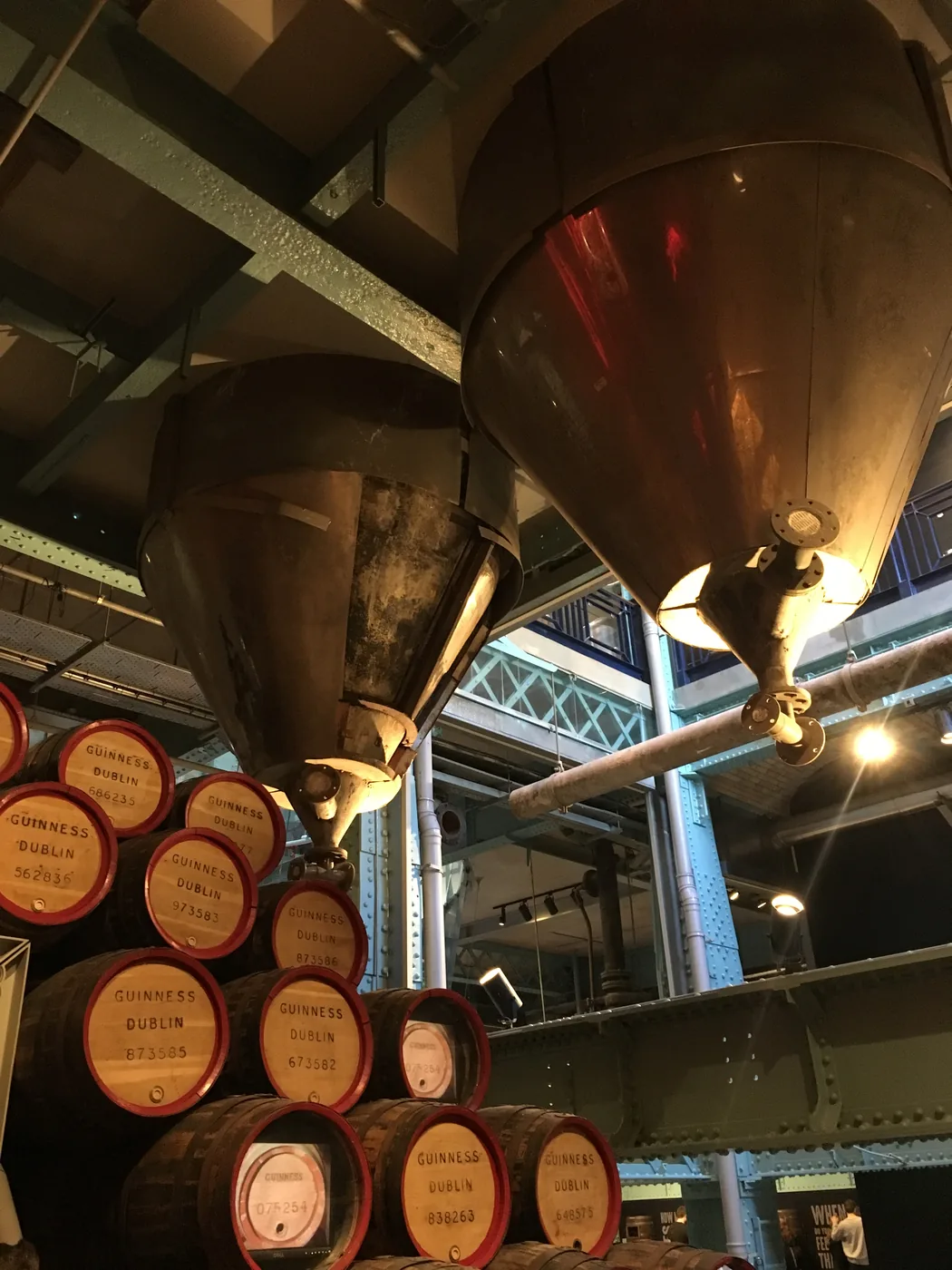
Copper vessels and barrels in the Guinness Storehouse
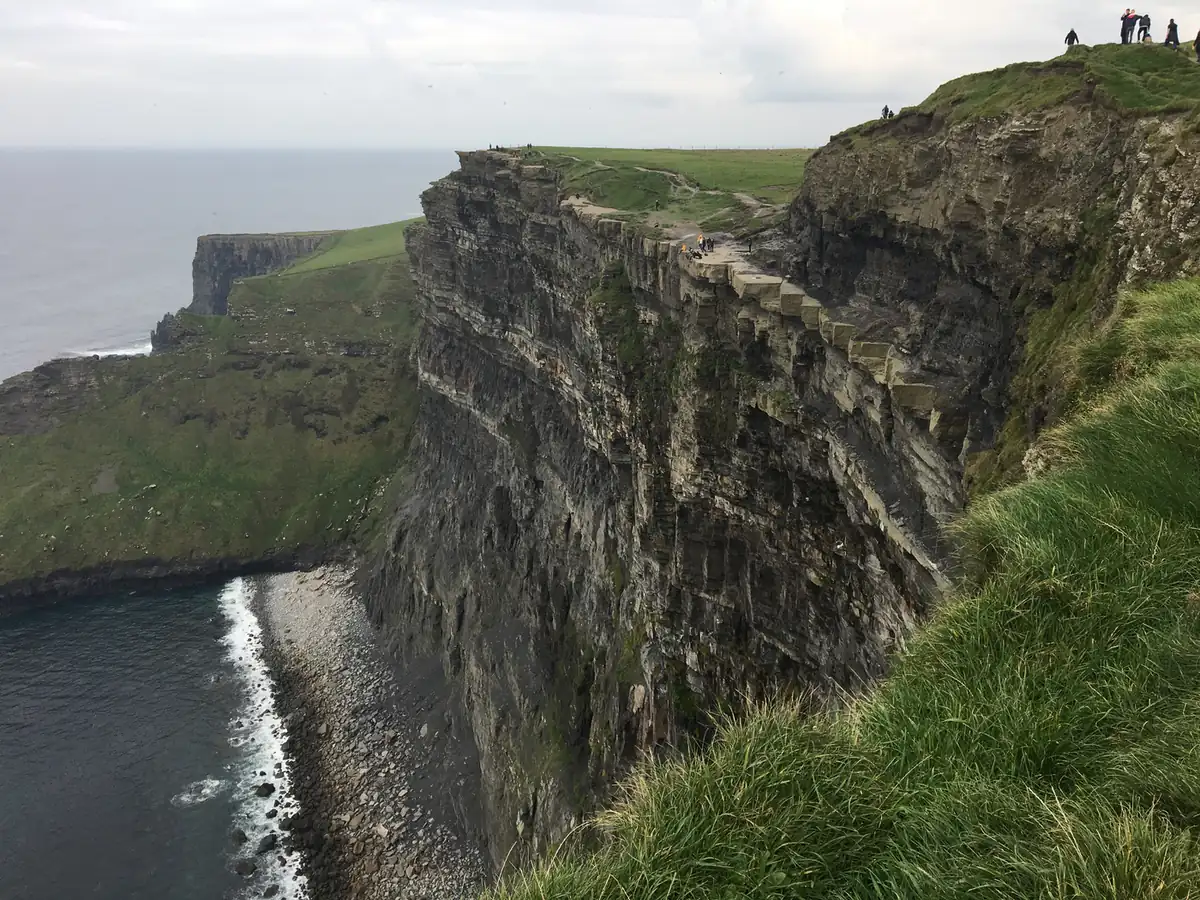
The Cliffs of Moher

We started with the big three sights in the city. The first was the Guinness Storehouse, where the tour ends with a pint in a glass bar on the top floor looking over the city. The second was Kilmainham Gaol, the old prison where the leaders of the 1916 Easter Rising were executed, which is a much heavier visit than the brewery. The third was Trinity College, home of the Book of Kells.

Then we took 2 day trips, the first to the Cliffs of Moher, which drop about 200 m into the Atlantic, and the second to Glendalough, a monastic site in the Wicklow Mountains, and on to Kilkenny.

What did we see first in Iceland?

Gullfoss from the rim
Strokkur erupting at Geysir

Iceland is about the size of South Korea, with fewer than 400,000 people, which is roughly 1 person for every 15 in Singapore.

Then came the nature part.

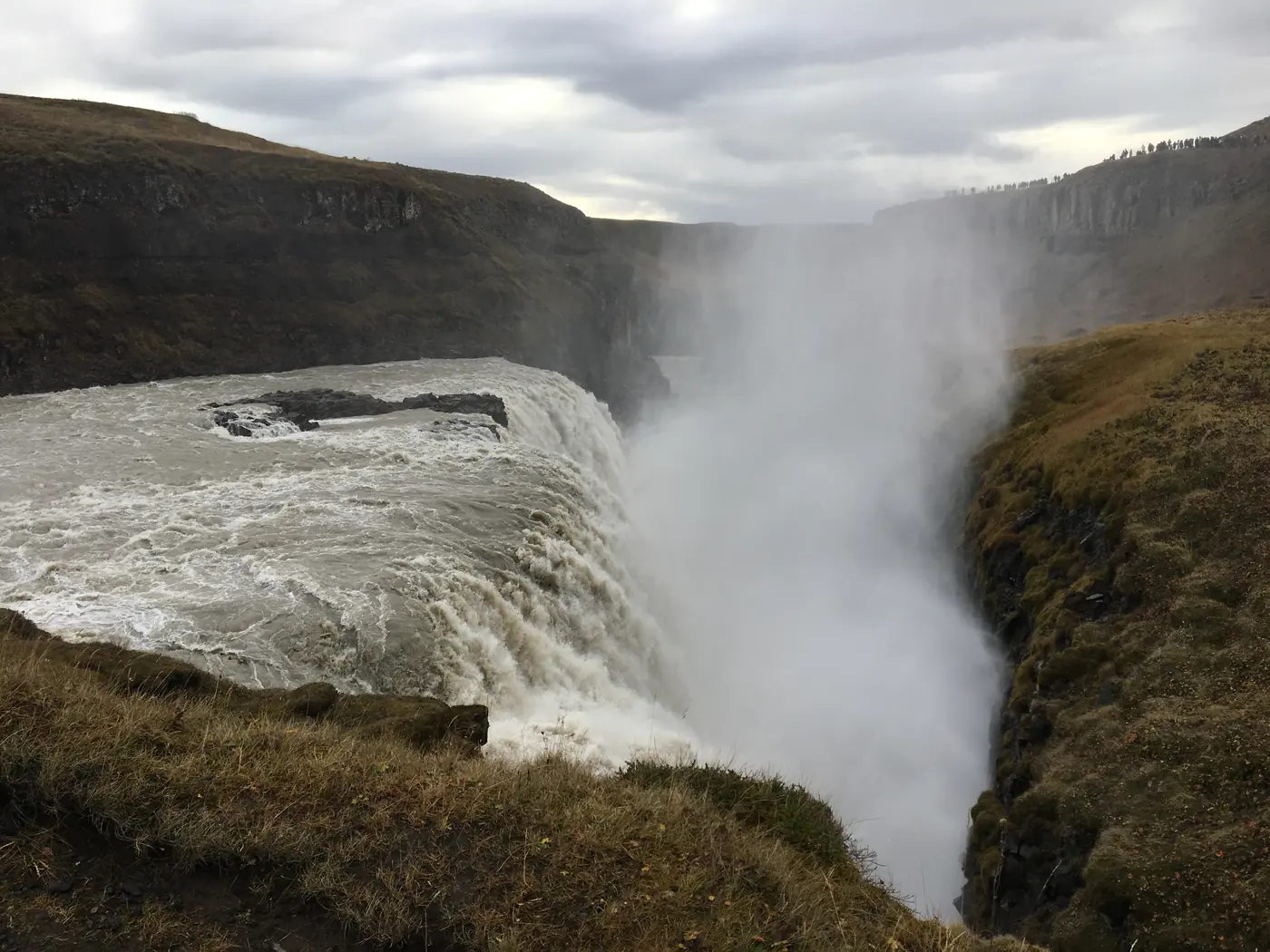
Most first-timers start with the Golden Circle, and so did we. Þingvellir is the national park where the old Icelandic parliament met from the year 930. Gullfoss is a huge two-step waterfall. And at Geysir, the Strokkur geyser shoots water into the air every few minutes, so a small crowd stands around it with phones up, waiting. We added Kerið, a crater lake with red volcanic walls, on the same loop.

What is on Iceland’s south coast?

A blue iceberg in Jökulsárlón
Kirkjufell

Iceland’s main highway, Route 1, is a loop of about 1,300 km around the whole island, and most people call it the Ring Road. Our stretch of it ran out from Reykjavík along the south coast.

The south coast is waterfall country. Skógafoss is a wide curtain of water you can walk right up to, and on a sunny day there is often a rainbow in the spray. Further east, about 370 km from Reykjavík, is Jökulsárlón, a lagoon where chunks of glacier break off and float out to sea. We also did a glacier hike nearby.

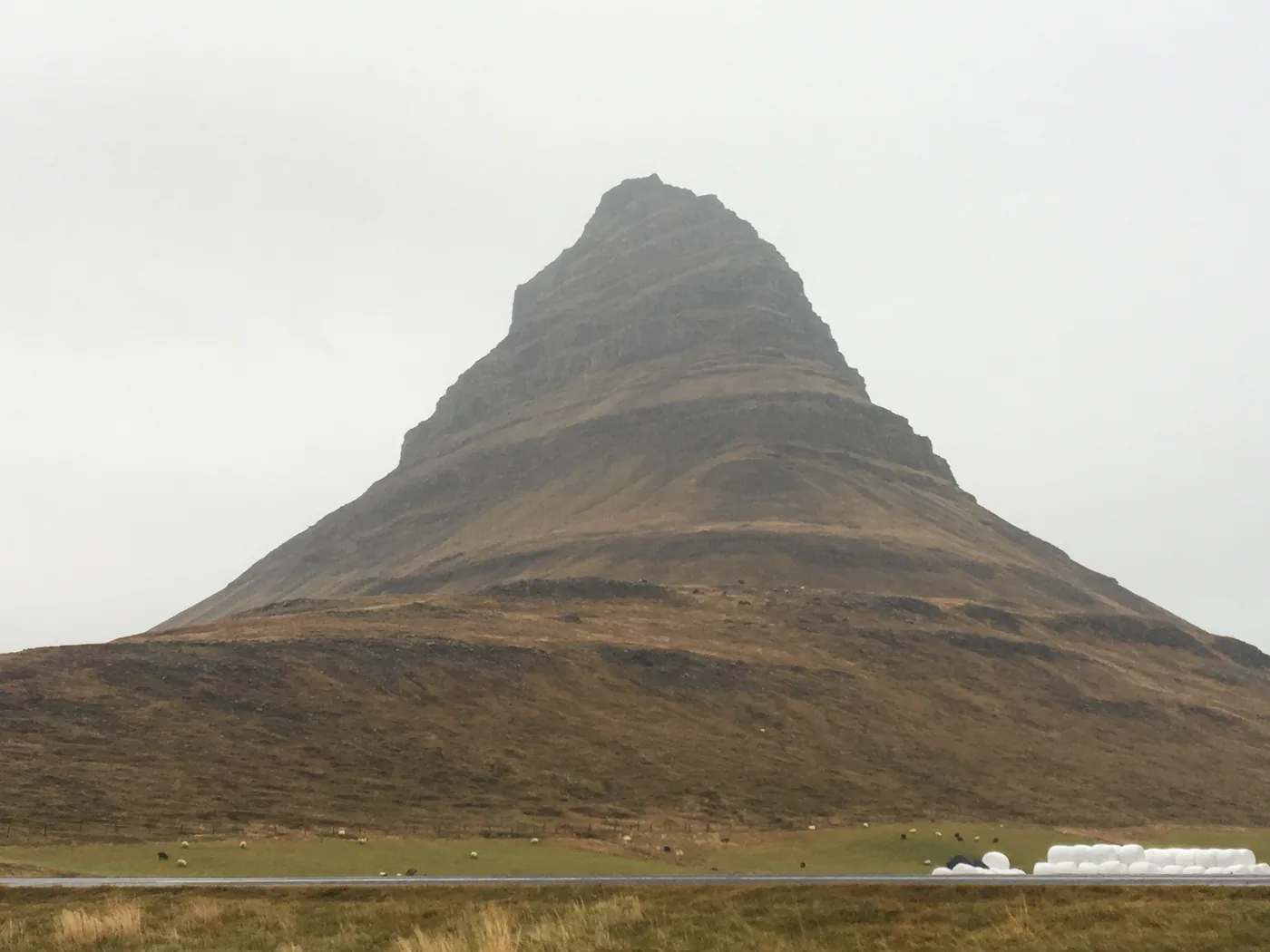
On a separate day, we went north to the Snæfellsnes peninsula, which people call “Iceland in miniature” because it has a bit of everything. It is also where Kirkjufell is, the mountain you may know from Game of Thrones.

Did we see the Northern Lights?

Hallgrímskirkja
Spencer in the Blue Lagoon

We tried, but no. October is early in the season, so it is never guaranteed, and it comes down to a clear night and some luck. We did not get either, so the Northern Lights are still a reason to go back.

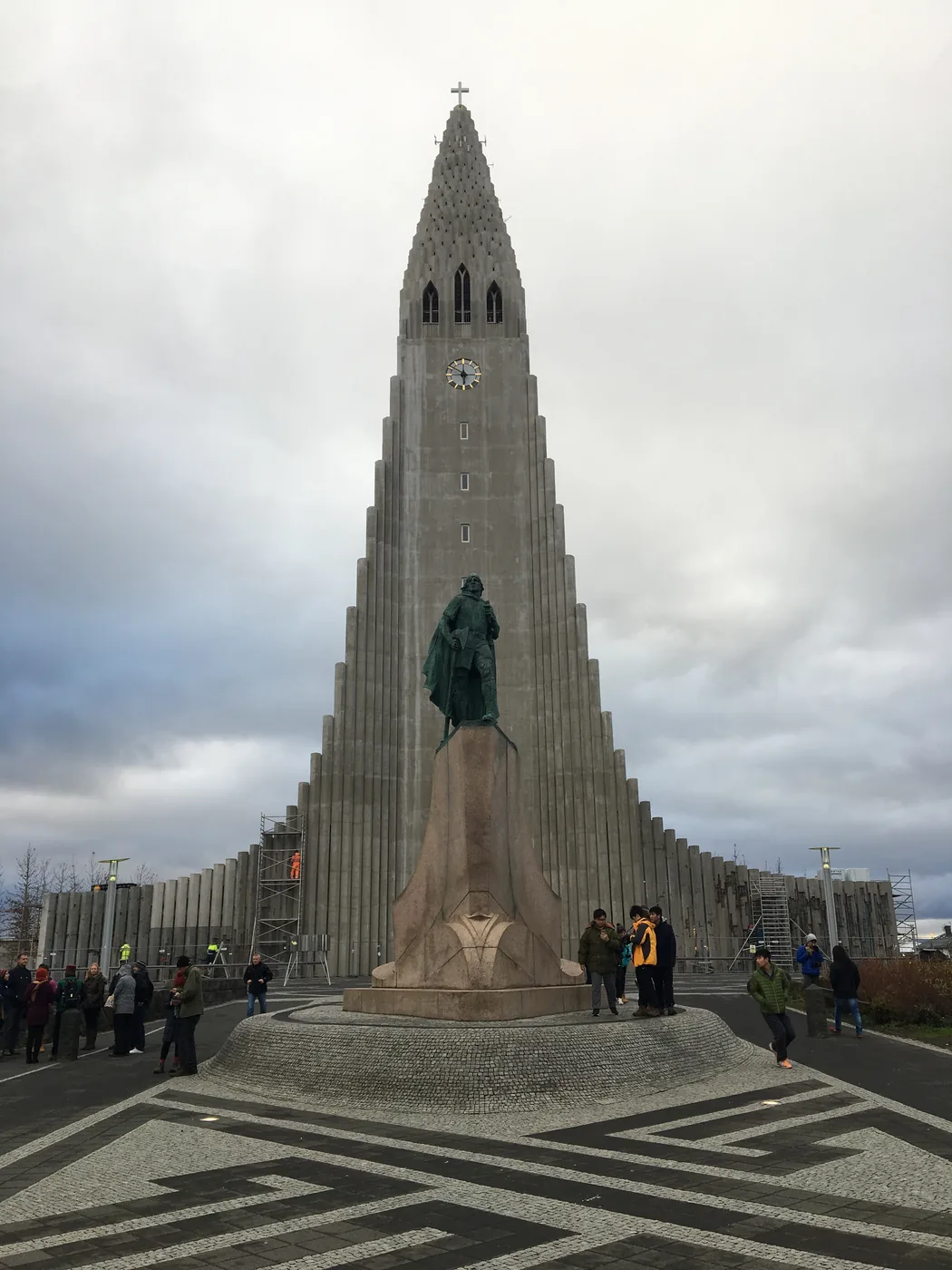
Back in Reykjavík, we did a free walking tour, the Sunday market, the Harpa concert hall and, on the way out, the Blue Lagoon.

What does Iceland taste like?

Icelandic lamb, langoustine and fish on one plate, Reykjavík

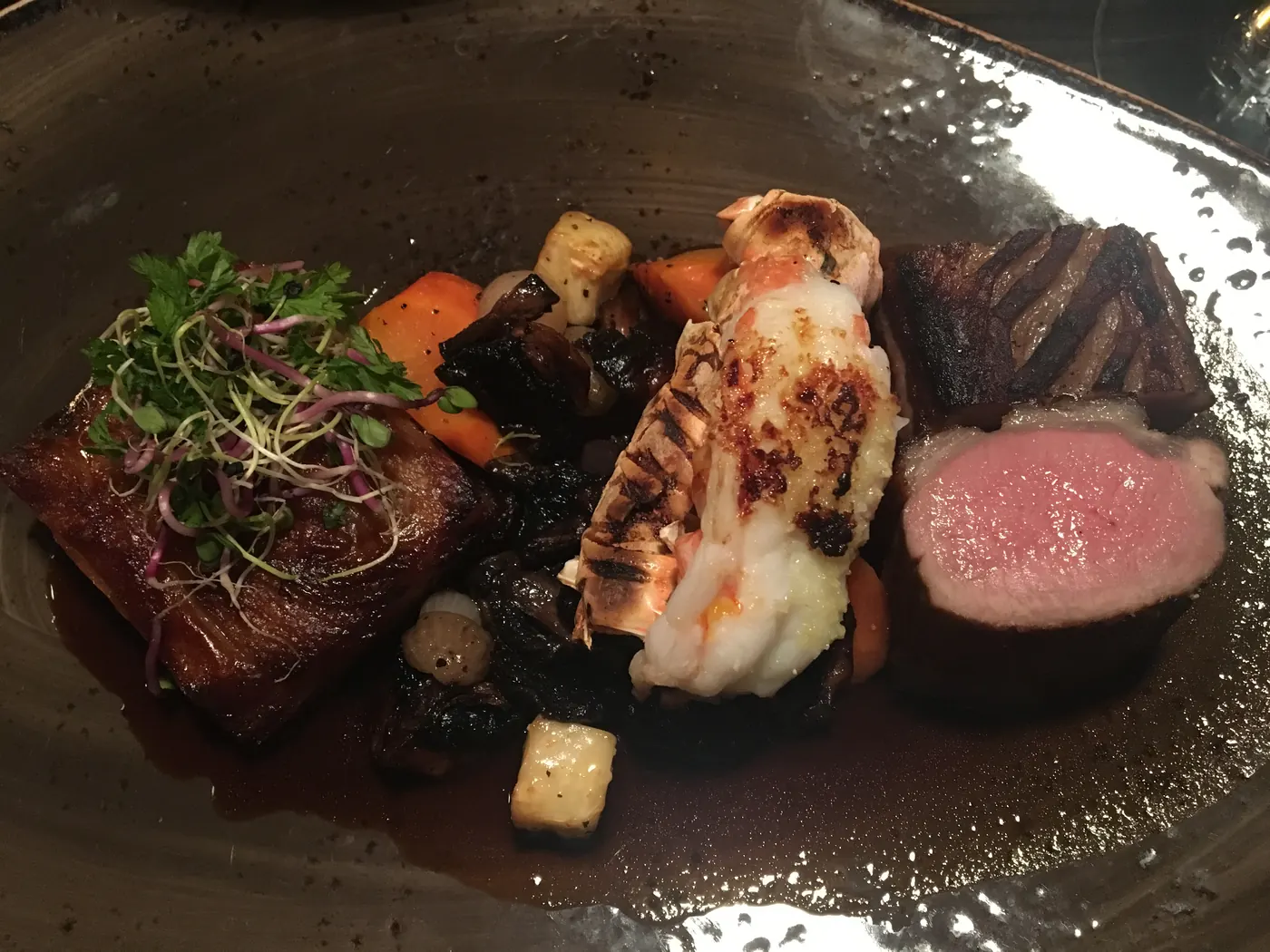
Icelandic food runs from comforting to challenging. At the comforting end, there is the lobster soup at Sea Baron, a small harbour-side place in Reykjavík. At the challenging end, we tried minke whale. And then there is hákarl, the fermented shark that Icelanders serve in a small cube with a shot of schnapps to wash it down. The smell of ammonia hits you first, and most people give up right there.

What did we do back in London?

The Hogwarts model, Harry Potter Studio Tour
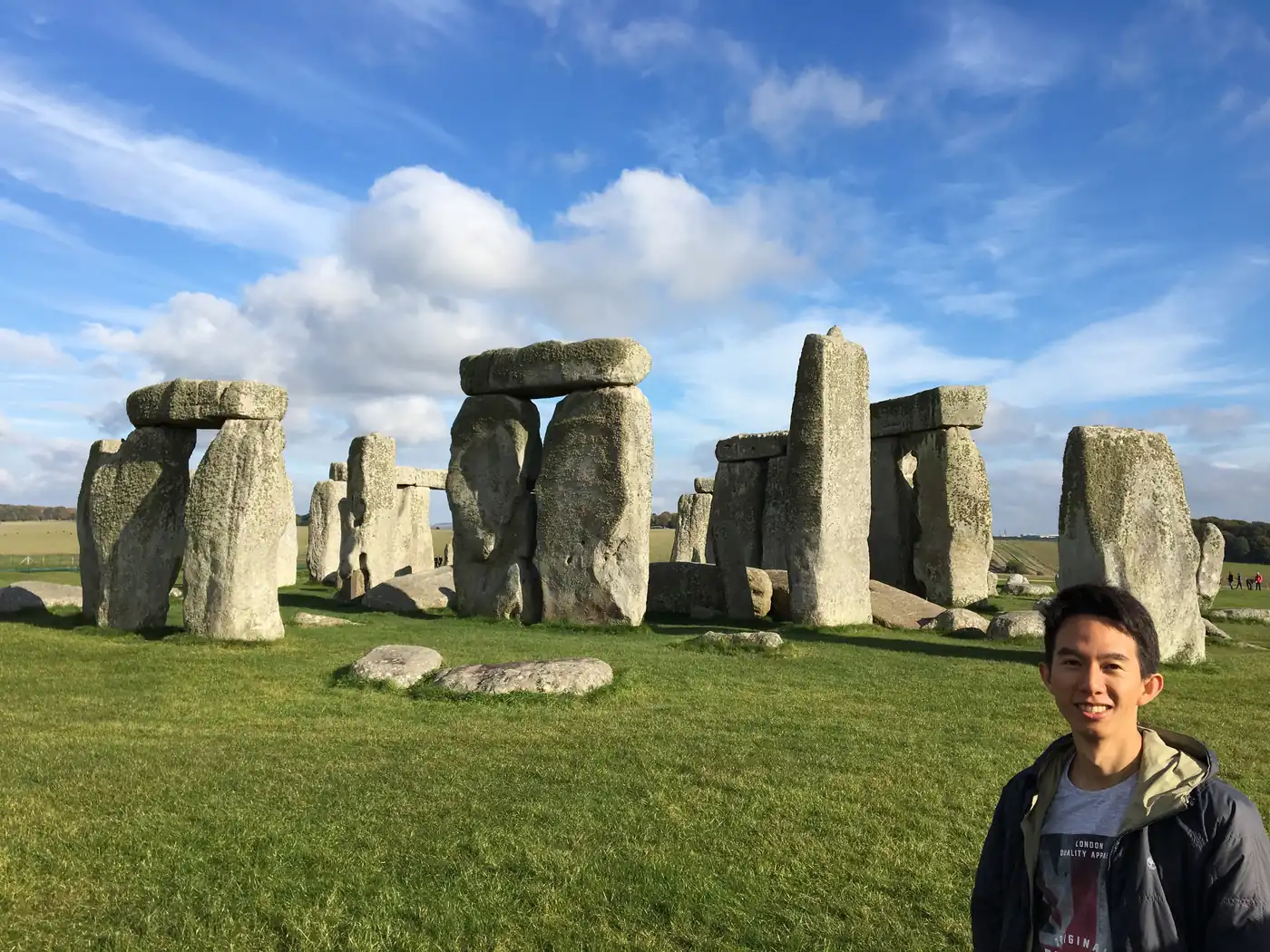
Spencer at Stonehenge

The last 4 days were London. We watched The Book of Mormon, had lunch at Gordon Ramsay’s Maze Grill, and did the Harry Potter Studio Tour. With friends who live in London, we took a day trip to Stonehenge and the Roman Baths in Bath. We also went to Dover for the white cliffs, and did a walking tour past Big Ben, the London Eye and Buckingham Palace for the changing of the guard.

How did the trading fit in?

The same way it always does, in about 15 minutes a day, and I kept supporting my students and traders from the road. Europe in October sits 7 to 8 hours behind Singapore, so the time zones need a little planning.

I wrote up how the routine works, the watchlist, the alerts and the time zones, in how I trade while travelling.

Where did I go next?

Two months later, I was off again, this time on a 3,000 km drive through South Africa and Lesotho.

Have you been to Iceland? Would you try the fermented shark? Let me know in the comments.

All my other trips are on the travel log, country by country, and more photos are on Instagram, @iamrecneps.

Spencer Li

by Spencer Li
https://synapsetrading.com/wp-content/uploads/2026/10/iceland-uk-2016-a-blue-iceberg-in-jokulsarlon.webp 1050 1400 Spencer Li https://synapsetrading.com/wp-content/uploads/2026/10/synapse-logo-horizontal-light.png Spencer Li2016-12-20 03:40:082026-08-05 20:43:13Iceland, Ireland and the UK: 18 Days from Dublin to London, with a Week in Iceland in Between

Free checklist

The 15-Minute Swing Trader’s Checklist

The daily and weekly routine I use to find, manage and review trades in about 15 minutes a day, trading since 2007.

Get the free checklist

Topics

  • Trading foundations
  • Technical analysis
  • Strategies and systems
  • Risk and money
  • Trading psychology
  • Markets and products

Synapse Trading

Swing trading for busy professionals, in 15 minutes a day.

Start free

Learn

  • Start here
  • Free trading guides
  • Blog
  • Tools and resources

Programs

  • Trading Mastery Program
  • Daily trading signals
  • Student results
  • Public trade log

Company

  • About
  • Contact me
  • Partnerships
  • Disclaimer
  • Privacy policy
  • Terms & Conditions

Synapse Trading Pte Ltd
Registration No. 201316168H
WhatsApp +65-8897-1204
info@synapsetrading.com

Contact Us

Synapse Trading Pte Ltd
Registration No. 201316168H

Whatsapp: +65-8897-1204
Telegram: @iamrecneps
Email: info@synapsetrading.com

Links

Disclaimer
Privacy policy
Terms & Conditions
Contact us
Partnerships

© 2012-2026 Synapse Trading | All rights reserved. Educational content only, not personalised financial advice. Trading carries risk, including loss of capital. Past performance is not indicative of future results. Synapse Trading is not licensed or regulated by MAS.
  • Link to Facebook
  • Link to X
  • Link to Instagram
  • Link to Youtube
  • Link to LinkedIn
  • Link to Mail
Scroll to top Scroll to top Scroll to top
Manage Consent
To provide the best experiences, we use technologies like cookies to store and/or access device information. Consenting to these technologies will allow us to process data such as browsing behavior or unique IDs on this site. Not consenting or withdrawing consent, may adversely affect certain features and functions.
Functional Always active
The technical storage or access is strictly necessary for the legitimate purpose of enabling the use of a specific service explicitly requested by the subscriber or user, or for the sole purpose of carrying out the transmission of a communication over an electronic communications network.
Preferences
The technical storage or access is necessary for the legitimate purpose of storing preferences that are not requested by the subscriber or user.
Statistics
The technical storage or access that is used exclusively for statistical purposes. The technical storage or access that is used exclusively for anonymous statistical purposes. Without a subpoena, voluntary compliance on the part of your Internet Service Provider, or additional records from a third party, information stored or retrieved for this purpose alone cannot usually be used to identify you.
Marketing
The technical storage or access is required to create user profiles to send advertising, or to track the user on a website or across several websites for similar marketing purposes.
  • Manage options
  • Manage services
  • Manage {vendor_count} vendors
  • Read more about these purposes
View preferences
  • {title}
  • {title}
  • {title}