

Parabolic Stop and Reversal (PSAR) Indicator
Join our Telegram channel for more market analysis & trading tips: t.me/synapsetrading
The Parabolic SAR (Stop and Reverse) is a technical indicator developed by J. Wells Wilder, used by traders to identify potential trend reversals and to determine suitable entry and exit points in the market. The indicator is visually represented on a price chart as a series of dots, either above or below the asset’s price, which helps traders quickly assess the current trend direction.
Table of Contents
Key Features of the Parabolic SAR:
- Trend Direction: If the dots are below the price, the market is in an uptrend. Conversely, if the dots are above the price, the market is in a downtrend.
- Reversal Signals: A reversal signal occurs when the dots switch sides (e.g., from below to above the price), indicating a potential change in trend direction. However, this signal doesn’t guarantee an actual price reversal; it only shows that the price has crossed the indicator line.
Formula for the Parabolic SAR:
The Parabolic SAR formula differs slightly depending on whether the trend is rising or falling:
- Rising SAR (RPSAR): RPSAR=Prior PSAR+[Prior AF×(Prior EP−Prior PSAR)]\text{RPSAR} = \text{Prior PSAR} + [\text{Prior AF} \times (\text{Prior EP} – \text{Prior PSAR})]
- Falling SAR (FPSAR): FPSAR=Prior PSAR−[Prior AF×(Prior PSAR−Prior EP)]\text{FPSAR} = \text{Prior PSAR} – [\text{Prior AF} \times (\text{Prior PSAR} – \text{Prior EP})]
Where:
- AF (Acceleration Factor): Starts at 0.02 and increases by 0.02 up to a maximum of 0.2 each time the extreme point (EP) makes a new high (for rising SAR) or low (for falling SAR).
- EP (Extreme Point): The highest high in an uptrend or the lowest low in a downtrend.
Calculation Steps:
- Monitor price for at least five periods, recording the highs and lows (EPs).
- Determine if the trend is rising or falling, and use the corresponding SAR formula.
- Set the initial AF at 0.02 and adjust as new EPs are recorded.
Interpretation:
- Buy/Sell Signals: Generated when the SAR dots flip from above to below the price or vice versa. A flip below the price indicates a buy signal, while a flip above the price indicates a sell signal.
- Trailing Stops: The SAR can also be used as a trailing stop loss to protect profits in a trending market.
Limitations:
- Constant Signal Generation: The Parabolic SAR always generates signals, which may lead to false signals in a sideways or range-bound market.
- Reversal Signals: These may occur even without an actual price reversal, as the SAR line catches up with the price due to the acceleration factor.
Comparing Parabolic SAR with Moving Averages:
While both the Parabolic SAR and Moving Averages (MA) are trend-following indicators, they differ in calculation and use:
- MA: Smooths out price data over a period to show the average trend.
- PSAR: Uses extreme points and an acceleration factor, making it more sensitive to price changes and potentially more responsive in trending markets.
Concluding Thoughts:
The Parabolic SAR is a useful tool for identifying trends and potential reversals, especially in trending markets. However, it is most effective when combined with other indicators, like the ADX or moving averages, to confirm signals and reduce the risk of false reversals in non-trending markets. Understanding its limitations and strengths allows traders to make more informed decisions and better manage their trades.
Want the daily routine? Enter your email for the free 15-Minute Swing Trader's Checklist.
Free, 5 pages, PDF. You get the checklist, then my occasional trading emails. Education only, not financial advice. Unsubscribe anytime.
Where your details go: Kit, our email provider, stores your email address in the United States. Our contract with Kit lets it use your address only to send our emails, and requires Kit to keep it secure. The United States has no national privacy law like Singapore's, so that contract is the main protection. More in our privacy policy.
 Our flagship mentoring program is suitable for both beginners and advanced traders, covering the 4 strategies which I used over the past 15 years to build up my 7-figure personal trading portfolio.
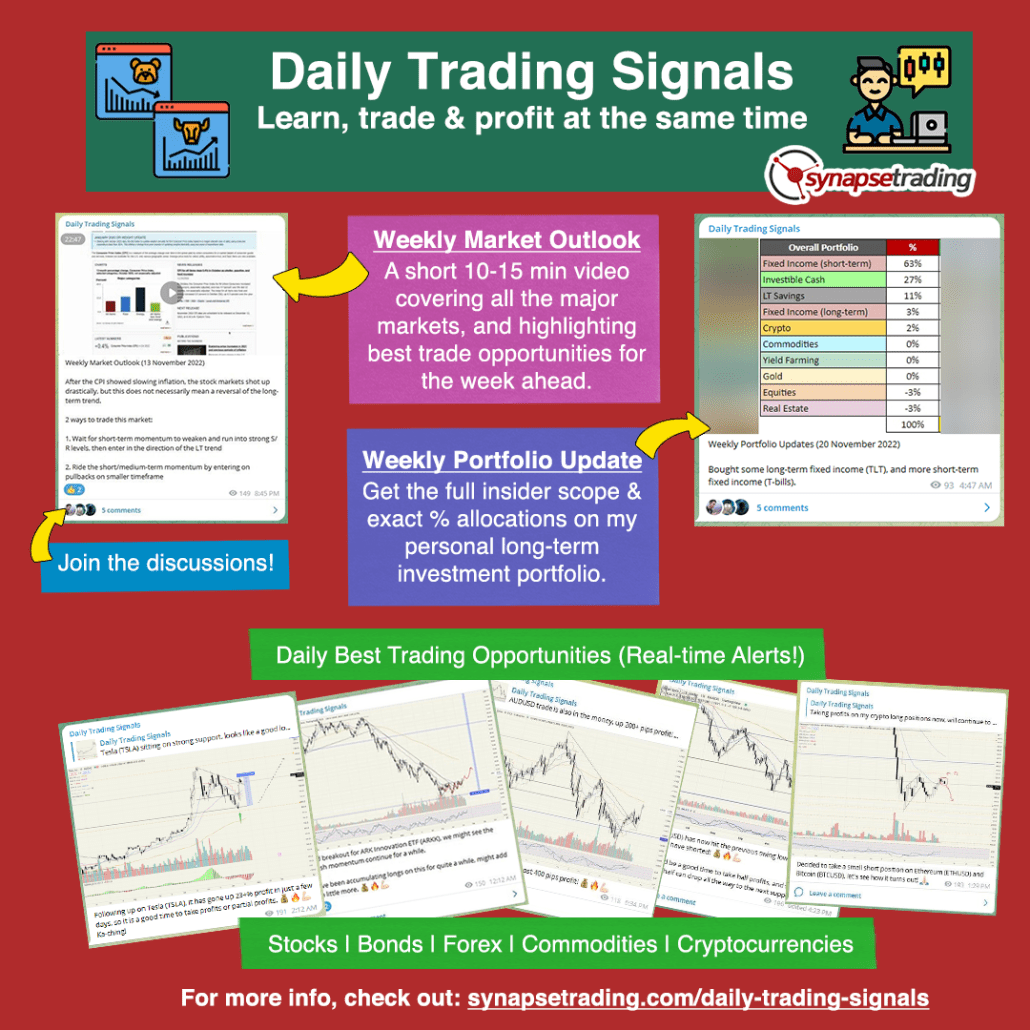 If you're looking for the best trading opportunities every day across various markets, and don't want to spend hours doing the research yourself, check out our private Telegram channel!

Leave a Reply
Want to join the discussion?Feel free to contribute!