• Link to Facebook
  • Link to X
  • Link to Instagram
  • Link to Youtube
  • Link to LinkedIn
  • Link to Mail
Synapse Trading
  • Home
  • About
    • My Background
    • My Trading Journey
    • My Travel Log
    • Media & Interviews
  • Mentoring
    • Trading Mastery Program
    • Results & Testimonials
  • Signals
    • Telegram (Free to join!)
    • Daily Trading Signals
    • Daily Trading Signals (Results)
  • Resources
    • Free Trading Guides
    • Tools & Resources
    • Blog & Infographics
  • Contact
    • Contact Us
    • Partnership Opportunities
  • Click to open the search input field Click to open the search input field Search
  • Menu Menu

What is life like after financial freedom? How can one live a fulfilling life?

Spencer Li

Practical Life Philosophies that You Can Use to Improve Your Life!

Living Your Best Life
Thumbnail Practical Life Philosophies that You Can Use to Improve Your Life

Thumbnail Practical Life Philosophies that You Can Use to Improve Your Life

Are you curious about the world around you and looking for a way to make sense of it all?

Look no further than philosophy!

Philosophy is the study of fundamental questions about reality, knowledge, and our place in the world.

It can help you understand yourself and the world around you better.

In this blog post, I will explore the different branches of philosophy, the origins of philosophy and how it can benefit you in your personal and professional life.
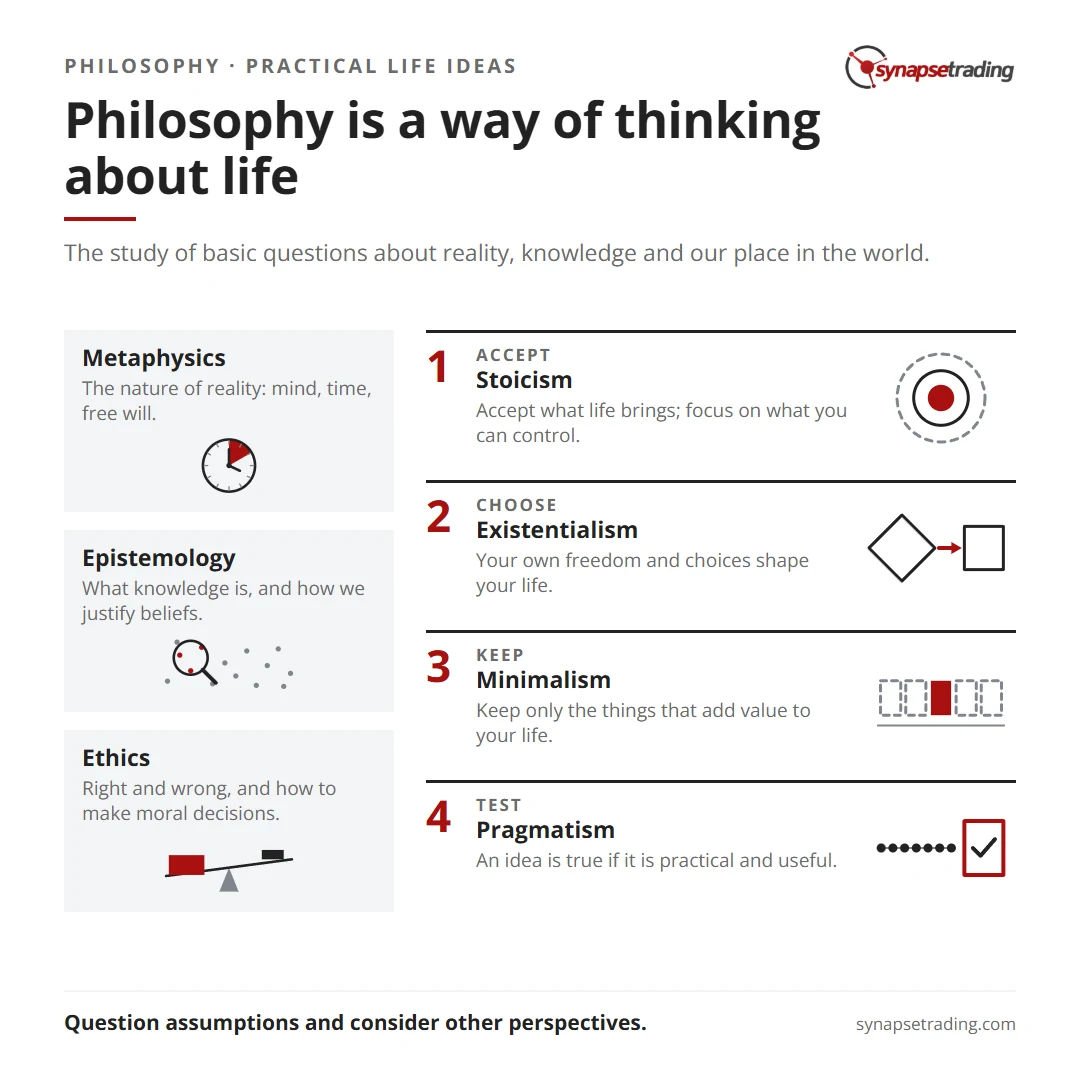
 

What is Philosophy?

Philosophy is a broad field that encompasses many different areas of inquiry.

At its core, however, philosophy is the study of fundamental questions about the nature of reality, knowledge, and our place in the world.

a) Metaphysics

One of the main areas of inquiry within philosophy is metaphysics, which is the branch of philosophy that deals with the nature of reality.

Metaphysics addresses questions such as:

What is the nature of the universe?

What is the relationship between mind and body?

Does free will exist?

What is the nature of time?

b) Epistemology

Another important area of philosophy is epistemology, which is the branch of philosophy that deals with knowledge.

Epistemology addresses questions such as:

What is knowledge?

How do we acquire knowledge?

What is the relationship between knowledge and belief?

How can we justify our beliefs?

c) Ethics

Ethics is another branch of philosophy which deals with the questions of morality, what is good and bad, right and wrong.

It looks at various moral theories like consequentialism, deontology, virtue ethics, and more, and addresses questions such as:

What is the nature of moral responsibility?

How should we make moral decisions?

What is the difference between right and wrong?

d) Living a Good Life

On a more general level, philosophy can also refer to a particular set of beliefs or a way of thinking about the world.

In this sense, philosophy can be understood as an approach to life, a set of guiding principles, or a perspective on the world that shapes one’s actions and decisions.

d) Other branches

There are other branches such as logic, which is the study of reasoning and argument, political philosophy which is the study of government and political systems and social philosophy which is the study of social interactions, institutions and organizations.

Philosophy is an attempt to understand the world and our place in it through reason and critical thinking.

It encourages us to question assumptions, to consider alternative perspectives, and to think deeply about important issues.

Philosophy provides tools and perspectives that can be used to understand and navigate the world and to make sense of our own experiences.

Origins of Philosophy

The origins of philosophy can be traced back to ancient Greece, specifically to the city of Miletus in Ionia, where thinkers such as Thales, Anaximander, and Anaximenes began asking questions about the nature of the universe and our place within it.

The earliest philosophers sought to understand the world and our place in it through reason and observation, rather than through tradition or religious belief.

The word “philosophy” comes from the Greek φιλοσοφία (philosophia), which is composed of two parts: “philo-” meaning “love” and “-sophia” meaning “wisdom.”

The word literally means “love of wisdom.”

Benefits of Philosophy

Philosophy is beneficial or relevant in our lives because it helps us to think critically about the world and our place in it.

It encourages us to question assumptions and to consider alternative perspectives, which can lead to a deeper understanding of ourselves and our relationship to the world around us.

Additionally, philosophical ideas and concepts often have real-world applications in areas such as ethics, politics, and law.

Furthermore, it teaches to make well-informed decisions, to think rationally and logically, which can benefit many aspects in one’s personal life and even in the society.

It can help to provide clarity, purpose and peace of mind for many people.

Practical Life Philosophies

There are many practical ways in which philosophy can help us live a more fulfilling life:

  • Stoicism: accepting whatever life brings, and focusing on what is within your control.
  • Existentialism: individual freedom and choice in shaping one’s own life.
  • Epicureanism: pursuit of simple pleasures as the most important goal in life.
  • Minimalism: only owning and keeping things that add value to your life.
  • Buddhism: living in the present moment, finding peace & happiness through mindfulness & compassion.
  • Humanism: reason, compassion, and the pursuit of knowledge and truth.
  • Utilitarianism: maximizing the happiness and well-being of the greatest number of people.
  • Transcendentalism: ultimate reality is spiritual and transcendent, and that individuals can connect with this reality through intuition and self-reflection.
  • Rationalism: reason and logic in understanding the world and making decisions.
  • Pragmatism: truth of an idea is determined by its practicality and usefulness.

I will be doing a separate blog post on each of these philosophies, with a detailed breakdown of practical applications.

Concluding Thoughts

Philosophy may seem like an academic discipline, but it’s more than that.

It is a way of thinking, an attitude towards life and a set of principles that guide one’s actions and decisions.

Through the study of philosophy, you can learn to think critically and make better decisions, gain a deeper understanding of yourself and the world around you, and find meaning and purpose in life.

Whether you’re trying to figure out what’s truly important in life, or just looking to improve your critical thinking skills, philosophy has something to offer.

As the saying goes, “The unexamined life is not worth living,” so dive in and start exploring the world of philosophy today!

Now that I have shared what philosophy is about, and the practical ways you can apply it in your life, which philosophy do you feel resonates the most with you?

What other useful philosophies do you apply in your life?

Let me know in the comments below.


thumbnail an unofficial guide to living our best life beyond financial freedom

If you are excited to get more life hacks, also check out: “Beyond Financial Freedom: An Unofficial Guide to Living Your Best Life”
0 Comments/by Spencer Li
https://synapsetrading.com/wp-content/uploads/2023/01/Thumbnail-Practical-Life-Philosophies-that-You-Can-Use-to-Improve-Your-Life.png 720 1280 Spencer Li https://synapsetrading.com/wp-content/uploads/2019/10/logo.jpg Spencer Li2023-01-11 17:10:372023-02-10 20:20:24Practical Life Philosophies that You Can Use to Improve Your Life!
Spencer Li

What are Peak Experiences, and How to Get More of it in Your Life?

Living Your Best Life
Thumbnail What are Peak Experiences

Peak Experiences and Flow States: What They Are and How to Have More of Them

Last updated: 3 July 2026 · By Spencer Li, CFTe


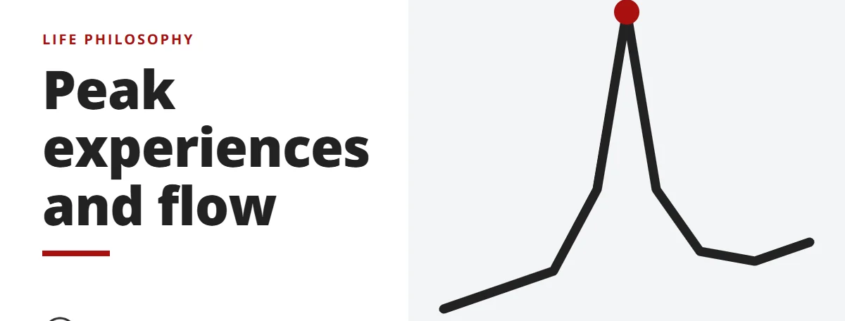
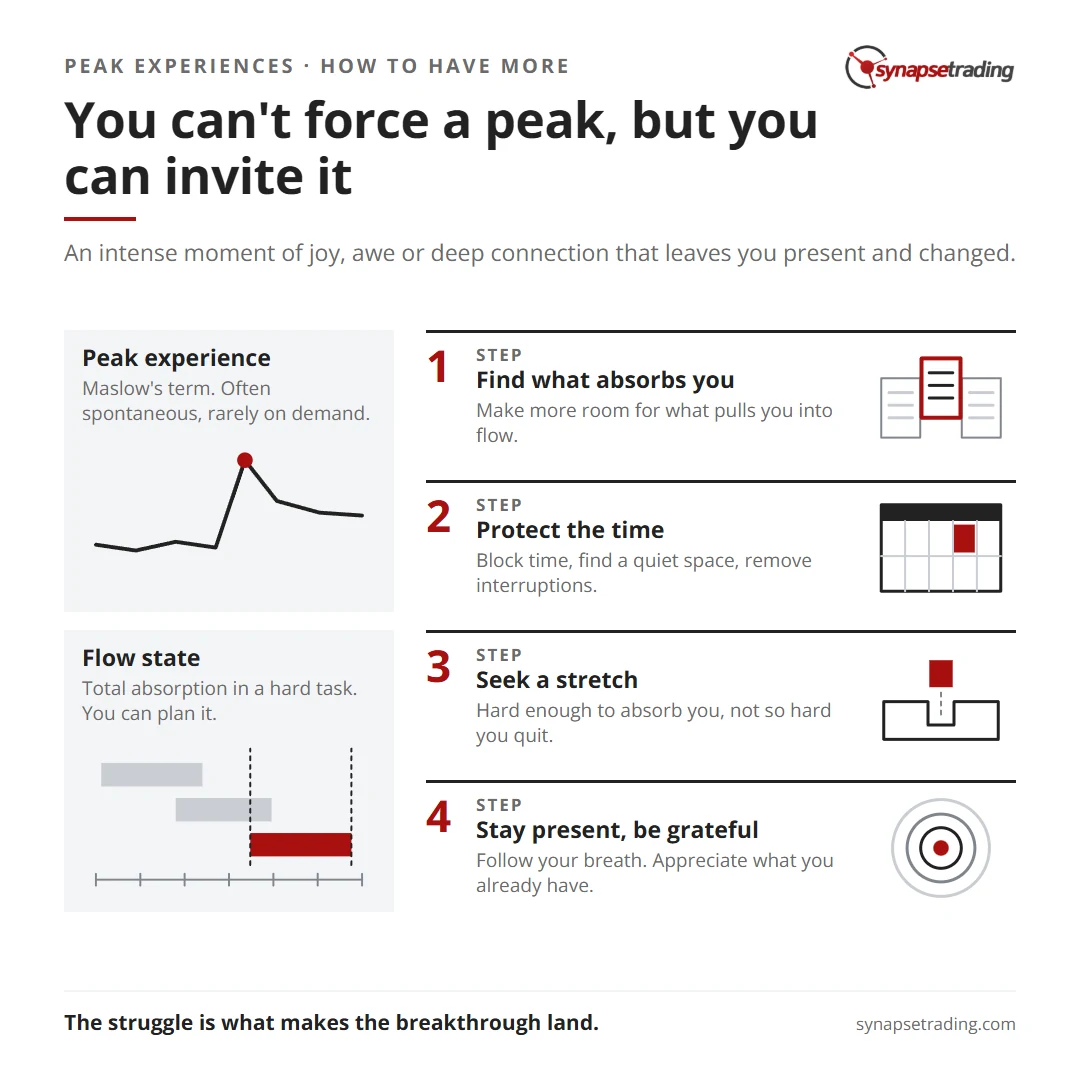
A peak experience is an intense moment of joy, awe, or deep connection that leaves you feeling fully present, fulfilled, and changed by it. A flow state (total absorption in a challenging activity) is the kind of peak experience you can deliberately set out to create. The term comes from psychologist Abraham Maslow, who studied self-actualized people and noticed they reported these “sudden, dramatic, and emotionally charged” moments of insight and unity far more often than most. You cannot force a peak experience to happen on command. What you can do is build the conditions for it: pick an activity you find genuinely engaging, protect uninterrupted time for it, stretch yourself slightly past your comfort zone, stay present instead of drifting, and practise gratitude for what you already have. Do that consistently, and these moments arrive more often.

Here is what peak experiences are, where the idea came from, and the five practices that reliably invite more of them into an ordinary week.

What is a peak experience?

A peak experience is a moment of intense psychological or emotional joy, awe, or wonder, sometimes carrying a feeling of transcendence or unity with the world. People who have one often describe it as life-changing, and it can quietly shift how they see themselves and everything around them.

The common thread is total immersion. During a peak experience you are completely absorbed in what you are doing, fully present, often working at the edge of your ability. There is usually a sense of challenge and growth woven through it, not just pleasure.

Peak experiences do not come from one fixed source. Some people find them through art or creative work. Others find them in sport or hard physical effort. Others reach them through spiritual or religious practice, or through a moment of real connection with another person. The trigger varies. The feeling, that immersive, meaningful, slightly-larger-than-yourself quality, does not.

Peak experience or flow state: are they the same thing?

People use the two terms interchangeably, and they overlap heavily, but they are not identical. Here is the simplest way I draw the line.

Peak experienceFlow state
Coined byAbraham Maslow (1960s)Mihaly Csikszentmihalyi (later)
Core feelingAwe, transcendence, unityEffortless, total absorption in a task
TriggerOften spontaneous (a sunrise, a birth, a realisation)Deliberate (a challenging activity matched to your skill)
DurationCan be a single fleeting momentCan last as long as the activity does
Can you plan it?Rarely on demandYes, by designing the conditions

In plain terms: every flow state is a kind of peak experience, but not every peak experience is flow. The sunrise that stops you in your tracks is a peak experience you did not engineer. The hour you lose inside a hard, absorbing piece of work is flow, and flow is the version you can actually set out to create. That distinction matters, because it means peak moments are not purely a matter of luck.

Where did the idea of peak experiences come from?

The concept comes from Abraham Maslow, the humanistic psychologist best known for the hierarchy of needs. Studying psychological and spiritual growth, Maslow noticed that the healthiest, most self-actualized people reported moments of profound insight and understanding that seemed to transform them.

He called these peak experiences and described them as “sudden, dramatic, and emotionally charged.” He believed they could give a person a sense of unity, transcendence, and connection to something larger than themselves.

Maslow’s work shaped a lot of what came after it. His ideas were picked up and developed in positive psychology, education, and management research. The specifics of his theory have drawn fair criticism over the years, but the core observation has held up: these intense, meaningful moments are real, and they matter for how we grow.

What are the benefits of peak experiences?

The reported benefits are consistent across the research and across ordinary lived experience:

  • Increased creativity and problem-solving
  • Greater happiness and well-being
  • Sharper focus and productivity
  • Faster personal and professional growth
  • A stronger sense of connection to other people and to the world

None of that is mystical. When you are fully absorbed and slightly stretched, you tend to produce better work, feel better doing it, and grow from it. Peak experiences are where a lot of that compounding quietly happens.

What are some examples of peak experiences?

They look different for everyone, but here are the common shapes:

  • A moment of spiritual connection, such as during meditation or a ceremony
  • A moment of deep emotional connection, such as falling in love or a real conversation with a close friend
  • A moment of personal accomplishment, such as finishing a marathon or hitting a long-term goal
  • A moment of awe, such as standing in front of a natural wonder
  • A moment of intense emotion, such as the birth of a child or the loss of someone you love
  • A moment of creative inspiration, such as writing a poem or composing music
  • A moment of intense focus on a hard task, such as deep work or meditation
  • A moment of intense physical sensation, such as a dance performance or skydiving
  • A moment of connection with nature, such as hiking in the mountains or swimming in the open sea
  • A moment of self-discovery, such as during a retreat or in therapy
  • A moment of sudden understanding, such as when a hard problem finally clicks

These are deeply personal and they vary from person to person. What they share is intensity and meaning. You tend to remember them for a long time.

How can I have more peak experiences?

You cannot summon a peak experience on demand. You can, though, build the conditions that make them far more likely. Five practices do most of the work.

Identify what genuinely absorbs you. Pay attention to the activities that pull you into flow and leave you fulfilled, then deliberately make more room for them. Most people already know what these are. They just do not protect them.

Protect distraction-free time for it. Block specific time, find a quiet space, and remove the interruptions. Flow needs an uninterrupted runway. It rarely survives a buzzing phone.

Seek out challenge that stretches you. Peak experiences live at the edge of your ability, where the task is hard enough to demand full attention but not so hard that you give up. Learn a new skill, take on something harder than last time, or pick up a problem just beyond your current reach.

Stay present. Practise mindfulness, whether that is following your breath or simply paying full attention to your senses. Presence is the gateway. A wandering mind never drops into flow.

Practise gratitude. Regularly reflect on and appreciate what you already have, and tell the people who support your growth that you see it. Gratitude deepens the fulfilment these moments bring and strengthens your connection to others.

One honest caveat. Peak experiences are not always pleasant in the moment. They often involve hard work, struggle, and even failure. The marathon hurts. The hard problem resists you for hours. But that is usually the point. The struggle is what makes the breakthrough land, and it is through the difficulty that we tend to grow and learn the most.

There is a practical bridge here to the discipline I write about elsewhere. The same conditions that produce flow, a clear challenge, full presence, and no distractions, are also the conditions under which people make their best decisions under pressure. A tool can hand you information instantly. It cannot hand you the present, focused state of mind in which you actually use that information well. That part stays yours.

Concluding thoughts

Peak experiences, and flow states in particular, are intense moments of joy, awe, and absorption that can bring a real sense of transcendence and growth. You will not control when every one arrives. But by finding the activities that absorb you, protecting time for them, seeking out challenge, staying present, and practising gratitude, you can weave far more of them into an ordinary life, and benefit from how they change you.

Now that you know what peak experiences are and how to invite more of them, is this something you want to make a deliberate part of your life? Let me know in the comments below.

If you enjoyed this, you will probably like Beyond Financial Freedom: An Unofficial Guide to Living Your Best Life, which carries the same theme further.

FAQ

What is the difference between a peak experience and a flow state?
A peak experience is any intense moment of joy, awe, or connection, and it often arrives spontaneously. A flow state is total absorption in a challenging activity matched to your skill, and it is the kind of peak experience you can deliberately set up. Every flow state is a peak experience; not every peak experience is flow.

Who came up with the concept of peak experiences?
Psychologist Abraham Maslow introduced it as part of his theory of self-actualization, describing peak experiences as “sudden, dramatic, and emotionally charged” moments of insight and unity.

Can you make a peak experience happen on purpose?
Not on command. You can, however, build the conditions that make one far more likely: choose a genuinely absorbing activity, protect uninterrupted time, stretch yourself slightly, stay present, and practise gratitude.

What are the benefits of having more peak experiences?
They are linked to greater creativity and problem-solving, more happiness and well-being, sharper focus, faster personal growth, and a stronger sense of connection to others and the world.

Are peak experiences always pleasant?
No. They often involve hard work, struggle, and even failure. The effort is usually what makes the breakthrough meaningful, and it is through the difficulty that we tend to grow the most.


About the author. Spencer Li is the founder of Synapse Trading and a Certified Financial Technician (CFTe) with 15 years of trading across stocks, forex, crypto, commodities, and bonds. His trade log is public, 404 trades, losses left in. He teaches low-risk swing trading in 15 minutes a day, one system for any market, and writes occasionally on the parts of a good life that have nothing to do with markets.

Reflection piece, not financial advice. Synapse Trading is not licensed by MAS to advise on investment products. Trading carries risk of loss; past performance is not indicative of future results.


Related

Beyond Financial Freedom: Living Your Best Life · On meaning, mindfulness and the good life

0 Comments/by Spencer Li
https://synapsetrading.com/wp-content/uploads/2023/01/Thumbnail-What-are-Peak-Experiences.png 720 1280 Spencer Li https://synapsetrading.com/wp-content/uploads/2019/10/logo.jpg Spencer Li2023-01-07 12:49:452026-07-06 02:47:52What are Peak Experiences, and How to Get More of it in Your Life?
Spencer Li

What is Minimalism? (7 Practical Ways to Apply it in Your Life!)

Living Your Best Life
Thumbnail What is Minimalism

Thumbnail What is Minimalism

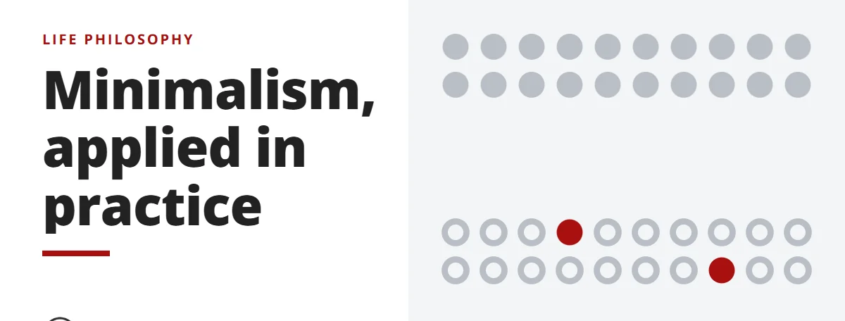
Minimalism is a lifestyle and philosophy that emphasizes simplicity, minimalism, and mindfulness in all aspects of life.

It is a rejection of the materialistic, consumerist culture that is prevalent in many Western societies, and instead emphasizes the importance of living with intention and purpose.

In this blog post, I will cover all the benefits of this life philosophy, practical ways you can apply it in your life, and how it ties in with your spiritual development.


Origins of Minimalism

The origins of minimalism can be traced back to the 1960s and 1970s, when a group of artists and writers began to reject the traditional, ornate styles that were popular at the time.

These artists and writers, who included figures such as Donald Judd and Sol LeWitt, instead embraced simplicity and purity of form in their work.

This led to the development of the minimalist movement, which sought to strip away the excesses of modern life and focus on what was truly essential.

Over time, the minimalist philosophy has spread beyond the realm of art and has become a popular lifestyle choice for many people.

Today, minimalism is embraced by people from all walks of life, who are drawn to its emphasis on simplicity, mindfulness, and intentionality.

Benefits of Minimalism

There are many benefits to adopting a minimalist lifestyle.

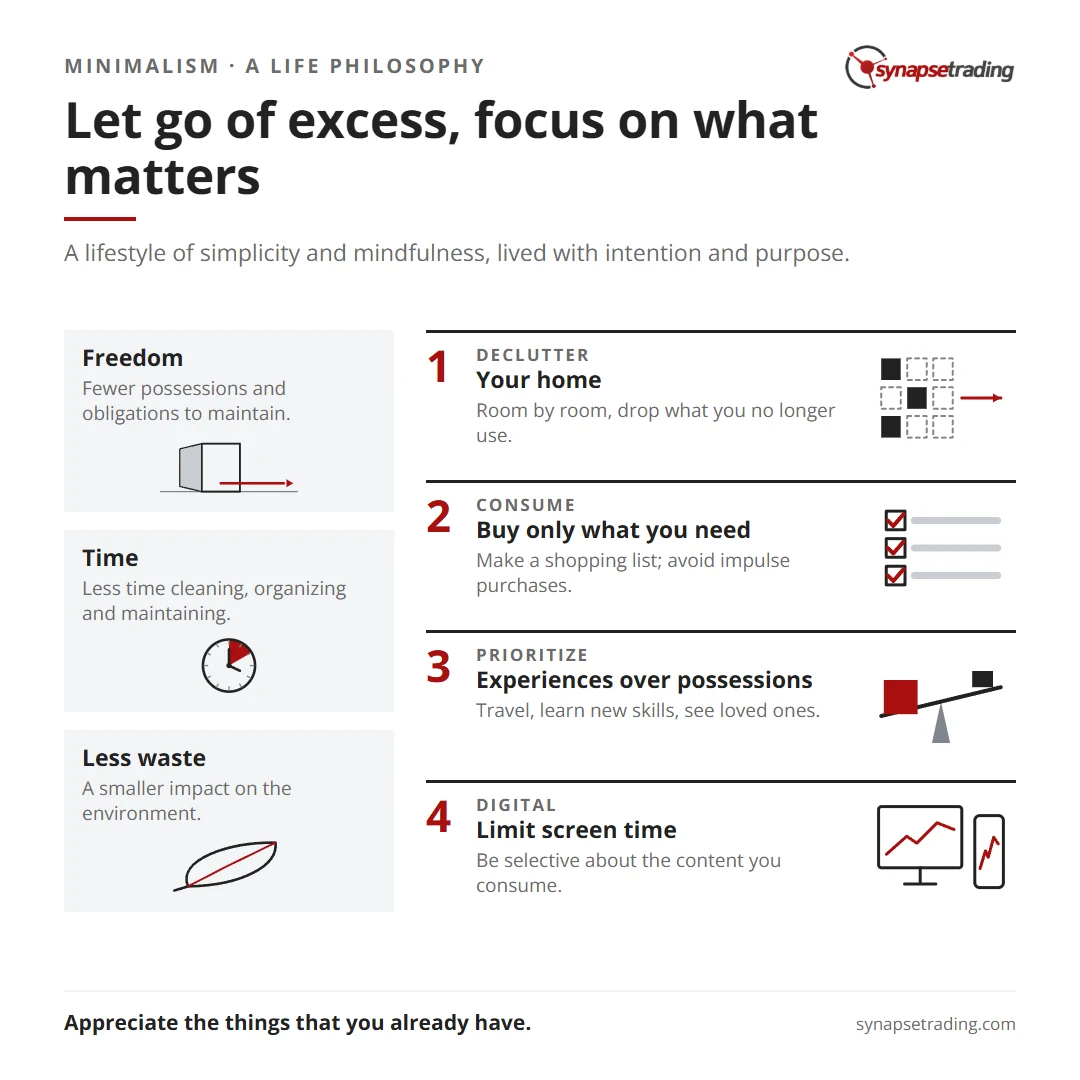
One of the biggest benefits is the feeling of freedom and liberation that comes from decluttering and simplifying your life.

By getting rid of excess possessions and obligations, you can free yourself from the burden of constant maintenance and upkeep.

This can provide a sense of relief and liberation, and can allow you to focus on what is truly important to you.

In addition to the psychological benefits of minimalism, there are also practical benefits.

For example, living a minimalist lifestyle can save you time and money.

By getting rid of excess possessions, you can reduce the amount of time and energy you spend on cleaning, organizing, and maintaining your belongings.

This can save you time and effort, and can allow you to spend your time and money on things that are truly meaningful to you.

Another benefit of minimalism is that it can help you to live a more sustainable and eco-friendly lifestyle.

By reducing your consumption and waste, you can reduce your impact on the environment and help to preserve natural resources for future generations.

This can be especially important in a world that is facing increasingly urgent environmental challenges.

How to Apply Minimalism in Your Life

If you are interested in adopting a minimalist lifestyle, there are many practical ways to do so. Here are some tips for applying minimalism in your life:

  1. Declutter your home: One of the first steps to adopting a minimalist lifestyle is to declutter your home and get rid of excess possessions that you no longer need or use. Start by going through each room in your home and getting rid of anything that you no longer need or use. This can include clothing, furniture, appliances, and other household items.
  2. Minimize your consumption: Another important step is to minimize your consumption and only purchase what you truly need and will use. This can involve making a shopping list and sticking to it, avoiding impulse purchases, and being selective about the products that you buy.
  3. Be mindful of the things that you already own: In addition to minimizing your consumption, it is also important to be mindful of the things that you already own. This means taking good care of your possessions and making sure that they last as long as possible. This can involve regular maintenance and repair, as well as being selective about the products that you use to clean and care for your belongings.
  4. Prioritize experiences over possessions: A key principle of minimalism is the idea that experiences are more important than possessions. Instead of focusing on acquiring more and more things, try to prioritize experiences that will enrich your life and provide lasting memories. This can include things like traveling, learning new skills, or spending time with loved ones.
  5. Simplify your daily routine: Another way to apply minimalism in your life is to simplify your daily routine. This can involve reducing the number of tasks and obligations that you have, and focusing on the things that are truly important to you. For example, you might prioritize spending time with loved ones, pursuing your hobbies and passions, or taking care of your health and wellbeing. By simplifying your daily routine, you can free up more time and energy for the things that matter most to you.
  6. Be mindful of your digital life: In today’s digital age, it is easy to become overwhelmed by the constant stream of information and distractions that are available online. To apply minimalism in your digital life, try to limit the amount of time that you spend on your devices, and be selective about the content that you consume. This can help to reduce the noise and distractions in your life, and can allow you to focus on the things that are truly important to you.
  7. Cultivate gratitude: Another important aspect of minimalism is the practice of gratitude. By cultivating gratitude, you can shift your focus away from the things that you lack, and instead appreciate the things that you already have. This can help to reduce feelings of dissatisfaction and discontent, and can help you to feel more content and satisfied with your life.

Minimalism & Spirituality

Minimalism and spirituality are two different, but related, concepts.

Minimalism is a lifestyle and philosophy that emphasizes simplicity, minimalism, and mindfulness in all aspects of life.

It is a rejection of the materialistic, consumerist culture that is prevalent in many Western societies, and instead emphasizes the importance of living with intention and purpose.

On the other hand, spirituality is a broad term that refers to the human search for meaning and connection with a higher power or the transcendent.

Spirituality can be expressed in many different ways, including through religious practices, meditation, and other forms of inner exploration.

Despite their differences, minimalism and spirituality are related in several key ways.

First, both minimalism and spirituality emphasize the importance of simplicity and mindfulness.

By focusing on the present moment and letting go of distractions and distractions, both minimalism and spirituality can help us to live more fully and authentically.

Second, both minimalism and spirituality encourage us to let go of excess possessions and attachments.

By getting rid of the things that we don’t need or use, we can free ourselves from the burden of constant maintenance and upkeep.

This can provide a sense of relief and liberation, and can allow us to focus on what is truly important to us.

Finally, both minimalism and spirituality can help us to connect with something greater than ourselves.

For some people, this might be a higher power or the transcendent.

For others, it might be a sense of connection with the natural world, or with a community of like-minded individuals.

In either case, minimalism and spirituality can both provide a sense of meaning and purpose in life.

Concluding Thoughts

Overall, minimalism is a lifestyle and philosophy that emphasizes simplicity, minimalism, and mindfulness in all aspects of life.

It can provide many benefits, including a feeling of freedom and liberation, practical savings of time and money, and a more sustainable and eco-friendly lifestyle.

By decluttering your home, minimizing your consumption, and being mindful of the things that you already own, you can begin to apply the principles of minimalism in your own life.

Now that I have shared what minimalism is about, and the practical ways you can apply it in your life, do you think this is a life philosophy which you will want to adopt?

For those already embracing this philosophy, what are some other ways which you have applied minimalism in your life?

Let me know in the comments below.


thumbnail an unofficial guide to living our best life beyond financial freedom

If you are excited to get more life hacks, also check out: “Beyond Financial Freedom: An Unofficial Guide to Living Your Best Life”
0 Comments/by Spencer Li
https://synapsetrading.com/wp-content/uploads/2022/12/Thumbnail-What-is-Minimalism.png 720 1280 Spencer Li https://synapsetrading.com/wp-content/uploads/2019/10/logo.jpg Spencer Li2022-12-15 19:46:522023-01-10 01:52:09What is Minimalism? (7 Practical Ways to Apply it in Your Life!)
Spencer Li

The Travelling Trader: Time to Explore Central Asia!

Living Your Best Life, Travel & Lifestyle
central asia travelling trader

After 3 years of not being able to travel due to Covid, I am now ready to embark on my next adventure!

In fact, I have also sold my house, so I’m not sure how long I will be on the road. (Until property prices come back down lol)

This trip will bring my total country tally to 70+ countries, let’s see how many I can hit by the end of the year.

As per usual, I will continue to provide market updates, as long as I have an internet connection.

Let’s all build up our warchest and get ready for the big sale!

View this post on Instagram

A post shared by Spencer Li (@iamrecneps)

View this post on Instagram

A post shared by Spencer Li (@iamrecneps)

View this post on Instagram

A post shared by Spencer Li (@iamrecneps)


thumbnail an unofficial guide to living our best life beyond financial freedom

If you are excited to get more life hacks, also check out: “Beyond Financial Freedom: An Unofficial Guide to Living Your Best Life”
0 Comments/by Spencer Li
https://synapsetrading.com/wp-content/uploads/2022/09/central-asia-travelling-trader.png 1524 2054 Spencer Li https://synapsetrading.com/wp-content/uploads/2019/10/logo.jpg Spencer Li2022-09-02 12:03:262022-12-16 16:35:09The Travelling Trader: Time to Explore Central Asia!
Spencer Li

Birthday Reflections Upon Turning 36

Living Your Best Life
penthouse birthday

Every birthday, I like to take a day off to reflect and give thanks for the previous year, and brainstorm what I would like to focus on in the upcoming years. I like to think of it as constant realignment of my priorities in life.

Here are some things I would like to focus on for the next few years:

  • Continue exercising and eating healthy consistently
  • Spend more time on friendships and relationships
  • Read more about psychology, philosophy, mental models
  • Try some new things like cooking, Salsa, art, wine appreciation, etc
  • Travel more (aim for 100 countries before 40)
  • Embrace minimalism, to focus time and attention on things which are important
  • Becoming better at mindfulness, empathy, gratitude, self-esteem, and showing love & kindness
  • Continue to create more educational and inspiring content on my blog and various channels to help others
  • Find new ways/careers/volunteer work that can make a difference in people’s lives

Once again, a big thanks to everyone who has supported me all these years, and to those who have put in the extra effort to make my 36th birthday a memorable one! ?


View this post on Instagram


A post shared by Spencer Li (@iamrecneps)


View this post on Instagram


A post shared by Spencer Li (@iamrecneps)


View this post on Instagram


A post shared by Spencer Li (@iamrecneps)


thumbnail an unofficial guide to living our best life beyond financial freedom

If you are excited to get more life hacks, also check out: “Beyond Financial Freedom: An Unofficial Guide to Living Your Best Life”
0 Comments/by Spencer Li
https://synapsetrading.com/wp-content/uploads/2022/07/penthouse-birthday-scaled.jpg 1920 2560 Spencer Li https://synapsetrading.com/wp-content/uploads/2019/10/logo.jpg Spencer Li2022-07-14 02:52:372022-12-16 16:34:33Birthday Reflections Upon Turning 36
Page 2 of 512345

Free Trading Guides

Free Trading Guides

Blog Categories

  • Beginner's Guide
  • Blockchain & Crypto
  • Book Summaries
  • Candlestick Patterns
  • Economics & News Trading
  • Investing & Portfolio Management
  • Living Your Best Life
  • Market Analysis
  • News & Events
  • Price Chart Patterns
  • Promotions
  • Risk & Money Management
  • Stock Trading
  • Testimonials
  • Tools & Resources
  • Trading Psychology
  • Trading Strategies
  • Trading Tips
  • Travel & Lifestyle

Free Trading Guides

Free Trading Guides

Contact Us

Synapse Trading Pte Ltd
Registration No. 201316168H

Whatsapp: +65-8897-1204
Telegram: @iamrecneps
Email: info@synapsetrading.com

Links

Disclaimer
Privacy policy
Terms & Conditions
Contact us
Partnerships

© 2012-2024 Synapse Trading | All rights reserved | - powered by Enfold WordPress Theme
  • Link to Facebook
  • Link to X
  • Link to Instagram
  • Link to Youtube
  • Link to LinkedIn
  • Link to Mail
Scroll to top Scroll to top Scroll to top