

How to Think Like a Trader by Changing your Frame

Join our Telegram channel for more market analysis & trading tips: t.me/synapsetrading
Table of Contents
Trading Psychology: The Behavioral Biases That Cost Traders Money (and How to Beat Them)
Last updated: 3 July 2026 · By Spencer Li, CFTe
Trading psychology is the study of how your own mind, not the market, decides whether you make or lose money. The market is a crowd of people with different beliefs, different theories, and different fears, and that mix is what creates the price moves you are trying to trade. To exploit those moves, you first have to understand yourself. The biggest threats are a handful of well-documented mental shortcuts: overconfidence (your estimates are too sure), optimism (you think you are above average), belief perseverance (you cling to a losing opinion), anchoring (you fixate on an arbitrary first number), availability bias (recent, vivid events feel more likely than they are), and herd instinct (you copy the crowd). None of them go away just because you read about them. The fix is not to delete the bias, it is to build a system and a routine that catches you in the moment before the bias costs you. Awareness first, then process.
Here is each bias, where it shows up at the screen, and what to do about it.
Why does psychology matter more than strategy in trading?
If we look at who actually participates in the markets, we find many different kinds of people, beliefs, and theories. Those differences are what create price movements and patterns in the first place. So a trading edge is really two things. One is reading the crowd. The other is not being the crowd’s easiest victim.
There is a useful idea from behavioural finance called the theory of limited arbitrage. It says that when irrational traders push price away from fair value, rational traders are often powerless to correct it. The error can persist, and even widen, long enough to wipe out the person betting against it. In other words, “I am right and the market is wrong” is not a position size. The market can stay irrational longer than you can stay solvent.
That is why understanding your own wiring matters. Choose a strategy that fits your personality, and stay aware of your biases so they do not run the trade for you.
The 6 biases that quietly drain trading accounts
To say anything precise about how price deviates from fair value, behavioural models borrow from decades of experiments by cognitive psychologists on how people form beliefs and preferences. Here are the six that hit traders hardest, side by side, before we go through each one.
| Bias | What it is | How it shows up at the screen | The fix |
|---|---|---|---|
| Overconfidence | Your estimates are far too sure | You size too big and skip the stop | Pre-set risk per trade, written down |
| Optimism / wishful thinking | You assume you are above average | “This one will work out”, held too long | Judge the process, not the hope |
| Belief perseverance | You cling to an opinion too tightly | You ignore evidence the trade is wrong | Define your invalidation point in advance |
| Anchoring | You fixate on an arbitrary first number | “I will sell when it gets back to my entry” | Anchor to structure, not your buy price |
| Availability bias | Recent, vivid events feel more likely | One crash makes you fear every dip | Trade the base rate, not the last headline |
| Herd instinct | You copy what the crowd is doing | You chase the hot IPO or the hot tip | Have your own setup, or stand aside |
Overconfidence: your confidence interval is too narrow
The evidence here is extensive, and it shows up in two ways. First, the confidence intervals people put around their estimates are far too narrow. Ask people for a 98% confidence range on something like the level of the Dow in a year, and the true number lands inside that range only about 60% of the time. Second, people are poorly calibrated on probabilities: events they call certain happen only around 80% of the time, and events they deem impossible happen about 20% of the time.
For a trader, that “impossible 20%” is the gap that blows up accounts. The trade that “can’t” go against you is exactly the one you sized too big and forgot to put a stop on.
Optimism and wishful thinking: nearly everyone is above average
Most people hold unrealistically rosy views of their own abilities. In surveys, over 90% of people rate themselves above average on things like driving skill, getting along with others, and sense of humour. People also run a systematic planning fallacy: they predict tasks (writing a survey paper, say) will finish much sooner than they actually do.
At the screen this becomes the hope trade. You do not cut the loser because surely it comes back, and you are, after all, a better-than-average trader. The market does not grade on a curve. Personally, I trust the process I can write down over the optimism I happen to feel that morning.
Belief perseverance: clinging to a loser
Once people form an opinion, they cling to it too tightly and for too long. Two effects are at work. People are reluctant to go looking for evidence that contradicts them, and even when they find it, they treat it with excessive skepticism. There is a stronger version, confirmation bias, where people misread evidence against their hypothesis as actually supporting it. In academic finance, this predicts that someone who starts out believing in the Efficient Markets Hypothesis may keep believing it long after compelling evidence against it has piled up.
In a trade, belief perseverance is the held loser with the moving goalposts. Each time the thesis breaks, you invent a new reason it is still valid. The cure is unglamorous: decide before you enter what price proves you wrong, and leave when it prints.
Anchoring: fixating on an arbitrary number
When people estimate, they start from some initial value (often arbitrary) and adjust away from it, and the adjustment is usually too small. They “anchor” on the first number. In one experiment, subjects estimated the percentage of United Nations countries that are African. Before answering, they were asked whether their guess was higher or lower than a random number between 0 and 100. The random number moved their answers a lot: people compared to 10 estimated 25%, while people compared to 60 estimated 45%.
The trading version is anchoring to your own entry price. “I will sell when it gets back to what I paid.” The market does not know or care what you paid. Anchor to structure (support, resistance, the level that invalidates the idea), not to your cost basis.
Availability bias: the last vivid event feels likely
When judging how likely an event is (the odds of getting mugged in Chicago, say), people search their memory for examples. That is sensible, but not all memories are equally easy to retrieve. More recent and more vivid events (a close friend getting mugged) weigh too heavily and distort the estimate.
For traders, one fresh crash makes every pullback feel like the start of the next one, so you sit out good setups. One lucky breakout makes every breakout look like easy money, so you chase. Both are the last vivid memory talking, not the base rate.
Herd instinct: following the crowd off the cliff
If this is you, you do what the rest of the market is doing. A hot new IPO, a stock that just crashed and is suddenly “a hot buy”, a rumour that some name is about to fly, and you pile in with everyone else. It is not always wrong. The market is the sum of all participants, so the crowd is often right. But the market is also partly random, and BLINDLY following it is wrong. The crowd is right until the exact moment it is not, and that turn is where the late followers get hurt.
“I know about these biases, so I am fine.” You are not.
Economists used to wave this evidence away with three arguments: people learn their way out of biases through repetition, experts make fewer errors, and stronger incentives make the effects disappear. Each of these softens the bias a little. None of them wipes it out.
Learning gets muted by errors of application. Explain a bias and people understand it, then immediately violate it again on the next specific case. Expertise often hurts rather than helps: experts armed with sophisticated models have shown more overconfidence than laymen, especially when they get only limited feedback on their predictions. And in trading, feedback is noisy and slow, which is exactly the condition under which expertise breeds overconfidence.
So reading this article does not inoculate you. Do note that, knowing the bias and not acting on the knowledge are two different skills. That gap is the whole game.
The human edge: where awareness becomes process
A scanner will flag a setup in a second, and an AI will recite all six of these biases back to you on demand. What neither will do is stop your hand when you are about to add to a loser, oversize because you “know” this one works, or chase the same hot tip the whole timeline is chasing. The biases are easy to name and hard to override, and the override is the work. That is the psychology edge, one of the Five Edges a machine cannot trade for you. The way you make awareness stick is not willpower, it is a written process and a routine that runs the same way on your best day and your worst.
FAQ
What is trading psychology?
Trading psychology is how your emotions and mental biases affect your trading decisions. It covers the systematic errors (overconfidence, anchoring, herd instinct, and others) that push traders into oversizing, holding losers, and chasing crowds, and the habits and rules used to counter them.
What is the most common psychological bias in trading?
Overconfidence is among the most damaging. People set confidence intervals that are far too narrow, so the outcome they think is “impossible” still happens about 20% of the time, which is the gap that leads to oversized, unstopped trades.
Can you get rid of behavioral biases if you just learn about them?
No. The evidence shows learning, expertise, and bigger incentives only soften biases, they do not remove them. People understand a bias when it is explained and then violate it again on the next trade. The reliable fix is a written process that catches the bias in the moment.
How do I stop trading with the herd?
Have your own setup with a defined entry, stop, and invalidation, and only act when your rules say so. If a move is just “everyone is buying it”, that is not a setup, that is a reason to stand aside. The crowd is often right until the exact moment it is not.
What is anchoring in trading?
Anchoring is fixating on an arbitrary reference number, most often your own entry price (“I will sell when it gets back to what I paid”). The market does not know your cost basis. Anchor your decisions to market structure (support, resistance, the level that invalidates the trade) instead.
Which of these six do you catch yourself doing most? For me it is the held loser. Naming yours is step one. Building the rule that stops it is step two.
If you want the bigger picture of how mindset fits with method and risk, read the pillar: The Definitive Guide to Trading Psychology and Mindset.
Want a process that runs the same on your best and worst day? Grab the free 15-Minute Swing Trading Starter Kit. It is the exact routine I use to scan once a day and trade any market in 15 minutes, biases and all.
About the author. Spencer Li is the founder of Synapse Trading and a Certified Financial Technician (CFTe) with 15 years of trading across stocks, forex, crypto, commodities, and bonds. His trade log is public, 404 trades, losses left in. He teaches low-risk swing trading in 15 minutes a day, one system for any market.
Education, not financial advice. Synapse Trading is not licensed by MAS to advise on investment products. Trading carries risk of loss; past performance is not indicative of future results.
Related
Definitive Guide to Trading Psychology and Mindset (pillar) · How to control your emotions when trading · Risk management and position sizing
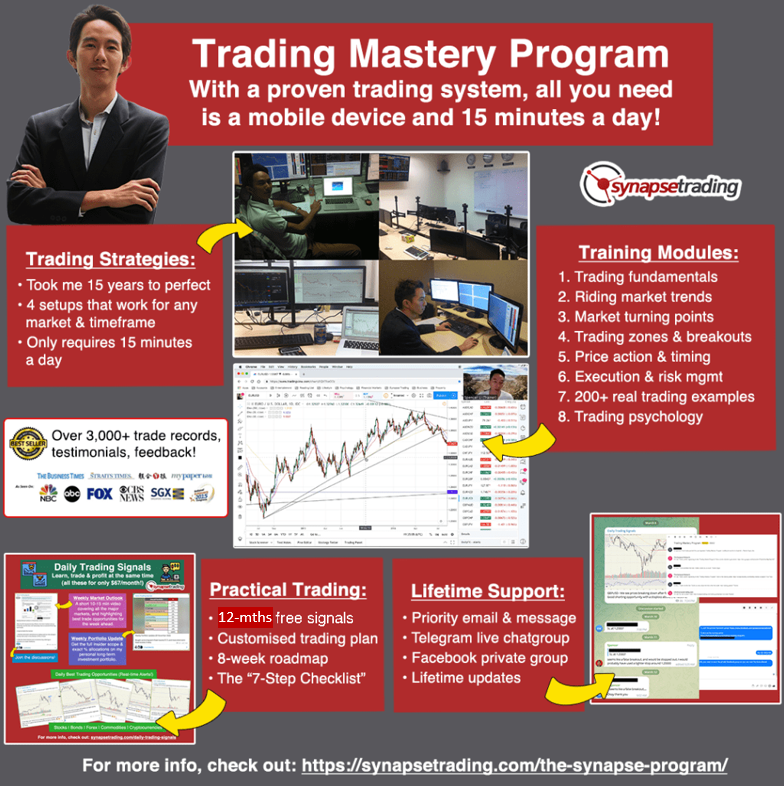 Our flagship mentoring program is suitable for both beginners and advanced traders, covering the 4 strategies which I used over the past 15 years to build up my 7-figure personal trading portfolio.
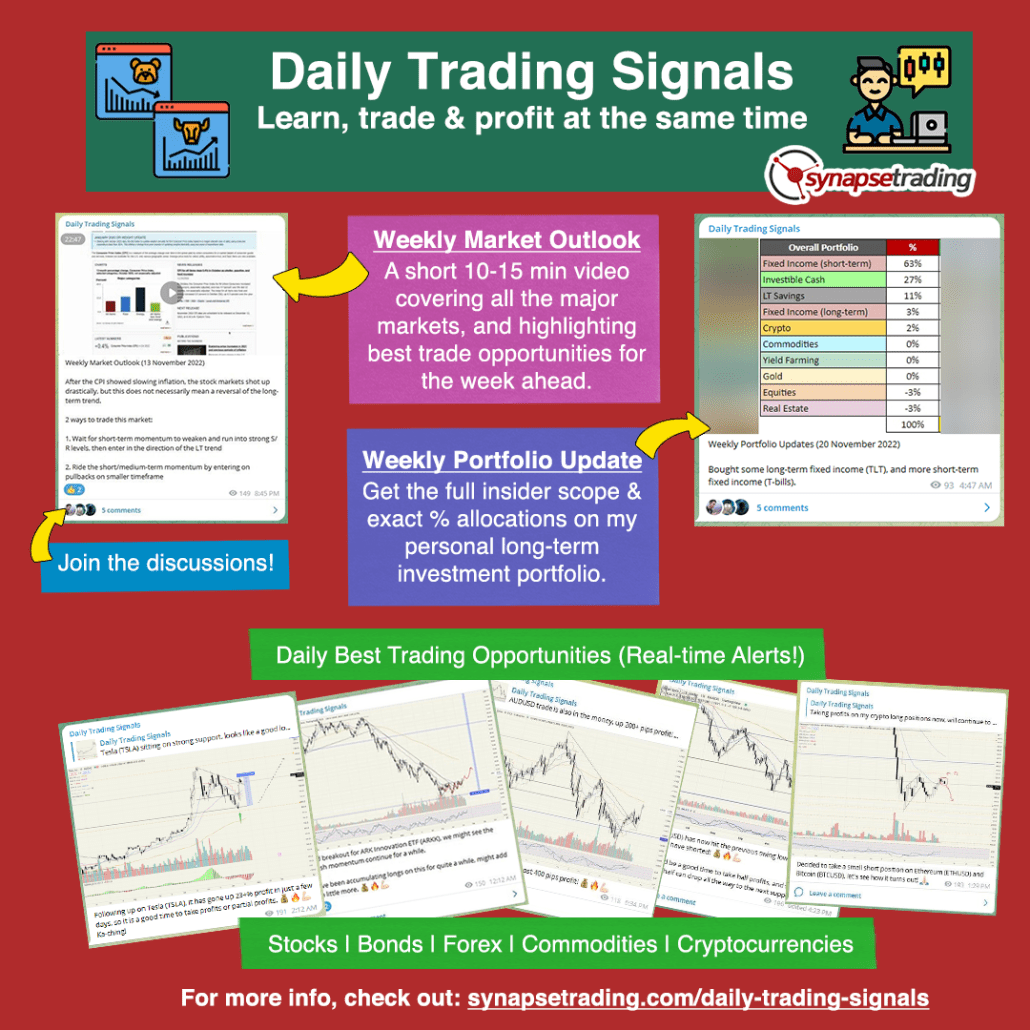 If you're looking for the best trading opportunities every day across various markets, and don't want to spend hours doing the research yourself, check out our private Telegram channel!

Leave a Reply
Want to join the discussion?Feel free to contribute!