

Why Is It So Hard to Cut Your Losses and Let Your Profits Run? The Psychology, and the Fix
Want the daily routine? Get the free 15-Minute Swing Trader’s Checklist. Get it free →
By Spencer Li, CFTe · Last updated: 26 October 2026
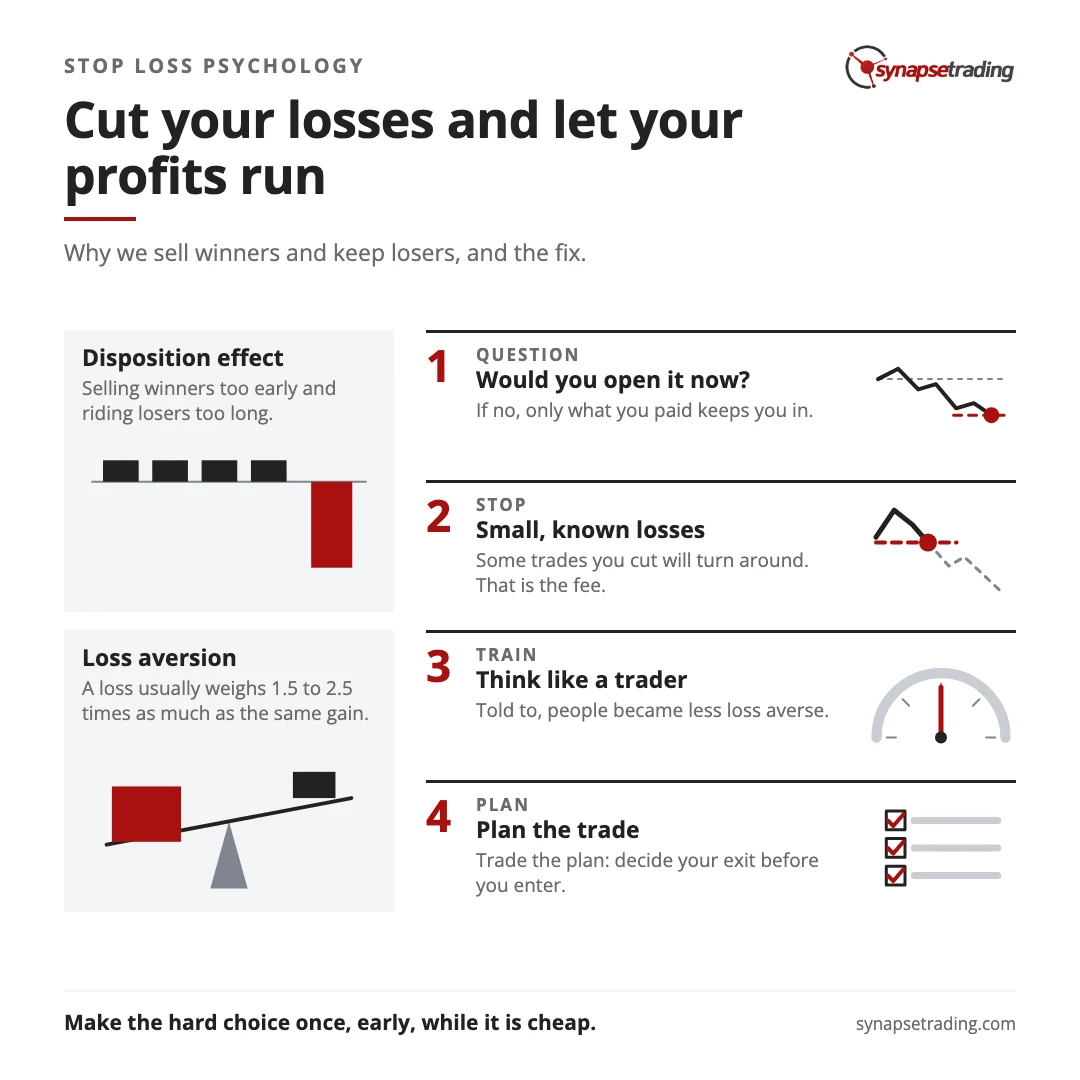
It is hard to cut your losses and let your profits run because your brain is built to do the opposite. A loss hurts more than an equal gain pleases, so selling a loser feels like making the pain official, while selling a winner feels like locking in a reward. Researchers call this the disposition effect, and it shows up in the records of thousands of real investors. The fix is to make the exit decision before the trade, when you are calm, and then let the plan carry it out.
I first wrote about this in May 2010. The research has grown since, and the habit has not changed at all.
Why do we sell winners and keep losers?
Picture two stocks in your account. One is up 10%. The other is down 10%. You need cash this week, so one of them has to go.
Most people sell the winner. It feels tidy. You bank a gain, you feel smart, and the loser gets more time to “come back”. That choice feels so normal that it hardly registers as a choice at all.
In 1985, Hersh Shefrin and Meir Statman gave the habit a name in the Journal of Finance. Their paper was called “The Disposition to Sell Winners Too Early and Ride Losers Too Long”. The name stuck, and it is now known as the disposition effect.
Terrance Odean then tested it on real money. In a 1998 paper he studied the trading records of 10,000 accounts at a large US discount broker, from 1987 to 1993. Every day, he compared the share of gains that investors took with the share of losses they took. Gains were realised at a rate of 0.148. Losses were realised at 0.098. In his words, a stock that is up “is more than 50 percent more likely to be sold from day to day than a stock that is down.”
That would be fine if the investors were picking well. They were not. Odean found that the winners they sold went on to beat the losers they kept by 3.4 percentage points over the next year. So the habit did not just feel bad later. It cost money.
There was one month when the pattern flipped, and it was December. That is when US investors sell losers to cut their tax bill. Give people a reason they can feel, and they cut losses readily enough.
How much more does a loss hurt than a gain?
Here is a bet. I toss a coin. Tails, you lose $100. Heads, you win $150.
On paper you should take it, because the average payoff is positive. Daniel Kahneman, in Thinking, Fast and Slow, reports that most people turn it down. When he asked what win would make the bet acceptable, “for many people the answer is about $200, twice as much as the loss.”
That “twice” is where the popular rule of thumb comes from, and I repeated it myself in 2010. The careful version is a range. Kahneman writes that the loss aversion ratio “has been estimated in several experiments and is usually in the range of 1.5 to 2.5.” It varies from person to person, and it climbs as the stakes get bigger.
So a loss weighs somewhere between one and a half and two and a half times as much as the same gain. That gap is the engine behind the disposition effect. Selling a loser turns a paper loss into a real one, and the brain treats that moment as the painful event.

Behavioral Analysis – Value Function Graph
The curve above is the value function from Kahneman and Tversky’s 1979 prospect theory paper. Look at how much steeper it is below zero than above. A small step down hurts more than the same step up feels good.
The same curve explains a second trap. Once you are already losing, the curve flattens, and each extra dollar of loss hurts a little less than the one before. So people start to gamble. They will take a risky shot at getting back to even over a sure smaller loss. Richard Thaler and Eric Johnson found this in 1990 and called it the break-even effect. Prospects that offer “a chance to break even are especially attractive” after a loss. Hersh Shefrin, in Beyond Greed and Fear, has a blunter name for it: get-evenitis.
If you would like to see the routine I use to keep these decisions off the emotional clock, my free 15-minute swing trader checklist is the one I run every day.
Why does the price you paid feel so important?
The price you paid is the most vivid number on your screen, and the market does not know it exists. Nobody on the other side of the trade cares where you got in.
Yet once you buy, your entry price becomes a reference point. Every move gets judged against it. Above it feels like winning. Below it feels like a debt the market owes you. That is why “I will sell once it gets back to what I paid” is one of the most common plans in investing, and one of the least logical ones.
In 2010 I suggested a simple question to break the spell, and it still works: “if you don’t have a position now, would you open a new position?” If the answer is no, the only thing keeping you in is the number you paid.
Is a stop loss just a way to get shaken out?
In November 2025, a trader on Reddit’s r/Daytrading put the frustration plainly: “It feels like every time i decide to cut my losses it runs again”.
They have a point, and I will not pretend otherwise. Some trades you cut will turn around and go exactly where you expected. That will happen to anyone who uses a stop, me included, and it stings every time. You took the loss, and you missed the move.
But look at what the alternative did in Odean’s data. The investors who held their losers and sold their winners did worse over the following year, not better. The trades that bounce back stay in your memory. The ones that kept falling quietly fade, and it is those that do the real damage to an account.
There is a second point in my 2010 post that I still stand by. “The number of times you win or lose doesn’t matter. It is how much you lose when you are wrong and how much you win when you are right that matters.” A stop makes the losses small and known. The winners, left alone, do the heavy lifting. Being stopped out of a trade that later works is the fee for never riding one loser all the way down.
How do you make the decision before the emotion arrives?
Kahneman reports a finding that I find oddly hopeful. Professional traders in financial markets are more tolerant of losses than the rest of us. In one experiment, ordinary participants were told to “think like a trader”, and they became less loss averse. Their physical arousal to losses, measured on the body, dropped sharply.
That means the reaction can be trained, at least in part. The way traders do it is by deciding in advance. In 2010 I put it as separating decision-making from execution, meaning to “plan the trade” and “trade the plan”.
Here is how that sounds in practice. In my weekly outlook on 17 December 2025, I went through the open positions. Caterpillar had pulled back after a strong uptrend, and I said “as long as it doesn’t trigger our stop loss right we will continue to ride the trends”. Applied Materials was “currently down about 2 3%”, and the plan was the same: “it hasn’t hit our stop loss yet right so this is something that we’ll continue to hold”.
There is no agonising in that. The exit was decided when the trade was opened, before fear or hope could join the meeting.
That is the fix in one line. Make the hard choice once, early, while it is cheap, and leave as little as possible for the version of you who is staring at a red number.
FAQ
What is the disposition effect?
It is the habit of selling winning investments too early and holding losing ones too long. Hersh Shefrin and Meir Statman named it in a 1985 Journal of Finance paper.
Do losses really feel twice as bad as gains?
Roughly, but the honest answer is a range. Kahneman reports that the loss aversion ratio is usually between 1.5 and 2.5, and it differs from person to person.
Is there evidence that real investors hold losers too long?
Yes. Terrance Odean’s 1998 study of 10,000 brokerage accounts found that a stock that was up was more than 50% more likely to be sold on a given day than one that was down.
Why do traders want to get back to breakeven before selling?
The purchase price becomes a reference point, and a loss feels like a debt to be repaid. Thaler and Johnson found that after a loss, a chance to break even becomes especially attractive.
Can you train yourself to be less loss averse?
To a degree. In one experiment, people told to “think like a trader” became less loss averse. Deciding your exit before you enter is the practical version of that.
Which is harder for you, cutting a loser or holding a winner? Let me know in the comments.
The step-by-step side of this is in how to manage losing trades. A close cousin of this bias is covered in status quo bias, the placement question is in where to put your stop loss and take profit, and my free trading guides collect the rest.
And if you want the 15-minute routine that keeps the plan in charge on red days too, grab the free 15-minute swing trader checklist.
About the author. Spencer Li is The 15-Minute Trader and the founder of Synapse Trading. He is a Certified Financial Technician (CFTe) with 15+ years of trading, run from 70+ countries. He holds a B.Acc and B.BM from SMU. Every trade he takes is public, dated, losses left in. He teaches rules-based swing trading in 15 minutes a day, one system for any market.
Education, not financial advice. Synapse Trading is not licensed by MAS to advise on investment products. Trading carries risk of loss, and past performance is not indicative of future results.
Want the daily routine? Enter your email for the free 15-Minute Swing Trader's Checklist.
Free 5-page PDF, then occasional trading emails. Education only, not financial advice. Unsubscribe anytime. Kit stores your email in the US: see our privacy policy.
Want to learn the full method? The Trading Mastery Program teaches the 4 strategies I have traded since 2011. It suits beginners and experienced traders.
Rather follow the trades as they happen? Daily Trading Signals is our Telegram channel: my trade ideas with entry, stop and exit, and every trade is public.
Questions about this post? Ask in the free Telegram channel →
Educational content only, not personalised financial advice. Trading carries risk, including loss of capital. Past performance is not indicative of future results. Synapse Trading is not licensed or regulated by MAS.


Trackbacks & Pingbacks
[…] the moment you are calm, which matters because cutting a loss in real time is hard for everyone, as the psychology of the stoploss explains. For the bigger picture, read why risk management is important in trading and the […]
[…] it room” turns a 1R loss into a 2R loss. It is the fastest way to wreck a good ratio, and the psychology of the stoploss explains why it is so […]
[…] The Trader’s Guide to Trading Psychology (pillar) · Confirmation bias in trading · Loss aversion and the disposition effect · How to cut losses and let winners run […]
[…] and Discipline (pillar) · Best Trading Tips and Quotes from Legendary Top Traders · How to Cut Losses and Let Winners Run · Reminiscences of a Stock Operator: Book […]
Comments are closed.