

What is Leverage in Forex?
Want the daily routine? Get the free 15-Minute Swing Trader’s Checklist. Get it free →
Leverage is the use of borrowed funds, known as capital, to invest in a currency, stock, or security. In forex trading, leverage is a commonly used tool that allows traders to open positions larger than their initial capital would otherwise permit. By borrowing money from a broker, traders can magnify the returns on favorable currency movements. However, leverage also amplifies potential losses, making it a double-edged sword. Proper risk management is crucial for forex traders using leverage to avoid significant losses.
Key Takeaways
– Leverage, the use of borrowed money to invest, is a prevalent practice in forex trading.
– It allows traders to control larger positions in a currency by borrowing money from a broker.
– While leverage can increase potential profits, it can also magnify losses.
– Brokers require a percentage of the trade to be held as collateral, called margin, with higher requirements for certain currencies.
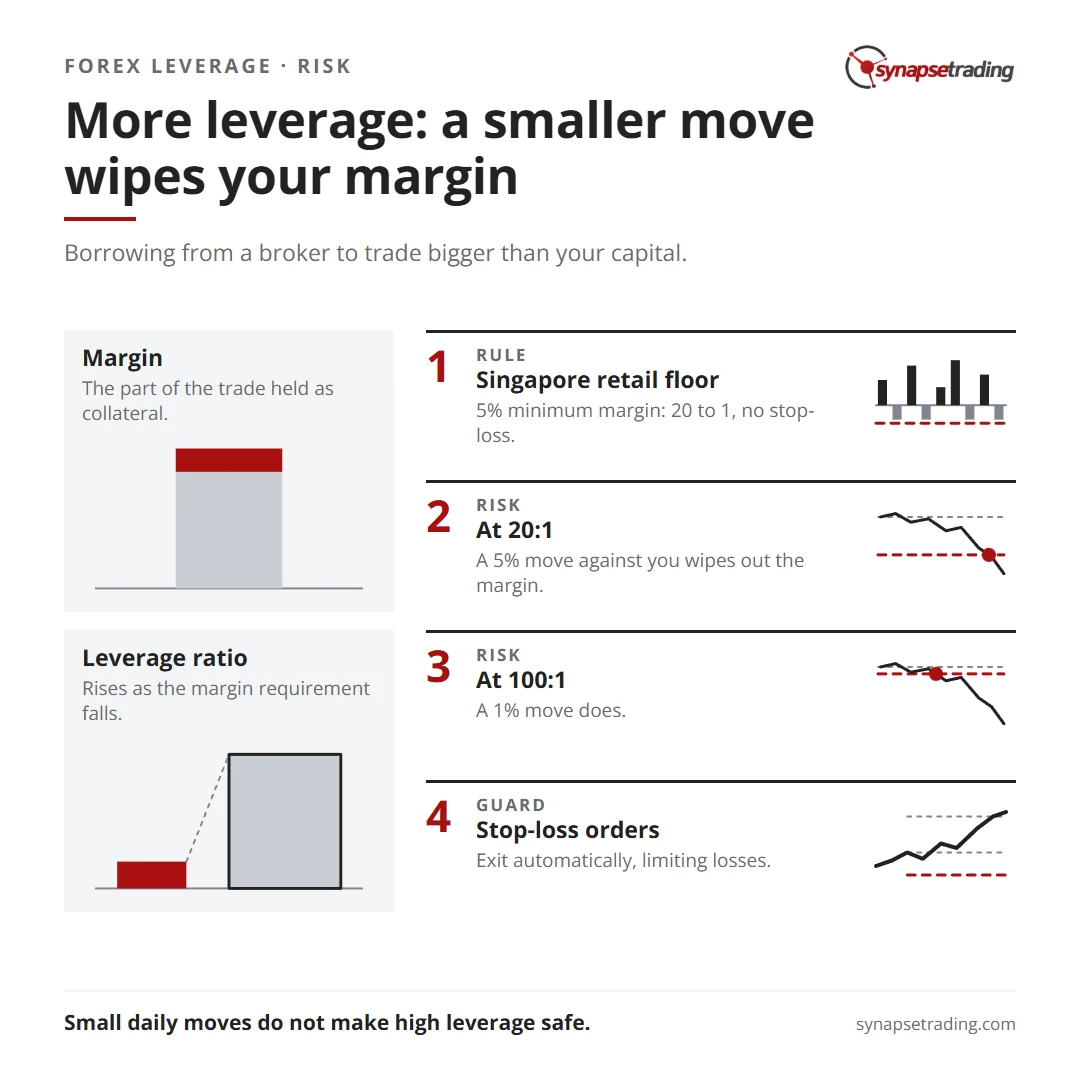
– In Singapore, MAS sets the minimum retail margin on currency pairs at 5%, which caps leverage at 20 to 1 on a position with no stop-loss attached.
Understanding Leverage in the Forex Market
The forex market is the largest financial market globally, with over $5 trillion in currency exchanges occurring daily. Forex trading involves buying and selling currency pairs with the expectation that the exchange rate will move in the trader’s favor. Currency rates are quoted with bid and ask prices by brokers. For example, if a trader buys the euro against the U.S. dollar (EUR/USD) at an ask price of $1.10, they hope the exchange rate will rise. If it does, they can sell the EUR/USD back to the broker at a higher bid price, with the difference representing their profit (or loss).
Leverage enhances the profit potential in forex trading by allowing traders to control a larger position than their initial investment. Forex markets offer some of the highest leverage ratios available to investors, making it possible to trade significant amounts with relatively small initial capital.
Types of Leverage Ratios
Leverage ratios vary depending on the broker and the trade size. For example, if a trader wants to buy $100,000 worth of EUR/USD, the broker might require $1,000 as margin, which represents a 1% margin requirement. This results in a leverage ratio of 100:1, meaning the trader controls $100,000 with just $1,000 of their own capital.
That 100:1 is not available to a retail trader at a Singapore-licensed broker. MAS sets a minimum margin rate of 5% on FX CFDs and leveraged FX contracts for retail investors, which works out to 20 to 1. MAS gave its reason when it set the floor in 2014: “While capping the leverage does not necessarily prevent losses, it mitigates the risk of retail investors taking on excessive positions and provides a buffer for unexpected losses.” The 5% applies to positions with no stop-loss attached. The same rules let a broker ask for less on a position that carries one. Either way, it is a floor, and a broker can ask for more.
Below is a table illustrating margin requirements and their corresponding leverage ratios:
| Margin Requirement | Leverage Ratio |
|---|---|
| 5% (Singapore retail minimum for currency pairs) | 20:1 |
| 2% | 50:1 |
| 1% | 100:1 |
| 0.5% | 200:1 |
As the margin requirement decreases, the leverage ratio increases, allowing traders to control larger positions with less capital. However, brokers may require higher margins for more volatile currencies or during periods of heightened market volatility.
Forex Leverage and Trade Size
Brokers may have different margin requirements depending on the trade size. Brokers outside Singapore often advertise 50:1 to 500:1, sometimes more on smaller trades. A Singapore-licensed broker cannot give a retail client more than 20:1 on a currency pair with no stop-loss attached. New accounts may have limited access to high leverage, and brokers might impose stricter margin requirements for emerging market currencies, which are generally more volatile.
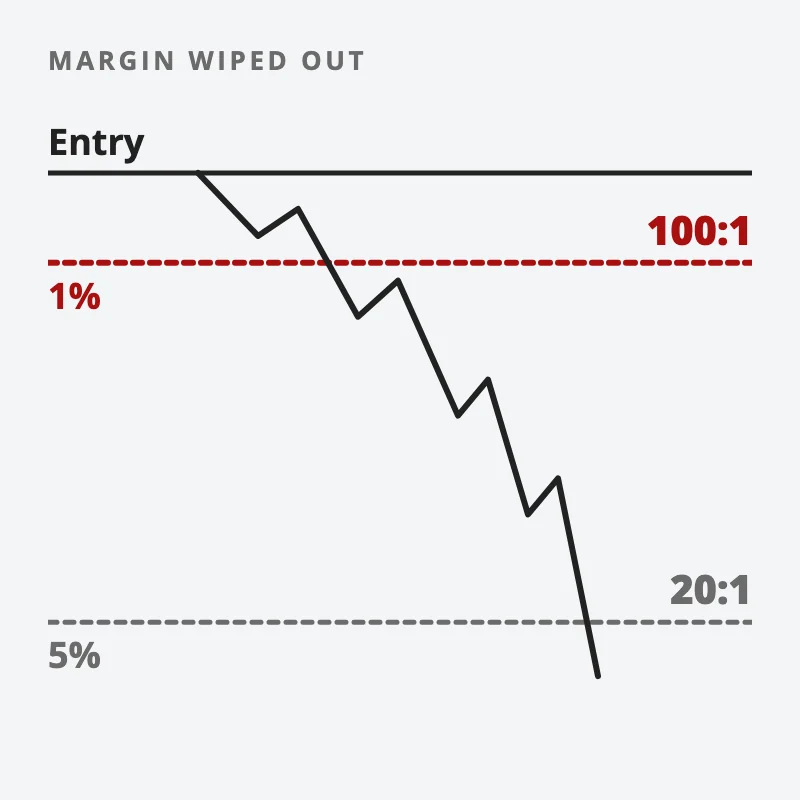
Forex brokers manage their risk by adjusting margin requirements or reducing leverage ratios, especially during volatile periods. Forex allows more leverage than most markets, because currencies usually move less in a day than stocks do. Small daily moves do not make high leverage safe. At 20:1, a 5% move against you wipes out the whole margin. At 100:1, a 1% move does.
The Risks of Leverage
While leverage can substantially increase potential profits, it can also lead to significant losses if the market moves against the trader’s position. For instance, if the currency underlying a trade depreciates instead of appreciating, the losses are magnified by the leverage used. To prevent catastrophic losses, forex traders often use stop-loss orders, which automatically exit a position if the market reaches a certain price level, limiting potential losses.
In conclusion, while leverage is a powerful tool in forex trading, it requires careful management and a solid understanding of risk. Proper use of leverage can enhance trading returns, but it can also lead to significant losses if not handled prudently.
Want the daily routine? Enter your email for the free 15-Minute Swing Trader's Checklist.
Free 5-page PDF, then occasional trading emails. Education only, not financial advice. Unsubscribe anytime. Kit stores your email in the US: see our privacy policy.
Want to learn the full method? The Trading Mastery Program teaches the 4 strategies I have traded since 2011. It suits beginners and experienced traders.
Rather follow the trades as they happen? Daily Trading Signals is our Telegram channel: my trade ideas with entry, stop and exit, and every trade is public.
Questions about this post? Ask in the free Telegram channel →
Educational content only, not personalised financial advice. Trading carries risk, including loss of capital. Past performance is not indicative of future results. Synapse Trading is not licensed or regulated by MAS.

