
• Link to Facebook
  • Link to X
  • Link to Instagram
  • Link to Youtube
  • Link to LinkedIn
  • Link to Mail
Free PDF: The 15-Minute Swing Trader's Checklist, the daily routine of a trader since 2007
  • Shopping Cart Shopping Cart
    0Shopping Cart
Synapse Trading
  • Mentoring
    • Trading Mastery Program
    • All mentoring options
  • Signals
    • Daily trading signals
    • Signals trade log
  • Results
    • Student results and testimonials
    • Public trade log, losses left in
  • Free guides
    • Start here
    • Trading foundations
    • Technical analysis
    • Strategies and systems
    • Risk and money
    • Trading psychology
    • Markets and products
    • Free trading guides
    • Tools and resources
    • Blog
  • About
    • My background
    • My trading journey
    • Media and interviews
    • Travel log
  • Contact
    • Contact me
    • Partnerships
  • Start free
  • Student login
  • Click to open the search input field Click to open the search input field Search
  • Menu Menu

Tag Archive for: swing trading

Spencer Li

Technical Analysis vs Fundamental Analysis: Which Should You Use, and How to Combine Them

Trading Foundations
Technical or fundamental analysis? - analysis

By Spencer Li, CFTe · Last updated: 26 October 2026

Technical analysis studies price and volume on a chart to decide when to act, while fundamental analysis studies the business or economy behind the price to decide why something is worth owning. Neither is better in general, because they answer different questions, so the useful choice is which one leads for your time horizon. A swing trader holding for days or weeks leans on technical analysis, a long-term investor leans on fundamental analysis, and most people do best using one to check the other.

In 2018, one of the questions new traders asked me most often was which method to learn. I wrote back that “Personally, I find that the best approach is to combine them to get the best of both worlds.” Eight years later, that has not changed. What has changed is how clearly I can explain why.

What is fundamental analysis really asking?

In my weekly outlook on 18 December 2025, I compared the AI boom with the dot-com bubble. I pointed out that the dot-com bubble burst because “the valuations were way higher than the reality”. The tricky part with AI was whether prices had run too far ahead of the fundamentals, or were roughly in line with them. Nobody could answer that from a chart.

That question is fundamental analysis in one sentence. You estimate what something is genuinely worth, and then you compare that value to the price the market is asking. For a company, the inputs are earnings, revenue, debt, the quality of management and the industry around it. For a currency or a commodity, they are interest rates, growth, supply and demand, which is why reports like the US jobs report can move a whole market in one evening.

When the value is well above the price, the asset may be cheap. When it is well below, the asset may be expensive. The catch is the word “may”, because the market can disagree with your valuation for far longer than you expect, and fundamental analysis on its own gives you no idea when the disagreement will end.

What is technical analysis really asking?

John Murphy, the author of Technical Analysis of the Financial Markets, put the split in one line: “The fundamentalist studies the cause of market movement, while the technician studies the effect.”

So technical analysis reads the effect. It studies price, volume and the patterns they form, on the idea that whatever people know or fear about an asset shows up in what they are willing to pay for it. A chart cannot tell you what a company is worth. It can tell you what the crowd is doing about it right now, whether the trend is up or down, and roughly where the price would have to go to prove your idea wrong.

Its biggest advantage is speed. You can scan dozens of charts in the time it takes to read one annual report, find the handful that are setting up, and leave the rest alone. If you are starting from zero, my guide on what technical analysis is covers the basics.

thumbnail beginner guide to trading and TA

If you would like to learn how to get started in trading, also check out: “The Beginner’s Guide to Trading & Technical Analysis”

How do the two compare side by side?

The easiest way to see the difference is to put them next to each other.
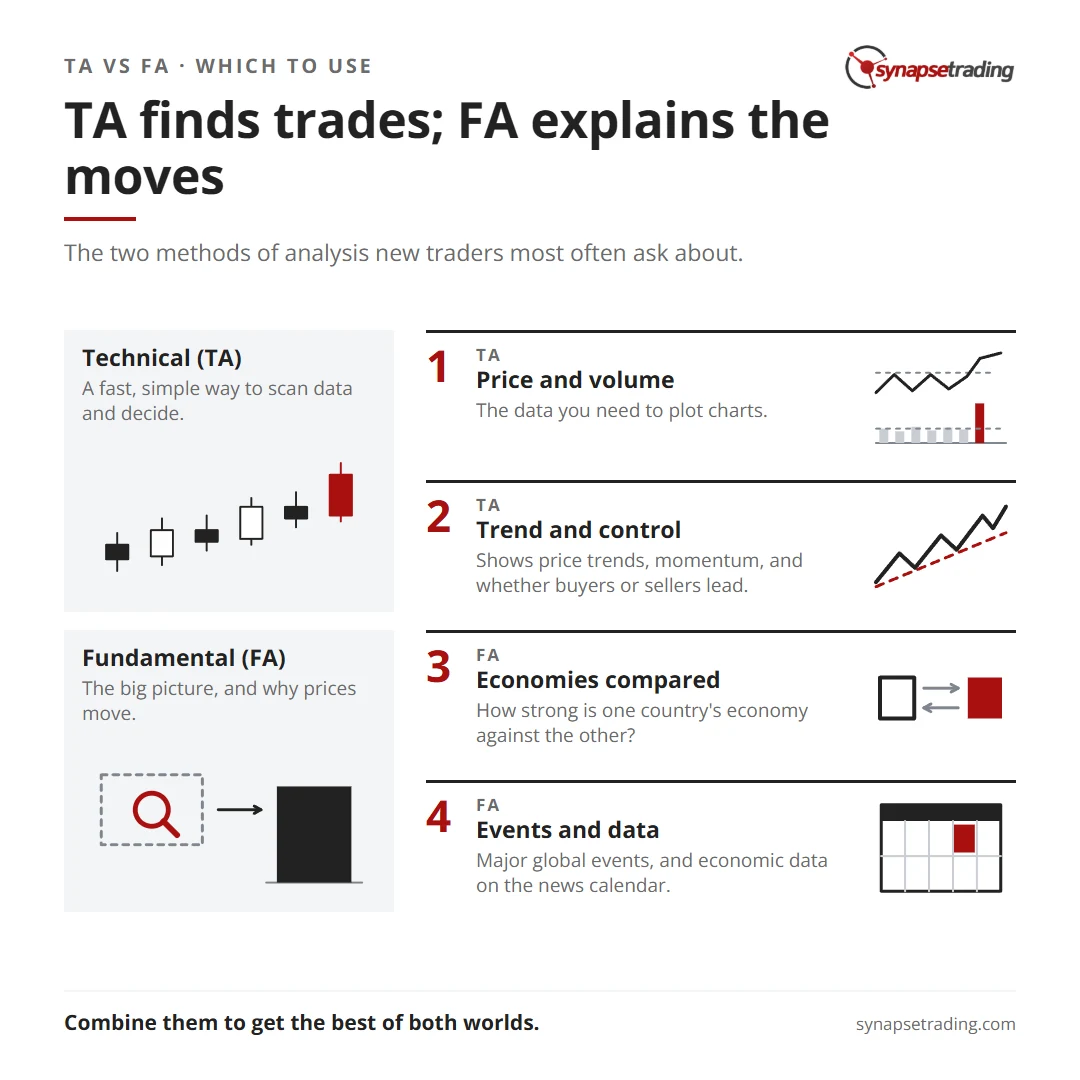
TA finds trades; FA explains the moves. Summary card for the post: Technical Analysis (TA) vs. Fundamental Analysis (FA).

Technical analysisFundamental analysis
What it studiesPrice, volume, chart patternsEarnings, value, economic and industry data
Main questionWhen should I act?Why is this worth owning?
Typical horizonDays to weeksMonths to years
SpeedFast, many charts at onceSlow, deep work on one asset
StrengthTiming, and knowing where you are wrongThe big picture and the reason behind a move
Blind spotSays nothing about whySays little about when

Read the bottom two rows together and a pattern jumps out. Each method’s strength sits exactly where the other one is blind, which is the whole case for using both.

If you trade around a full-time job and want a routine that keeps both in view, my free 15-minute swing trader checklist is the one I use myself.

Isn’t technical analysis just astrology?

In December 2020, someone on Reddit’s r/stocks started a thread titled “Technical Analysis is like Astrology and Anyone who Believes in it is a Fool”. The title did not leave much room for nuance.

They have a point, and the best evidence for it comes from a technician. In Evidence-Based Technical Analysis, published in 2007, David Aronson tested 6,402 technical rules on the S&P 500 from 1980 to 2005. Once he corrected for the fact that testing that many rules will throw up some lucky winners by chance, not one of them was statistically significant. He also argued that much of the subjective side of charting, the hand-drawn lines and the pattern spotting, cannot be tested at all, because nobody can write it down precisely enough to prove it wrong. I wrote up the whole argument in my summary of Aronson’s book.

So I would never use a chart as a crystal ball. What a chart does well is far more modest, and far more useful. It shows you whether buyers or sellers are in control right now. It also tells you in advance the price at which your idea is wrong, so a bad trade costs you a small, known amount instead of a nasty surprise. Astrology never offers to tell you when it has failed. A stop loss does exactly that.

Why does the crowd’s opinion matter as much as the value?

In 1936, the economist John Maynard Keynes compared investing to a newspaper beauty contest, where readers won a prize for picking the faces that other readers would pick. To win, you could not choose the face you found prettiest. You had to guess what everyone else would choose, and one step further, what everyone else expected everyone else to choose. Keynes called it devoting our intelligence to “anticipating what average opinion expects the average opinion to be”.

That idea comes from economics and psychology rather than from trading, and it explains why the two methods need each other. Fundamental analysis tells you what a thing is worth. But the price you can sell at tomorrow is set by the crowd, and the crowd is busy guessing what everybody else thinks. A chart is simply the scoreboard of that guessing game.

So when your valuation and the chart disagree, neither one is automatically lying. Either the crowd knows something you have missed, or the crowd has not caught on yet, and the honest response is usually to wait until the two line up.

How do I combine them in practice?

On 7 May 2026, in my weekly outlook, I mentioned that I had just taken a position in a copper ETF. The fundamental reason was one I had talked about in earlier videos. Copper has “very strong fundamentals”, with a shortage of supply that I called “a fundamental force driving this commodity”. But that story had been true for a while, and I did not act on it until the chart agreed, after a decline, when price gapped back above all its moving averages. A week later, I said I was simply waiting for it to break to new highs.

That is the whole method in one trade. The fundamentals told me what was worth watching and why, and the chart told me when to act and where I would be wrong. In practice it runs in three steps.

  1. Let fundamentals build the shortlist. Look for things with a real reason to move, such as a supply shortage, a strong business or a clear shift in interest rates.
  2. Let the chart decide the timing. Wait until price confirms the story, and decide before you enter where the idea stops working.
  3. Treat a disagreement as information. When a great story sits on an ugly chart, it is often better to wait than to argue with the market.

There is one more place where fundamentals protect a chart trader, and it is the earnings calendar. The single news rule in my daily routine is not to hold a stock through its earnings report, because a chart cannot see the number coming and the price can gap straight past any stop. That is fundamental analysis at its most practical, and it takes about five seconds a day.

If you want to see how this fits with the four main trade types, my guide on the types of trading strategies shows which ones lean on each method. And if you want the routine I run every day in 15 minutes, grab the free 15-minute swing trader checklist.

So which one should you use?

It depends mostly on how long you plan to hold. If you swing trade for days or weeks, technical analysis does most of the work, because over that horizon timing and risk control matter more than next year’s earnings. If you invest for years, fundamental analysis leads, because over that horizon the business, rather than this week’s candle, decides how it goes.

Even then, the other method still earns its place. An investor who glances at a chart can avoid buying a good business in the middle of a crash, and a trader who checks the earnings date avoids being blindsided by one. You do not have to master both to the same depth. You only have to stop pretending one of them does not exist.

FAQ

Is technical analysis or fundamental analysis better?
Neither is better in general, because they answer different questions. Technical analysis is better for timing and short holding periods, and fundamental analysis is better for judging value over years.

Can you use technical and fundamental analysis together?
Yes. A common approach is to use fundamental analysis to decide what is worth trading and why, and technical analysis to decide when to enter and where the idea is wrong.

Which should a beginner learn first?
If you want to trade actively, technical analysis is usually the faster start, because it gives you a repeatable way to scan charts and make decisions. Fundamental analysis matters more as your holding period gets longer.

Do swing traders need fundamental analysis?
A little. Most swing traders rely on charts for timing, but they still check the earnings calendar and big economic releases so they are not caught on the wrong side of a known event.

Does technical analysis actually work?
The evidence is mixed. Aronson’s 2007 test of 6,402 rules on the S&P 500 found none that survived a correction for luck, so a chart is best used for timing and risk control rather than prediction.

What is the main difference between technical and fundamental analysis?
Technical analysis studies price and volume to answer when. Fundamental analysis studies the business or economy behind the price to answer why.


Which one do you lean on more, and has a great story on an ugly chart ever cost you? Let me know in the comments.

If you want to go further, my free trading guides cover both sides in more depth.

And if you want a daily routine that keeps the chart and the earnings calendar in view without hours at the screen, grab the free 15-minute swing trader checklist.


About the author. Spencer Li is The 15-Minute Trader and the founder of Synapse Trading. He is a Certified Financial Technician (CFTe) with 15+ years of trading, run from 70+ countries. He holds a B.Acc and B.BM from SMU. Every trade he takes is public, dated, losses left in. He teaches rules-based swing trading in 15 minutes a day, one system for any market.

Education, not financial advice. Synapse Trading is not licensed by MAS to advise on investment products. Trading carries risk of loss, and past performance is not indicative of future results.
by Spencer Li
https://synapsetrading.com/wp-content/uploads/2026/10/technical-analysis-fundamental-analysis-card.webp 630 1200 Spencer Li https://synapsetrading.com/wp-content/uploads/2026/10/synapse-logo-horizontal-light.png Spencer Li2018-10-04 07:13:162026-10-26 17:20:59Technical Analysis vs Fundamental Analysis: Which Should You Use, and How to Combine Them
Spencer Li

Swing Trading vs Intraday Trading: Which Is Better If You Have a Day Job?

Trading Strategies & Systems
Swing or intraday trading? - trading styles

By Spencer Li, CFTe · Last updated: 26 October 2026

For most people who trade around a job, swing trading is the better choice. Intraday trading means opening and closing every position within the same day, so it needs you at the screen for the whole session. Swing trading means holding a position for days to weeks to catch a medium-term move, which you can run in about 15 minutes a day. Neither style is more profitable by default. But the best study I know of on people who tried to day trade for a living makes for grim reading, and I tried it myself for a couple of years before it started to cost me my health.

I first wrote about this in June 2018. Everything I have seen since has pushed me further the same way.

What is the difference between swing trading and intraday trading?

Ask most people what trading looks like and they describe a scene from a film. Someone sits in front of six screens, prices flashing, shouting orders and firing off trades at lightning speed. It is very much dramatised, but the person in that scene does exist, and he is a day trader.

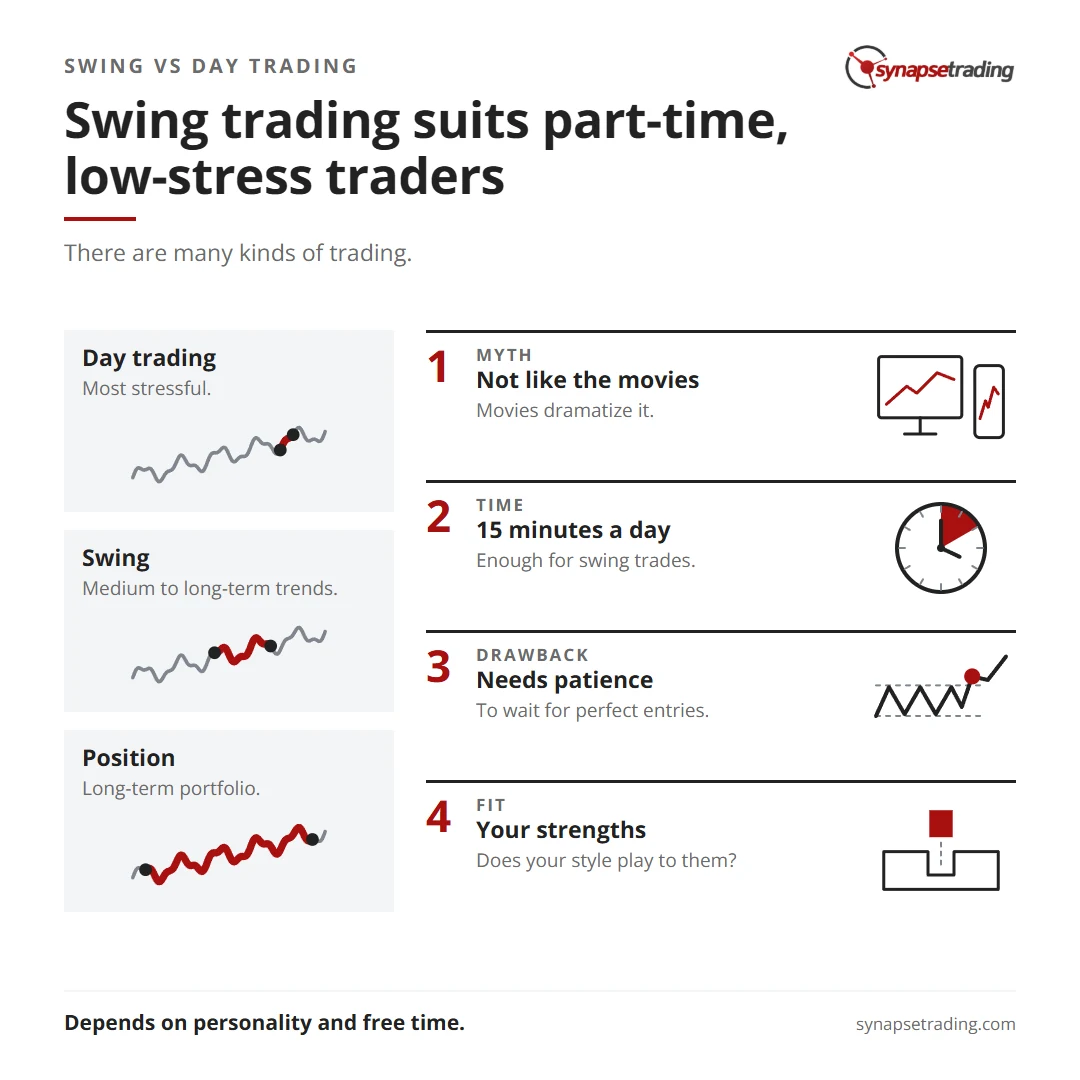
The real difference between the styles is how long you hold a position, and everything else follows from that. Scalpers hold for seconds to minutes. Day traders hold for minutes to hours and close everything before the market shuts, so they carry nothing overnight. Swing traders take tactical positions to capture the medium-term trend and hold them for days to weeks. Position traders hold for months or years, which is closer to timing the market to build a long-term portfolio, as I described in how to build a $1M portfolio by 30.

Intraday tradingSwing trading
Holding periodSeconds to hours, nothing overnightDays to weeks
Screen timeThe whole sessionAbout 15 minutes a day
DecisionsMany, fast, under pressureFew, made when the market is closed or quiet
Income patternSmoother, more frequentLumpier, from fewer and larger moves
Fits a full-time job?RarelyYes
Main riskBurnout, costs and fast mistakesOvernight gaps, and impatience

The table hands neither side a profit edge, because the holding period does not create one. What it changes is how much of your time and nerve each trade asks for.

Why did I stop day trading?

The honest reason had nothing to do with strategy. I tried day trading for a couple of years, and the money was actually pretty good. But it started to take a toll on my health, and I decided that was a trade I did not want to keep making.

The only time in my career I was glued to the screen was when I was trading for a fund, and that was very early on. Being switched on for the whole session, every session, suits some people, and it did not suit me. Once I moved to swing trading, 15 minutes a day turned out to be more than enough to place and manage my trades, which left the rest of the day for the things that matter more.

The slower style also changed what I was trying to do. In my weekly outlook on 4 December 2025, I told viewers I had been deliberately taking fewer positions, because “the purpose is not really to take a lot of trades in a short amount of time. That will be more like day trading.” The aim with swing trading is to find a few good-quality positions and hold them.

If you want that routine without the screen time, my free 15-minute swing trader checklist is the one I run each day.

What happens to most people who try to day trade for a living?

Three economists in Brazil had something most researchers never get, which is the full record of every trader in a market. They looked at every individual who started day trading Brazilian equity futures between 2013 and 2015 and kept at it for at least 300 days. In their working paper, published in February 2020 as “Day trading for a living?”, Fernando Chague, Rodrigo De-Losso and Bruno Giovannetti report that 97% of them lost money.

The rest of the abstract does not cheer things up. Only 0.4% earned more than a bank teller. Even the best individual in the whole group earned a small daily sum, and the day-to-day swings around it, measured as a standard deviation, were about eight times larger, which is a lot of risk for that pay. And they found no evidence that people got better by day trading for longer.

They also wrote that day trading for a living is virtually impossible, “contrary to what course providers claim”. As a course provider, I read that line with some discomfort, and then agreed with it.

Do note the limits. This is one market, one product and one period, and nobody has run the same full census on swing traders, so I cannot show you an equivalent number for the slower style. What the study does show is how the fast game treats the typical person who plays it with real money.

Why do fast decisions go wrong more often?

I played a lot of competitive chess in school, and anyone who has played blitz knows the feeling. You can see the right idea, but the clock does not let you check it, so you play the move that looks right and find out a few seconds later that it was not.

The psychologists Christopher Chabris and Eliot Hearst measured this with the best players in the world. They took games from the Monaco tournaments, where top grandmasters played rapid games at under 30 seconds a move and classical games at about 3 minutes a move, and had a strong chess program flag every blunder. In their 2003 paper in Cognitive Science, the same grandmasters made 6.85 blunders per 1,000 moves in rapid games and 5.02 in classical games.

So less time meant about 36% more blunders. The psychologist Fernand Gobet, replying to the paper, made a fair point that the gap is small next to the total number of moves, and grandmasters do not turn into beginners when the clock speeds up. I agree with him. The blunder rate creeps up rather than explodes.

Now carry that over to trading, where the count matters. Suppose a day trader makes 20 decisions a day and a swing trader makes 20 a month. Even if each fast decision were only slightly worse, the day trader takes about 20 times as many chances to make one, and every mistake is paid for in money and in fees, with no draw on offer. Time pressure does not make you a bad trader. It just hands you more chances to be one.

Isn’t swing trading stressful too?

On 28 August 2025, a trader on Reddit’s r/swingtrading posted that they were quitting swing trading altogether. Their complaint was a fair one: “Even swing trading, you have to constantly monitor your stocks and stressing out daily.”

Reading their post, two things stood out. They described spending 4+ hours on research, and the final straw was two stocks that beat earnings and then fell. Both are choices about the routine, more than about the style. A swing routine that takes four hours a day has turned into day trading with longer holds. And earnings are where a swing trader is most exposed, because a stock can gap overnight on the result and skip straight past your stop. The only news rule in my own daily checklist is to not hold through earnings, for exactly that reason.

But I will concede the point that swing trading is not calm in every market. In my weekly outlook on 24 March 2026, with the market nervous, I said it gets “a bit harder to hold on to positions” at times like that. You might shorten the holding period, maybe do a bit of day trading, or wait for the trend to be clear. Some weeks, the slow style is uncomfortable too, and the honest answer is that waiting is part of the job.

That waiting is the real cost of swing trading. Your income is lumpier than a day trader’s, because it comes from fewer and larger moves. You need a ton of patience, first to wait for a clean setup, then to sit on your hands while the trade plays out. If watching a position do nothing for a week drives you up the wall, that is worth knowing about yourself early. A free 15-minute swing trader checklist helps here, because it gives the waiting a shape.

So which one should you choose?

The best style depends on your personality and how much free time you really have, and there is no universal winner. Two plain questions settle most of it.

  1. How much time can you give the market every day, on a normal week rather than your best one?
  2. Do fast decisions sharpen you or fray you? Be honest here, because most of us picture the calm version of ourselves, and the one who actually turns up is the one who slept badly.

If you can sit through the whole session and fast decisions energise you, intraday trading can suit you, and you go in knowing what the Brazil numbers say about the typical outcome. If you trade around a job, a business or a family, swing trading fits the life you already have, which is the reason I use it. Personally, I prefer the swing trading approach because it gives me the best return on my time and effort, and I have yet to meet anyone who regrets getting their afternoons back.

Swing trading suits part-time, low-stress traders. Summary card for the post: Swing Trading vs. Intraday Trading: Which is Better?.

If you are still sorting out which kind of trade you even want to take, the 4 types of trading strategies is a good next read. And if the fast end still tempts you, read what 0DTE options are before you try them.

FAQ

Is swing trading or day trading more profitable?
Neither is more profitable by default. A day trader takes more, smaller trades and a swing trader takes fewer, larger ones. A full census of Brazilian day traders who kept going for at least 300 days found that 97% lost money, published in a working paper in February 2020.

Is swing trading better for beginners?
For most beginners, yes. It needs about 15 minutes a day, fits around a job, and the slower pace gives you time to think through each decision rather than react under a clock.

Can I swing trade with a full-time job?
Yes. Swing trades are held for days to weeks and can be managed outside office hours, so you never need to watch the market while you work.

What are the drawbacks of swing trading?
Your income is lumpier, because it comes from fewer and larger moves. You hold positions overnight, so a gap on news or earnings can skip past your stop. And it asks for a lot of patience.

What is the difference between scalping and day trading?
Both close every position within the same day. Scalpers hold for seconds to minutes and take many tiny profits, while day traders hold for minutes to hours.


Which style do you trade now, and if you have tried both, which one did your health and your evenings prefer? Let me know in the comments.

If you are new to all of this, my free trading guides walk you through the basics in order.

And if you want a routine that fits around a full-time job, grab the free 15-minute swing trader checklist.


About the author. Spencer Li is The 15-Minute Trader and the founder of Synapse Trading. He is a Certified Financial Technician (CFTe) with 15+ years of trading, run from 70+ countries. He holds a B.Acc and B.BM from SMU. Every trade he takes is public, dated, losses left in. He teaches rules-based swing trading in 15 minutes a day, one system for any market.

Education, not financial advice. Synapse Trading is not licensed by MAS to advise on investment products. Trading carries risk of loss, and past performance is not indicative of future results.

by Spencer Li
https://synapsetrading.com/wp-content/uploads/2026/10/swing-trading-vs-intraday-trading-which-is-better-card.webp 630 1200 Spencer Li https://synapsetrading.com/wp-content/uploads/2026/10/synapse-logo-horizontal-light.png Spencer Li2018-06-13 23:21:092026-10-27 09:56:05Swing Trading vs Intraday Trading: Which Is Better If You Have a Day Job?

Free checklist

The 15-Minute Swing Trader’s Checklist

The daily and weekly routine I use to find, manage and review trades in about 15 minutes a day, trading since 2007.

Get the free checklist

Topics

  • Trading foundations
  • Technical analysis
  • Strategies and systems
  • Risk and money
  • Trading psychology
  • Markets and products

Synapse Trading

Swing trading for busy professionals, in 15 minutes a day.

Start free

Learn

  • Start here
  • Free trading guides
  • Blog
  • Tools and resources

Programs

  • Trading Mastery Program
  • Daily trading signals
  • Student results
  • Public trade log

Company

  • About
  • Contact me
  • Partnerships
  • Disclaimer
  • Privacy policy
  • Terms & Conditions

Synapse Trading Pte Ltd
Registration No. 201316168H
WhatsApp +65-8897-1204
info@synapsetrading.com

Contact Us

Synapse Trading Pte Ltd
Registration No. 201316168H

Whatsapp: +65-8897-1204
Telegram: @iamrecneps
Email: info@synapsetrading.com

Links

Disclaimer
Privacy policy
Terms & Conditions
Contact us
Partnerships

© 2012-2026 Synapse Trading | All rights reserved. Educational content only, not personalised financial advice. Trading carries risk, including loss of capital. Past performance is not indicative of future results. Synapse Trading is not licensed or regulated by MAS.
  • Link to Facebook
  • Link to X
  • Link to Instagram
  • Link to Youtube
  • Link to LinkedIn
  • Link to Mail
Scroll to top Scroll to top Scroll to top
Manage Consent
To provide the best experiences, we use technologies like cookies to store and/or access device information. Consenting to these technologies will allow us to process data such as browsing behavior or unique IDs on this site. Not consenting or withdrawing consent, may adversely affect certain features and functions.
Functional Always active
The technical storage or access is strictly necessary for the legitimate purpose of enabling the use of a specific service explicitly requested by the subscriber or user, or for the sole purpose of carrying out the transmission of a communication over an electronic communications network.
Preferences
The technical storage or access is necessary for the legitimate purpose of storing preferences that are not requested by the subscriber or user.
Statistics
The technical storage or access that is used exclusively for statistical purposes. The technical storage or access that is used exclusively for anonymous statistical purposes. Without a subpoena, voluntary compliance on the part of your Internet Service Provider, or additional records from a third party, information stored or retrieved for this purpose alone cannot usually be used to identify you.
Marketing
The technical storage or access is required to create user profiles to send advertising, or to track the user on a website or across several websites for similar marketing purposes.
  • Manage options
  • Manage services
  • Manage {vendor_count} vendors
  • Read more about these purposes
View preferences
  • {title}
  • {title}
  • {title}