• Link to Facebook
  • Link to X
  • Link to Instagram
  • Link to Youtube
  • Link to LinkedIn
  • Link to Mail
Synapse Trading
  • Home
  • About
    • My Background
    • My Trading Journey
    • My Travel Log
    • Media & Interviews
  • Mentoring
    • Trading Mastery Program
    • Results & Testimonials
  • Signals
    • Telegram (Free to join!)
    • Daily Trading Signals
    • Daily Trading Signals (Results)
  • Resources
    • Free Trading Guides
    • Tools & Resources
    • Blog & Infographics
  • Contact
    • Contact Us
    • Partnership Opportunities
  • Click to open the search input field Click to open the search input field Search
  • Menu Menu

Tag Archive for: SGX academy

Spencer Li

Guest Speaker & Panelist at SGX Active Traders Conference 2015

News & Events

I am honoured to be invited as one of the distinguished speakers and panelists selected to represent SGX for this major event.

I will be sharing on swing trading strategies, with real market case studies, to show how I built a monthly 5-figure passive income portfolio with just 15 minutes a day.

See you there! 😀

SGX_Active_Traders_Conference_2015_without_badge

0 Comments/by Spencer Li
https://synapsetrading.com/wp-content/uploads/2019/10/logo.jpg 0 0 Spencer Li https://synapsetrading.com/wp-content/uploads/2019/10/logo.jpg Spencer Li2015-05-13 08:00:512018-10-30 13:29:02Guest Speaker & Panelist at SGX Active Traders Conference 2015
Spencer Li

Shortcuts to Analyzing Financial Ratios for Stocks

Trading Tips
7 essential financial ratios

Reading financial statements is one thing; analyzing them and deciphering their true meaning is another. To do that, you need to understand the seven essential financial ratios. They’re like a shortcut for filtering out good stocks.

The first is gross profit margin. This represents the proportion of money left over after subtracting the cost of goods sold. To calculate gross profit margin, take gross profit and divide by sales. The higher the margin, the more profitable a company is. Margins of 15% or more are considered good.

The second ratio is net profit margin. This represents the portion of money left after subtracting all expenses to calculate net profit margin divided net profit by sales. The higher the margin, the more profitable the company is. In general, look for margins of 7% or more.

The third ratio is return on equity or ROE. This measures how much profit a company makes from shareholder equity. To calculate ROE, take the net profit and divide it by equity. The higher the number, the more money the company makes for its shareholders. Look for an ROE of 15% or higher.

The fourth essential ratio is the current ratio. This measures a company’s current assets against its current liabilities. To calculate the current ratio, simply divide the current assets by the current liabilities. The higher the ratio, the more likely the company will be able to cover short term liabilities. A good current ratio is anything above 1.

The fifth ratio you should know is the debt to cash flow ratio. This measures the company’s debts against its operating cash flow. To calculate this, take the company’s total debt and divide it by operating cash flow. The lower the ratio, the better the company’s ability to finance their operations, any ratio less than or equal to three is considered good.

The sixth essential ratio is the net gearing ratio. This measures the company’s debts against its shareholder equity. To calculate this ratio, first take the total debt and subtract the company’s cash, then divide that number by the equity. The higher the ratio, the more debt and therefore risk the company has. Look for a net gearing ratio of 0.5 or less.

Finally, the seventh essential ratio is the dividend yield. This measures how much in dividends the company pays out compared to their stock price. To calculate the dividend yield, take the dividend per share and divide it by share price. The higher the yield, the more dividends shareholders receive. Look for companies with consistent yields between 4 and 7 percent.

And that’s it!

By applying these 7 essential ratios, you too can uncover hidden gems in the stock market!

0 Comments/by Spencer Li
https://synapsetrading.com/wp-content/uploads/2015/05/7-essential-financial-ratios.png 711 1276 Spencer Li https://synapsetrading.com/wp-content/uploads/2019/10/logo.jpg Spencer Li2015-05-08 08:00:332021-02-14 17:16:11Shortcuts to Analyzing Financial Ratios for Stocks
Spencer Li

How to Read Stock Financial Statements

Trading Tips
reading financial statements

If you really want to know how a company is doing, you need to read their financial statements. It’s the fastest and most reliable way to know if a company is doing well or struggling to survive.

There are three different kinds of financial statements: the balance sheet, the income statement and the cash flow statement. First, let’s start with the balance sheet. This summarizes a company’s assets, liabilities and equity at a specific time.

Assets are broken down into two categories: current assets which include cash and highly liquid investment securities, and non-current assets which include any property buildings plants equipment & company software. Next, are the company’s liabilities which are also broken down into two categories: current liabilities which include bank loans accounts payable and other payables like payroll and accrued expenses and non-current liabilities which include any long-term loans or financial obligations. If you subtract the total liabilities from the total assets, you get the total shareholders equity.

Now, let’s move to the company’s income statement. This measures how much profit or loss the company has made over a specific period of time, which is why it’s also referred to as a P&L statement. First, you have revenue which is the amount of money the company makes by selling products or providing services.

Next, come cogs or cost of goods sold which is the amount spent producing or acquiring the products or services, including material and labor costs, subtract cogs from revenue and you’ve got gross profit. Then, come the operating expenses which include day-to-day things like marketing costs, indirect labor costs and so on, subtract that from gross profit and you’ve got operating income. Next, take that number and subtract all other miscellaneous expenses and you’ve got the company’s profit before taxes, subtract the taxes and you’ve got the net profit.

And that leads us to the third financial statement, the cash flow statement. This measures how much cash flows in and out of a company over a specific period because a company’s revenue and expenses can be delayed or deferred. This shows the actual cash flowing in and out of the company. First, you add together the cash flows from all operating activities including profit before taxes, trade and other receivables, and trade and other payables then you add the cash flows from investment activities along with the cash from financing activities. You then, compare the cash at the beginning of the financial year to the cash at the end, to determine if the company had a positive or negative cash flow and that’s how you read a company’s financial statements.
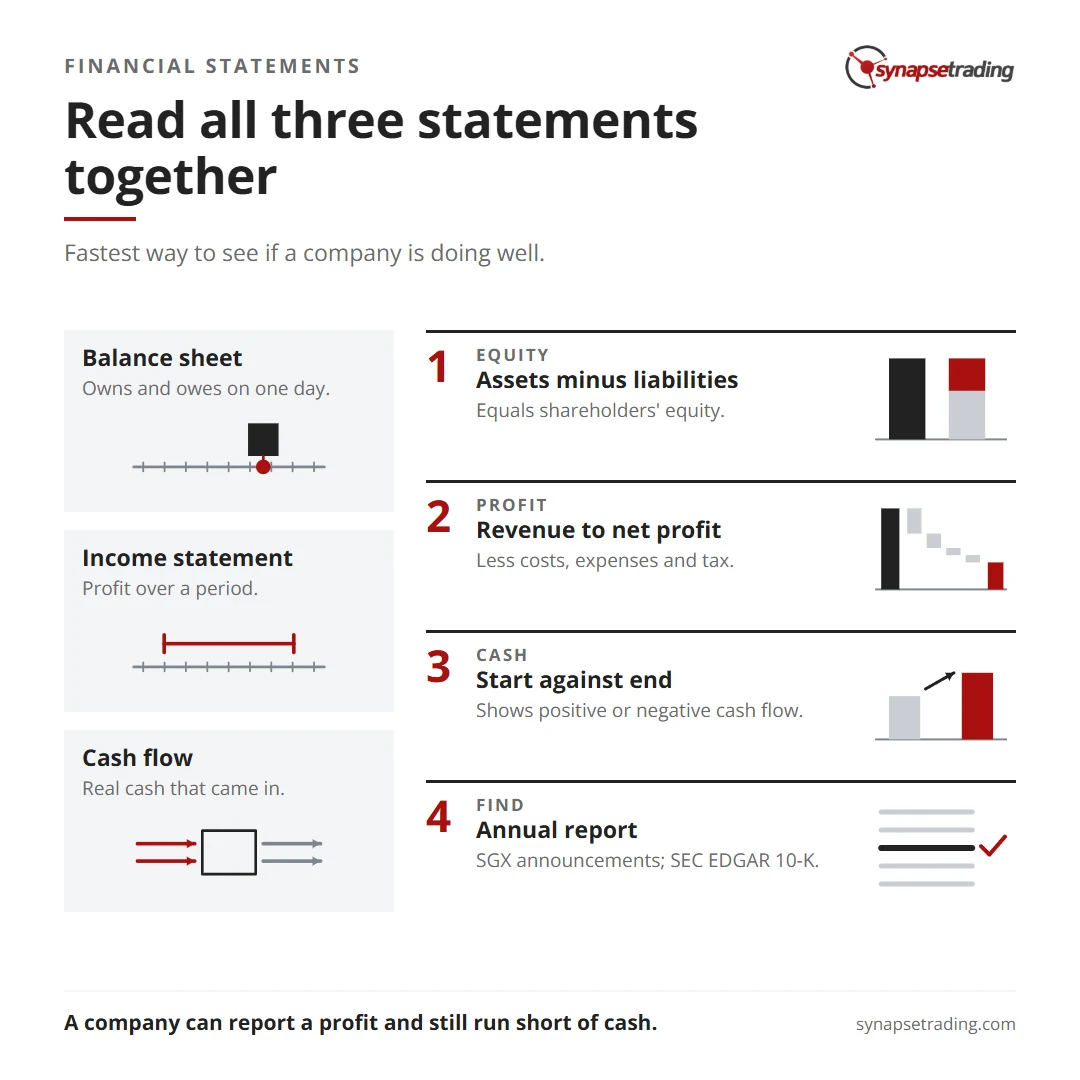
In our next video we’ll go even further and learn what these numbers actually mean.

0 Comments/by Spencer Li
https://synapsetrading.com/wp-content/uploads/2015/02/reading-financial-statements.png 1066 1893 Spencer Li https://synapsetrading.com/wp-content/uploads/2019/10/logo.jpg Spencer Li2015-02-22 08:30:502021-02-13 22:33:37How to Read Stock Financial Statements
Spencer Li

How to Find Undervalued Stocks for Investment

Trading Tips
finding value in stocks

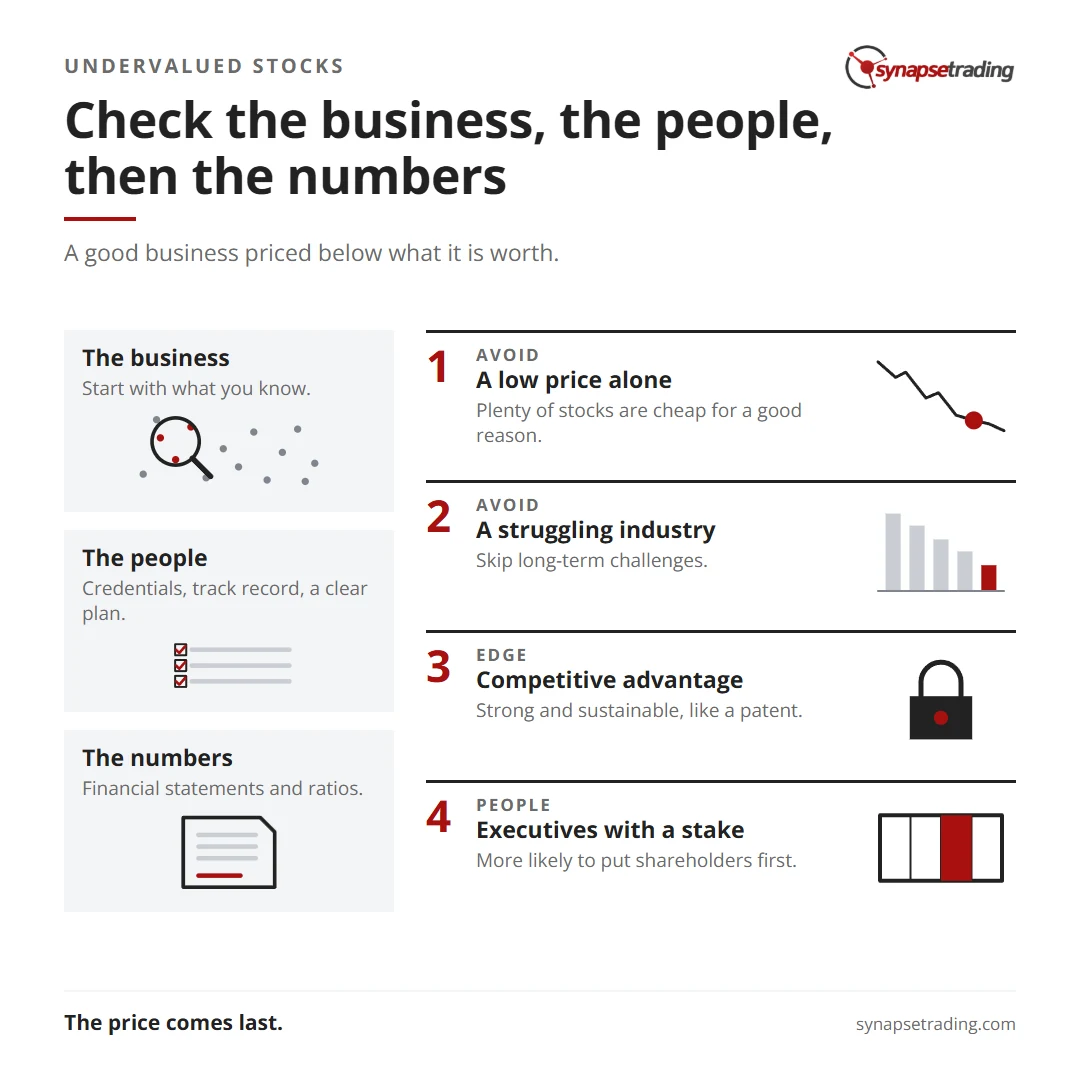
To be a successful value investor in the stock market, you need to know how to identify which stocks are the most valuable. But the most valuable stocks aren’t necessarily the ones that are performing the best. In fact, the real goal is to find stocks with strong intrinsic value that are currently under valued by the market. So how do you identify these gems?

First, find the right type of business.

In general, you should always start with what you know. For instance, if you’re familiar with the technology sector, you may want to look there. Just make sure that the industry isn’t experiencing long term challenges. This will help you avoid eroding profits in the future.

Next, look for a company with a strong and sustainable competitive advantage. For instance, if a company has a patent on an emerging technology, this could help them for years to come. Finally, make sure the company has strong growth potential and a clear strategy for the future. Is there a growing demand for their product? Do they have the infrastructure necessary to expand?

Questions like these can help gauge their future success.

The second way to identify intrinsic value is to study a company’s management team.

Do some research.

See if they have the proper credentials and make sure that their skill sets are well suited for the current business climate and of course, look at their track records. Were they successful in their recent positions or did they leave those companies weaker than before? And, are they transparent with their shareholders? Executives who are open to new ideas and willing to adapt are generally more capable of overcoming future challenges.

Next, have they laid out a clear plan for future growth if not you should be concerned and how are they paid? Do they receive a flat salary or is it performance-based? And do they own a significant stake in the company? Executives who are themselves invested in their company’s success are more likely to put their shareholders first.

The third and final way to identify intrinsic value, is to analyze the company’s financial numbers.

But this topic requires a lot of attention, which is why we’ll cover it in our next video reading financial statements.

0 Comments/by Spencer Li
https://synapsetrading.com/wp-content/uploads/2015/02/finding-value-in-stocks.png 750 1286 Spencer Li https://synapsetrading.com/wp-content/uploads/2019/10/logo.jpg Spencer Li2015-02-12 04:43:062021-02-14 15:18:01How to Find Undervalued Stocks for Investment
Spencer Li

Invitation to Speak at SGX Investment Carnival

News & Events

Later this evening (Saturday), I will be making a guest appearance at the SGX Investment Carnival, and sharing some practical tips on how to achieve early financial freedom, especially for those starting with little capital.

When I popped by today, I was pleasantly surprised to see the video tutorials that I did with SGX being displayed at their booth. I think that is a very good way for beginners to learn.

I will be there (Cathay Cineleisure @ Somerset) from 4.00pm to 4.30pm, so those who want to sign up for my training program, or simply want to have a chat with me about the prop trading opportunity, feel free to drop by and say hi.

See you there! 😀


sgx carnival

The investment carnival organised by Singapore Exchange (SGX) attracted a crowd of 1,050 people on Friday (Feb 6). SGX said 80 new trading and central depository accounts have been opened as at 6pm – on the first day of the event.

The three-day carnival at Orchard Road is aimed at educating new investors and encouraging them to start trading in stocks.

Investing in the stock market may seem daunting to most people. Thus, SGX launched the carnival to break down the investment journey into simple steps. These include helping young adults identify their investment goals and understand the basics of share trading.

Source: http://www.channelnewsasia.com/news/business/singapore/sgx-s-investment-carnival/1642466.html

0 Comments/by Spencer Li
https://synapsetrading.com/wp-content/uploads/2019/10/logo.jpg 0 0 Spencer Li https://synapsetrading.com/wp-content/uploads/2019/10/logo.jpg Spencer Li2015-02-07 05:26:342019-11-11 17:45:27Invitation to Speak at SGX Investment Carnival
Page 3 of 512345

Free Trading Guides

Free Trading Guides

Blog Categories

  • Beginner's Guide
  • Blockchain & Crypto
  • Book Summaries
  • Candlestick Patterns
  • Economics & News Trading
  • Investing & Portfolio Management
  • Living Your Best Life
  • Market Analysis
  • News & Events
  • Price Chart Patterns
  • Promotions
  • Risk & Money Management
  • Stock Trading
  • Testimonials
  • Tools & Resources
  • Trading Psychology
  • Trading Strategies
  • Trading Tips
  • Travel & Lifestyle

Free Trading Guides

Free Trading Guides

Contact Us

Synapse Trading Pte Ltd
Registration No. 201316168H

Whatsapp: +65-8897-1204
Telegram: @iamrecneps
Email: info@synapsetrading.com

Links

Disclaimer
Privacy policy
Terms & Conditions
Contact us
Partnerships

© 2012-2024 Synapse Trading | All rights reserved | - powered by Enfold WordPress Theme
  • Link to Facebook
  • Link to X
  • Link to Instagram
  • Link to Youtube
  • Link to LinkedIn
  • Link to Mail
Scroll to top Scroll to top Scroll to top