

Penny Stocks vs Blue Chips: What the Low Price Really Costs You
Want the daily routine? Get the free 15-Minute Swing Trader’s Checklist. Get it free →
Why a 1-cent share is not a cheap company, and the three hidden costs that make penny stocks harder to trade than they look
Published: 17 October 2026 · Last updated: 17 October 2026 · By Spencer Li, CFTe
What is the difference between penny stocks and blue chips? A penny stock is a share in a very small company that trades at a low price, often below 20 cents on SGX. A blue chip is a share in a large, established company that leads its industry and has a record of steady dividends. The low price is what draws people to penny stocks. It is also the least useful thing about them.
So which should you trade? For most people starting out, blue chips, or at least large and liquid stocks. A penny stock costs more to trade per dollar, moves on thin volume, and comes with far less information. Those three costs (the price step, thin trading and missing information) are invisible when you look at the share price. They show up in your results.
Is a low share price the same as a cheap stock?
No, and this is the mistake that starts most penny-stock stories.
The share price tells you what one share costs. It tells you nothing about what the company is worth. For that, you multiply the price by the number of shares.
Take two hypothetical companies. Company A has 1 billion shares at S$0.012, so the whole company is valued at S$12 million. Company B has 100 million shares at S$5, so it is valued at S$500 million. A is the “cheaper” share. B is the bigger, and often the sturdier, business.
The US Securities and Exchange Commission (SEC) uses size, not price, for its definition. It says the term ‘microcap stock’ (sometimes referred to as ‘penny stock’) “applies to companies with low or micro market capitalizations”, which it puts at less than about US$250 to US$300 million. A trader on Reddit made the same point about a US share: “Yes, it’s under $5, but with a $2B cap on Nasdaq.” A low price on a big company is just a low price.
What are the hidden costs of a penny stock?
There are three. Each is a cost you pay without seeing a fee for it.
Tick: how much does one price step cost?
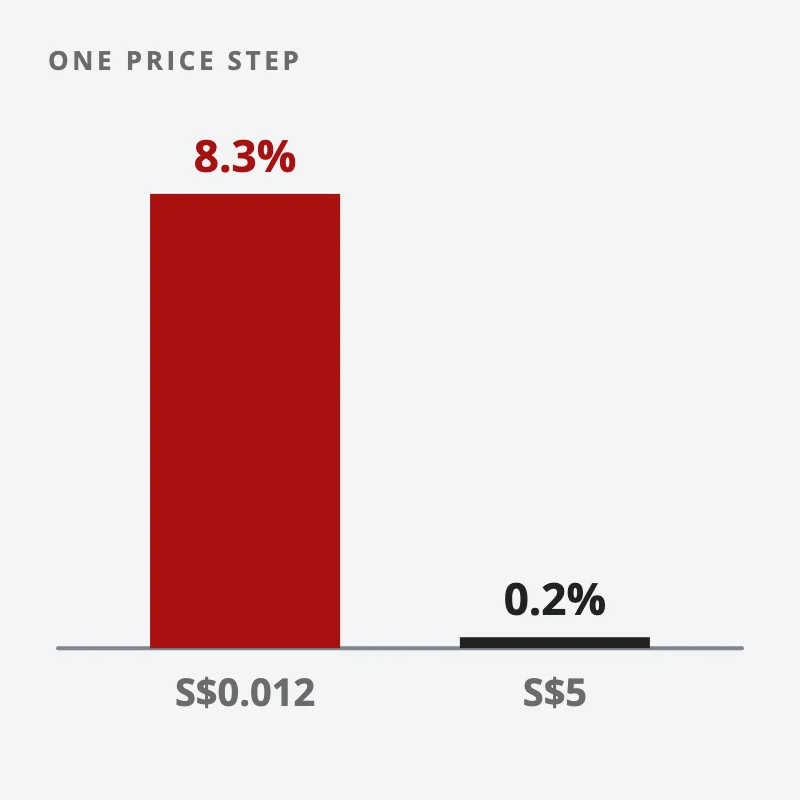
Every exchange sets a minimum step a price can move. On SGX, Rule 8.3.3 says a share below 20 cents moves in steps of S$0.001, and a share at S$1 or more moves in steps of S$0.01.
Now do the sum. On a S$0.012 share, one step is 0.001 ÷ 0.012, which is 8.3% of the price. On a S$5 share, one step is 0.01 ÷ 5, which is 0.2%.
So if the gap between the best buyer and the best seller is a single step, buying a 1.2-cent share and selling it straight back costs you 8.3% before the price has moved at all. On the S$5 blue chip, the same round trip costs 0.2%. That is a forty-fold difference in friction, on the same idea.
Thin: what happens when few shares trade?
Thin means little volume. The SEC warns that with low volumes in microcaps, “any size trade can have a large percentage impact on the price.”
That cuts both ways. A small buy order can lift the price, which is why penny charts look so exciting. A small sell order can drop it, which is why your stop-loss may fill well below where you set it. When you want to get out, there may simply be no one on the other side at your price.
This is why a sensible product checklist has a line called “Not too wild”: if you swing trade, avoid a penny stock that swings 10 to 20 percent in a day. A move like that is not a signal you can plan around. It is noise with a big range. More on how volatility differs from real risk is in risk vs volatility.
Truth: how much do you actually know?
Large companies have analysts, news coverage and investors reading every filing. Small ones often have none of that. The SEC lists the lack of public information as the first risk of microcaps, and calls them “susceptible to fraud and manipulation.”
So a penny stock gives you less to check and more room for someone to tell you a story. That is where pump-and-dump schemes live.
How do penny stocks and blue chips compare side by side?
| Penny stock | Blue chip | |
| Typical price on SGX | Below S$0.20 | S$1 and above |
| Company size | Small, often under a few hundred million | Large, industry-leading |
| One price step, as % of price | Several percent | A fraction of a percent |
| Daily volume | Often thin, can vanish | Usually deep |
| Information available | Little coverage, fewer filings read | Analysts, news, long record |
| Dividends | Rare | Often steady, by definition |
| Main risk | Gaps, slippage, manipulation | Long, slow falls you sit through |
Read the last row carefully. Blue chips carry risk too. It is a different kind.
But aren’t penny stocks where the big winners come from?
A trader asked it honestly in 2021: “I would have more fun playing penny stocks. Is this dangerous?”
Here is the fair answer. Some of the best stocks in history did start small. Peter Lynch made his name partly by finding small, fast-growing companies before the crowd did. And yet William O’Neil, who studied the biggest winners in the US market, wrote: “I prefer not to buy any common stock that sells for below $15 per share.” His reason was that most of the big winners he studied broke out from prices well above that, between $30 and $50.
So both are true. Small companies can grow into large ones. But by the time a small company is proving itself, it is usually no longer a penny stock, and the move is easier to trade on a liquid chart. Hunting for the next winner at one cent mostly means paying the tick, volume and information costs on hundreds of companies that never grow.
And blue chips are not safe just because they are big. A large company can fall for months while holders tell themselves it will come back. The difference is that you can get out of a liquid blue chip at a price close to your stop. On a penny stock, you may not get out at all.
If you want the routine we use to pick liquid stocks and size them so one bad trade stays small, our free 15-Minute Swing Trader’s Checklist lays it out. Get the free checklist →
What should a beginner trade instead?
Start with large, liquid stocks, or an index fund if you want the market without picking names. The guide to which products and markets to start with runs through a checklist for any product: good liquidity, decent movement, low costs and free data.
Then build the habit of filtering. Our post on how to find stocks to swing trade shows how to screen for volume and trend before you look at a single chart. And whatever you pick, cap the size. The guide to how much of your portfolio to put in one stock shows why no single position should be able to sink the account.
The wider picture, from share basics to CFDs, is in the ultimate guide to stocks and CFDs trading.
So are penny stocks worth it?
For most traders, they are a poor place to start. The low price feels like an opportunity, but you pay for it in friction, gaps and missing facts. A blue chip costs more per share and far less per trade.
Next time a 1-cent share catches your eye, try the three questions. What does one tick cost me? Who will buy it from me when I want out? And what do I actually know about this company that I could check today?
FAQ
What is a penny stock in Singapore?
There is no single official cut-off, but traders usually mean a share trading below 20 cents on SGX, in a small company. Below 20 cents, SGX Rule 8.3.3 sets the minimum price step at S$0.001.
What is a blue chip stock?
A blue chip is a share in a large, established company that leads its industry and has a record of stable dividends.
Are penny stocks riskier than blue chips?
Usually, yes. They have bigger price steps relative to their price, thinner trading and less public information, which makes them easier to manipulate and harder to exit.
Can a blue chip stock lose money?
Yes. Large companies can fall a long way and stay down for years. The difference is that a liquid blue chip lets you exit close to your planned price, which a thin penny stock often does not.
Is a cheap share a good deal?
Only if the company is cheap too. The company’s value is the share price times the number of shares, so a 1-cent share can belong to a company worth less than one at S$5.
Go deeper
Choosing what to trade is the first filter. The free 15-Minute Swing Trader’s Checklist covers the rest: the daily scan, the questions to ask before every trade, and the five rules that keep you in the game.
About the author. Spencer Li is The 15-Minute Trader and the founder of Synapse Trading. He is a Certified Financial Technician (CFTe) with 15+ years of trading, run from 70+ countries. He holds a B.Acc and B.BM from SMU. Every trade he takes is public, dated, losses left in. He teaches low-risk swing trading in 15 minutes a day, one system for any market.
Educational content only, not personalised financial advice. Trading carries risk, including loss of capital. Past performance is not indicative of future results. Synapse Trading is not licensed or regulated by MAS.
Want the daily routine? Enter your email for the free 15-Minute Swing Trader's Checklist.
Free 5-page PDF, then occasional trading emails. Education only, not financial advice. Unsubscribe anytime. Kit stores your email in the US: see our privacy policy.
Want to learn the full method? The Trading Mastery Program teaches the 4 strategies I have traded since 2011. It suits beginners and experienced traders.
Rather follow the trades as they happen? Daily Trading Signals is our Telegram channel: my trade ideas with entry, stop and exit, and every trade is public.
Questions about this post? Ask in the free Telegram channel →
Educational content only, not personalised financial advice. Trading carries risk, including loss of capital. Past performance is not indicative of future results. Synapse Trading is not licensed or regulated by MAS.

