

Singapore Stocks vs US Stocks: Which Should You Trade or Invest In?
Want the daily routine? Get the free 15-Minute Swing Trader’s Checklist. Get it free →
SGX or the US market, compared on what actually changes your result: liquidity, tax, currency and the clock
Published: 17 October 2026 · Last updated: 17 October 2026 · By Spencer Li, CFTe
Should a Singapore investor buy Singapore stocks or US stocks? It depends on what the money is for. For swing trading, the US market usually wins, because it has far more liquid stocks, tighter spreads and more names in a clean trend on any given week. For income paid in Singapore dollars, SGX often wins, because one-tier dividends are generally not taxed, there is no currency to convert, and there is no US estate tax to think about.
Plenty of people hold both, and that is a sensible answer.
Each market wins somewhere. The sections below show where.
Why did I plan to sell my Singapore stocks in 2017?
In May 2017 I wrote a post on this blog saying I was planning to cash out most of my Singapore portfolio. The STI had just pushed past 3,000, and the weekly chart told a different story. The index had spent about 7 years going sideways, which I called “somewhat unprecedented” at the time, while the US market kept creeping up.
I also wrote that trading volumes were waning, and that “it does seem like a dying market.”
Now, in fairness to SGX, a market I called dying has had a very good year. SGX reported that retail securities daily average value “surged 52% y-o-y in FY2026 to its highest level in 12 years.” So the picture in 2026 is livelier than it was in 2017. What has not changed is the gap in size and depth, and for a swing trader that gap is the whole story.
What is the real difference between SGX and US stocks?
Here are the two side by side, for someone based in Singapore.
| SGX stocks | US stocks | |
| Currency | SGD, no conversion | USD, converted both ways |
| Dividends to a Singapore individual | One-tier dividends generally not taxable (IRAS) | 30% withheld at source (IRS) |
| Gains on selling | Generally not taxable in Singapore (IRAS) | Not usually taxed by the US for a nonresident (IRS) |
| US estate tax | Not a US asset | US shares count as US-situated assets above USD 60,000 |
| Trading hours | Singapore daytime | 9:30pm to 4am Singapore time, or 10:30pm to 5am outside US daylight time |
| Smallest purchase | A board lot, now 10 shares or 1 share for higher-priced counters SGX has moved | 1 share |
| Where the shares sit | Your own CDP account, or a broker’s custody account | A broker’s custody account |
New to CDP and custody? How SGX trading works shows where your shares sit.
Why does liquidity matter more to a trader than to an investor?
So why does it matter so much how actively a stock trades? Because a trader pays the spread every time, and a long-term investor pays it once.
A typical liquidity floor for a daily swing scan is a stock that trades at least 1 million shares a day or USD 50 million in value, with a bid-ask spread of 0.1% of the price or less. A floor like that suits the US market. Apply it to SGX and the list gets much shorter.
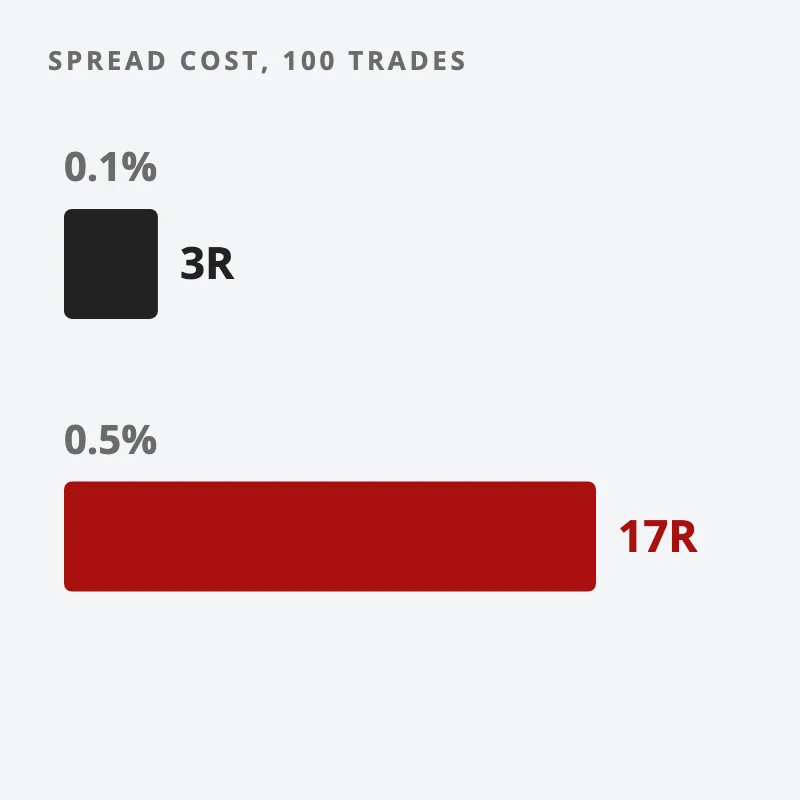
Here is what a wider spread does in practice. Say your stop sits 3% below your entry, which is a normal swing trade. You buy at the ask and sell at the bid, so a round trip costs you roughly one full spread.
- With a 0.1% spread, that is about 0.03R a trade.
- With a 0.5% spread, it is about 0.17R a trade.
Over 100 trades, that is roughly 3R against 17R. You pay it before the strategy has done a single thing for you. On a thin counter it gets worse, because when your stop triggers there are fewer buyers waiting and the fill can land well below your price. That hurts.
Then there is choice. A trend follower needs stocks that are trending, and thousands of liquid names will throw up more of them in any week. Do note that this is a numbers game, and says nothing about any single SGX stock.
For an investor who buys a bank or a REIT and holds it for years, none of this matters much. A 0.5% spread paid once in ten years is a rounding error.
What do US stocks cost a Singapore investor that SGX stocks do not?
This is where SGX earns its place. The extra costs of owning US stocks from Singapore come in four kinds.
- Currency. Every Singapore dollar becomes a US dollar on the way in, and back again on the way out. The conversion spread does not appear on your commission line, but you pay it both ways.
- Dividend tax. The IRS tells US payers to “Withhold at 30% or lesser tax treaty rate” on dividends paid to nonresidents. Singapore has no income tax treaty with the US, so most Singapore individuals see the full 30%. On a hypothetical stock yielding 4%, that is 1.2% of your capital a year, gone at source. Compare that with IRAS, which lists “Dividends paid to shareholders by a Singapore resident company under the one-tier corporate tax system” as generally not taxable.
- Estate tax. This one is easy to miss. For nonresidents, the IRS counts “Stock of corporations organized in or under U.S. law” as a US-situated asset. An estate must file a US return “if the fair market value at death of the decedent’s U.S.-situated assets exceeds $60,000.” Check with a tax adviser for your own case, because the rules on what counts are detailed.
- The clock. US markets open at 9:30pm Singapore time while the US is on daylight time, and close at 4am. If you want to watch the open, that is your evening gone.
On gains, the two markets come out about even for most people. The IRS says “capital gain income is not usually taxable to a nonresident alien,” and IRAS says “Gains from the sale of a property, shares and financial instruments in Singapore are generally not taxable.” That word “generally” matters if you trade very actively, and Is trading income taxable in Singapore? goes through what IRAS actually looks at.
Two of the four frictions have a common workaround for long-term investors. A US index fund that is domiciled in Ireland, listed in London, generally gets a lower withholding rate on its US dividends and generally sits outside the US estate rules. How to choose an index ETF from Singapore explains the domicile question in full.
The clock matters far less if you trade end-of-day. You read the US close over breakfast in Singapore, place your orders, and get on with the day. About 15 minutes, none of it at 3am.
If you want that daily routine in one page, our free 15-Minute Swing Trader’s Checklist has it, along with the questions to ask before every trade. Get the free checklist →
So which one should you choose?
Start from the job the money has to do, and let that pick the market.
| What the money is for | The usual fit | Why |
| Swing trading | US stocks and US ETFs | Liquidity, tight spreads, more names in a trend |
| Dividend income in SGD | SGX | One-tier dividends generally untaxed, no currency risk, no US estate exposure |
| Long-term index investing | Often Ireland-domiciled funds | Lower dividend withholding, generally outside US estate rules |
| A small account | Either | SGX cut board lots from 5 October 2026, and US brokers sell single shares |
That last row changed this year. SGX moved its board lot “From 100 units to 10 units for instruments priced above $10 and up to $100”, and to 1 unit above SGD 100, for the counters it has moved so far. A SGD 40 stock that used to need SGD 4,000 for one lot now needs SGD 400. So the old argument that SGX is too expensive for small accounts is much weaker than it was.
In May 2026 a trader asked on a Singapore investing forum whether anyone was slowly moving from their broker to CDP and Singapore assets, for estate planning reasons. It is a fair worry. The estate rule above is exactly why people ask it, and for a large US portfolio held for decades, moving some of it home is a reasonable answer.
If you do trade US stocks, the next question is which ones. How to find stocks to swing trade shows screener settings for the first cut.
Is one market better than the other?
Neither is better in general. Each is better at a different job.
SGX is a fine home for dividend income in your own currency. The US is where a swing trader finds the liquidity and the trends. The 2017 post was a trader’s view, and the 2026 numbers show it was too gloomy about SGX as a whole.
Two questions settle it for most people. Is this money for income you will spend in Singapore, or for a trading account that needs things to move? And how much of that 30% withholding are you paying today without noticing? Answer those, and the market picks itself. For the wider picture on trading shares, see the guide to stocks and CFDs trading.
FAQ
Is it better to invest in Singapore or US stocks?
It depends on the job. SGX suits dividend income in Singapore dollars, with one-tier dividends generally untaxed. US stocks suit swing trading and growth, with more liquidity, but they carry 30% dividend withholding, currency conversion and US estate tax exposure.
Do Singaporeans pay tax on US stock dividends?
Yes, at source. The IRS rule is to withhold 30% or a lower treaty rate on dividends paid to nonresidents, and Singapore individuals usually see the full 30%.
Do Singaporeans pay US estate tax on US shares?
They can. The IRS counts stock of US corporations as a US-situated asset, and an estate must file a US return if those assets exceed USD 60,000 at death. Check with a tax adviser for your own case.
What time does the US stock market open in Singapore?
At 9:30pm Singapore time during US daylight time, roughly March to November, and 10:30pm otherwise.
Are capital gains on SGX or US stocks taxed in Singapore?
Generally not, on either side. Very active trading can change the Singapore answer, so read the IRAS rules if you trade often.
Go deeper
Whichever market you pick, the habits are the same. The free 15-Minute Swing Trader’s Checklist has the daily routine, the questions to ask before every trade, and the five rules that protect your account. Enter your email and we’ll send it over:
We use your email address to send you the checklist, then emails about trading and our courses. Unsubscribe in one click, any time. Privacy policy.
About the author. Spencer Li is The 15-Minute Trader and the founder of Synapse Trading. He is a Certified Financial Technician (CFTe) with 15+ years of trading, run from 70+ countries. He holds a B.Acc and B.BM from SMU. Every trade he takes is public, dated, losses left in. He teaches low-risk swing trading in 15 minutes a day, one system for any market.
Educational content only, not personalised financial advice. Trading carries risk, including loss of capital. Past performance is not indicative of future results. Synapse Trading is not licensed or regulated by MAS.
Want the daily routine? Enter your email for the free 15-Minute Swing Trader's Checklist.
Free 5-page PDF, then occasional trading emails. Education only, not financial advice. Unsubscribe anytime. Kit stores your email in the US: see our privacy policy.
Want to learn the full method? The Trading Mastery Program teaches the 4 strategies I have traded since 2011. It suits beginners and experienced traders.
Rather follow the trades as they happen? Daily Trading Signals is our Telegram channel: my trade ideas with entry, stop and exit, and every trade is public.
Questions about this post? Ask in the free Telegram channel →
Educational content only, not personalised financial advice. Trading carries risk, including loss of capital. Past performance is not indicative of future results. Synapse Trading is not licensed or regulated by MAS.

