• Link to Facebook
  • Link to X
  • Link to Instagram
  • Link to Youtube
  • Link to LinkedIn
  • Link to Mail
Synapse Trading
  • Home
  • About
    • My Background
    • My Trading Journey
    • My Travel Log
    • Media & Interviews
  • Mentoring
    • Trading Mastery Program
    • Results & Testimonials
  • Signals
    • Telegram (Free to join!)
    • Daily Trading Signals
    • Daily Trading Signals (Results)
  • Resources
    • Free Trading Guides
    • Tools & Resources
    • Blog & Infographics
  • Contact
    • Contact Us
    • Partnership Opportunities
  • Click to open the search input field Click to open the search input field Search
  • Menu Menu

Tag Archive for: SGX academy

Spencer Li

An Easy Way to Diversify your Investment Portfolio

Trading Tips
free resources

You’ve probably heard about the importance of diversifying your portfolio.

The question is how do you do it and what if you have limited capital to invest and can’t afford to purchase a lot of different stocks at once? In this video, we’ll introduce you to two new asset classes: exchange-traded funds or ETFs and real estate investment trusts or REITs. These will enable you to diversify your portfolio and generate passive income without having to invest too much. First, let’s look at ETFs also known as tracker funds.

ETFs track the performance of a stock index like the STI Dow Jones Hang Seng or commodity and bond indices. These are useful for new investors because by simply investing in ETFs you’re effectively investing in the price movements of all the companies listed on the underlying index. This makes it much easier to diversify your portfolio, then if you picked individual stocks and commodities especially if you’re starting out with limited capital.

Besides stocks and ETFs, however, there is another popular asset class, one that’s been around for thousands of years. Yup, real estate. So, how can a new investor with limited funds, invest in this market? Through a real estate investment trust or REIT.

A REIT is a company that invests in real estate properties and by investing in a REIT, you can share the benefits and risks of owning a real estate portfolio. In short, a REIT allows you to buy and sell properties as if they were stocks by buying a stake in a REIT.

You are effectively vested in all the properties owned by the REIT, so as the REIT makes its profits from asset appreciation and rental income, you will receive regular payouts which can provide you with passive income.

We’ve come to the end of part 1 of our video series. We hope you’ve learned the importance of making your money work for you and the different asset classes and opportunities that are available to you. In the next part of our series, we’ll explore the big market cycles and find out how to better time your purchases so you can receive the biggest benefits possible.

0 Comments/by Spencer Li
https://synapsetrading.com/wp-content/uploads/2016/02/free-resources.png 344 481 Spencer Li https://synapsetrading.com/wp-content/uploads/2019/10/logo.jpg Spencer Li2016-03-29 01:30:282021-02-13 14:36:32An Easy Way to Diversify your Investment Portfolio
Spencer Li

How to Draw Support and Resistance Levels

Trading Tips
support resistance

So far, we’ve covered the importance of market timing and the need to trade according to the current trend. But when exactly should you be buying or selling a security? This brings us to the topic of support and resistance zones.

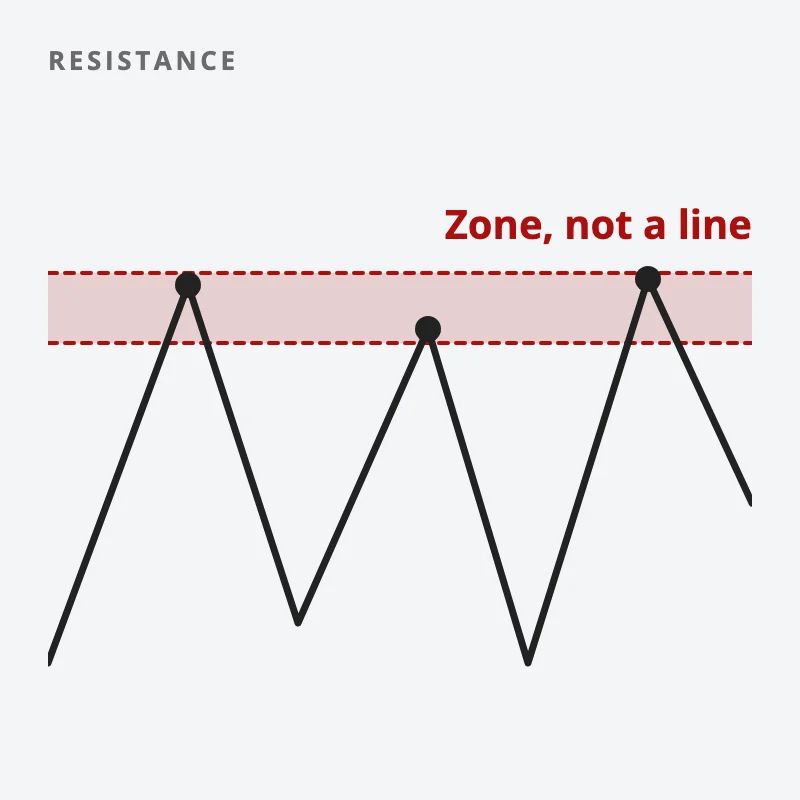
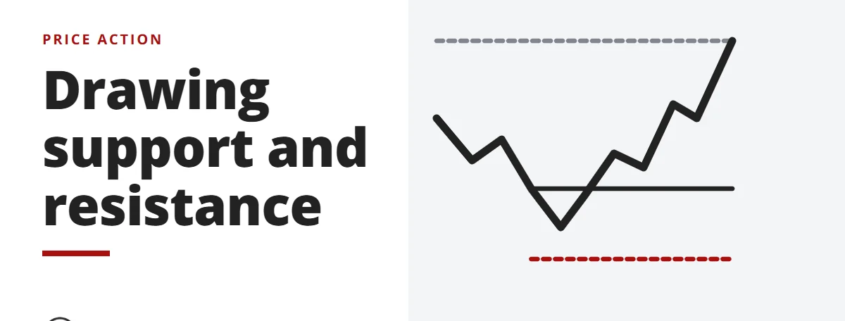
Support and resistance zones are like invisible lines on a price chart which prices and traders react to. They signal a great opportunity to either enter or exit a trade. These zones usually correspond with the pattern by which a particular security has moved in the past. For instance, let’s say a stock reaches a certain price level before declining, it goes down for about a year before hitting its bottom and turning back up again.

The next time that stock approaches, the price at which it first began to decline, some investors will start to sell it off, anticipating that it will decline once again. This is how a resistance zone is created. On the other hand, when that stock approaches the price at which at last turned around, many investors will step in and buy it, creating a support zone. Securities sit in these zones temporarily, while buyers and sellers try to figure out whether to jump in or jump out of the market. The key is to watch carefully how prices react in the support or resistance zone because eventually, one of two things will happen.

The zone will either hold and the price will reverse direction or the security will break through and continue on its trajectory. It’s important to note that breakthroughs have the tendency to recalibrate a security support and resistance zones. For example, often times when a security breaks through a resistance zone that same level becomes its support zone during the next cycle. That’s because of all the investors who missed the chance to benefit last time around and are looking to either buy the security for cheap or sell it before it declines.
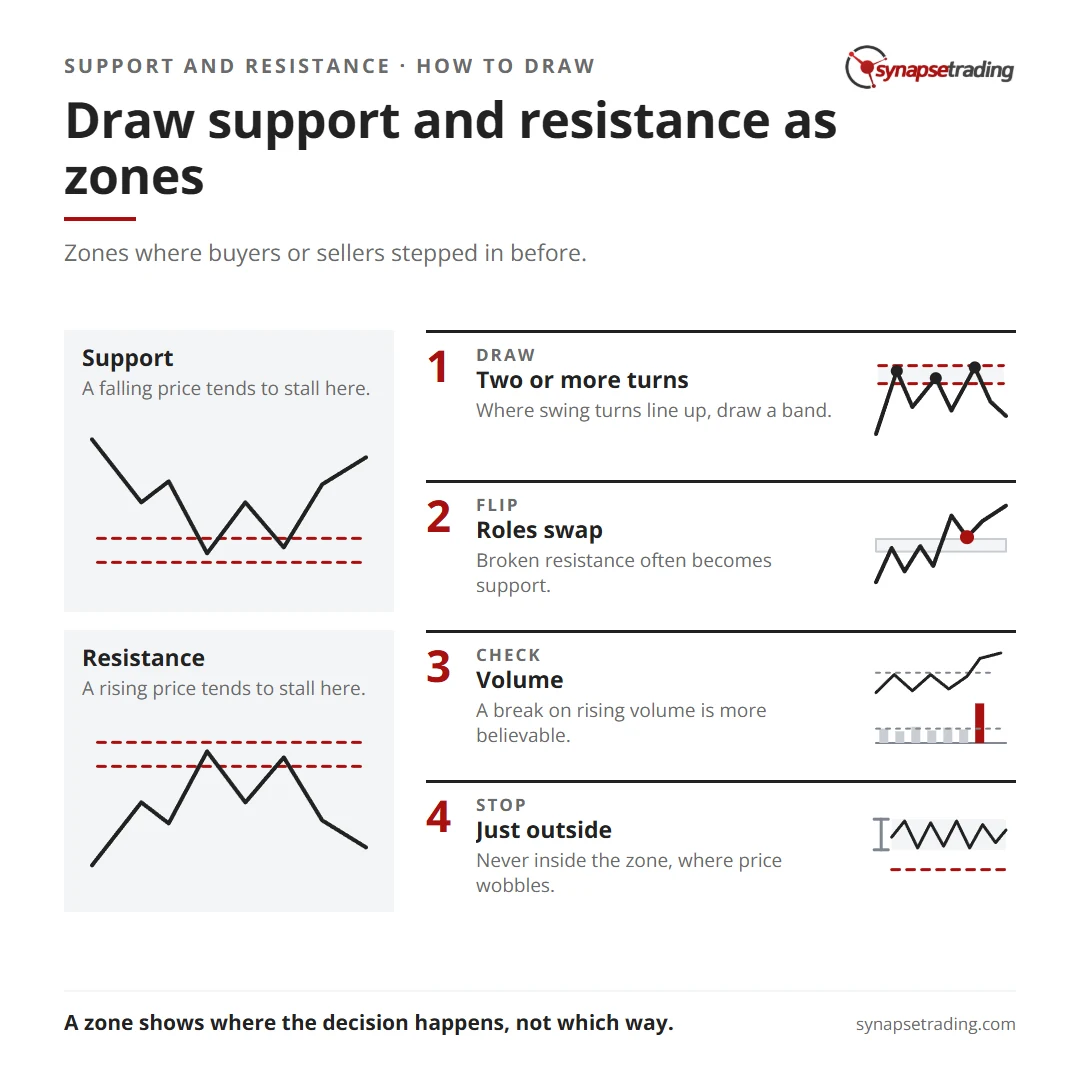
As a trader, it’s important to learn how to identify the support and resistance zones for a particular security once you’ve figured out where those zones are, you should then make your buying and selling decisions near those zones. That will provide you with a market edge, allowing you to achieve greater success over the short and long term.

0 Comments/by Spencer Li
https://synapsetrading.com/wp-content/uploads/2015/05/support-resistance.png 709 1269 Spencer Li https://synapsetrading.com/wp-content/uploads/2019/10/logo.jpg Spencer Li2015-05-29 08:00:252021-02-13 13:43:47How to Draw Support and Resistance Levels
Spencer Li

Techniques for Identifying Market Trends

Trading Tips
identifying market trends

If you want to make money by timing the stock market you need to follow the trends.

Buying and selling creates its own momentum and a market that’s moving up or down is likely to keep moving in that direction for a certain period of time.

What this means is that you should avoid trading against the current trend.

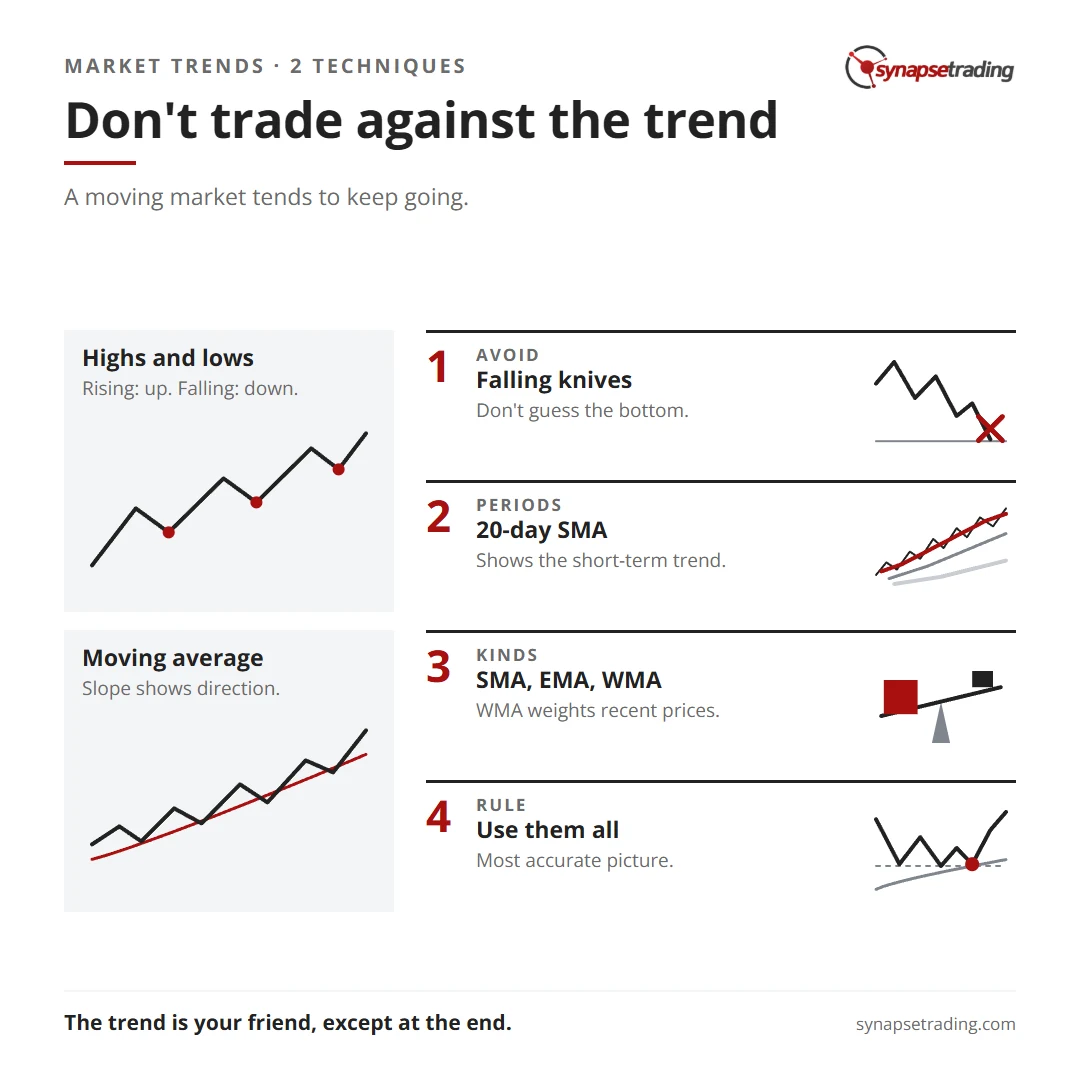
For example, when the market is bearish and heading down, don’t try to predict which stocks have hit bottom, that would be like trying to catch a falling knife.

Instead, find an objective way to both identify the current trend and decipher when that trend has changed too, because just like the saying goes, “the trend is your friend, except at the end”.

So, let’s explore two simple techniques for identifying market trends.

The most common ways to look at the nature of a trend’s movement. As a stock moves up or down, it rarely does so in a straight line, rather it zigzags forming a series of highs and lows.

If the highs keep getting higher and the lows keep getting higher that stock is in an uptrend. If the highs get lower and the lows get lower, you’re looking at a downtrend. And if the highs and lows are consistent over a certain period, it’s in a sideways trend.

Another way to identify the market trend is to look beyond the daily price fluctuations and determine the general direction of a stock.

You do this by calculating an average. For example, a 20-day simple moving average or an SMA, is an average of the past 20 days of closing prices, which moves or updates on a daily basis by incorporating the latest prices.

If the SMA is sloping upwards, that’s an uptrend; sloping down downtrend and sideways, means flat.

A 20-day SMA gives a good picture of the short-term trend but you can also use other periods like the 50-day SMA and the 200-day SMA for the long-term trend. Those aren’t the only moving averages, however, there’s the exponential moving average or EMA, and the weighted moving average or WMA, which gives more weight to recent prices.

As a trader, you can use any of these techniques individually, but for the most accurate picture of market trends, you should use them all.

Because when it comes to behavioral analysis, the best way to increase your chances of success, is to consider as much data as possible.

So that’s market timing! Next, let’s cover support and resistance zones.

0 Comments/by Spencer Li
https://synapsetrading.com/wp-content/uploads/2015/05/identifying-market-trends.png 715 1279 Spencer Li https://synapsetrading.com/wp-content/uploads/2019/10/logo.jpg Spencer Li2015-05-22 08:00:242021-02-15 00:20:10Techniques for Identifying Market Trends
Spencer Li

Swing Trading Strategies: How to Profit from the Stock Market with 15 minutes a day

News & Events
MG 0096

swing trading strategiesLast Saturday, I was invited as a guest speaker and panelist to share my swing trading strategies and stock picks, alongside other SGX Academy veterans such as Wong Kon How and Robin Ho.

Being the youngest certified SGX trainer at 28, I was honoured for this opportunity, and excited at the same that Synapse Trading is taking the next leap forward by working closely with SGX to help raise the level of financial education in Singapore, and ensure quality training.

_MG_9698

_MG_0096

_MG_0229

_MG_0242


Stock Picks in front of a LIVE! Audience:

During the event, I explained my strategies and used it to pick out the best stocks in less than 5 minutes. Here are some of the things we looked out for:

_MG_9820

_MG_9839


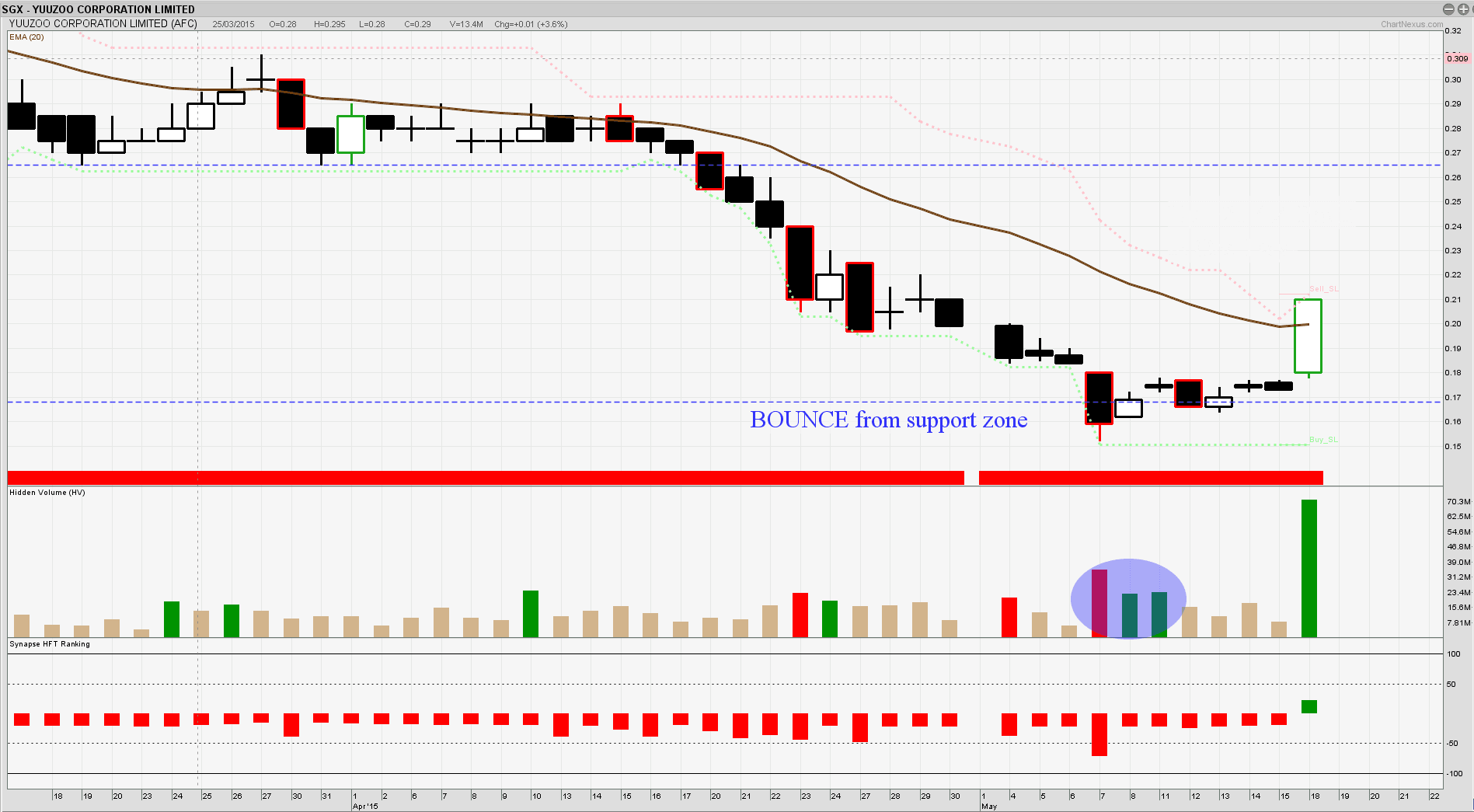
This counter (YuuZoo) was featured in my portfolio, and during the lunch break, one lady asked me why I recently acquired this counter. I told her that I was expecting a bounce very soon, and true enough, we saw that bounce on Monday morning!

afc 180515 yuuzoo


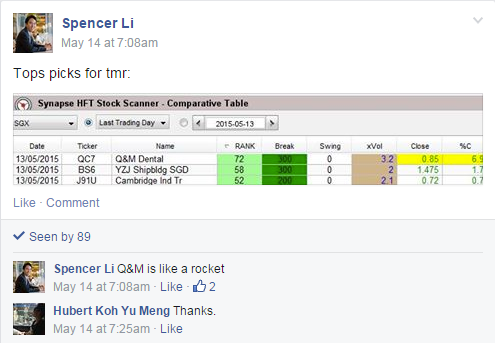
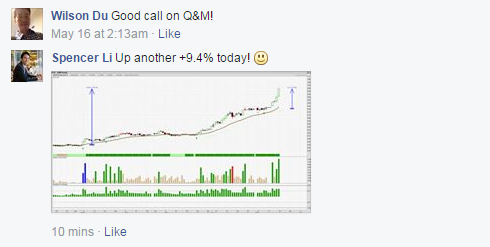
Q&M Dental was another counter that I have been advocating in all my seminars, including at Invest Global 2015 where I shared the stage with Jim Rogers, and I have also been posting it in my private forum for my students. I will let the results speak for itself! 😀

synapse forum 180515 1

synapse forum 180515 2

qc7 180515 Q&M

0 Comments/by Spencer Li
https://synapsetrading.com/wp-content/uploads/2015/05/MG_0096.png 1380 1980 Spencer Li https://synapsetrading.com/wp-content/uploads/2019/10/logo.jpg Spencer Li2015-05-19 05:45:002019-04-06 17:20:41Swing Trading Strategies: How to Profit from the Stock Market with 15 minutes a day
Spencer Li

The Basics of Market Timing

Trading Tips
basics of market timing

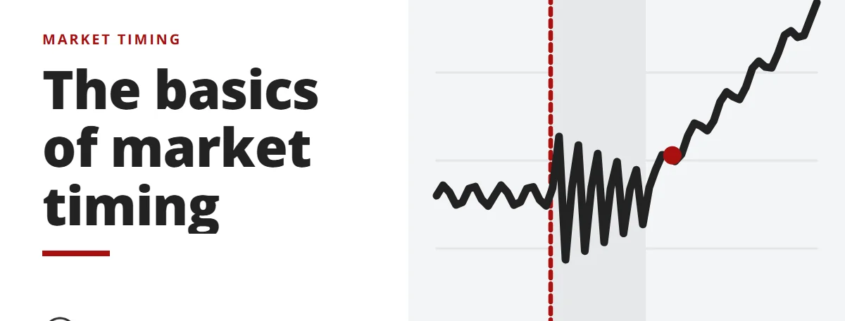
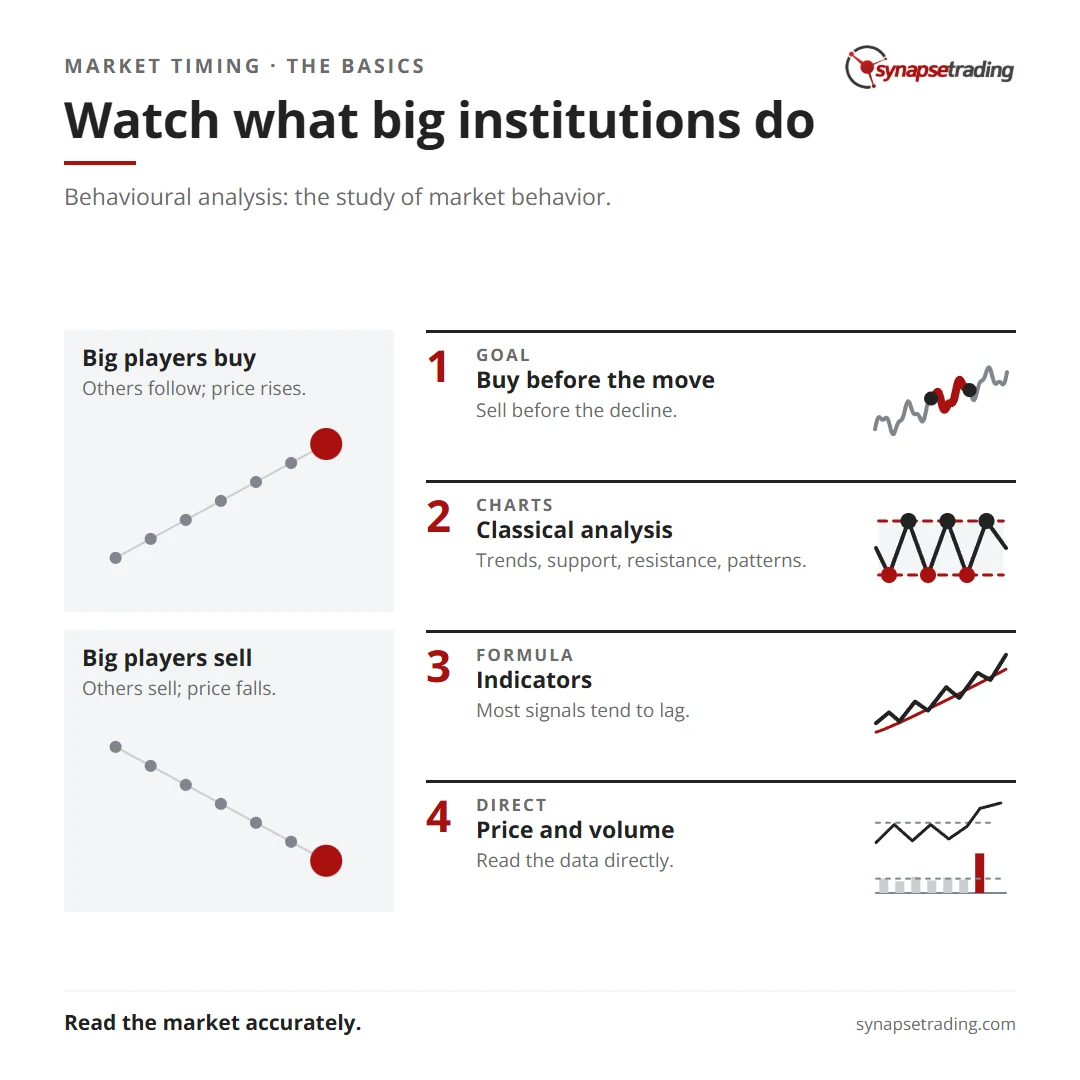
The price of every stock or financial product fluctuates over time, and no matter how strong a stock is or how solid its fundamentals, you can only make money when the stock goes up in price relative to where you bought it. That’s why it’s so important to read the market accurately and buy stocks at the right time.

The goal for any investor is to buy a stock just before it makes a big move, and sell it just before it starts to decline. The question is how do you do it?

For starters, you want to look at the big players on the financial landscape, like banks and financial institutions.

These are the organizations who determine the direction of a stock more than any other. If they start to buy a certain stock in large numbers, chances are other investors will follow suit, leading to a rise in value. And if they start to dump a stock, then other shareholders will likely do the same, causing a decrease in value.

By keeping a close eye on what these institutions are doing, you’ll be able to spot shifts in the market before they happen.

This study of market behavior is known as behavioural analysis and encompasses three main schools of thought: classical technical analysis, indicator-based technical analysis, and price action and volume analysis.

Classical technical analysis is all about reading charts. The goal is to identify the trend lines of a particular stock and pinpoint the support and resistance zones, where buying and selling usually takes place.

Classical technical analysis also includes pattern recognition techniques, used to identify shapes on the chart which have a certain predictive value.

Then, there’s indicator based technical analysis in which you take price and volume data and plug it into a mathematical formula to figure out when to buy or sell. Unfortunately, most indicator signals tend to be lagging, which can result in misleading or inaccurate analysis.

Finally, there’s price action and volume analysis, in which a trader leverages their deep understanding of market movements to interpret price and volume data directly. It’s the methodology that most professional traders use as it allows faster, more accurate predictions.

Those are the basics.

Over the next few videos, we’ll dive a little deeper and teach you how to identify market trends and most importantly how to pinpoint the right time to buy and sell.

0 Comments/by Spencer Li
https://synapsetrading.com/wp-content/uploads/2015/05/basics-of-market-timing.png 706 1271 Spencer Li https://synapsetrading.com/wp-content/uploads/2019/10/logo.jpg Spencer Li2015-05-15 08:00:232021-02-15 00:16:04The Basics of Market Timing
Page 2 of 512345

Free Trading Guides

Free Trading Guides

Blog Categories

  • Beginner's Guide
  • Blockchain & Crypto
  • Book Summaries
  • Candlestick Patterns
  • Economics & News Trading
  • Investing & Portfolio Management
  • Living Your Best Life
  • Market Analysis
  • News & Events
  • Price Chart Patterns
  • Promotions
  • Risk & Money Management
  • Stock Trading
  • Testimonials
  • Tools & Resources
  • Trading Psychology
  • Trading Strategies
  • Trading Tips
  • Travel & Lifestyle

Free Trading Guides

Free Trading Guides

Contact Us

Synapse Trading Pte Ltd
Registration No. 201316168H

Whatsapp: +65-8897-1204
Telegram: @iamrecneps
Email: info@synapsetrading.com

Links

Disclaimer
Privacy policy
Terms & Conditions
Contact us
Partnerships

© 2012-2024 Synapse Trading | All rights reserved | - powered by Enfold WordPress Theme
  • Link to Facebook
  • Link to X
  • Link to Instagram
  • Link to Youtube
  • Link to LinkedIn
  • Link to Mail
Scroll to top Scroll to top Scroll to top