

Monthly Market Wrap (May 2026)
Join our Telegram channel for more market analysis & trading tips: t.me/synapsetrading
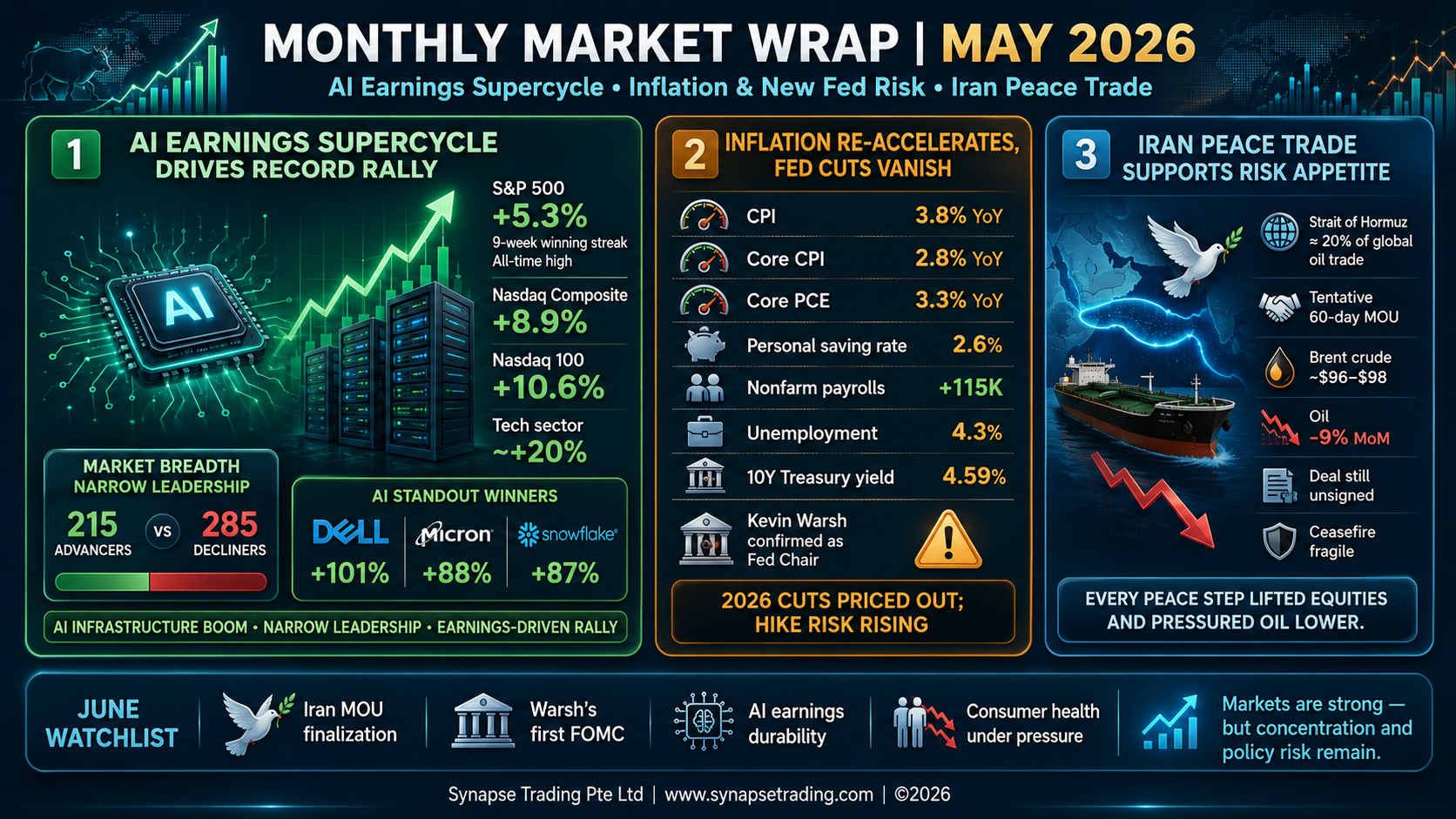
The month of May 2026 will be remembered as the moment two structural forces — the AI earnings supercycle and the Iran war’s de-escalation — combined to produce one of the most dramatic equity rallies in a generation. The S&P 500 closed out nine consecutive weekly gains, its longest winning streak since December 2023, powered almost entirely by a technology sector that reported blended earnings growth of 28.6% against a backdrop of rising inflation, a new Federal Reserve chair, and a geopolitical environment that remained fragile even as it improved. The rally was real, the earnings were genuine, and the narrowness of the leadership was a warning. Markets are entering June with record index levels, a tentative Iran peace deal, and a macro setup that will punish any complacency.
Table of Contents
1. Equity Markets: Record Highs on Narrow Foundations
US equity markets delivered a historic month. The S&P 500 rose approximately 5.3% in May, extending a nine-week winning streak that ranks among the longest in four decades. The Dow Jones Industrial Average crossed the 51,000 milestone for the first time in its history, while the Nasdaq Composite surged 8.9% to close near 26,972. The Nasdaq 100 outperformed even that, gaining 10.6% as mega-cap technology names once again did the heavy lifting for the entire market.
The divergence beneath the surface, however, was stark. Of the 500 S&P 500 constituents, only 215 finished May in positive territory, while 285 closed in the red. The index hit all-time highs while the majority of its components declined — a structural dynamic that reflects the extraordinary concentration of AI-driven capital spending into a narrow cohort of beneficiaries. The technology sector as a whole advanced roughly 20%, accounting for all ten of the index’s top monthly performers. This kind of leadership narrowness has historically been a late-cycle signal worth monitoring closely.
Table 1: Major Index Performance — May 2026
| Index | May Return | Key Level / Milestone | Driver |
| S&P 500 | +5.3% | All-time high; 9-week win streak | AI earnings; Iran de-escalation |
| Nasdaq Composite | +8.9% | ~26,972 | Mega-cap tech; AI infrastructure |
| Nasdaq 100 | +10.6% | Best monthly gain of 2026 | Semiconductor and cloud names |
| Dow Jones Industrial Average | Milestone | First-ever close above 51,000 | Broad risk appetite |
| Nikkei 225 | Positive | Fresh record highs at month-end | Easing Middle East tensions; energy imports |
| Shanghai Composite | Positive | Highest level since 2015 (11-year high) | Stronger industrial profit data |
| Hang Seng | Lagged | Underperformed regional peers | Regulator crackdown on offshore brokerages |
| STOXX 600 (Europe) | ~+2% | Modest gains | Iran peace relief vs. energy inflation |
Global markets participated in the rally with notably less conviction than US equities. Japan’s Nikkei benefited from easing Middle East tensions, which carry outsized significance for an economy dependent on energy imports. China’s Shanghai Composite climbed to an 11-year high supported by improving industrial profit data, though the Hang Seng lagged after the securities regulator moved against offshore online brokerages serving mainland investors. Europe’s STOXX 600 posted gains of just under 2%, caught between relief over Iran peace progress and the ongoing inflation drag from elevated energy prices.
2. Macroeconomic Developments: Inflation Shock and a New Fed Chair
The macroeconomic backdrop in May was defined by the pass-through of energy-driven inflation working its way into reported data, and by the most consequential change in US monetary leadership in nearly a decade. Neither development was unambiguously market-friendly, yet equities absorbed both and kept climbing — a testament to the earnings momentum underneath, and a warning about the assumptions embedded in current valuations.
The April CPI report, released on May 12, showed headline inflation rising 0.6% month-on-month and 3.8% year-on-year — the highest annual reading since May 2023. Energy was the primary driver, with the gasoline index up 28.4% year-on-year and the energy component accounting for over 40% of the monthly increase in isolation. Core CPI rose 0.4% for the month and 2.8% year-on-year, indicating that inflationary pressure is not confined to energy. Real average hourly wages declined 0.5% in April, meaning the purchasing power of workers is actively contracting.
The Fed’s preferred gauge confirmed the trend. The April PCE report, released on May 28, showed headline PCE accelerating to 3.8% year-on-year from 3.5% in March — also a three-year high — while core PCE rose to 3.3%. The personal saving rate dropped to 2.6%, its lowest level since June 2022, as households depleted savings to cope with rising costs. Americans are not absorbing this inflation comfortably; they are funding it by drawing down their financial cushion.
The labor market continued to moderate. April nonfarm payrolls came in at 115,000, well above the 55,000 consensus but down from a strong March print. The unemployment rate held at 4.3%, average hourly earnings rose 3.6% year-on-year, and the labor force participation rate slipped to 61.8%, its lowest since October 2021. The economy is generating jobs, but the directional trend is clearly one of deceleration.
Table 2: Key US Macroeconomic Indicators — April 2026 Data (Released in May)
| Indicator | Reported Value | Prior / Consensus | Strategic Implication |
| CPI (Headline, YoY) | +3.8% | Prior: ~3.5%; Highest since May 2023 | Inflation moving in the wrong direction |
| CPI (Headline, MoM) | +0.6% | Energy: 40%+ of monthly increase | Pass-through from Iran war shock |
| Core CPI (YoY) | +2.8% | MoM: +0.4% | Broad price pressure; not just energy |
| PCE (Headline, YoY) | +3.8% | Prior: +3.5%; Three-year high | Fed’s preferred gauge confirms trend |
| Core PCE (YoY) | +3.3% | Above Fed’s 2% target | Rate cut probability near zero |
| Personal Saving Rate | 2.6% | Lowest since June 2022 | Households depleting buffers |
| Nonfarm Payrolls (Apr) | +115,000 | Consensus: +55,000 | Beat, but trend is decelerating |
| Unemployment Rate | 4.3% | Steady | Labor market cooling gently |
| Average Hourly Earnings (YoY) | +3.6% | Softer than expected | Real wages negative; consumer squeeze |
The defining institutional event of the month was the confirmation of Kevin Warsh as Federal Reserve Chair. Confirmed by the Senate on May 13 in a 54-to-45 vote and sworn in as Powell’s replacement on May 15 — Powell having chosen to remain on the Board of Governors — Warsh inherits one of the most uncomfortable setups a new central banker could ask for. Rates are sitting at 3.50%–3.75% following the Fed’s April pause, and inflation is moving upward rather than toward target.
The market reaction was significant. Rate cut expectations for 2026 have effectively evaporated. Futures markets are now assigning roughly 40% probability to a rate hike by the December meeting. The dynamic is politically awkward: a Fed chair nominated by an administration that campaigned on lower rates may be forced to raise them. How Warsh navigates that tension — and how the market prices it — will be among the most important themes of the second half of the year.
3. Geopolitical Developments: Iran, De-escalation, and the Strait of Hormuz
The Iran war, which began in late February with joint US-Israeli airstrikes, remained the central geopolitical variable in markets throughout May. But the direction of travel shifted decisively. Where March and April were defined by the shock of open conflict and the closure of the Strait of Hormuz, May was defined by the painstaking construction of an off-ramp.
Building on the temporary ceasefire announced in early April, US and Iranian negotiators worked through May toward a broader framework. President Trump called off planned strikes on May 19. By May 23, he was describing a deal to reopen the Strait of Hormuz as “largely negotiated.” By May 28, negotiators had reached a tentative 60-day memorandum of understanding: an extended ceasefire, formal negotiations on Iran’s nuclear program, a temporary moratorium on uranium enrichment, discussions over sanctions relief, and a phased reopening of Persian Gulf maritime trade routes.
As of month-end, Trump had not given final sign-off and Iran had not formally confirmed acceptance, leaving the agreement tentative. The path was not smooth — on May 25, US forces conducted strikes on missile launch sites and boats in southern Iran in what Central Command described as defensive actions, a reminder that the ceasefire remains fragile. Markets also had to absorb a false peace report on May 28 that briefly moved prices before being retracted.
Nonetheless, the net market effect was unambiguous. The Strait of Hormuz handles roughly 20% of global oil trade. Each step toward reopening it lifted equities and pressured oil lower. The peace trade was arguably the single most important driver of risk appetite in the back half of the month, and its resolution — or breakdown — will determine much of the macro setup heading into Q3.
4. Corporate Earnings: The AI Supercycle Delivers
Q1 2026 was one of the strongest earnings seasons in S&P 500 history. With 97% of companies having reported by month-end, 85% exceeded EPS estimates and 81% beat on revenues. Blended year-on-year earnings growth came in at 28.6% — more than double the 13.1% expected at the end of March. The driver was the AI infrastructure buildout flowing through to revenues and margins across the technology supply chain. The headline numbers were not statistical noise; they reflected genuine demand for data centers, semiconductors, and cloud platforms at a scale that has reset the earnings bar for the sector.
Table 3: Notable Stock Movers — May 2026
| Company (Ticker) | May Performance | Key Metric | Notable Detail |
| Dell Technologies (DELL) | +101% (best month ever; top S&P 500 performer) | Revenue +88% YoY; EPS $4.86 vs $2.96 consensus | AI-optimized server revenue +757% YoY to $16.13B; $24.4B in AI orders; raised FY AI server guidance to ~$60B |
| Micron Technology (MU) | ~+88% | HBM demand surge | Beneficiary of high-bandwidth memory demand for AI servers; AI trade broadening to memory |
| Snowflake (SNOW) | ~+87% | +36% in a single session (best day ever) | Beat estimates on AI momentum; announced ~$6B, 5-year cloud and AI infrastructure deal with AWS |
| Nvidia (NVDA) | +18% YTD heading into print; slipped ~1.5% after hours | Revenue $81.6B (+85% YoY); EPS $1.87 vs $1.76 consensus | Data center revenue $75.2B (+~100% YoY) = 92% of sales; boosted dividend to $0.25; $80B buyback announced |
| Palantir (PLTR) | ~+10% | Sympathy move | Rose on Dell results as validation of joint “AI factory” partnership |
| Zoetis (ZTS) | Sharp decline | EPS $1.53 vs $1.61 consensus miss | Cut full-year revenue and earnings guidance |
| AutoZone (AZO) | Declined | Beat on earnings but sold off | Gross margin contraction of 57 basis points; market punished margin weakness despite top-line beat |
Dell’s result deserves emphasis. Revenue of $43.84 billion represented an 88% year-on-year increase and a 23% beat against consensus — figures that would have been considered implausible as recently as eighteen months ago. AI-optimized server revenue of $16.13 billion, up 757% year-on-year, and $24.4 billion in new AI orders in a single quarter reflect the scale of the infrastructure investment cycle underway. The stock’s 32% single-day gain and 101% monthly return made it the S&P 500’s top performer. Together with Micron and Snowflake, it confirmed that the AI trade has materially broadened beyond chip designers into servers, memory, and enterprise data infrastructure. The pattern from this and recent quarters is consistent: extraordinary rewards for confirmed AI beneficiaries, and swift punishment for any earnings miss or margin compression elsewhere.
5. Commodities and Fixed Income: Oil Retreats, Bonds Sell Off
Oil remained the asset class at the center of everything. Brent crude, which had broken above $100 per barrel at the height of the conflict, spent May grinding lower as peace prospects improved, trading around $96–$98 by late month — down roughly 9% from a month earlier but still more than a third higher than pre-war levels. Individual headlines on Iran negotiations produced violent intraday moves, including a 5% drop on mixed signals from Trump regarding the peace deal. If the Strait of Hormuz reopens on schedule, additional downside for crude is the base case; however, with the deal unsigned at month-end, the market is not yet pricing a full resolution.
Gold had a volatile month at historically elevated levels. Spot gold traded around $4,556 per ounce mid-month after pulling back approximately 2% from highs, caught between two opposing forces: war-driven inflation fears providing structural support, and rising real yields plus a strong dollar acting as a headwind. Central bank demand remained a consistent support with net purchases of 244 tonnes in Q1 2026, up 3% year-on-year, but the metal struggled to make meaningful progress against the rising opportunity cost of holding a non-yielding asset.
Bond markets had a difficult month. The 10-year Treasury yield climbed to 4.59% by mid-May, its highest level in nearly a year, as investors repriced the Fed from a cutting mode to a potential hiking mode. The US dollar was the natural beneficiary, posting its best weekly gain in two months around mid-month and strengthening through May as higher yields attracted capital flows. For fixed income investors, duration remains the enemy, and the combination of sticky inflation and the Warsh Fed’s uncertain policy trajectory suggests continued caution on long-dated paper until the rate picture clarifies.
Table 4: Commodities and Fixed Income Snapshot — May 2026
| Asset | May Level / Change | Key Driver | Outlook Consideration |
| Brent Crude Oil | ~$96–$98 (late month); -9% MoM | Iran de-escalation; peace trade | Further downside if Hormuz reopens; deal still unsigned |
| Gold (Spot) | ~$4,556/oz; -~2% from highs | War inflation fears vs. real yield headwind | Central bank demand structural support; chop while real yields climb |
| 10-Year Treasury Yield | 4.59% (near 1-year high) | Fed repricing from cuts to potential hike | Stay short duration; Warsh Fed’s first FOMC critical |
| US Dollar (DXY) | Strengthened; best weekly gain in 2 months | Rising US yields drawing capital | Beneficiary of higher-for-longer repricing |
6. Digital Assets: A Notable Divergence from Equities
Crypto was conspicuously absent from the May equity rally, and the divergence was meaningful. Bitcoin began the month positively, climbing above $82,000 by May 6 — its highest level since January. The rally had no legs. BTC faded to approximately $77,000 by May 19 and spent the balance of the month largely range-bound. The real damage came at month-end: Bitcoin broke down sharply and opened June below $67,000. For a month in which the Nasdaq gained nearly 9%, Bitcoin finishing deep in the red represents a genuine break in the correlation between crypto and risk assets that has characterized much of 2024 and 2025.
Ethereum fared worse. ETH traded up to around $2,400 in early May before sliding to approximately $2,130 by mid-month, and by early June had broken below the psychologically significant $2,000 level. Ethereum has been persistently underperforming Bitcoin with no major catalyst on the horizon to reverse the trend. The relative weakness across both majors is consistent with capital rotating from crypto into AI equities, where earnings momentum is both real and accelerating. Until that flow reverses or Bitcoin establishes a new narrative, the tactical case for adding digital asset exposure is not compelling, and the late-May breakdown warns of further downside in the near term.
Table 5: Digital Asset Performance — May 2026
| Asset | May High | End of May / Early June Level | Key Observation |
| Bitcoin (BTC) | ~$82,000 (May 6) | Below $67,000 (early June) | Broke down late month; diverged sharply from Nasdaq |
| Ethereum (ETH) | ~$2,400 (early May) | Below $2,000 (early June) | Broke key psychological level; persistent BTC underperformance |
7. Synthesis and Strategic Outlook for June 2026
May 2026 delivered a rare and uncomfortable combination: record-breaking equity index levels powered by a genuine AI earnings supercycle, set against rising inflation, a new Fed chair navigating a policy environment that may require hiking rather than cutting, and a war winding down but not yet resolved. The S&P 500’s nine-week winning streak and the Dow’s first close above 51,000 were driven almost entirely by technology. Dell, Micron, and Snowflake posted some of the largest monthly gains in index history. The majority of index constituents, however, declined. That structural narrowness is the rally’s most significant vulnerability.
The macro backdrop is genuinely difficult. Inflation at 3.8% and trending higher, a softening labor market, a savings rate near cycle lows, and a market that has shifted from pricing rate cuts to pricing a possible hike under Kevin Warsh — these are not conditions that support expanding valuations on discretionary or rate-sensitive names. The bull case depends on three things holding simultaneously: the Iran peace deal advancing toward implementation, oil continuing to retreat toward pre-war levels, and AI earnings continuing to deliver results that justify the extraordinary multiples being assigned. Any one of those three failing would test this market quickly.
For positioning, the trend in AI infrastructure leaders remains firmly intact and fighting it has been costly, but chasing triple-digit monthly gains is not a strategy. Existing positions in AI winners should be held with disciplined stop placements; new entries are more sensible on pullbacks than at breakout levels from an already extraordinary run. Energy exposure remains a reasonable hedge: the peace deal is tentative, any negotiation breakdown would send Brent back toward $100, and the risk-reward on a small energy position remains asymmetric. Duration in bonds should be kept short until the Warsh Fed’s first FOMC meeting — scheduled for June — provides clearer signals on the new policy reaction function. Gold remains a sound core hedge given structural central bank demand, though expect volatility while real yields are elevated. For crypto, the late-May breakdowns in both Bitcoin and Ethereum argue for patience; stabilization and a reclaim of broken levels would be the minimum required before considering new exposure.
- Iran MOU Finalization: Trump’s final sign-off and Iran’s formal acceptance of the 60-day memorandum of understanding remain outstanding. The timeline for Hormuz reopening and the durability of any agreement are the most significant near-term macro variables for energy prices and risk appetite globally.
- June FOMC — Warsh’s First Meeting: The inaugural Federal Open Market Committee meeting under Kevin Warsh will provide the first concrete signal of the new policy regime. With inflation at 3.8% and futures pricing a meaningful probability of a hike, Warsh’s press conference tone will be as important as the rate decision itself.
- AI Earnings Durability Heading into Q2: The Q1 results from Dell, Nvidia, Micron, and Snowflake have set an exceptionally high bar. Whether the AI capex commentary holds up through Q2 results and whether software names can begin to demonstrate revenue conversion from AI investment will determine whether the current leadership concentration broadens or cracks.
- Consumer Health: With the personal saving rate at 2.6% and real wages negative, the US consumer is under pressure in a way that has not been visible in equity indices. Watch retail sales, credit card delinquencies, and consumer confidence data for signs that the demand destruction from energy inflation is beginning to show up in corporate revenues outside the technology sector.
The wall of worry is real and documented. So is the earnings power underneath this market. May demonstrated that both can coexist for longer than expected, driven by a structural technology cycle that is in only its middle innings. Stay long the proven AI infrastructure winners with defined risk, remain selective everywhere else, and treat the June FOMC and the Iran MOU outcome as the two events most likely to define the second half of 2026.
About the author. Spencer Li is the founder of Synapse Trading and a Certified Financial Technician (CFTe) with 15+ years of trading across stocks, forex, crypto, commodities, and bonds. His trade log is public: every trade since April 2024, dated, losses left in. He has taught a 15-minute daily trading routine since 2014, one system for any market.
Education, not financial advice. Synapse Trading is not licensed by MAS to advise on investment products. Trading carries risk of loss; past performance is not indicative of future results.
Want the daily routine? Enter your email for the free 15-Minute Swing Trader's Checklist.
Free, 5 pages, PDF. You get the checklist, then my occasional trading emails. Education only, not financial advice. Unsubscribe anytime.
Where your details go: Kit, our email provider, stores your email address in the United States. Our contract with Kit lets it use your address only to send our emails, and requires Kit to keep it secure. The United States has no national privacy law like Singapore's, so that contract is the main protection. More in our privacy policy.
 Our flagship mentoring program is suitable for both beginners and advanced traders, covering the 4 strategies which I used over the past 15 years to build up my 7-figure personal trading portfolio.
 If you're looking for the best trading opportunities every day across various markets, and don't want to spend hours doing the research yourself, check out our private Telegram channel!

Leave a Reply
Want to join the discussion?Feel free to contribute!