• Link to Facebook
  • Link to X
  • Link to Instagram
  • Link to Youtube
  • Link to LinkedIn
  • Link to Mail
Free PDF: The 15-Minute Swing Trader's Checklist, the daily routine of a trader since 2007
Synapse Trading
  • Mentoring
    • Trading Mastery Program
    • All mentoring options
  • Signals
    • Daily trading signals
    • Signals trade log
  • Results
    • Student results and testimonials
    • Public trade log, losses left in
  • Free guides
    • Start here
    • Trading foundations
    • Technical analysis
    • Strategies and systems
    • Risk and money
    • Trading psychology
    • Markets and products
    • Free trading guides
    • Tools and resources
    • Blog
  • About
    • My background
    • My trading journey
    • Media and interviews
    • Travel log
  • Contact
    • Contact me
    • Partnerships
  • Start free
  • Click to open the search input field Click to open the search input field Search
  • Menu Menu

Forex, stocks, crypto, options and commodities – what you trade, as opposed to how.

Spencer Li

Comparison of the new Bitcoin (BTC) ETFs: Which is the Best?

Markets & Products
Which Bitcoin ETF is best? - crypto

Best Bitcoin ETF: How to Compare Spot Bitcoin ETFs by Fees

Last updated: 22 July 2026 · By Spencer Li, CFTe


For most people, the best Bitcoin ETF is the cheapest credible spot fund, because every one of them holds the same asset (Bitcoin), so the fee is the main thing you actually control. Among the US spot Bitcoin ETFs, the Grayscale Bitcoin Mini Trust (BTC) has the lowest headline fee at 0.15%, with Bitwise (BITB) at 0.20%, Ark 21Shares (ARKB) at 0.21%, and the big-name funds, iShares (IBIT) from BlackRock, Fidelity (FBTC), and VanEck (HODL), clustered at 0.25%. The old Grayscale Trust (GBTC) sits far above the pack at 1.5%. A spot ETF (one that holds actual Bitcoin rather than futures contracts) lets you buy Bitcoin exposure through an ordinary brokerage account, with no wallet, no private keys, and no exchange to trust. Here is how to compare them yourself, so you pick the one that fits you.
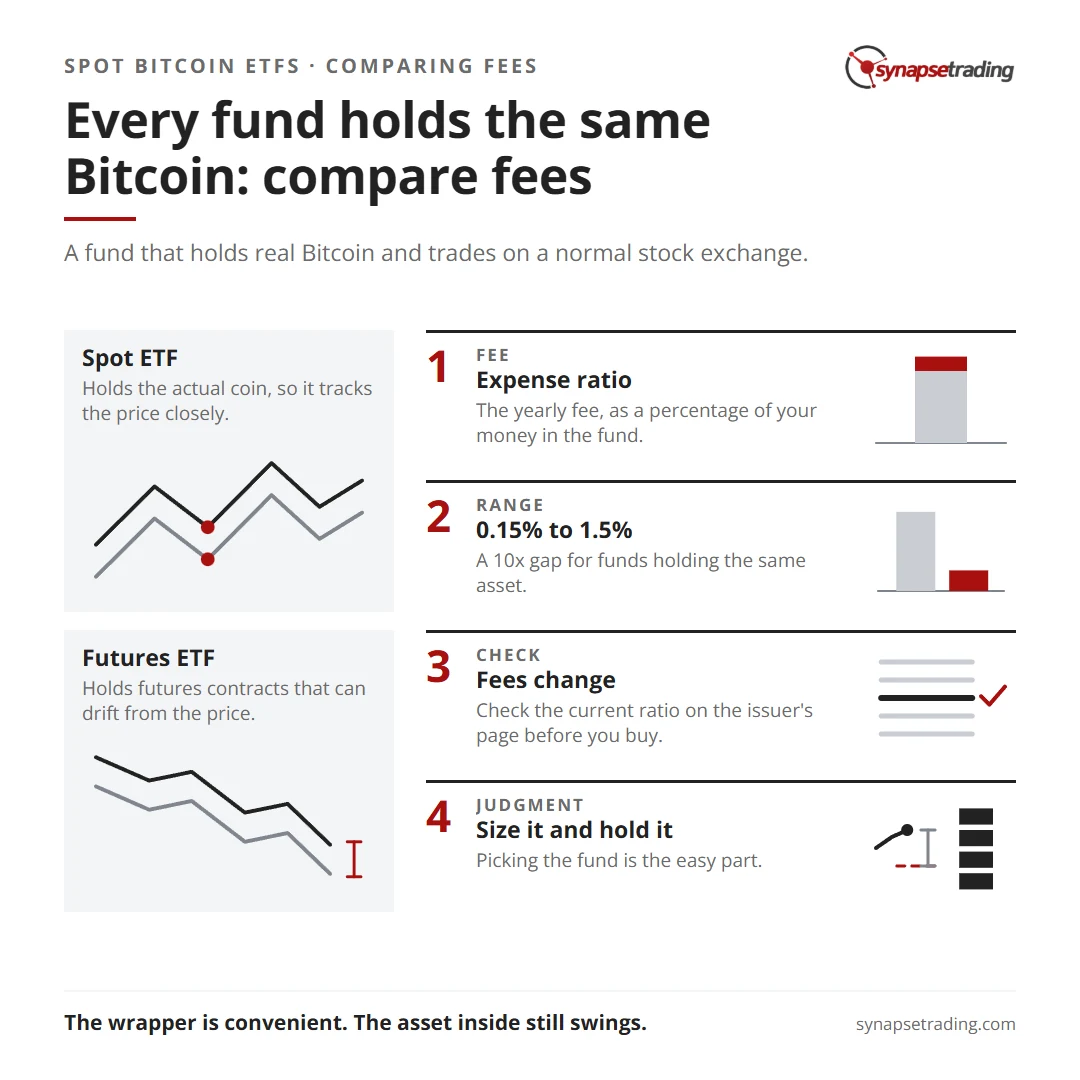
Every fund holds the same Bitcoin: compare fees. Summary card for the post: Comparison of the new Bitcoin (BTC) ETFs: Which is the Best?.

What is a spot Bitcoin ETF?

A spot Bitcoin ETF is a fund that holds real Bitcoin and trades on a normal stock exchange. You buy it like any share, through the brokerage you already use.

That word “spot” matters. A spot ETF holds the actual coin. A futures ETF (the older kind, like the ProShares BITO that launched first) holds Bitcoin futures contracts instead, which can drift away from the real Bitcoin price over time. The spot funds track Bitcoin much more directly, which is why their approval was the bigger event.

The appeal is simple. You skip the parts of crypto that scare most people: setting up a wallet, guarding a private key (the secret code that controls your coins, lose it and the coins are gone), and trusting a crypto exchange not to collapse. The ETF issuer handles custody. You just hold a ticker.

How did we get spot Bitcoin ETFs? A short timeline

These funds did not appear overnight. The road to approval ran more than a decade.

  • 2013: The Winklevoss twins filed the first Bitcoin ETF application. It set the template, and it was rejected.
  • 2017 to 2019: A run of SEC rejections, citing market-manipulation worries. ProShares, Direxion, and Bitwise all got turned down.
  • 2021: The tone shifted under SEC Chairman Gary Gensler, who took office in April. The first Bitcoin futures ETF, ProShares Bitcoin Strategy (BITO), was approved.
  • 2022 to 2023: More futures ETFs cleared, but spot funds still stalled over market-oversight concerns.
  • 2024: The first US spot Bitcoin ETFs were approved together, the regulatory shift that opened the door to the funds compared below.

So when you hold one of these today, you are holding the end of a long fight.

What is an expense ratio, and why does it decide the “best” ETF?

The expense ratio is the annual fee a fund charges to hold and run it, written as a percentage of your money in the fund.

A worked example. If an ETF has a 0.20% expense ratio and you put in $100, you pay about 20 cents a year in fees. The fee is taken straight from the fund’s assets, so you never write a cheque, you just earn slightly less than the raw Bitcoin price over time.

Here is why this is the lever that matters. Every spot Bitcoin ETF holds the same thing: Bitcoin. They do not pick better coins or time the market. So if Fund A and Fund B both just hold Bitcoin, the cheaper one wins by default, because the fee is the one number that reliably eats into your return. A lower expense ratio means more of Bitcoin’s move stays in your pocket.

Comparison of the spot Bitcoin ETFs by fee

Below are the US spot Bitcoin ETFs ranked from cheapest to most expensive. Do note that, issuers cut fees and run temporary waivers to win early assets, so always check the current ratio on the issuer’s page before you buy.

ETFTickerExpense ratioNotes
Grayscale Bitcoin Mini TrustBTC0.15%Lowest headline fee
Bitwise Bitcoin ETFBITB0.20%Launched with a fee waiver, since expired
Ark 21Shares Bitcoin ETFARKB0.21%Partnered with 21Shares, a crypto specialist
iShares Bitcoin TrustIBIT0.25%Run by BlackRock, the largest asset manager
Fidelity Wise Origin Bitcoin FundFBTC0.25%Backed by Fidelity’s custody and platform
VanEck Bitcoin TrustHODL0.25%Established ETF issuer
Valkyrie Bitcoin ETFBRRR0.25%Started at 0.49%, cut to 0.25%; early waiver
Franklin Bitcoin ETFEZBC0.29%Franklin Templeton
WisdomTree Bitcoin FundBTCW0.30%WisdomTree
Invesco Galaxy Bitcoin ETFBTCO0.39%Invesco plus Galaxy Digital’s crypto desk
Hashdex Bitcoin ETFDEFI0.94%Converted from a futures fund
Grayscale Bitcoin TrustGBTC1.50%Highest fee; longest track record and large asset base

Two things jump out of that table.

First, the fee range is wide: 0.15% at the bottom, 1.5% at the top. That is a 10x gap for funds holding the same asset. Over years, that difference compounds against you.
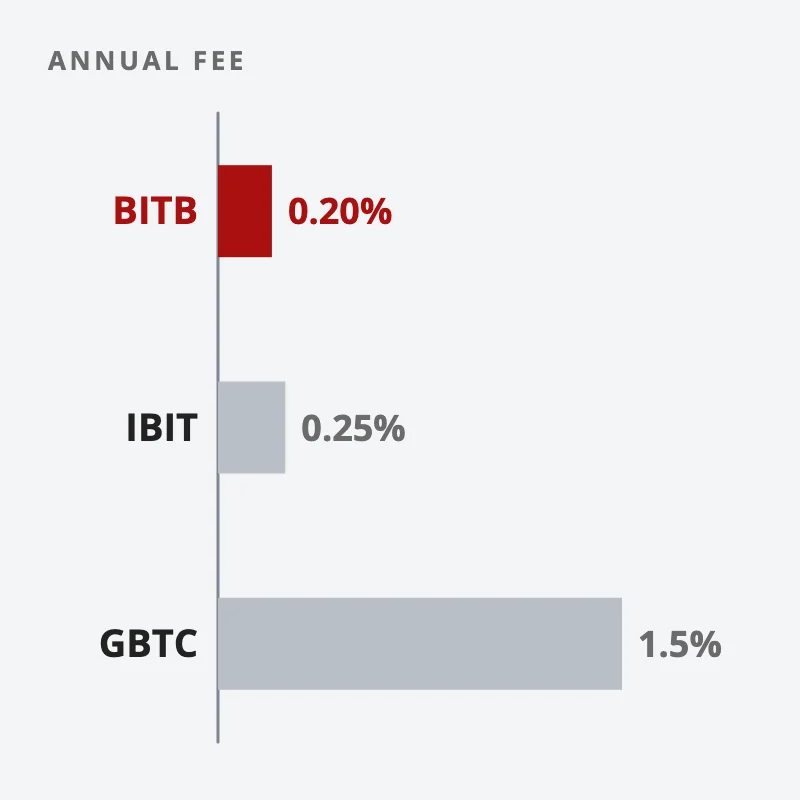
Bars of spot Bitcoin ETF expense ratios: BITB at 0.20% (cheapest, highlighted), IBIT at 0.25%, and GBTC far longer at 1.5%
Every spot fund holds the same Bitcoin, so the lowest fee keeps more of the move.

Second, GBTC is the odd one out. It was the original Bitcoin trust before it converted to an ETF, and it kept the largest asset base and the longest history. Its 1.5% fee is the price of that legacy. Some long-term holders accept it for the track record. For most new money, the cheaper funds are the obvious starting point.

Why spot Bitcoin ETFs mattered for the market

Beyond your own cost, these funds changed who can buy Bitcoin and how.

They lowered the barrier. No wallet, no keys, no exchange. If you can buy a stock, you can buy Bitcoin exposure. That alone pulls in a large group of investors who were never going to set up a crypto wallet.

They added a layer of legitimacy. Regulatory approval of a spot ETF was a signal that Bitcoin is an investable asset inside the traditional system, not just an internet curiosity. That tends to reduce some of the old skepticism.

They made it easy to size small. You can buy a few shares. You do not have to commit to a whole coin or a minimum exchange order. For a beginner who just wants a small, sensible slice of Bitcoin in a diversified portfolio, that fractional access is the practical win.

None of this removes Bitcoin’s volatility. The wrapper is convenient. The asset inside is still the same swinging asset it always was.

Which Bitcoin ETF is best for you?

There is no single “best” fund, only the best fit for your goal. Here is how I would frame the choice.

  • If you are cost-conscious (and most long-term holders should be), start with the cheapest credible fund. BTC at 0.15% leads, with BITB at 0.20% and ARKB at 0.21% close behind.
  • If you want the biggest, most liquid name, IBIT (BlackRock) and FBTC (Fidelity) at 0.25% trade size and a household brand for a basis point or two of fee.
  • If track record and asset base matter more to you than fee, GBTC is the legacy option, though you pay 1.5% for it.

Where the human edge comes in

A comparison table can rank these funds by fee in a second, and you should let it. That part is now free. What the table will not do is decide how big a Bitcoin position belongs in your portfolio, or whether you can sit through a 50% drawdown without panic-selling at the bottom. The cheapest ETF in the world does not help if you size it wrong or bail at the worst moment. Picking the fund is the easy part. Sizing it and holding through the volatility is the judgment, and it is the first of the Five Edges no fund can supply for you.

FAQ

What is the best Bitcoin ETF?
For most investors, the best Bitcoin ETF is the cheapest credible spot fund, since they all hold the same asset. The Grayscale Bitcoin Mini Trust (BTC) has the lowest headline fee at 0.15%, with BITB at 0.20%, ARKB at 0.21% and IBIT, FBTC, and HODL at 0.25%.

What is the cheapest Bitcoin ETF?
The Grayscale Bitcoin Mini Trust (BTC) has the lowest headline fee at 0.15%, with Bitwise (BITB) at 0.20% and Ark 21Shares (ARKB) at 0.21%. Always check the current ratio, as issuers change them.

What is the difference between a spot and a futures Bitcoin ETF?
A spot Bitcoin ETF holds actual Bitcoin, so it tracks the price closely. A futures Bitcoin ETF holds futures contracts instead, which can drift away from the real Bitcoin price over time. The spot funds are the more direct way to hold Bitcoin through a brokerage.

Why is GBTC’s fee so high?
Grayscale’s GBTC was the original Bitcoin trust before converting to an ETF, and it kept the longest track record and a large asset base. Its 1.5% expense ratio is far above its peers; it cut the fee to compete but still sits at the top of the range.

Do I still need a crypto wallet if I buy a Bitcoin ETF?
No. The whole point of a spot Bitcoin ETF is that the issuer handles custody. You buy and sell it like a stock through your brokerage, with no wallet and no private keys to manage.


Which one fits how you invest, the rock-bottom fee or the big-name liquidity? Let me know in the comments.

And if you want the bigger picture on crypto beyond the ETF wrapper, read the deeper guide: The Ultimate Guide to Blockchain and Cryptocurrencies.

Want a simple system for any market, crypto included? Grab the free 15-Minute Swing Trading Starter Kit. It’s the exact routine I use to scan once a day and trade any market in 15 minutes.


About the author. Spencer Li is The 15-Minute Trader and the founder of Synapse Trading. He is a Certified Financial Technician (CFTe) with 15+ years of trading, run from 70+ countries. He holds a B.Acc and B.BM from SMU. Every trade he takes is public, dated, losses left in. He teaches rules-based swing trading in 15 minutes a day, one system for any market.

Education, not financial advice. Synapse Trading is not licensed by MAS to advise on investment products. Trading carries risk of loss; past performance is not indicative of future results.


Related

The Ultimate Guide to Blockchain and Cryptocurrencies · What is Bitcoin and how does it work · What is Cryptocurrency, and is it a Good Investment? · How to Choose an Index ETF From Singapore

by Spencer Li
https://synapsetrading.com/wp-content/uploads/2026/10/best-bitcoin-btc-etf-card.webp 630 1200 Spencer Li https://synapsetrading.com/wp-content/uploads/2026/10/synapse-logo-horizontal-light.png Spencer Li2024-01-31 04:58:092026-10-22 13:19:50Comparison of the new Bitcoin (BTC) ETFs: Which is the Best?
The Synapse Network

How to Trade Using the Forex Currency Strength Meter to Pick a Better Pair

Markets & Products
Pick the stronger currency - forex currency strength meter

By Spencer Li, CFTe · Last updated: 16 October 2026

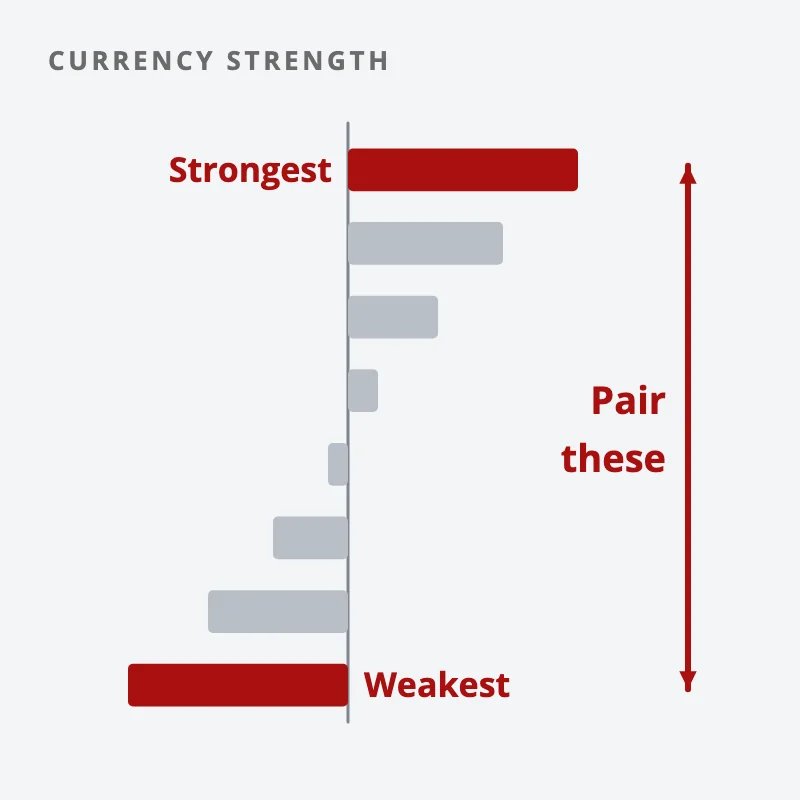
A forex currency strength meter is a tool that ranks the major currencies from strongest to weakest by how each one has moved against all the others over a set window. Most meters do this for the eight majors, across the 28 pairs they form between them. You use it to decide what to trade, by pairing a currency near the top against one near the bottom, and then you go to your own chart to decide when to get in.

Eight currencies ranked by strength as bars from a zero line, with the strongest at the top and the weakest at the bottom paired together
Pair a currency near the top of the meter with one near the bottom.

Most people get the window wrong. A 24-hour meter and a three-week swing trade answer two different questions, and mixing them up causes most of the frustration with these tools.

I should be upfront about where I stand. I trade mostly stocks and commodities, and as at June 2026, only 8 of the 450 closed trades in my trade log since April 2024 were forex pairs. But the first chart in my weekly market outlook is the US dollar index, which is really a strength meter for one currency.

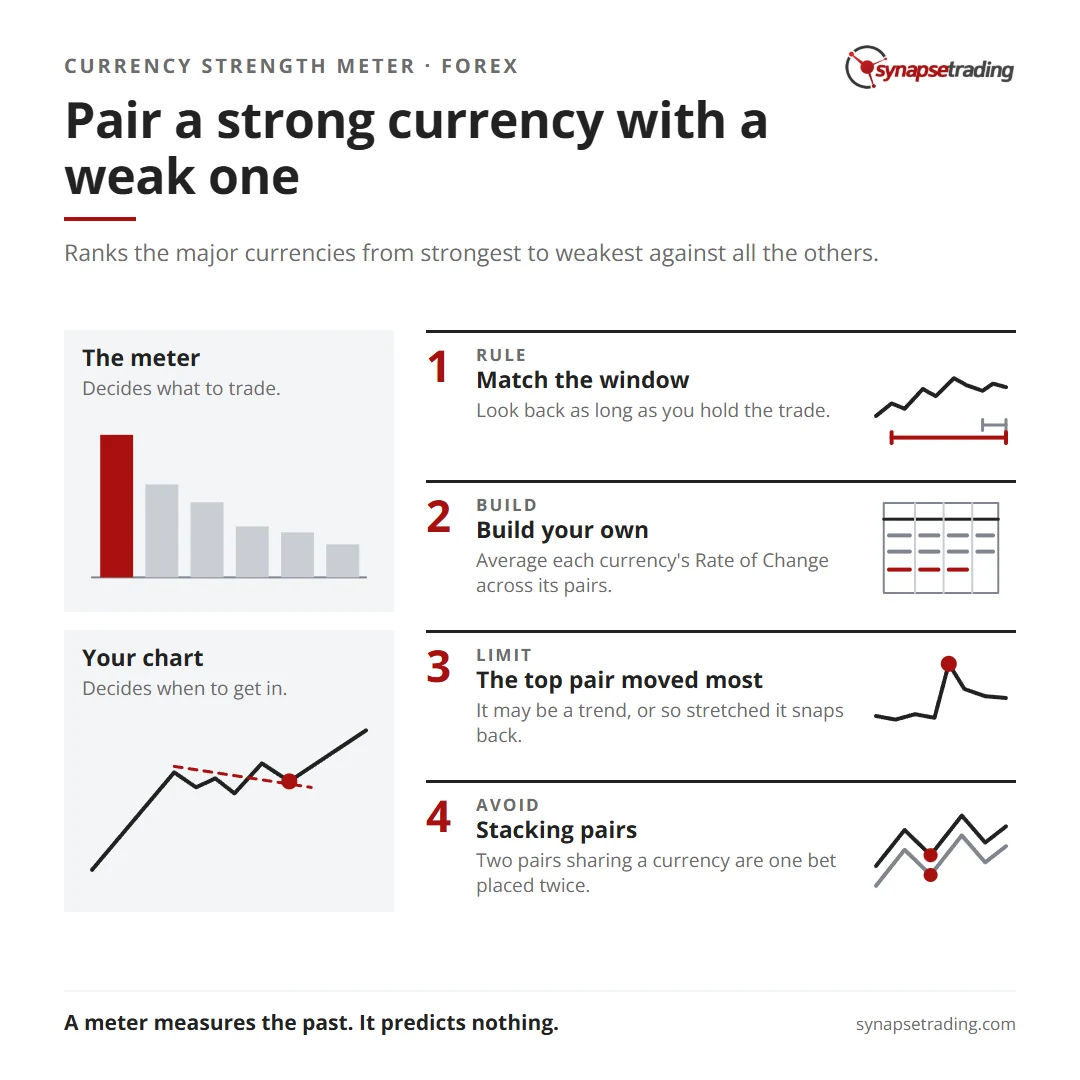
Pair a strong currency with a weak one. Summary card for the post: How to Trade Using the Forex Currency Strength Meter to Pick a Better Pair.

Why is more than half of the dollar index the euro?

The US dollar index, the DXY you see on financial news, was first built by the Federal Reserve in 1973. Today it is run by ICE Futures U.S., and its basket holds just six currencies: the euro, yen, pound, Canadian dollar, Swedish krona and Swiss franc.

They do not count equally. The euro alone carries 57.6% of the weight, and ICE says the index has been adjusted only once, when the euro arrived.

So when a news anchor says “the dollar is strong”, the DXY is mostly telling you the dollar is strong against the euro. The Australian and New Zealand dollars are left out. The yen counts for less than a quarter of what the euro does. For a number that moves gold, stocks and bonds, it is a surprisingly lopsided one.

A strength meter tries to fix that. It compares every major currency with every other one and gives each a score on the same scale.

How does a currency strength meter actually work?

Every forex price is a ratio of two currencies, so how can you measure the strength of just one? When EUR/USD rises, that chart alone cannot tell you whether the euro got stronger or the dollar got weaker.

The answer is to look at the same currency in every pair it trades in. Each of the eight majors appears in seven pairs, which is where the 28 comes from. If the euro rose against all seven of its partners, that is euro strength, but if it only rose against the dollar, the move is probably about the dollar rather than the euro.

The two vendor pages I checked describe the same basic recipe. currencystrengthmeter.org matches each currency with all of its pairs, scores it in each and averages the scores. LiveCharts.co.uk takes readings from every pair over the last 24 hours and uses the average gain or loss for each currency. currencystrengthmeter.org adds that simple meters do not weight the pairs, while more advanced ones, its own included, apply weighting factors.

Do note that both look back over the last 24 hours. That suits a day trader. If you hold trades for a week or more, you need a longer window, and the easiest way to get one is to build the meter yourself.

How do you build a currency strength meter without coding?

All you need is a spreadsheet and the Rate of Change, an indicator that measures how far a price has moved, in percent, over a set number of bars.

Choose a window that matches how long you hold a trade, take the Rate of Change of each pair over that window, and then average each currency’s numbers across every pair it appears in.

There is one twist the quick guides tend to skip. When the currency is first in the pair, you use the number as it is. When it is second, you flip the sign, because EUR/USD rising 1% means the dollar fell against the euro.

Let me show you with three currencies and made-up round numbers. Suppose that over your window:

  • EUR/USD rose 1.0%
  • USD/JPY fell 0.5%
  • EUR/JPY rose 0.5%

The euro is first in both of its pairs, so its score is the average of +1.0 and +0.5, which is +0.75. The dollar is second in EUR/USD and first in USD/JPY, so its numbers are −1.0 and −0.5, an average of −0.75. The yen is second in both, so its numbers flip to +0.5 and −0.5, and the average is zero.

So the ranking is euro, yen, dollar. It points you to EUR/USD. With all eight majors you do the same with seven numbers per currency, which is tedious to set up once and quick after that.

Look at the example once more. The pair at the top, strongest against weakest, is also the pair that moved the most. That happens by construction, because the gap between any two scores grows with the move in their shared pair, and it matters in a moment.

A meter you built is one small habit, and habits stick better inside a routine. The free 15-minute swing trader checklist is the daily routine I use myself.

What does a strong currency against a weak one give you?

On 18 March 2026, I recorded my weekly outlook while the dollar index had been climbing since January, with money running into the dollar as a safe haven. Yet USD/SGD was drifting lower. So the Singapore dollar was stronger still, strong enough to gain on a dollar that was gaining on most other things.

That is currency strength in one chart. Strong only means stronger than the others in the window you chose.

The textbook use is to pair the strongest currency against the weakest, which currencystrengthmeter.org says gives you the most robust trend. The vendors split on the quieter pairs. currencystrengthmeter.org suggests range traders look at pairs with only a slight difference in strength, while LiveCharts.co.uk says pairs of similar strength often go sideways and are worth staying away from.

Personally, I use it the trend way. A swing trade in my own system is usually a pullback inside a strong trend, so I want a pair that is already trending, then a calm entry on my own chart. Two currencies of equal strength give me a pair with no particular reason to go anywhere.

Why does the meter sometimes disagree with the chart?

On 15 September 2020, a trader on Reddit’s r/Forex described a meter showing the euro strong and the dollar weak while EUR/USD was falling. They asked a fair question: “are strength meters not a good tool to use?”

On a simple meter that weights its pairs equally, that cannot happen inside one window. The gap between the euro’s score and the dollar’s score moves with EUR/USD itself, so if the euro scores higher, EUR/USD rose over the meter’s window. Weighting only bends that a little.

So when the two disagree, they are almost always looking at different windows. Imagine a 24-hour meter next to a daily chart in a downtrend of several weeks, where the euro can simply be having a good day inside a bad month, which is the retracement the trader suspected.

But they were right to be suspicious, and there is a limit I should be honest about. When I read both vendor pages on 2 October 2026, each described a meter that measures the past, and neither claimed to predict anything. And because the top pair is by construction the one that has already moved the most, the meter always points you at the move that is furthest along. Sometimes that is a trend with plenty left in it. Sometimes it is a pair so stretched that it snaps back the week you buy it, and the meter cannot tell you which.

Which mistakes cost traders money with a currency strength meter?

Say the dollar sits at the bottom of the meter, so you buy EUR/USD and GBP/USD. It feels like two trades, but it is one bet against the dollar placed twice, so if the dollar turns, both lose together and the account takes double the hit you planned for.

MistakeWhat goes wrongDo this instead
Using the meter to time entriesIt shows what has moved, and nothing about when to enterPick the pair with the meter, time the entry on your chart
Reading a 24-hour meter for a trade that lasts weeksThe ranking flips daily and you chase noiseMatch the window to how long you hold
Stacking pairs that share a currencyOne bet placed twiceCount your exposure by currency
Buying EUR/USD and USD/CHF togetherOne is short the dollar, the other long itCheck both sides of every pair before adding
Trusting a meter you cannot see insideTwo meters with different formulas can disagreeKnow its window and weighting, or build your own

Most of these mistakes come from the fear of missing a move, and a meter makes that fear worse, because the strongest pair is always sitting at the top of the screen looking like a sure thing. Waiting for an entry that keeps the loss small is where a routine helps, and the free 15-minute swing trader checklist is the one I run every day.

How do I use currency strength if I mostly trade stocks?

This is how most of my own use looks. I barely trade forex pairs, but I check the dollar every week, because it spills into almost everything else I trade.

In my outlook on 18 March 2026, I said a strong dollar is generally bad news for gold, and I pointed out a somewhat inverse relationship between the dollar index and the S&P 500 ETF. Stocks were falling as the dollar rose. On 2 April 2026, with the dollar still holding up quite strong, I read it as money flocking to a safe haven, usually a bearish sign for stocks.

Hence, I treat the dollar as context rather than a trigger. It tells me whether the wind is at my back before I buy a stock or a commodity, and the entry still comes from that chart. I have no idea whether the relationship holds next year. But it costs one chart and a minute to check.

Big scheduled news can swing the dollar in a minute too, which I cover in what NFP means for traders.

FAQ

What is a forex currency strength meter?
It is a tool that ranks the major currencies from strongest to weakest by averaging how each one moved against the others over a set window. Most cover the eight majors and the 28 pairs between them.

How is currency strength calculated?
For each currency, the meter takes its percentage move in every pair it trades in, flips the sign when the currency is second in the pair, and averages the results. Some meters also weight the pairs.

What is the best timeframe for a currency strength meter?
The one that matches how long you hold a trade. Many free meters look back 24 hours, which suits day traders. If you hold for weeks, use a longer window.

Can a currency strength meter tell me when to enter a trade?
No. It tells you which currencies have been strong or weak, which helps you choose the pair. The entry still comes from your own chart.

Is the dollar index the same as a currency strength meter?
It is close, but it covers one currency. The DXY measures the US dollar against six currencies, with the euro at 57.6% of the weight, while a strength meter scores all eight majors on the same scale.


Do you use a strength meter, a dollar chart, or neither? Has a ranking ever pointed you at a pair that had already done its move? Let me know in the comments.

For the bigger picture, read The Ultimate Guide to Forex Trading, and the rest of my free trading guides are all in one place.

And if you want a routine that picks the pair and the entry in a few minutes a day, grab the free 15-minute swing trader checklist.


About the author. Spencer Li is The 15-Minute Trader and the founder of Synapse Trading. He is a Certified Financial Technician (CFTe) with 15+ years of trading, run from 70+ countries. He holds a B.Acc and B.BM from SMU. Every trade he takes is public, dated, losses left in. He teaches low-risk swing trading in 15 minutes a day, one system for any market.

Education, not financial advice. Synapse Trading is not licensed by MAS to advise on investment products. Trading carries risk of loss, and past performance is not indicative of future results.

by The Synapse Network
https://synapsetrading.com/wp-content/uploads/2026/10/how-to-trade-using-the-forex-currency-strength-meter-card.webp 630 1200 The Synapse Network https://synapsetrading.com/wp-content/uploads/2026/10/synapse-logo-horizontal-light.png The Synapse Network2023-08-11 05:23:292026-10-16 17:49:42How to Trade Using the Forex Currency Strength Meter to Pick a Better Pair
The Synapse Network

How to Choose a Good Forex Broker so You Don’t Get Scammed

Markets & Products
Pick a forex broker safely - forex

Statistics indicate that the Forex market is trading more than $1 trillion per day.

When you add currency options and futures contracts, this figure could easily be another couple of trillion dollars traded on any given day.

Forex Trading

The International Exchange Committee of the Bank for International Settlements, in one of its latest reports, suggested that the overall amount of Forex-related transactions might have reached around $3.0 trillion.

With such vast amounts of capital involved, Forex scams have inevitably increased, fueled by the allure of earning fortunes in a short period.

Many of the older prevalent frauds have decreased, thanks to serious enforcement measures by various regulatory bodies and the rise of quality brokers, such as those rated highly like FXPro.

However, despite having the best brokers at hand, many scams still exist, and new fraudulent schemes emerge daily.
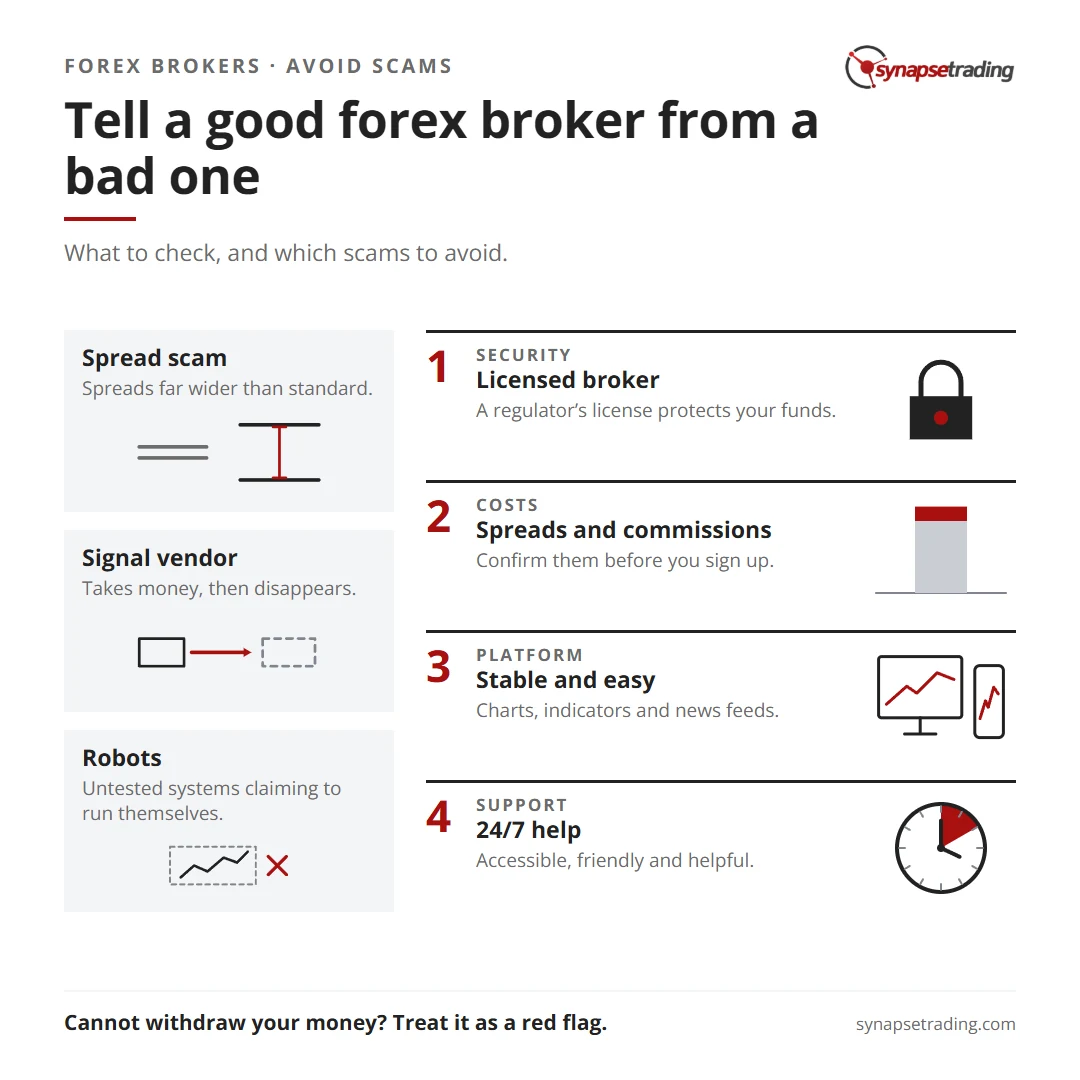
Tell a good forex broker from a bad one. Summary card for the post: How to Choose a Good Forex Broker so You Don’t Get Scammed.

Good vs. Bad Forex Broker: How to Know?

So, how can you distinguish a good Forex broker from a bad one? Below are the key characteristics you should look for when evaluating a Forex broker:

1. Security

Security is the most significant factor to investigate in a Forex broker. After all, you will be depositing your money, so you need to ensure that your investment is safe. A solid Forex broker operates under a license granted by a regulatory body, ensuring your funds are protected.

2. Operating Costs

Forex brokers generally generate their profits through spreads and commissions. Before signing up with a broker, it’s crucial to confirm the transaction costs and commissions to avoid unexpected charges.

3. Banking Options

A good broker provides a wide range of deposit and withdrawal methods, making it easy and safe for traders to deposit funds and withdraw their profits. The best brokers simplify this process to ensure traders can access their funds without hassle.

4. Trading Platforms

Forex trading is conducted on the trading platform offered by the broker. Before registering, ensure the platform is stable, easy to use, and equipped with features such as graphic tools, technical indicators, and news feeds. A good platform should include all the necessary information and tools for successful trading.

5. Customer Support

Excellent customer support is a must for any online Forex broker. Ideally, support should be available 24/7, with agents who are accessible, friendly, and helpful in resolving any issues that may arise.

Forex Scams You Should Know About

Even with knowledge of what makes a good broker, it’s important to be aware of common Forex scams. Below are some of the most prevalent scams in the Forex market:

1. The Old Forex Scam

This scam was based on the manipulation of supply and demand spreads. The difference between supply and demand reflects the commission of a transaction processed through an intermediary. Some brokers would offer spreads that differed significantly from the standard, such as offering a seven-point spread on EUR/USD instead of the typical two to three points. While this scam has decreased over the past decade, it’s still important to be cautious, especially with unregulated brokers.

2. The Signal Vendor

Signal vendors claim to offer professional recommendations that will supposedly lead to substantial profits. They often boast of long experience and business acumen, supported by testimonials from people claiming to have made significant money following their advice. However, many of these vendors simply collect money from unsuspecting traders and then disappear.

3. Scam in the Current Market

A persistent scam involves trading systems that promise to generate automatic profits, even while you sleep. These systems, often referred to as “robots,” claim to operate automatically to achieve great wealth. However, many of these systems have not been independently tested or approved, leading traders to gamble their money on unproven methods. It’s essential to thoroughly research any system before integrating it into your trading strategy.

Concluding Thoughts

There are other warning signs to watch for, such as brokers that do not allow withdrawals from investor accounts or problems within the trading platform. If you cannot withdraw your money, consider it a major red flag. Similarly, if the trading platform does not perform as expected, this could indicate deeper issues.

With the knowledge of what to expect and what to avoid, you can confidently choose the best Forex broker for your trading needs, minimizing the risk of falling victim to scams.

by The Synapse Network
https://synapsetrading.com/wp-content/uploads/2026/10/how-to-choose-a-good-forex-broker-so-you-dont-get-scammed-card.webp 630 1200 The Synapse Network https://synapsetrading.com/wp-content/uploads/2026/10/synapse-logo-horizontal-light.png The Synapse Network2023-08-11 05:20:542026-09-17 22:30:27How to Choose a Good Forex Broker so You Don’t Get Scammed
The Synapse Network

How to Use Forex Factory Free Trading Tools 

Markets & Products
Forex Factory's free tools - forex

Forex Factory is one of the few websites that provides high-quality, reliable information for traders for free. It’s a valuable resource for both beginners and experts in forex trading. As you learn to trade, the costs associated with trading can eventually add up, so it’s important to take advantage of free tools to trade more effectively. Forex Factory offers several tools that can significantly enhance your trading strategy without any cost.
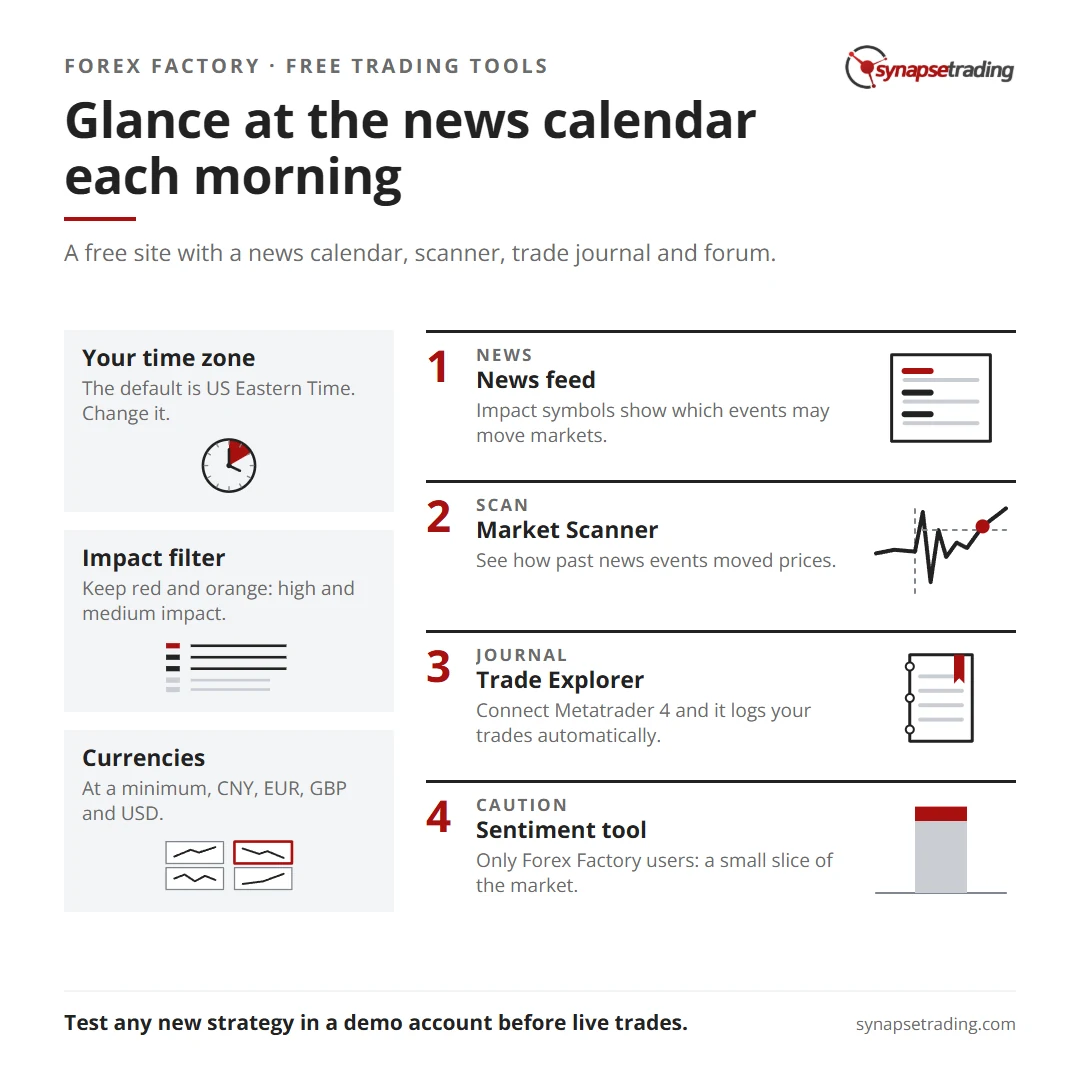
Glance at the news calendar each morning. Summary card for the post: How to Use Forex Factory Free Trading Tools .

Free Forex Factory Tools

Forex Factory provides the following tools for free:
Economic Calendar
Forex News with Impact Indicators
Explorer – Record Your Own Results
Forex Market Scanner
Forex Factory Forum
These tools can help you quickly analyze the market’s bigger picture with just a few minutes of daily work. Below, we’ll guide you on how to use these tools effectively.

Forex Factory Calendar – How To Set It Up

The Forex Factory News Calendar is a fantastic resource because it’s simple yet incredibly informative. The goal for any trader is to be able to digest the data quickly and log it to memory in seconds, which is easily achievable with this tool.

The calendar covers:

The Date & Time: When the data is released.
The Currency Affected: The currency impacted by the announcement.
Impact Indicator: How much impact the event could have on the market.
Event Name: The specific economic event.
In-Depth Details: What the data means, its impact, and the source of the data.
Actual Result, Forecast, and Previous Release: A comparison of the actual data with the forecast and previous release.
Historical Data Graphs: Graphs that allow you to generate trends from the data.
As a quick reference:

Red: High Impact – Major News Event
Orange: Medium Impact News Event
Yellow: Low Impact News Event
The Forex Factory calendar updates automatically, usually within seconds of the official data release, making it great for major news events.

However, there are two downsides to using the Forex Factory calendar in its default state:

Potentially the Wrong Time Zone: The default is based on Eastern Time US.
Shows All Data Points by Default: This can be overwhelming if not filtered.
These issues can be resolved and personalized to your needs in seconds.

How to Personalize the Forex Factory Calendar:

Change the Time to Your Time Zone:

Click the time at the top right corner of the website (no need to log in). This will allow you to set your time zone. Once changed, the new time zone will reflect on the calendar immediately.
Adjust the Data View:

Choose whether you want to see the data day by day or in a weekly view. Because we filter out the data in the next section, we keep this at a weekly view.

Filtering the Data:

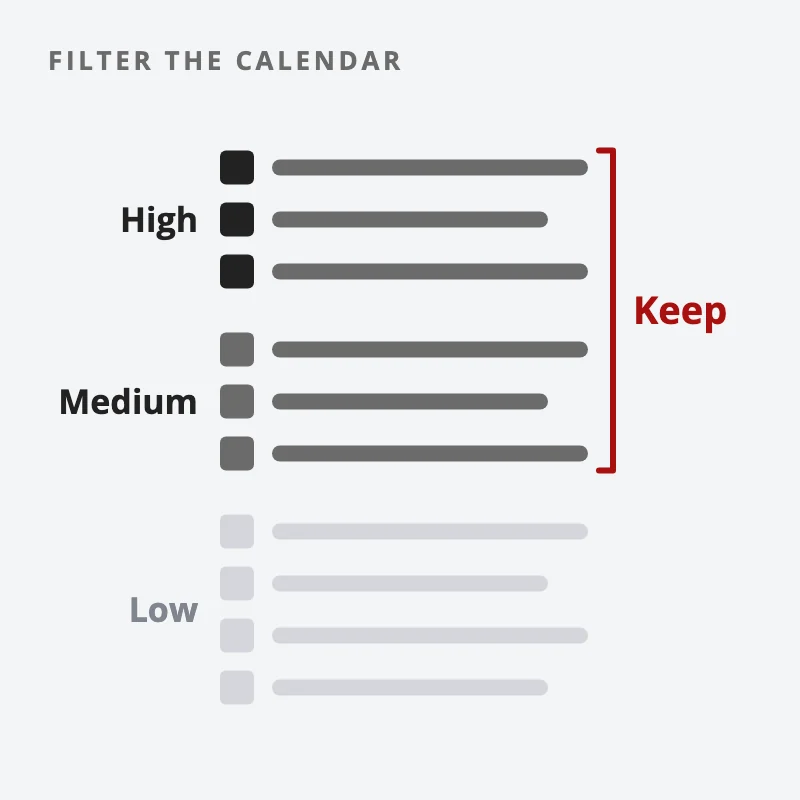
Select the Impact Levels: Choose the red and orange impact events because these can cause significant volatility during your trading day.
Select Currencies: At a minimum, select CNY, EUR, GBP, and USD. The rest are optional depending on what you trade (e.g., if you trade JPY crosses, include JPY news events).
Apply the Filters: Click apply, and you’ll have a more concise, personalized news calendar.
With this tool in place, you can quickly glance at the calendar each morning to see what news has been released, what data will be released today, and what to look out for during your session. This single tool can improve your knowledge and help you avoid bad timings, so we recommend you give it a try.

An economic calendar grouped by impact, with the high and medium impact rows kept and the low impact rows faded out
Filter the calendar down to high and medium impact news so the events that move markets stand out.

You can view the tool here.

How To Use The News Feature

Now that you’re familiar with the Forex Factory calendar, you can use it in conjunction with the market tool to read the markets going forward and understand market behaviors surrounding data releases.

Forex Factory also provides a great news stream that shows the impact a major news event may have on the markets.

Reading the News Event Features:

The Forex Factory News section is updated in real-time. If a news event has a symbol (red, orange, or yellow), it indicates that the event may have an impact on the markets. The symbols are consistent with the Forex news calendar, so you will know what they mean instantly.

By glancing at the News tool, you can quickly deduce potential effects on the markets, allowing you to focus only on impactful news events that could help or hinder your activities.

Staying on top of news and data flow as a trader is important. Ignorance is not bliss when it comes to forex trading. Missing out on high-impact news that has just been reported could result in losses if the market suddenly moves against your position.

No matter what time frame you choose to trade in, whether it is the daily time frame or the 1-minute chart, you should always check the forex news calendar frequently.

You can view the news section here.

How To Use The Market Scanner Tool

The Market Scanner tool on Forex Factory allows you to see how past news events have impacted market prices. This can give you insights into market behavior and help you anticipate future moves.

Using the Market Scanner:

Visualize Price Action: The Market Scanner shows how an asset like EUR/USD reacted to past news events. This can help you predict how similar future events might influence the market.
Gauge Market Reactions: By reviewing past data, you can better understand how the market responds to certain types of news, which can give you an edge in your trading.
Although you are looking at past data, this tool can help you gauge how market participants are reacting to certain data releases, which can provide an advantage in future trading.

You can view the Market Scanner here.

How To Record Your Own Trading Journal Using The Trade Explorer

Keeping a trading journal is crucial for tracking your performance and improving your strategy. Forex Factory’s Trade Explorer tool allows you to automatically log your trades and analyze your trading history.

Benefits of Using a Trading Journal:

Track Mistakes: Documenting your trades helps you identify patterns that lead to losses, allowing you to avoid them in the future.
Become Accountable: A journal keeps you disciplined and helps you monitor your progress over time.
Identify Successful Patterns: By recognizing what works well, you can replicate your successes.
Enhance Learning Opportunities: Reflecting on your trades helps solidify successful strategies and discard ineffective ones.

Setting Up the Trade Explorer:

Create an Account: Register for free on Forex Factory to start your trading journal.
Automate Data Tracking: Connect your Metatrader 4 account to the Trade Explorer, and it will automatically track your trades and generate performance insights.
With this tool, you can focus on trading while the system automatically records and analyzes your performance, making it easier to spot areas for improvement.

Forex Factory Forum – A Huge Trading Resource For Free

The Forex Factory Forum is one of the largest and most active forex trading communities online, with over 500,000 members discussing strategies, sharing tips, and providing feedback.

How to Use the Forum:

Learn from Others: Engage with other traders to learn new strategies or get advice on your current approach.
Share Your Experiences: By discussing your trades, you may receive valuable feedback that can help you improve.
Save Valuable Information: If you find a thread or strategy particularly useful, you can download it as a PDF for future reference.
The forum is an invaluable resource for learning and connecting with other traders. However, always test any new strategies in a demo account before applying them to live trades.

Market Sentiment Tool (Free) – A Word of Caution

Forex Factory’s Market Sentiment tool shows the percentage of traders who are long or short on a particular asset. However, this data reflects only the users of Forex Factory’s Explorer tool, a small slice of the market.

Recommendation:

Use this tool with caution. While it can provide insights into trader sentiment, it should not be relied upon solely for trading decisions.

Concluding Thoughts

Forex Factory offers a suite of powerful, free tools that can significantly enhance your trading strategy. From the Economic Calendar and Market News to the Market Scanner and Trade Explorer, these resources offer valuable insights that can help you stay informed and make strategic decisions. Use these tools alongside your analysis and test any new strategies in a demo account before applying them to live trades. With careful use, Forex Factory’s tools can help you become a more confident and successful trader.

1 Comment/by The Synapse Network
https://synapsetrading.com/wp-content/uploads/2026/10/how-to-use-forex-factory-free-trading-tools-card.webp 630 1200 The Synapse Network https://synapsetrading.com/wp-content/uploads/2026/10/synapse-logo-horizontal-light.png The Synapse Network2023-08-11 05:08:012026-09-05 18:30:51How to Use Forex Factory Free Trading Tools 
The Synapse Network

Types of Forex Trading Strategies (Pros & Cons)

Markets & Products
Forex strategies, pros and cons - forex

Forex trading requires a strategic approach that combines multiple factors to create a trading plan tailored to your goals and resources.

While there are countless strategies available, it’s essential to understand and feel comfortable with the one you choose.

Here, we explore eight effective Forex trading strategies, each with its own set of pros and cons, to help you make informed decisions in the market.

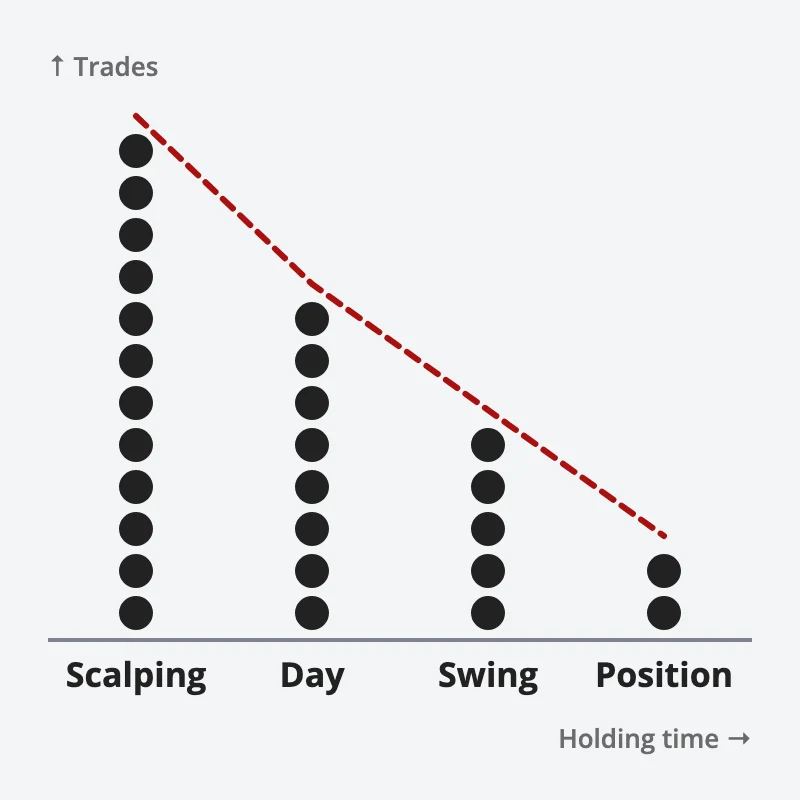
Four strategies from shortest to longest hold, scalping, day, swing and position, with a stack of trade dots that gets shorter at each step
Shorter-term strategies give more trades but take more of your time.

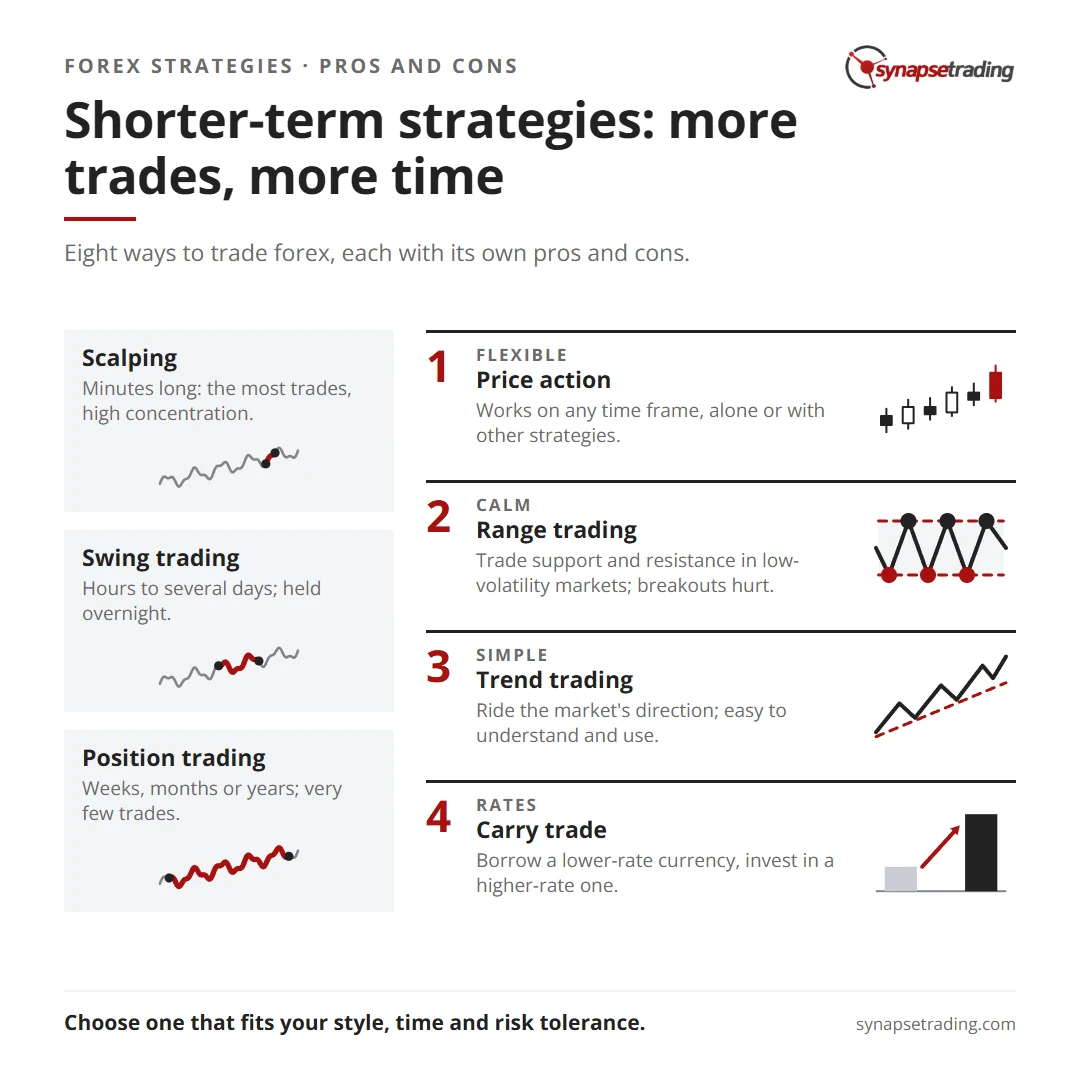
Shorter-term strategies: more trades, more time. Summary card for the post: Types of Forex Trading Strategies (Pros & Cons).

1. Price Action Trading

Price action trading involves analyzing historical prices to develop technical trading strategies. This approach can be used alone or in conjunction with indicators, with little reliance on fundamental analysis, though economic events can be considered as supplementary factors. Price action trading is versatile, allowing traders to apply it across various time frames, whether long, medium, or short-term.

Length of Trade: Price action trading can be used for trades of varying durations.

Entry/Exit Points: Traders use various techniques, such as Fibonacci retracement, candle wicks, trend identification, and oscillators, to identify support and resistance levels for entry and exit points.

Pros:
– Flexible across multiple time frames.
– Can be combined with other strategies or used on its own.
– Provides clear entry and exit points.

Cons:
– Requires a deep understanding of price movements.
– May involve complex analysis techniques.
– Not suitable for traders relying heavily on fundamental analysis.

2. Range Trading Strategy

Range trading focuses on identifying key support and resistance levels and placing trades around these levels. This strategy is most effective in markets with low volatility and no clear trend. Technical analysis is crucial for this strategy, as traders need to monitor potential breakouts and manage risk accordingly.

Length of Trade: Range trading can be applied to any time frame, depending on market conditions.

Entry/Exit Points: Oscillators like RSI, CCI, and stochastics are commonly used to time entry and exit points. Price action may also be used to validate signals or identify breakouts.

Pros:
– Provides substantial trading opportunities.
– Offers a favorable risk-reward ratio.
– Effective in stable, low-volatility markets.

Cons:
– Requires significant time investment.
– Risk of breakouts leading to losses.
– Demands a strong understanding of technical analysis.

3. Trend Trading Strategy

Trend trading is a straightforward Forex strategy that capitalizes on a market’s directional momentum. This strategy is suitable for traders of all experience levels and generally involves holding positions for medium to long-term periods, depending on the trend’s duration.

Length of Trade: Trend trading typically spans medium to long-term periods.

Entry/Exit Points: Entry points are often determined using oscillators, while exit points are based on maintaining a positive risk-reward ratio. Stop levels are set according to market conditions, and take profit levels are adjusted accordingly.

Pros:
– Provides numerous trading opportunities.
– Offers a favorable risk-reward ratio.
– Easy to understand and implement.

Cons:
– Requires a strong understanding of technical analysis.
– Can be labor-intensive due to the need for ongoing market monitoring.
– May require lengthy time investment depending on the trend.

4. Position Trading

Position trading is a long-term strategy that primarily relies on fundamental analysis, though technical methods like Elliott Wave Theory can also be used. This strategy involves holding positions for weeks, months, or even years, focusing on broader market trends and ignoring minor fluctuations.

Length of Trade: Position trades are long-term, often spanning weeks, months, or years.

Entry/Exit Points: Traders use key levels on longer time frame charts (weekly/monthly) to determine entry and exit points. Technical analysis is employed to complement fundamental analysis and ensure accurate market predictions.

Pros:
– Requires minimal time investment.
– Highly favorable risk-reward ratio.
– Ideal for long-term traders focused on fundamental analysis.

Cons:
– Very few trading opportunities.
– Demands a strong understanding of both technical and fundamental analysis.
– May involve long periods of waiting before trades materialize.

5. Day Trading Strategy

Day trading involves opening and closing trades within the same trading day. This strategy requires traders to monitor the market closely and make quick decisions based on short-term price movements. Day trading can involve single or multiple trades throughout the day.

Length of Trade: Day trades are short-term, ranging from minutes to hours, but all positions are closed before the market closes.

Entry/Exit Points: Traders often use moving averages to identify trends and set entry points. Exit points are typically determined using a 1:1 risk-reward ratio.

Pros:
– Offers numerous trading opportunities within a single day.
– Allows traders to avoid overnight risks.
– Provides immediate feedback on trading decisions.

Cons:
– Requires significant time and effort.
– Involves a steep learning curve for beginners.
– Can lead to overtrading and emotional stress.

6. Forex Scalping Strategy

Scalping is a strategy focused on taking small profits frequently by opening and closing multiple positions throughout the day. Scalpers usually operate on smaller time frame charts, and this strategy is best suited for highly liquid currency pairs with tight spreads.

Length of Trade: Scalping involves very short-term trades, often lasting just minutes.

Entry/Exit Points: Scalpers identify trends using indicators like moving averages and use oscillators like RSI to pinpoint entry and exit points. Stops are placed close to entry points to minimize losses.

Pros:
– Offers the greatest number of trading opportunities.
– Provides quick feedback on trades.
– Minimizes market exposure time.

Cons:
– Requires lengthy periods of time investment.
– Demands a high level of concentration and quick decision-making.
– Involves a lower risk-reward ratio.

7. Swing Trading

Swing trading is a medium-term strategy that takes advantage of price swings within a market. Traders aim to buy at market lows and sell at market highs, capturing profits from both range-bound and trending markets.

Length of Trade: Swing trades typically last from a few hours to several days.

Entry/Exit Points: Oscillators and indicators are used to time entries and exits, with risk management being a key component. Stops are set using the ATR indicator, and a positive risk-reward ratio is maintained.

Pros:
– Provides a substantial number of trading opportunities.
– Balances time investment with profitability.
– Can be used in both trending and range-bound markets.

Cons:
– Requires a solid understanding of technical analysis.
– May still involve significant time investment.
– Involves holding positions overnight, which can add risk.

8. Carry Trade Strategy

Carry trading involves borrowing a currency with a lower interest rate and investing in a currency with a higher interest rate, resulting in a positive carry. This strategy is most effective in strongly trending markets and can be held for medium to long-term periods.

Length of Trade: Carry trades are medium to long-term, depending on interest rate fluctuations.

Entry/Exit Points: Entry points are chosen based on the start of a trend, while the interest rate differential remains constant regardless of the trend.

Pros:
– Requires minimal time investment.
– Provides a median risk-reward ratio.
– Suitable for traders looking to capitalize on interest rate differentials.

Cons:
– Involves infrequent trading opportunities.
– Requires a strong understanding of the forex market.
– Exposed to both exchange rate and interest rate risks.

Concluding Thoughts

Selecting the right Forex trading strategy is essential for success in the market. Each strategy has its own advantages and disadvantages, making it crucial to choose one that aligns with your trading style, time commitment, and risk tolerance. By understanding the pros and cons of each strategy, traders can make informed decisions that best suit their goals and resources, ultimately leading to more effective and profitable trading.

by The Synapse Network
https://synapsetrading.com/wp-content/uploads/2026/10/types-of-forex-trading-strategies-pros-cons-card.webp 630 1200 The Synapse Network https://synapsetrading.com/wp-content/uploads/2026/10/synapse-logo-horizontal-light.png The Synapse Network2023-08-11 04:57:022026-08-09 22:50:10Types of Forex Trading Strategies (Pros & Cons)
Page 5 of 14«‹34567›»

Free checklist

The 15-Minute Swing Trader’s Checklist

The daily and weekly routine I use to find, manage and review trades in about 15 minutes a day, trading since 2007.

Get the free checklist

Topics

  • Trading foundations
  • Technical analysis
  • Strategies and systems
  • Risk and money
  • Trading psychology
  • Markets and products

Synapse Trading

Swing trading for busy professionals, in 15 minutes a day.

Start free

Learn

  • Start here
  • Free trading guides
  • Blog
  • Tools and resources

Programs

  • Trading Mastery Program
  • Daily trading signals
  • Student results
  • Public trade log

Company

  • About
  • Contact me
  • Partnerships
  • Disclaimer
  • Privacy policy
  • Terms & Conditions

Synapse Trading Pte Ltd
Registration No. 201316168H
WhatsApp +65-8897-1204
info@synapsetrading.com

Contact Us

Synapse Trading Pte Ltd
Registration No. 201316168H

Whatsapp: +65-8897-1204
Telegram: @iamrecneps
Email: info@synapsetrading.com

Links

Disclaimer
Privacy policy
Terms & Conditions
Contact us
Partnerships

© 2012-2026 Synapse Trading | All rights reserved. Educational content only, not personalised financial advice. Trading carries risk, including loss of capital. Past performance is not indicative of future results. Synapse Trading is not licensed or regulated by MAS.
  • Link to Facebook
  • Link to X
  • Link to Instagram
  • Link to Youtube
  • Link to LinkedIn
  • Link to Mail
Scroll to top Scroll to top Scroll to top