• Link to Facebook
  • Link to X
  • Link to Instagram
  • Link to Youtube
  • Link to LinkedIn
  • Link to Mail
Free PDF: The 15-Minute Swing Trader's Checklist, the daily routine on the record since 2014
Synapse Trading
  • Mentoring
    • Trading Mastery Program
    • All mentoring options
  • Signals
    • Daily trading signals
    • Signals trade log
  • Results
    • Student results and testimonials
    • Public trade log, losses left in
  • Free guides
    • Start here
    • Trading foundations
    • Technical analysis
    • Strategies and systems
    • Risk and money
    • Trading psychology
    • Markets and products
    • Free trading guides
    • Tools and resources
    • Blog
  • About
    • My background
    • My trading journey
    • Media and interviews
    • Travel log
  • Contact
    • Contact me
    • Partnerships
  • Start free
  • Click to open the search input field Click to open the search input field Search
  • Menu Menu
Spencer Li

How to Create a Trading Journal (And Discover Your Edge in the Markets)

Trading Foundations
Journal your way to edge - trading journal

Have you ever wondered why you keep making the same trading mistakes over and over again?

As you start your trading journey, one very important habit to cultivate is to have a good trading journal, which is why in this blog post, I’m going to share with you how you can start a trading journal and use it to effectively improve your trading results.

If you would like to learn all the essential elements to kickstart your trading journey, also check out: The Beginner’s Guide to Trading & Technical Analysis
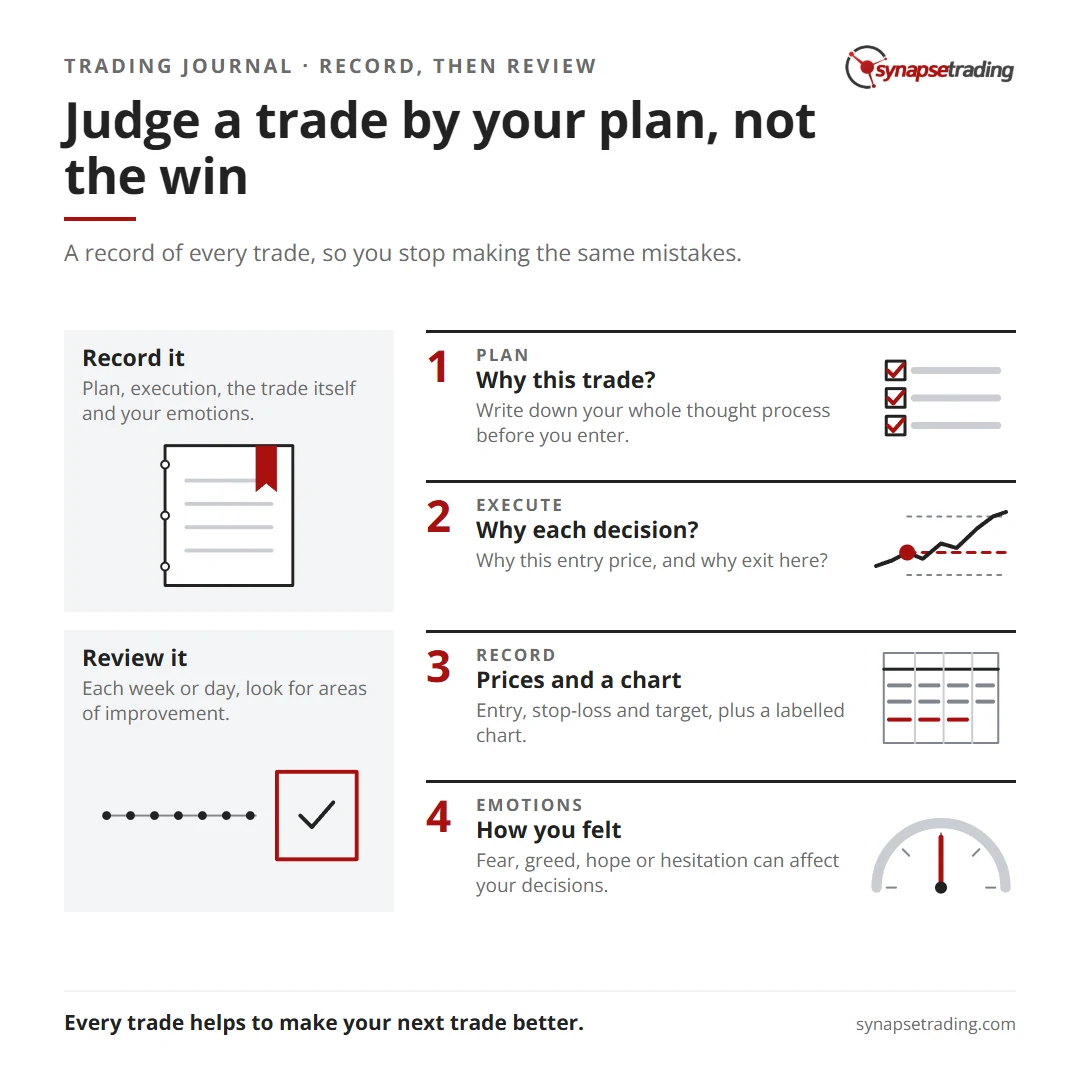
 

Judge a trade by your plan, not the win. Summary card for the post: How to Create a Trading Journal (And Discover Your Edge in the Markets).


Trading Journal #1 Plan New Trade

The first thing to record is the planning of your new trade.

You should already have a trading plan before you even start trading, but before you actually execute the trade, it is good to record down the trade in your trading journal.

  • Why are you taking this trade?
  • Why is this a good trade?
  • What is the strategy behind it?
  • What is the reason or the rationale for you wanting to take this trade?
  • What are the pro factors? The negative factors?

Everything should be recorded down, basically your whole thought process of your decision-making of how you come about to decide whether you want to take this trade or you want to pass on this trade.

So all that should be recorded down in your trading journal for future reference.


Trading Journal #2 Execute Your Trade

Next is the execution of the trade.

  • What was the reason and analysis of each decision point during the trade?
  • For example, when you’re making the entry, why are you entering at this price?
  • Why not wait a little bit later?
  • Why not enter at a better price or when you are going to exit the trade,
  • Why do you want to take profits?
  • Why not let the trade run further?

All these things should be recorded down in your trading journal.

Basically, why you make every decision along the way.


Trading Journal #3 Record Your Trade

Next, you’re going to record the trade itself in your journal, meaning all the trade parameters.

You’re going to record:

  • What type of trading style was it?
    Was it a long-term trade? A medium-term trade, a short-term trade?
    So that will correspond to whether it’s position trading, swing trading, or day trading.
  • And what was the product that you traded?
    Was it forex, a stock, an option or a derivative?
  • Next, what was the timeframe?
    Was it on a 5-minute chart, a 1-hour chart, a daily chart, a monthly chart?

These are all the standard parameters that should be recorded down in your trading journal.

Next up, you should also record down your entry price, stoploss price, and target price. These are the bare minimum parameters that you need to have for each trade.

  • The entry price (EP) is the price that you entered the trade.
  • The stoploss price (SL) is the price that you get stopped out.
    So if it’s a losing trade, and you got stopped out, then you record the price which you got out or if you didn’t get stopped out, you also record down the stoploss price, because that is the price that intended for it to be the stoploss.
  • And lastly, the target price (TP) will be the price that you choose to take profit at.
    If you actually stagger your trade, for example, you take half profits at certain price or decide to trail, and shift your stoploss or different variations of position management.

All this is useful information to see whether the position management strategy that you’re using is actually effective, or maybe it might be too complicated and decreasing the optimal returns that you should be getting.

Next, you should also attach a chart of your entry and exit in your trading journal.

Ideally the chart should be labeled with as many things as possible. Other than your entry and exit, you can label where you shift your stoploss or scale in or out of positions.

You can also choose to label your thought process directly on your chart.

So for example, if you choose to make your journal solely chart-based, then you could also record down most of the information directly on your chart, and then you’ll save a screenshot of it.

It might be easier for you to reference. All you have to do is just look through all the different charts, compilations. All the information is already on the chart.

However, it will not allow you to effectively analyze the data.

If you record it on a spreadsheet instead, then it’s easier if you want to do analytics to review the numbers and your profits.

This is a trade-off. Or you can do both if you have the time.

But the bare minimum you should have is to at least have an attached chart so that when you look at the chart, you can remember what this trade was about.


Trading Journal #4 Record Your Emotions

The most important thing to record is your emotions throughout the trade.

Many traders tend to neglect this aspect because they think that they just want to record the hard data, so they don’t really record down how they were feeling or why they made this decision.

But trading is an emotional activity.

It’s largely psychological, but your emotions still do play a big role.

A large part of trading is how well you can effectively manage this emotion.

So the first step to understanding or managing the emotions, is to be able to record it down.

For example, when you were taking this trade,

  • Were you feeling fear?
  • Were you afraid that you might miss out the trade or feeling greedy?
  • Or were you feeling hopeful or hesitant because maybe you were previously been burned in your last trade?

All these emotions are very important because subconsciously, they may affect your decision-making.


Trading Journal #5 Review Your Trades

The next segment is how to use these data that you have collected from your trading journal to improve your trading results.

The frequency at which you do your review will depend on your trading style.

If you are doing swing trading, then maybe you can do a review at the end of every week; if you are day trading, then you could do it at the end of every day.

The main point of this review is to look for areas of improvement.

What are some of the things that you should be looking out for?

  • Did you follow your trading plan?
    You should have a trading plan before you even start trading, so you can compare the before and after, (your trading plan versus your trading journal), how closely do they match up?
  • If you deviated from your trading plan, why did it happen?
    Was it because of certain emotions or was it some impulse?
  • So with that, then you need to decide whether it is the plan needs to be improved or whether it is you who needs to improve so that you can be more disciplined to follow the trading plan.

The next level is to go down to each individual trade, for example, for every trade:

  • Why was it a winning trade?
  • Why was it a losing trade?

Just because a trade is a winning trade doesn’t necessarily mean that it was a perfect trade or you did everything correctly because there’s an element of chance.

Even if you broke all your trading rules and you traded horribly, there’s still a chance that you might end up with a winning trade, but that doesn’t necessarily reflect your ability to trade.

And it definitely doesn’t mean that you should replicate this behavior in the future.

It’s important to not just see the trade as winning trade equals good trade and losing trade equals bad trade, but to understand the underlying reasons for why it was a winning trade and why it was a losing trade.

For losing trades, was it due to poor execution or was it due to market conditions?

So similar to the idea put forth earlier, just because a trade was a losing trade doesn’t necessarily mean that it was a bad trade because you can do everything perfectly and executed everything according to plan and it could still turn out to be a losing trade simply because no trading strategy is 100%.

Even if your trading strategy is 70%, there is still a 30% chance that the trade will be a losing trade, even if you did everything correctly.

The key thing is to see how closely you follow your plan, whether you execute everything according to your plan.
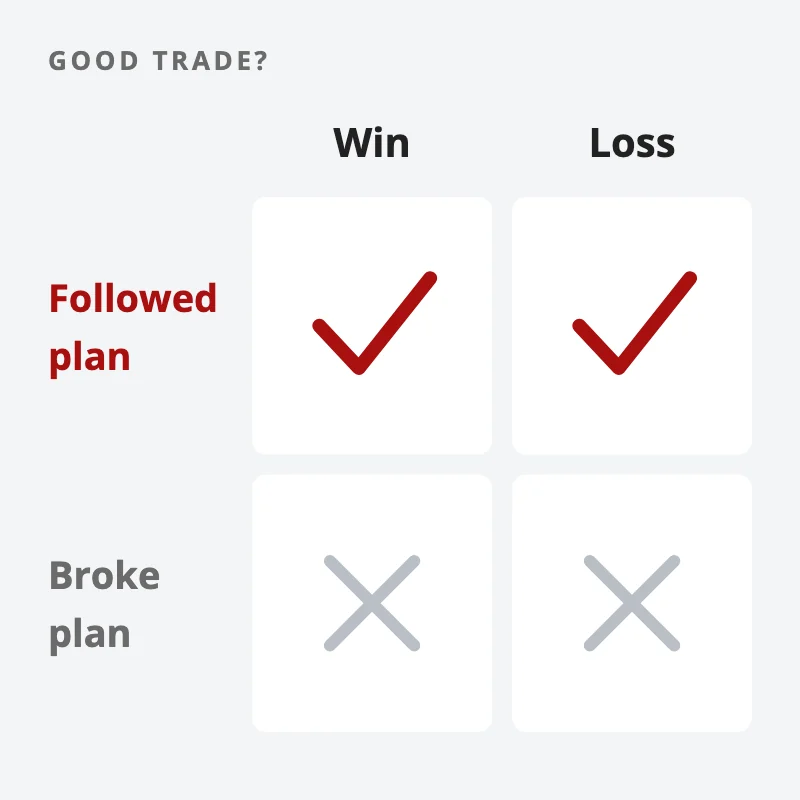
A two by two grid of win or loss against followed plan or broke plan; both followed-plan boxes get a red tick, both broke-plan boxes a grey cross
Judge a trade by whether you followed your plan, not by whether it won.

As I said earlier, it’s a matter of reviewing everything and seeing whether the plan needs to be improved and changed, or whether it is you who needs to improve your discipline, such that you can be less emotional and be able to execute the plan which you have come up with.

And that is the key to being a good trader.


Summary of Trading Journal

So to sum up, I’ve shared with you 2 main segments of the trading journal.

The first was all the things that you need to record in your trading journal. (Parts 1 to 4).

That’s how you can create a good trading journal.

The second part is how you actually use this information to improve your trading results. (Part 5).

So remember that all successful traders, even professionals, they keep a trading journal.

And in fact, this is quite a standard practice for many of the funds and financial institutions, especially for some that I used to work at.

It was common practice that they want all the traders to have a trading journal so that when you are reviewing it with your manager or your bosses, there’s a record and it actually helps them understand your trading style and your trading decisions on a day-to-day basis.

Even if you are trading on your own, it’s actually very important to have this trading journal because you will be able to better understand yourself as well.

Only you will be able to figure out your strengths and your weaknesses.

So having this trading journal gives you a window into your own trading psyche and allow you to fine tune your trading strategies and thus, improve your trading results.

For all new traders out there, do you currently have a trading journal and for seasoned traders, how useful is a trading journal when you were starting your trading journey?

Let me know in the comments below!
by Spencer Li
https://synapsetrading.com/wp-content/uploads/2026/10/trading-journal-market-edge-card.webp 630 1200 Spencer Li https://synapsetrading.com/wp-content/uploads/2026/10/synapse-logo-horizontal-light.png Spencer Li2021-03-14 18:42:142026-09-27 18:42:49How to Create a Trading Journal (And Discover Your Edge in the Markets)
Spencer Li

How to Craft a Winning Trading Plan (The 7 Key Ingredients)

Trading Foundations
Your trading plan's seven parts - trading plan

You’ve probably heard that you need a trading plan before you start trading, but how exactly do you go about crafting one?

Now, if you’ve ever tried to start a business, you will know that you need a business plan, which tells you the A to Z of everything you need to do for your business, the step-by-step process you’re going to execute your plan, your strategy, and all that.

So the same thing applies to trading.

You need a trading plan before you start trading.

And today I’m going to share with you the 7 key ingredients that you need to craft a winning trading plan.

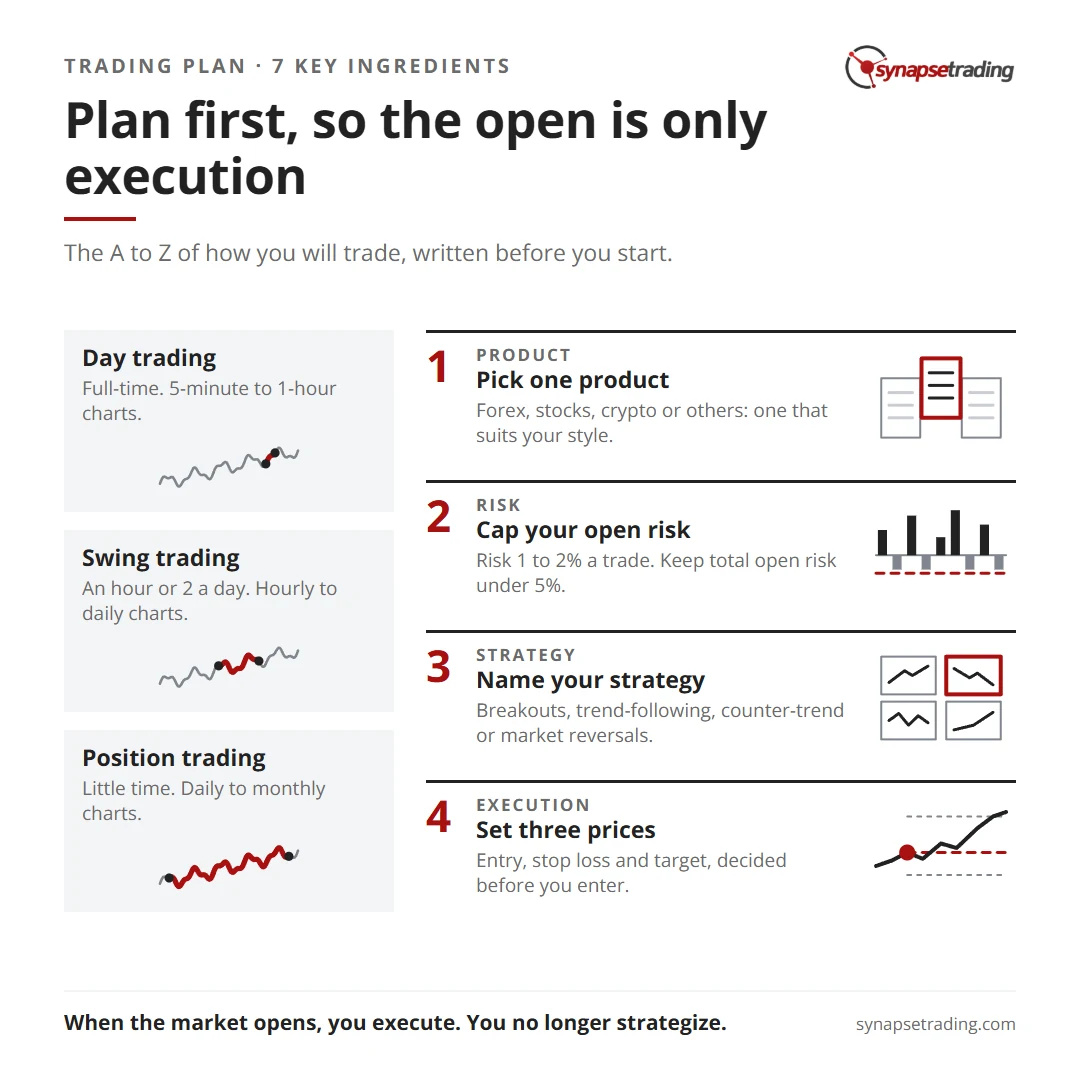
Plan first, so the open is only execution. Summary card for the post: How to Craft a Winning Trading Plan (The 7 Key Ingredients).

Trading Plan Ingredient #1 Trading Style

The first thing you need to do is to determine what is your preferred trading style.

Now, there are three main types of trading styles: day trading, swing trading, and position trading.

The main determining factor would probably be the amount of time that you can afford to spend on trading.

So if you are doing it as a full-time job, or if you have a lot of time to spend, then you can probably consider trying day trading.

And if you like the fast-paced environment and making quick decisions, then that may be something for you.

On the other hand, if you’re just doing it as a part-time endeavor where you have maybe an hour or 2 a day to spend on trading, then you might consider swing trading instead where you take longer-term positions, more in the medium to long-term position instead of going in and out of the market, such as like in day trading.

Lastly, if you do not have much time at all to spend, then probably the most effective thing for you to do is position trading that you take long-term positions that could last weeks or months.

So this does not require you to spend a lot of time analyzing the charts on a day-to-day basis.

Trading Plan Ingredient #2 Trading Timeframe

Now, the second factor to consider is the timeframe.

Now this corresponds closely to the trading style that you choose.

For example, if you are day trading, most likely you’ll be using an intraday timeframe such as the 5-minute chart or the 15-minute chart, or even the 1-hour chart.

On the other hand, if you are swing trading, most likely you’ll be using a timeframe such as the hourly chart, the 4-hour chart or the daily chart.

And lastly, if you are doing position trading, which is a long-term endeavor, you’ll probably be using the daily chart or the weekly chart, or even the monthly chart.

Trading Plan Ingredient #3 Product Selection

The third major ingredient is the product.

Now, this is the trading product that you are choosing to specialize in.

For example, it could be things like forex, stocks, bonds, commodities, derivatives, cryptocurrencies, options, etc.

There are actually many different products, so you need to find a product that suits your trading style, suits your personality, something that you are going to be familiar with.

Trading Plan Ingredient #4 Risk Management

Now, this is the part that determines how you allocate your resources.

So for example, one thing to note is your starting capital, which is the amount of capital that you are going to start with, because this will determine your trading size and the risk that you’re going to take for each trade.

So for example, a common calculation is to risk 1 to 2% of your capital per trade, depending on how much risk you want to take.

If you are starting with $10,000, then you will probably be risking 2% of $10,000 per trade, which is about $200 a trade.

And the other thing you need to take note off, is the open risk on all your trades.

If you are risking, say 1 or 2% on each trade, you need to ask yourself, what is the maximum risk or maximum drawdown that can happen if all the positions that you have open at one time, all get stopped out simultaneously.

So when that happens, what is the total amount of risk?

And that is known as the open risk.

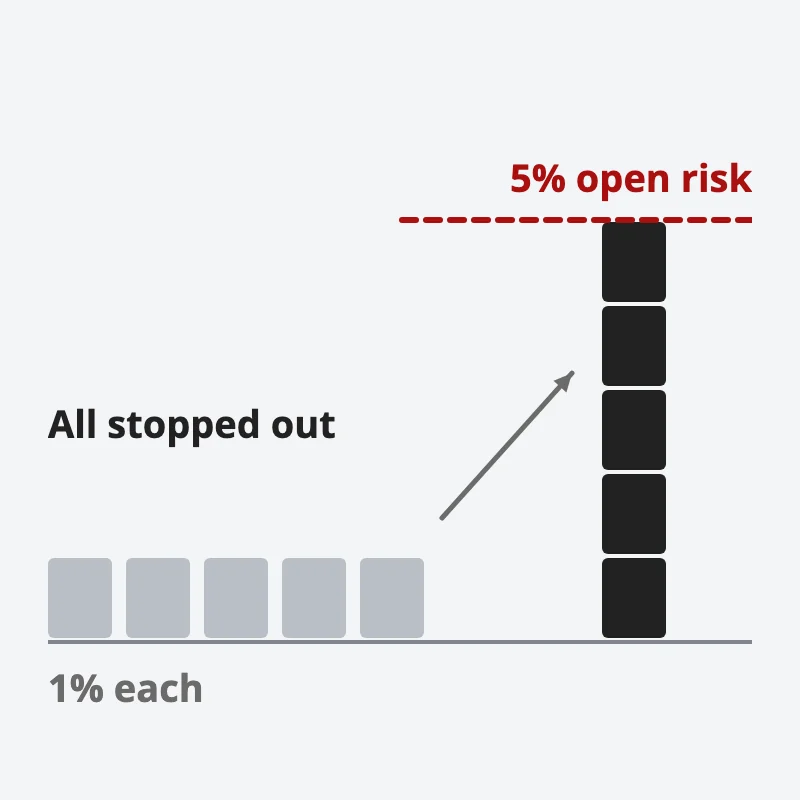
If you’re risking 1% a trade and you have 5 trades that all go sour at the same time, you lose 5%. So 5% is your open risk.

You want to limit your open risk to less than 5% because you don’t want to lose a large chunk of your capital at the same time.

Five open trades each risking 1%; if all are stopped out at once they stack up to a 5% open risk
Add up the risk on all your open trades, and keep that open risk under 5%.

It’s ideal that you have a limit to the monthly drawdown that you incur, because you don’t want to have a scenario where you lose a large chunk of your capital in one time period, because if you will lose too much capital in one month, then in the next month, you have no more capital to trade.

If you are not doing well this month, it will be ideal to perhaps take a break from trading and you can come back to fight the next month.

Trading Plan Ingredient #5 Type of Analysis

The next major category to look at is the type of analysis that you are going to be using.

Now, there are three main types of analysis: price action, classical charting, and technical indicators.

Now, each of these is a complex topic that I have created other tutorials on.

So the main thing for you is really to decide which one you are going to specialize in.

But most of the time as a trader, it’s important to actually learn and master all the three different techniques because you are going to use them in combination in certain ways.

And that actually leads you to formulate your trading strategies, which is number 6, the type of strategy that you are going to be using.

Trading Plan Ingredient #6 Type of Strategy

Now, personally, I feel that most trading strategies will fall under 4 main categories: breakouts, trend-following, counter-trend and market reversals.

So if you look at your strategy, you want to be able to see which category it falls under so that you can better understand, what are the strengths and weakness of each strategy.

To help you out, I have other tutorials that cover each strategy in greater detail.

So, what are the different strategies that I use?

Breakouts are when price breaks to new highs or new lows.

Trend-following is more like finding an opportunity to ride on a strong trending market.

So usually you look to enter on pullbacks.

Counter-trends are usually opportunities where the market has gone to certain extremes, like too overbought or too oversold. Knowing how to pinpoint and target those counter-trends, is the essence of counter-trend trading.

Lastly, market reversals are like the big kind of reversals or turns in the market.

They do not happen that frequently, but when it does happen, you want to be aware because it leads to a change in the major trend.

Trading Plan Ingredient #7 Trade Execution

The final 7th ingredient is the trade execution.

Now there are three key parameters that you need to determine before you decide to enter a trade.

And that is the trade entry, the stop loss and the target price.

The trade entry is the price at which you are going to enter the trade and that is determined by the strategy and the setup that you are using.

The stop loss is the price that you are going to get out of the trade.

So, a stop loss is there to protect and limit the amount of loss that you are going to incur on the trade.

There are certain types of stop loss, such as the fixed stop loss, the trailing stop loss and all these should be part of your trading plan.

And finally, the last thing is the target price, which is where you are going to take profit on a trade if it does go in your favor.

So you need to have certain preset rules, for example, how are you going to project a target price?

Or how are you going to determine where’s the optimal point to scale down your positions or to get out of the position totally?

Trading Plan Bonus Ingredients

Now that I’ve covered the seven key ingredients to a winning trading plan, there are some other things that you might want to include as well.

For example, evaluation metrics.

How do you going to measure and improve the performance of your trades, as well as trading psychology rules that you can implement to prevent you from making cognitive biases or mistakes in your trading.

So remember that the key purpose of having a solid trading plan is to separate the execution phase from the planning phase.

Ideally, the moment the market opens, you are focused on executing your trading plan and you no longer have to strategize because if you are trying to do both at the same time, it is going to be really difficult to concentrate.

Therefore, that is the idea of a trading plan.

Now that I have shared the key ingredients in my planning plan,

What are some of the things that are missing from your trading plan or things that you think can be improved on?

Do let me know in the comments below.


About the author. Spencer Li is The 15-Minute Trader and the founder of Synapse Trading. He is a Certified Financial Technician (CFTe) with 15+ years of trading, run from 70+ countries. He holds a B.Acc and B.BM from SMU. Every trade he takes is public, dated, losses left in. He teaches low-risk swing trading in 15 minutes a day, one system for any market.

Education, not financial advice. Synapse Trading is not licensed by MAS to advise on investment products. Trading carries risk of loss; past performance is not indicative of future results.

by Spencer Li
https://synapsetrading.com/wp-content/uploads/2026/10/trading-plan-ingredients-card.webp 630 1200 Spencer Li https://synapsetrading.com/wp-content/uploads/2026/10/synapse-logo-horizontal-light.png Spencer Li2021-03-07 16:38:372026-09-13 20:20:34How to Craft a Winning Trading Plan (The 7 Key Ingredients)
Spencer Li

Book Summary: Die with Zero (How to Maximise Your Life)

Trading Foundations
Die with Zero, summarised - book summary

Die With Zero: The Book That Made Me Rethink Money, Time, and Why I Stopped Chasing More

Last updated: 20 August 2026 · By Spencer Li, CFTe


“Die with Zero” by Bill Perkins argues that the goal of money is not to accumulate as much as possible, but to convert it into life experiences before you run out of time to enjoy them. The core idea: if you die with a large pile of unspent money, you sacrificed hours of your life earning money you never used, which means you effectively wasted those hours. The book flips the usual retirement advice. Instead of hoarding a big sum to live off the interest and dying with the capital intact, Perkins says you should aim to spend down to (close to) zero, peak your net worth earlier in life, give your money away while you are alive, and time each experience for the age when you can actually enjoy it. When I read it, it put words to something I had already been living. Here is what it actually says, and why it changed how I think about working harder.

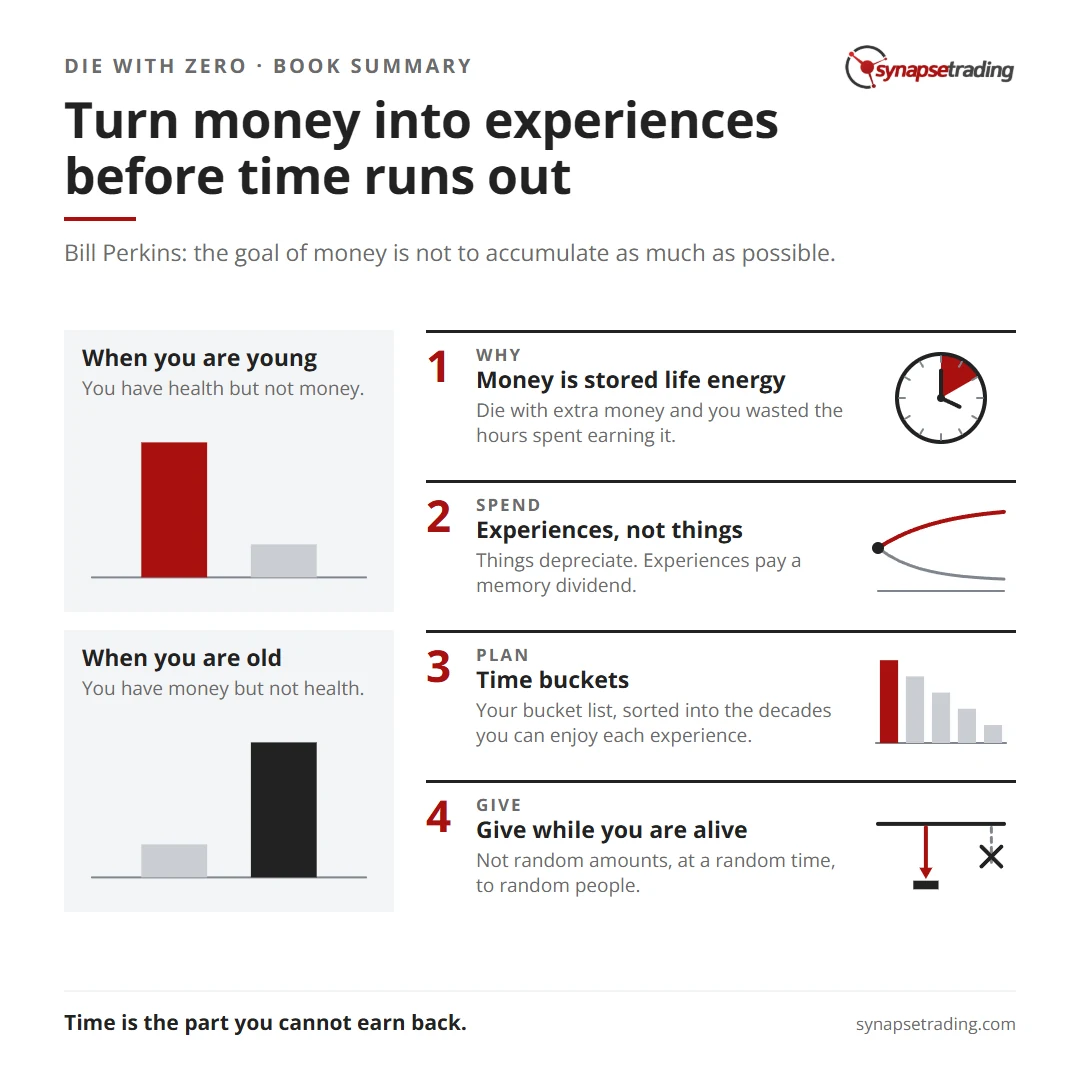
Turn money into experiences before time runs out. Summary card for the post: Book Summary: Die with Zero (How to Maximise Your Life).

How much time should you exchange for money?

Perkins starts with a simple reframe: money is stored life energy.

Life energy is all the hours you are alive to do things. Whenever you work, you spend some of that finite life energy. So any amount of money you have earned represents the life energy you spent earning it.

Follow that logic and something uncomfortable falls out. If you die with extra money, you sacrificed hours of your life for money you never spent. You wasted those hours.

That means there is an optimal amount of work, enough to fund the lifestyle you actually want, and anything beyond that is unnecessary. But most people work and save far past that point, usually out of fear or habit.

Perkins is blunt about why. Our culture’s focus on work is like a seductive drug. It takes all your yearning for discovery and wonder and experiences, and promises to give you the means (money) to get those things. Then the focus on the work and the money becomes so single-minded that you forget what you were yearning for in the first place. The poison becomes the medicine.

Once you are in the habit of working for money to live, the thrill of making money quietly exceeds the thrill of actually living. That is the trap.

What should you spend money on for maximum value?

Spend on experiences, not things.

Many psychological studies have shown that spending money on experiences makes us happier than spending it on material possessions. Things feel exciting at first, then depreciate. Experiences do the opposite. They gain value over time, because they pay what Perkins calls a memory dividend (the ongoing happiness you get from recalling and re-sharing an experience long after it happened).

The frame underneath this: your life is the sum of your experiences. Everything you do, the daily, weekly, annual, and once-in-a-lifetime experiences, adds up to who you are.

So the practical move is to actively think about the life experiences you want and how many times you want to have them. They can be large or small, free or costly. The point is to decide deliberately rather than drift.

Three questions Perkins keeps asking, which are worth sitting with:

  • What is the best way to spend our money for maximum enjoyment and maximum memories?
  • What is the best way to allocate our life energy before we die?
  • What are the life experiences you would like to have in this lifetime?

What are the biggest regrets people have at the end of life?

The biggest deathbed regret is wishing you had lived a life true to yourself, not the life others expected of you. Perkins draws on the five most common regrets recorded by people near the end of life, and almost all of them are about experiences not had and feelings not expressed, not about money not earned.

#The regretWhat it is really about
1I wish I’d had the courage to live a life true to myself, not the life others expected of meOther people’s script over your own
2I wish I hadn’t worked so hardOver-working past the optimal point
3I wish I’d had the courage to express my feelingsWithheld emotion
4I wish I had stayed in touch with my friendsNeglected relationships
5I wish that I had let myself be happierDelayed permission to enjoy life

Notice what is missing from that list: nobody wishes they had earned more.

And here is the part most people miss. This regret does not only strike once, at the very end. It strikes at every stage of life. The bookworm teenager who skipped the fun of high school for a supposedly brighter future. The middle-aged dad who kept skipping irreplaceable moments with his teens while chasing one more promotion.

Perkins calls these mini-deaths. The teenager in you dies. The college student in you dies. The single unattached version of you dies. The parent-of-an-infant version of you dies. Once each of those passes, there is no going back. You can delay some experiences for only so long before the window shuts forever.

When the end is near, people suddenly think, “What the hell am I doing? Why did I wait this long?” Until then, most of us live as if we had all the time in the world.

Why does timing matter as much as the money?

Because some experiences can only be enjoyed at a certain age, and your ability to enjoy them declines.

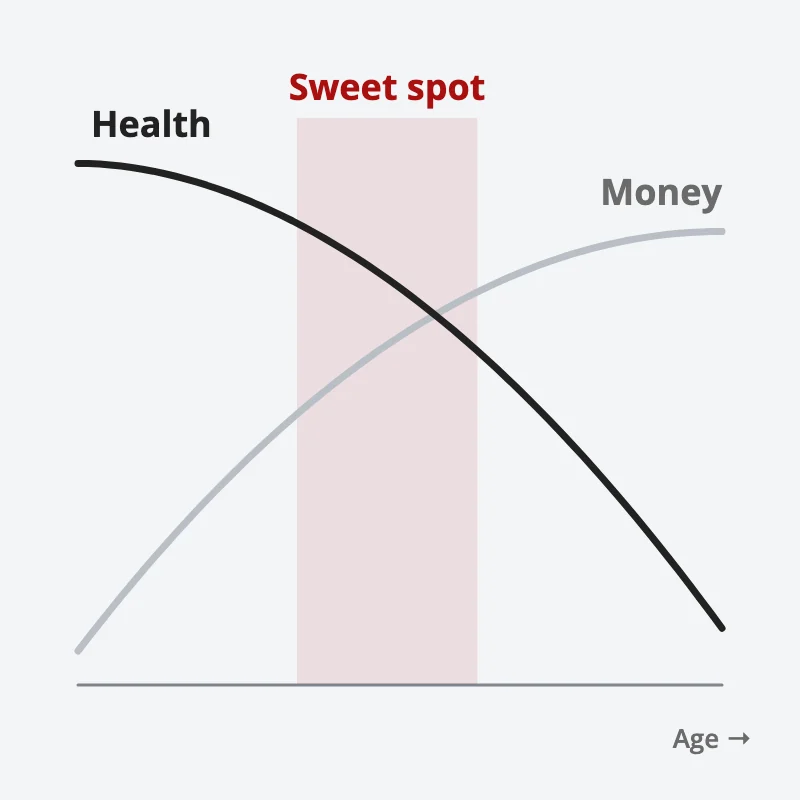
There is a sweet spot in everyone’s lifetime when they can most enjoy the fruits of their wealth. The problem is that people keep saving well past that point. That is the senselessness of indefinitely delayed gratification.

When you are young, Perkins argues you should focus more on building good experiences than on earning money, because your earning power will rise over time anyway. Your dollar earned per unit of time goes up as you get older, so the cheapest time (in life-energy terms) to buy experiences is when you are young.

The constraint shifts with age, and the research bears it out. People asked what stopped them from taking a trip gave different answers by age group:

Age groupWhat constrains them most
Under 60Time and money
75 and olderHealth problems

That is the whole argument in one table. When you are young you have health but not money. When you are old you have money but not health. Dying with zero is not only about money. It is about time. Start thinking about how you use your limited time, your life energy, and you are well on your way to living the fullest life you can.

Over a lifetime, health falls while money rises; the sweet spot for spending on experiences is the stretch in between where you have both
Young you have health, old you have money, so enjoy experiences while you have both.

What are “time buckets” and how are they different from a bucket list?

A bucket list is a flat list of things to do before you die. Time buckets are the same idea, but sorted into the life decades when each experience can actually be enjoyed.

The reason this matters: your declining health and narrowing interests mean your list of doable activities shrinks as you age. So your spending rate should not stay constant. If you want to die with zero and make the most of whatever health you have at each point, you will need to spend more in your fifties than your sixties, and more in your sixties than your seventies, let alone your eighties and nineties.

Perkins makes the trade-off vivid. Many people will spend tens or hundreds of thousands of dollars to prolong life by a few weeks. That is money they gave up years, even decades, of healthy and vibrant life to earn, traded for a few extra weeks when they are sick and immobile. The key is to strike the balance between spending on the present (on what you actually value) and saving smartly for the future.

How do you actually plan to die with zero?

It is simpler than it sounds. Estimate the maximum age you might live to, then work out how much cash you will need to get there.

Do note that your expenses (except medical) will be much lower as you age. They can be covered with a combination of annuities, insurance, savings, plus a buffer. And for nearly anything you might worry about in your future, there is an insurance product designed to protect against it.

The result of this approach: your net worth should peak earlier, in your 50s or 60s, instead of peaking on the day you die. Which means you can retire earlier, because you do not need to hoard as much.

Why give your money away while you are still alive?

Because giving it after you die leaves the timing, the amount, and even the recipient to chance.

Most people wait until they pass away to give wealth to their kids or to charity. But why not give it to your children when they can make the most of it?

Perkins ran an informal Twitter poll asking people the ideal age to receive an inheritance windfall. Of more than 3,500 voters, the answers were telling:

Ideal age to inheritShare of votes
18 to 2512%
26 to 35More than half (the clear winner)
36 to 4529%
46 or older6%

Why does 26 to 35 win? Some pointed to the time value of money and compound interest: the earlier you get it, the more it can grow. Others pointed to the immaturity problem of getting it too young. Perkins adds a third factor, health: you always get more value out of money before your health declines. The 26-to-35 range combines all three. Old enough to be trusted with money, young enough to fully enjoy it.

The alternative, waiting until you die, is what Perkins calls the three Rs: giving random amounts of money, at a random time, to random people (because who knows which of your heirs will still be alive when you go?).

What do you actually want to give your kids?

Memories, not just money.

Just as you are trying to form memories of time with your kids, it makes sense to want them to form memories of you. Both sets of memories pay a memory dividend, one stream for you and one for them. So the real question is: how do you want your kids to remember you?

Your kids only have their childhood for a certain number of years. What experiences do you want to have with them, or rather, what experiences do you want them to have with you? Does each extra hour of work really serve your legacy, or quietly deplete it?

My views: why am I not working harder?

I get this question often. People wonder why I am not working harder, trading more, scaling the business, making more money.

My question back to them is, “what is the point of making more money?”

So I choose to spend my time doing the things I enjoy. Playing sports. Hanging out with my friends and family. Reading (2000+ books and counting). Travelling around the world (70+ countries to date).

And I look forward to creating more memories and experiences across the next two-thirds of my life.

Money is the easy part to grow. Time is the part you cannot earn back.

FAQ

What is the main idea of “Die with Zero” by Bill Perkins?
The main idea is to convert your money into life experiences before you run out of time and health to enjoy them, rather than dying with a large unspent pile. Money you never spend represents wasted hours of your life energy.

Does “die with zero” mean spending all your money recklessly?
No. It means planning so your net worth peaks in your 50s or 60s and is drawn down deliberately over your remaining years, using annuities, insurance, savings, and a buffer to cover later-life expenses. It is intentional spending, not reckless spending.

What is the “memory dividend”?
The memory dividend is the ongoing happiness you keep getting from recalling and re-sharing a past experience. Unlike material things that depreciate, experiences gain value over time because you draw on the memory again and again.

What is the best age to give your children their inheritance?
In Perkins’ poll of 3,500+ people, the clear winner was ages 26 to 35: old enough to be trusted with money, young enough to enjoy it and let it compound. Giving while you are alive also lets you control the amount, timing, and recipient instead of leaving it to chance.

What are time buckets in “Die with Zero”?
Time buckets are your bucket list sorted into the decades of life when each experience can actually be enjoyed, since health and interests narrow with age. They help you schedule experiences for the right age rather than indefinitely postponing them.


If this resonated, the next book worth your time is Morgan Housel’s “The Psychology of Money,” which sits right next to this one on the same shelf. And if you want my full reading list, see the pillar below.

For more book summaries and recommendations, read the pillar: Best Investing and Trading Books of All Time.


About the author. Spencer Li is The 15-Minute Trader and the founder of Synapse Trading. He is a Certified Financial Technician (CFTe) with 15+ years of trading, run from 70+ countries. He holds a B.Acc and B.BM from SMU. Every trade he takes is public, dated, losses left in. He teaches rules-based swing trading in 15 minutes a day, one system for any market. He has also read 2000+ books and travelled to 70+ countries.

Education, not financial advice. Synapse Trading is not licensed by MAS to advise on investment products. Trading carries risk of loss; past performance is not indicative of future results.


Related

Best Investing and Trading Books of All Time (pillar) · The Psychology of Money (book summary) · How I Retired Early Through Trading

by Spencer Li
https://synapsetrading.com/wp-content/uploads/2026/10/die-with-zero-card.webp 630 1200 Spencer Li https://synapsetrading.com/wp-content/uploads/2026/10/synapse-logo-horizontal-light.png Spencer Li2020-09-12 02:35:582026-08-20 12:11:49Book Summary: Die with Zero (How to Maximise Your Life)
Spencer Li

Technical Analysis (TA) vs. Fundamental Analysis (FA)

Trading Foundations
Technical or fundamental analysis? - analysis


For many new traders, one of the most common question I get is regarding the method of analysis to use, and it usually boils down to technical analysis vs fundamental analysis.

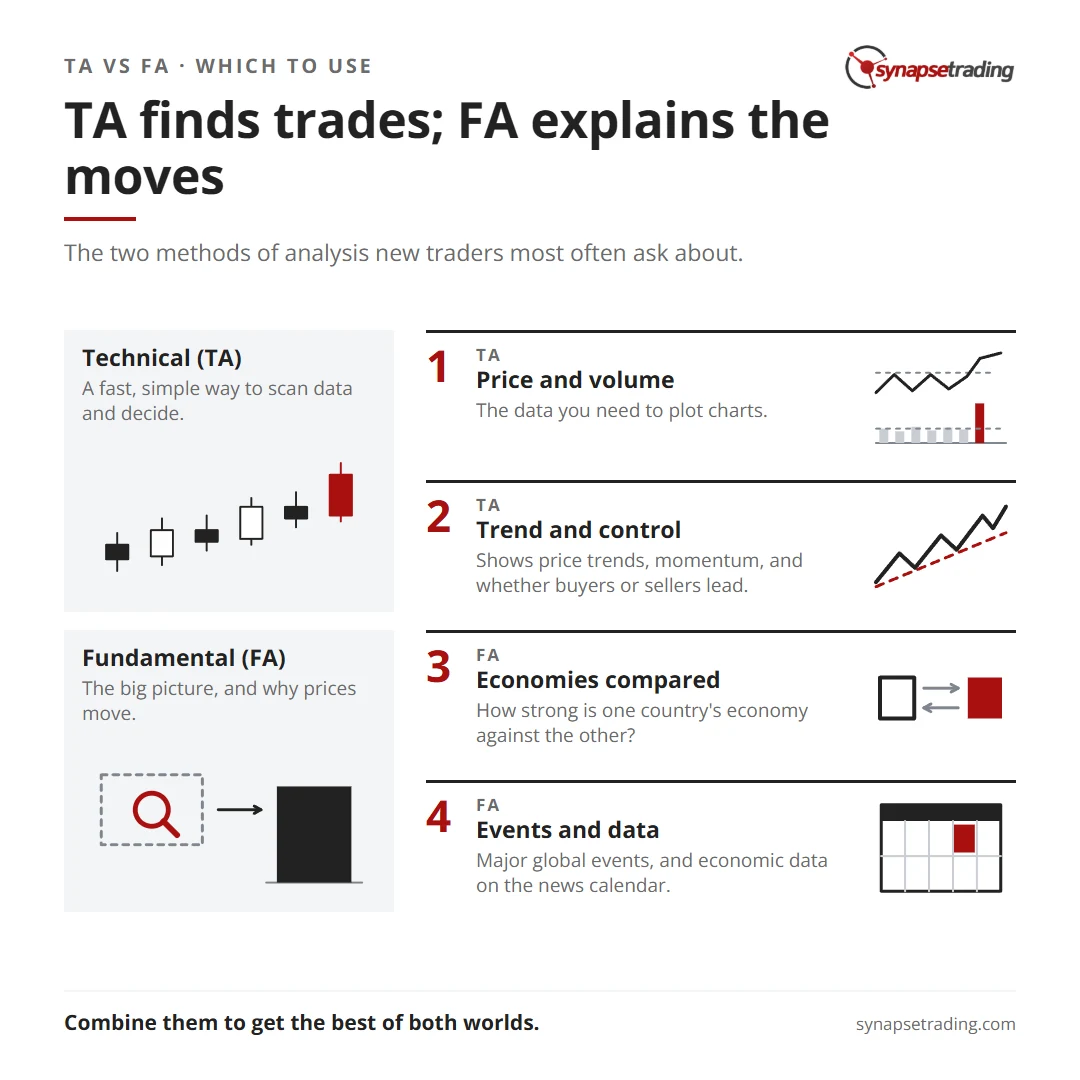
TA finds trades; FA explains the moves. Summary card for the post: Technical Analysis (TA) vs. Fundamental Analysis (FA).

Technical Analysis (TA) gives you a fast and simple way to scan through data, find good opportunities, and make a trading decision.

Fundamental Analysis (FA) helps you understand the big picture and why prices are moving in certain ways.

Personally, I find that the best approach is to combine them to get the best of both worlds.


thumbnail beginner guide to trading and TA

If you would like to learn how to get started in trading, also check out: “The Beginner’s Guide to Trading & Technical Analysis”


by Spencer Li
https://synapsetrading.com/wp-content/uploads/2026/10/technical-analysis-fundamental-analysis-card.webp 630 1200 Spencer Li https://synapsetrading.com/wp-content/uploads/2026/10/synapse-logo-horizontal-light.png Spencer Li2018-10-04 07:13:162026-07-03 20:08:02Technical Analysis (TA) vs. Fundamental Analysis (FA)
Spencer Li

Dangerous Myths About Trading that Could be Affecting Your Profitability

Trading Foundations
Dangerous myths about trading - trading basics

If you listen frequently to the mainstream media, or take advice from friends and family who are not traders themselves, they might give some good-intentioned but ill-informed advice, which could harm your trading results.

Such dangerous myths about trading might seem to be “common knowledge” because they keep getting repeated frequently, but have you stopped to consider whether they are really true?

Here are some common myths:

  • Trading is very risky because you can lose all your capital
  • Forex is more risky than stocks
  • Leverage increases your risk
  • You need a lot of capital to start trading
  • You need to trade very often if you want to make more money
  • You need to monitor prices and charts 24/7
  • Brokers are out to hunt your stoploss

Do these sound familiar?

Today, I will tackle 3 of the most common myths.

 
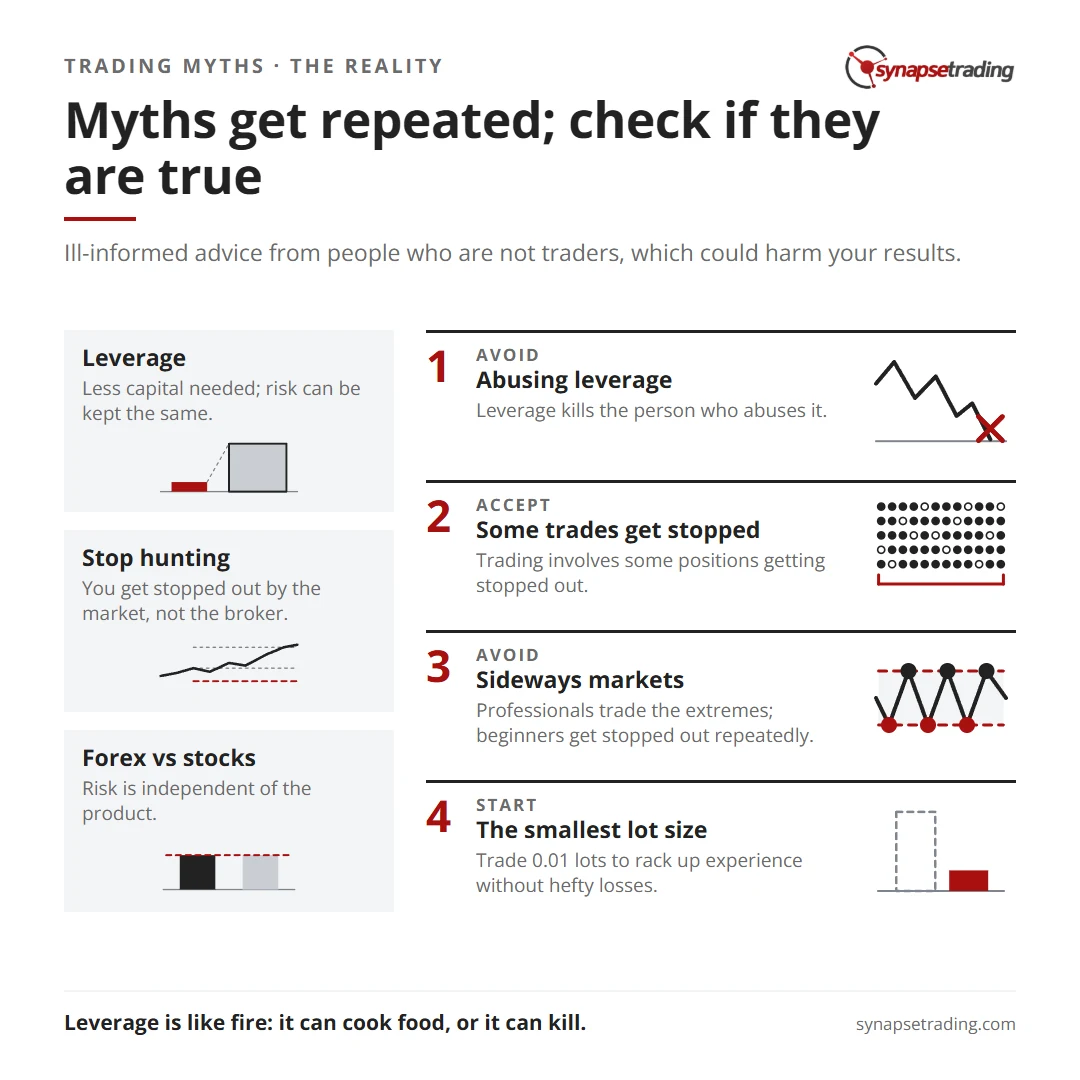
Myths get repeated; check if they are true. Summary card for the post: Dangerous Myths About Trading that Could be Affecting Your Profitability.

MYTH #1: TRADING WITH LEVERAGE INCREASES YOUR RISK

(Reality: Trading with leverage reduces capital required, but risk can be kept the same.)

The media handles the idea of leverage very poorly, because it often sensationalizes the trader who over-leverages and blows everything.

The idea is simple: I have $100, and I leverage so that I can trade $500 or $1000 of stock/forex. I make one bad trade, and I’m wiped out.

This is true for the person without proper risk-management. After all, the temptation of leverage is to dump all your money into one trade, max out the leverage, and hopefully you make 500% on one trade and can call it a day. The truth is, these lucky trades do happen in reality. Eventually though, the trader with his newfound wealth (and greed), piles his money into another trade, and loses everything.

Leverage kills the person who abuses it. It’s like fire; it can cook food for people, or it can kill people.

Leverage, in practice, actually keeps you disciplined. In forex trading, using leverage is actually a standard practice. When you use leverage, you are actually committing less margin to a trade, and you can get comfortable with trading by committing as little margin as possible. Here’s what I mean:

For example, suppose you have a stop loss of -$10 and a target profit of +$30, and you make a trade of unknown size X.

1:100 leverage – Margin committed for X lots = $102.50 (I’m making this up)

1:500 leverage – Margin committed for X lots = $20.50 (five times smaller)

In the case of higher leverage, you stay comfortable because even though the stop loss is -$10, you see that the margin committed on your account is only $20.50. This allows you to not have to see the wild fluctuations in margin requirement, and keep your trading size small.

Also, trading with higher leverage allows you to take multiple positions with little capital. With as little as $500, you can take 3-5 forex positions with leverage, risking anywhere from $5 to $20 or so for each trade. This is a great way to start for aspiring forex traders.


MYTH #2: BROKERS ARE OUT TO HIT YOUR STOP LOSSES

(Reality: You get stopped out because of the market, not because of the broker.)

Many people who have been trading for some time get convinced that the broker wants them to be stopped out of their positions. I’ve heard of this and seen it happen: the trade hits your stop loss, then immediately goes in your favour and flies in the direction you want, and then you beat yourself up and say “I was supposed to make $XYZ on this trade but I got stopped out because of the stupid broker!”

The truth is, the broker has better things to do than to keep hunting the stoploss on your account.

At least, this is for brokers who want to remain in business over the long-term. How do brokers make money? They make money only if you keep trading. Why would any broker want you to stop trading? They would actually want you to be profitable, because for every trade you make, they get a small cut from the spread (also known as the bid-ask spread). Essentially, they want you to love trading and trade so much and so often that they get large revenues from spreads.

Why in the world would the broker want to stop you out?The reason why we get stopped out, is because we are bad traders.

Professionals are buying or selling exactly where your stop loss is placed, because they know that the average investor would place their stop loss there.

The solution to not getting stopped out, is to first acknowledge that trading involves some positions getting stopped out. Being right 40-50% of the time is already sufficient for you to be profitable, so don’t be surprised if half your positions get stopped out.

One example is a sideways market. Beginners love to enter on sideways markets because it presents many signals in both directions. However, professionals are buying and selling at the extremes of the sideways markets, causing beginners to get stopped out repeatedly, while professionals make money repeatedly.Remember that there is another trader on the other side who is filling your order; if you are losing money, it is because someone else is taking money from your account, and putting it in their account.

MYTH #3: FOREX IS MORE RISKY THAN STOCKS

(Reality: Risk is independent on the product, and forex actually requires less capital.)

In the forex market, you can ‘get a feel of the game’ by risking a few dollars per trade. By trading the smallest lot size (0.01 lots), you can easily make many trades and rack up trading experience by “trading live” without incurring hefty losses. By learning to make many decisions and experiencing all the different conditions of the market, you would become seasoned enough to trade a bigger size, and fine-tune your own trading strategy to become profitable in the long-run.

Many traders discover they have certain characteristics about themselves that hinder success. In trading a ‘live’ account with a small sum of money, they are putting in some skin in the game, and getting used to the ups and downs of their account. The best part about forex is that there are no fixed commission charges (stocks tend to have a fixed minimum fee regardless of trade size), making the ‘tuition’ fees a lot less than trading in stocks.

Another great thing about forex is that thee market is open 24/7 on weekdays, so you can decide when to trade based on your schedule. That helps people who have busy working schedules: trading in the middle of the night, or during lunch, on a daily basis, works out to a trading schedule that accommodates your lifestyle needs.

Lastly, with regards to price movements, stocks tend to see bigger gaps between days. Here’s what I mean:


forexForex pairs/currency futures tend to have less gaps between bars; bars close and open at roughly the same price.


stockMost stocks have gaps between the candlesticks/bars, due to the opening and closing of the market every day.


Gaps make the analysis a little more complex, because you have to take into account the size of the gap along with the actual candlestick printed on the chart. Forex allows you to employ technical analysis more simply, and learn how to read price action without the distraction of having to figure out what the gap means.


thumbnail beginner guide to trading and TA

If you would like to learn how to get started in trading, also check out: “The Beginner’s Guide to Trading & Technical Analysis”

by Spencer Li
https://synapsetrading.com/wp-content/uploads/2026/10/dangerous-myths-trading-card.webp 630 1200 Spencer Li https://synapsetrading.com/wp-content/uploads/2026/10/synapse-logo-horizontal-light.png Spencer Li2017-02-22 16:34:232026-09-30 12:04:49Dangerous Myths About Trading that Could be Affecting Your Profitability
Page 10 of 12«‹89101112›»

Free checklist

The 15-Minute Swing Trader’s Checklist

The daily and weekly routine I use to find, manage and review trades in about 15 minutes a day, on the record since 2014.

Get the free checklist

Topics

  • Trading foundations
  • Technical analysis
  • Strategies and systems
  • Risk and money
  • Trading psychology
  • Markets and products

Synapse Trading

Swing trading for busy professionals, in 15 minutes a day.

Start free

Learn

  • Start here
  • Free trading guides
  • Blog
  • Tools and resources

Programs

  • Trading Mastery Program
  • Daily trading signals
  • Student results
  • Public trade log

Company

  • About
  • Contact me
  • Partnerships
  • Disclaimer
  • Privacy policy
  • Terms & Conditions

Synapse Trading Pte Ltd
Registration No. 201316168H
WhatsApp +65-8897-1204
info@synapsetrading.com

Contact Us

Synapse Trading Pte Ltd
Registration No. 201316168H

Whatsapp: +65-8897-1204
Telegram: @iamrecneps
Email: info@synapsetrading.com

Links

Disclaimer
Privacy policy
Terms & Conditions
Contact us
Partnerships

© 2012-2026 Synapse Trading | All rights reserved. Educational content only, not personalised financial advice. Trading carries risk, including loss of capital. Past performance is not indicative of future results. Synapse Trading is not licensed or regulated by MAS.
  • Link to Facebook
  • Link to X
  • Link to Instagram
  • Link to Youtube
  • Link to LinkedIn
  • Link to Mail
Scroll to top Scroll to top Scroll to top