

Trading Self-Reflection: The Art of Losing
Want the daily routine? Get the free 15-Minute Swing Trader’s Checklist. Get it free →
Although I ended with a small loss at the end of the day, I felt that this day was a victory. Before you think that I am crazy, let me explain.
Because of the probabilistic nature of trading, it is necessary to have losing trades. Depending on the style of trading, it is highly likely to have losing days as well.
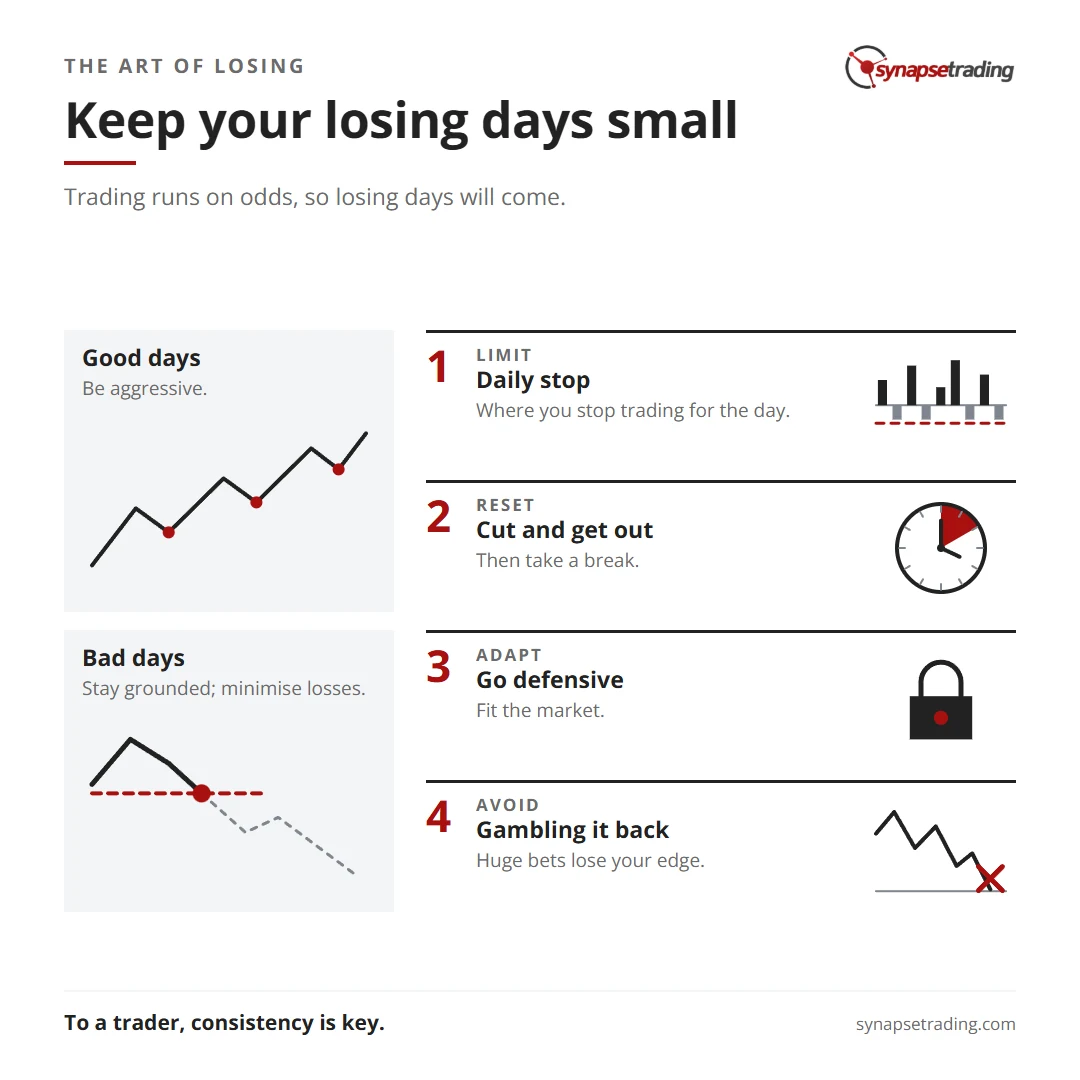
The skill of a trader lies not just in being aggressive and swinging for home runs on good days, but also in being able to stay emotionally grounded and minimise losses on bad days. By bad days, I mean those days which the market does not match your trading style.
There were a couple of times where my setups, timing and entry were flawless, but I lacked the conviction to hold onto my positions, and I ended up only taking a small profit, after which the price continued to run for another 3-5 times of the small profit I took.
My loss for the day came very close to my daily stop, the point at which I would have stopped trading for the day. But I managed to recalibrate my mental state by cutting losses, getting out, and taking a break. When I came back, I switched to a defensive trading style to adopt to the market conditions, and managed to cut my loss to under a third of that daily stop.
At the point of a large loss, I have seen many traders self-destruct by taking huge gambles to “make back” their losses. This becomes irrational trading, and you no longer have the edge. It becomes gambling. If you are wondering what the difference is, you can read this article about trading and gambling.
To a trader, consistency is key. By consistency, I mean consistency in analysis ability, as well as mental stability. A good intraday trader typically has 4 winning days out of 5 trading days. In addition, the winning days should be a lot larger than the losing days.
Hence, keeping your losing days small is also an essential skill.
About the author. Spencer Li is The 15-Minute Trader and the founder of Synapse Trading. He is a Certified Financial Technician (CFTe) with 15+ years of trading, run from 70+ countries. He holds a B.Acc and B.BM from SMU. Every trade he takes is public, dated, losses left in. He teaches rules-based swing trading in 15 minutes a day, one system for any market.
Education, not financial advice. Synapse Trading is not licensed by MAS to advise on investment products. Trading carries risk of loss; past performance is not indicative of future results.
Want the daily routine? Enter your email for the free 15-Minute Swing Trader's Checklist.
Free 5-page PDF, then occasional trading emails. Education only, not financial advice. Unsubscribe anytime. Kit stores your email in the US: see our privacy policy.
Want to learn the full method? The Trading Mastery Program teaches the 4 strategies I have traded since 2011. It suits beginners and experienced traders.
Rather follow the trades as they happen? Daily Trading Signals is our Telegram channel: my trade ideas with entry, stop and exit, and every trade is public.
Questions about this post? Ask in the free Telegram channel →
Educational content only, not personalised financial advice. Trading carries risk, including loss of capital. Past performance is not indicative of future results. Synapse Trading is not licensed or regulated by MAS.


Trackbacks & Pingbacks
[…] losing trades and keeping a trading journal. The trading psychology guide covers the rest, and the art of losing is worth reading on a bad […]
Comments are closed.