

Anchoring Bias – I Refuse to Change My Mind!
Join our Telegram channel for more market analysis & trading tips: t.me/synapsetrading
Table of Contents
What Is Anchoring Bias in Trading (and How to Beat It)?
Last updated: 14 June 2026 · By Spencer Li, CFTe
Anchoring bias is the tendency to lean too hard on the first number you see, and then judge everything after it against that number instead of against reality. In trading, the anchor is usually your entry price, a target price you had in mind, or the direction of the early trend. Once it is set, you read every new piece of information through that anchor, and your decisions drift away from what the chart is actually telling you. It shows up in two predictable ways: you refuse to cut a loss until price crawls back to your entry, and you refuse to take a good profit because you anchored to a better one you missed. The fix is not a clever indicator. It is a habit: evaluate the trade on its current merits, as if you had no position, whether you are in, out, up, or down.
Here is where the anchor comes from, the exact ways it costs you money, and how to trade as if you never saw the number.
What is anchoring bias?
Anchoring (the full name is “anchoring and adjustment”) is a mental shortcut, a heuristic (a rule of thumb the brain uses to judge probabilities quickly). You take a starting number, the anchor, and you adjust away from it. The problem is that people under-adjust. They stay too close to the anchor even when it has nothing to do with the right answer.
A rational trader treats new information on its own terms. The entry price is a sunk fact. The market does not know or care what you paid. But a trader under anchoring bias reads the same new information through a warped lens, placing weight on a price level that is, statistically, arbitrary. It feels meaningful only because it is your number.
That is the whole trap. The anchor is psychological, not market-driven. The market is pricing the asset right now. You are pricing your own history.
The three anchors that catch traders
In trading the anchor almost always comes from one of three places.
| Anchor | What it sounds like | How it bites |
|---|---|---|
| Your entry price | “I’ll get out when it comes back to where I bought.” | You hold a losing trade hostage to your cost basis and refuse to cut it. |
| A target / better price you missed | “It was 105 an hour ago, I’m not selling at 102.” | You refuse a perfectly good exit because you anchored to a price that is gone. |
| The initial trend | “It’s been going up for weeks, this dip is nothing.” | You are slow to see a reversal, especially when you are on the wrong side of it. |
Notice that all three are about your reference point, not the market’s. None of them is information about the asset. They are information about you.
How will this affect your trading?
Two failure modes, and you have probably done both.
You won’t cut a loss. You anchored to your entry. So instead of asking “is this trade still valid?”, you ask “is it back to break-even yet?”. The position keeps bleeding while you wait for a number that the market has no reason to revisit. The trend may have reversed against you, and because you are anchored to the old direction, you are slow to admit it and slow to flip. That reluctance to change your view is the anchor doing its work.
You won’t settle for less. Price ran to a level, you hesitated, and now it has pulled back. The exit in front of you is genuinely good. But you anchored to the better price you missed, so you reject the good one and hold out for a number that may never come back. A worse exit, or a loss, often follows.
Both mistakes share one root. You are trading against your own anchor instead of trading the chart.
How to overcome anchoring bias
The cure is a single discipline, applied every time: be flexible and objective. Evaluate the price and the setup on their current merits, not against the number stuck in your head.
A few habits that make that real:
- Run the blank-slate test. Ask: “If I had no position and saw this chart fresh right now, would I buy, sell, or stand aside?” If the honest answer differs from what you are doing, your anchor is steering, not your analysis.
- Decide your exit before you enter, in market terms. Set a stop based on structure (a level where the idea is wrong), not on your entry price. A stop placed by the chart cannot be anchored to your cost.
- Treat your entry as a sunk cost. What you paid is irrelevant to whether the trade is still worth holding. The market never agreed to give it back.
- Write down why you are in the trade. When the reason no longer holds, exit, regardless of where price sits relative to your entry. This pre-commitment is the single best defence against anchoring.
- Separate the decision to exit from the wish to be right. Refusing to take a worse-than-hoped profit is vanity dressed up as discipline. A good exit you take beats a perfect exit you imagine.
The thread running through all of these: act on the price the market is showing you now, not the price you are emotionally attached to.
Where the human edge comes in
A trading system can give you the entry, the stop, and the exit rule. What it cannot do is make you take the stop when your gut is screaming “wait for break-even”. Anchoring is not a flaw in your strategy. It is a flaw in the operator. That is why psychology is one of the Five Edges that stay with the human. The machine has no entry price to fall in love with. You do, and beating that is the work.
FAQ
What is anchoring bias in trading?
Anchoring bias is the tendency to fixate on a reference price (usually your entry, a target you missed, or the early trend direction) and judge new information against that number instead of against current market conditions. It leads traders to hold losers too long and exit winners on the wrong terms.
What is an example of anchoring bias?
A trader buys a stock at 100, it falls to 90, and instead of asking whether the trade is still valid, the trader refuses to sell “until it gets back to 100”. The entry price of 100 is the anchor, and it has no bearing on what the stock is worth now.
Why is anchoring bias dangerous for traders?
Because it overrides your stop-loss discipline. Anchored to your entry, you delay cutting a loss; anchored to a price you missed, you reject a good profit. Both errors push your decisions away from the rational norm and toward your own emotional reference point.
How do you overcome anchoring bias?
Treat your entry price as a sunk cost, set stops and targets from chart structure rather than from what you paid, and run a blank-slate test: would you take this same position if you saw the chart fresh, with no position on? Trade the chart in front of you, not the number in your head.
Is anchoring bias the same as loss aversion?
No, though they often work together. Anchoring is fixating on a reference number; loss aversion is feeling losses more painfully than equivalent gains. Anchoring to your entry price makes loss aversion worse, because break-even becomes the line you irrationally defend.
So, which anchor catches you most often: the entry price, the one that got away, or the old trend? Naming it is half the battle. Let me know in the comments.
For the full set of mental traps that quietly drain trading accounts, read the pillar: The Trader’s Guide to Trading Psychology and Behavioral Finance.
Want a routine that takes the emotion out of it? Grab the free 15-Minute Swing Trading Starter Kit. It’s the exact once-a-day process I use to set entries, stops, and exits in advance, so the anchor never gets a vote.
About the author. Spencer Li is the founder of Synapse Trading and a Certified Financial Technician (CFTe) with 15 years of trading across stocks, forex, crypto, commodities, and bonds. His trade log is public, 404 trades, losses left in. He teaches low-risk swing trading in 15 minutes a day, one system for any market.
Education, not financial advice. Synapse Trading is not licensed by MAS to advise on investment products. Trading carries risk of loss; past performance is not indicative of future results.
Related
Trader’s Guide to Trading Psychology (pillar) · Loss aversion in trading · How to cut your losses · Confirmation bias in trading
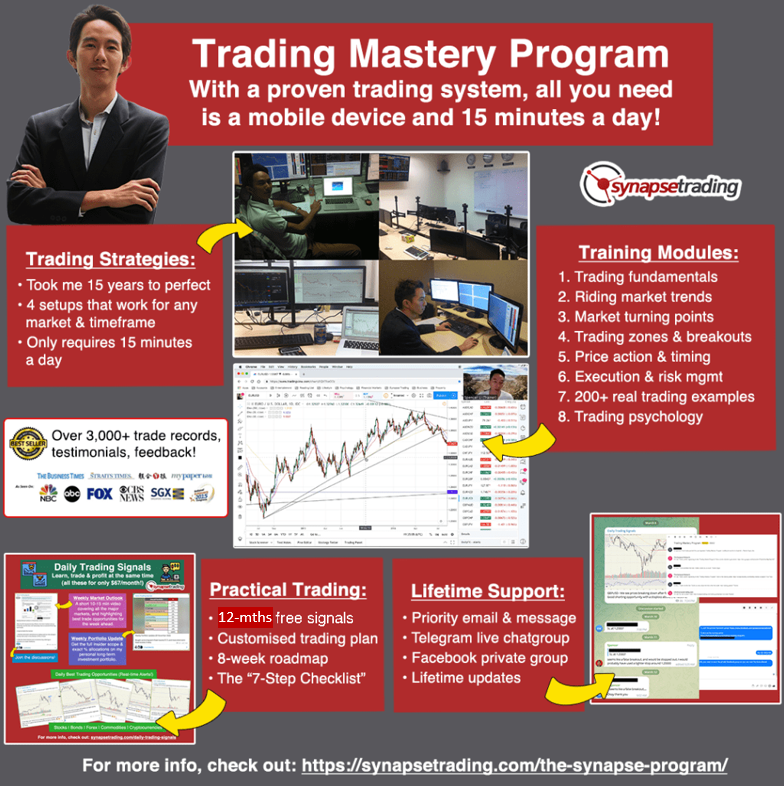 Our flagship mentoring program is suitable for both beginners and advanced traders, covering the 4 strategies which I used over the past 15 years to build up my 7-figure personal trading portfolio.
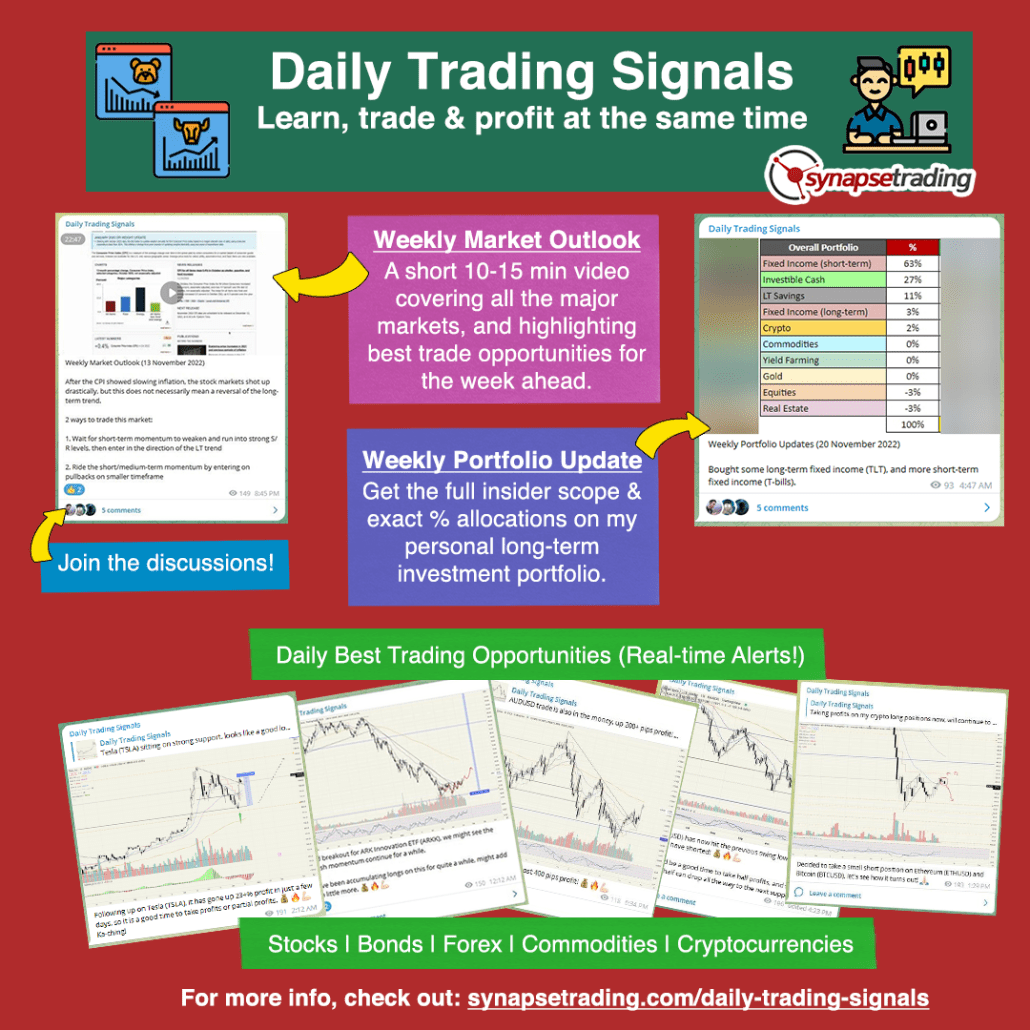 If you're looking for the best trading opportunities every day across various markets, and don't want to spend hours doing the research yourself, check out our private Telegram channel!


Leave a Reply
Want to join the discussion?Feel free to contribute!