

What is the Difference between Stocks & Forex?
Want the daily routine? Get the free 15-Minute Swing Trader’s Checklist. Get it free →
When comparing forex and the stock market, the most significant difference lies in what you are trading. Forex, or foreign exchange, is a market for buying and selling currencies, whereas the stock market deals in shares, representing ownership in a company. Your choice between trading currencies or stocks should primarily depend on your interest in the specific asset, but other factors also come into play.
Market Trading Hours
Market hours can significantly influence your trading approach and the time you need to monitor the markets.
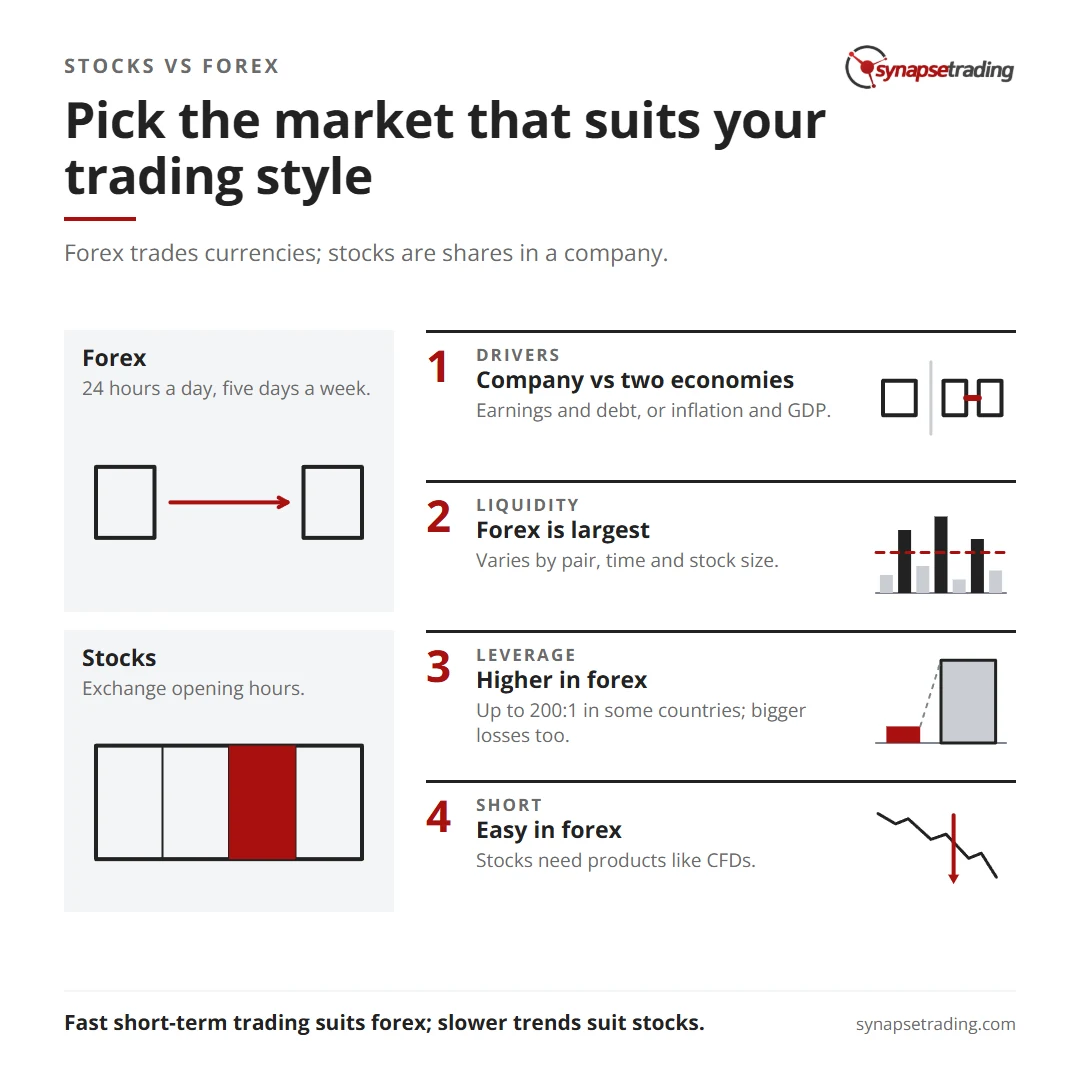
The forex market operates globally, allowing trading 24 hours a day, five days a week. This constant availability offers numerous trading opportunities but also carries the risk of market movements occurring while you are not actively monitoring it. A robust risk management strategy, including the use of stops and limits, is essential to protect your trades from unnecessary losses.
The best times to trade forex are when the market is most active, typically during the overlap of two trading sessions. For example, the GBP/USD pair sees increased activity when London and New York sessions overlap between 12 pm to 4 pm (London time), offering higher liquidity, faster transactions, and potentially lower spreads.
In contrast, share trading is generally limited to the specific opening hours of the stock exchange where the shares are listed. However, many exchanges now offer extended trading hours, allowing traders to act on news events even when the market is closed.
Market Influences
Another key difference between forex and stock trading is the factors that move market prices. While both markets are driven by supply and demand, the specifics vary.
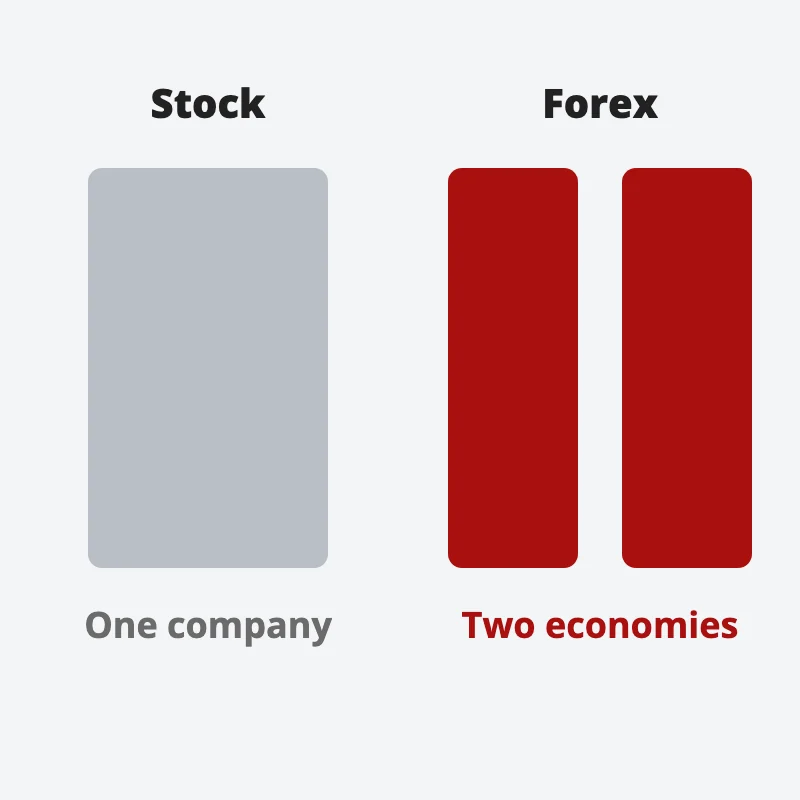
In stock trading, you focus on factors directly impacting a particular company, such as its debt levels, cash flows, earnings, and broader sector health. Economic data, news reports, and overall market sentiment also play significant roles.
Forex trading, on the other hand, involves a broader set of influences, as you must consider the macroeconomic factors of multiple countries. This includes analyzing unemployment rates, inflation, GDP, and political events in the countries whose currencies you are trading. Since forex involves buying one currency while selling another, understanding the performance of both economies is crucial.
Liquidity
Liquidity, or the ease with which an asset can be bought or sold, is another important factor.
Forex is the largest financial market in the world, with extremely high liquidity, frequently seeing daily turnovers in the trillions of dollars. However, liquidity can vary depending on the currency pair and the time of day, with major pairs like EUR/USD generally being the most liquid.
The stock market, while still highly liquid, sees fewer daily trades compared to forex. Blue-chip stocks like Apple, Microsoft, and Facebook are usually the most liquid, with a large number of buyers and sellers available. However, liquidity can decrease significantly when dealing with less popular or smaller-cap stocks.
Volatility
Volatility measures the likelihood of significant and unforeseen price changes in a market.
Forex markets are known for their high volatility due to the ease of trading and the large volume of transactions. While forex prices often trade within small ranges, they can change rapidly, especially in response to political, economic, or social events. Traders must stay informed about global events to manage the risks associated with this volatility.
The stock market tends to have more stable price patterns that can be tracked over time, though it is not immune to volatility, particularly during times of political or economic uncertainty. For instance, the Dow Jones Industrial Average experienced sharp declines in March 2018 due to trade tensions between the U.S. and China.
Trading in volatile markets can present opportunities for profit but also comes with increased risks, necessitating careful management to avoid unnecessary losses.
Leverage
Leverage allows traders to gain greater exposure to the market with a smaller amount of capital, which is a common feature in both forex and stock trading.
Leverage is more frequently associated with forex trading, often with much higher ratios, sometimes up to 200:1 in certain countries. While leverage can amplify returns, it also increases the potential for significant losses, making it a double-edged sword.
Regardless of the market, understanding your exposure and the associated risks is essential when trading on leverage.
Going Long or Short
When choosing between forex and the stock market, it’s important to consider whether you can short-sell – a strategy that involves profiting from a market’s decline.
Forex trading inherently involves shorting one currency while buying another, giving traders easy access to falling markets.
In stock trading, traditionally, investors could only take long positions, benefiting from a rise in a company’s stock value. However, with the advent of derivative products like CFDs (Contracts for Difference), traders can now go long or short on stocks, enabling them to capitalize on market movements in either direction.
Concluding Thoughts
Ultimately, the decision to trade forex or stocks depends on your personal preferences, risk tolerance, and trading style.
If you prefer a fast-paced environment with ample short-term trading opportunities, forex might be the better choice, especially for day traders, scalp traders, or swing traders. On the other hand, if you’re interested in short to mid-term trends with potentially lower volatility, the stock market may be more suitable.
Understanding the nuances of each market and aligning them with your financial goals will help you make an informed decision.
Want the daily routine? Enter your email for the free 15-Minute Swing Trader's Checklist.
Free 5-page PDF, then occasional trading emails. Education only, not financial advice. Unsubscribe anytime. Kit stores your email in the US: see our privacy policy.
Want to learn the full method? The Trading Mastery Program teaches the 4 strategies I have traded since 2011. It suits beginners and experienced traders.
Rather follow the trades as they happen? Daily Trading Signals is our Telegram channel: my trade ideas with entry, stop and exit, and every trade is public.
Questions about this post? Ask in the free Telegram channel →
Educational content only, not personalised financial advice. Trading carries risk, including loss of capital. Past performance is not indicative of future results. Synapse Trading is not licensed or regulated by MAS.

