

The Yen Carry Trade Unwinding, Explained: How a Cheap Loan in Tokyo Moved Every Market
Want the daily routine? Get the free 15-Minute Swing Trader’s Checklist. Get it free →
By Spencer Li, CFTe · Last updated: 26 October 2026
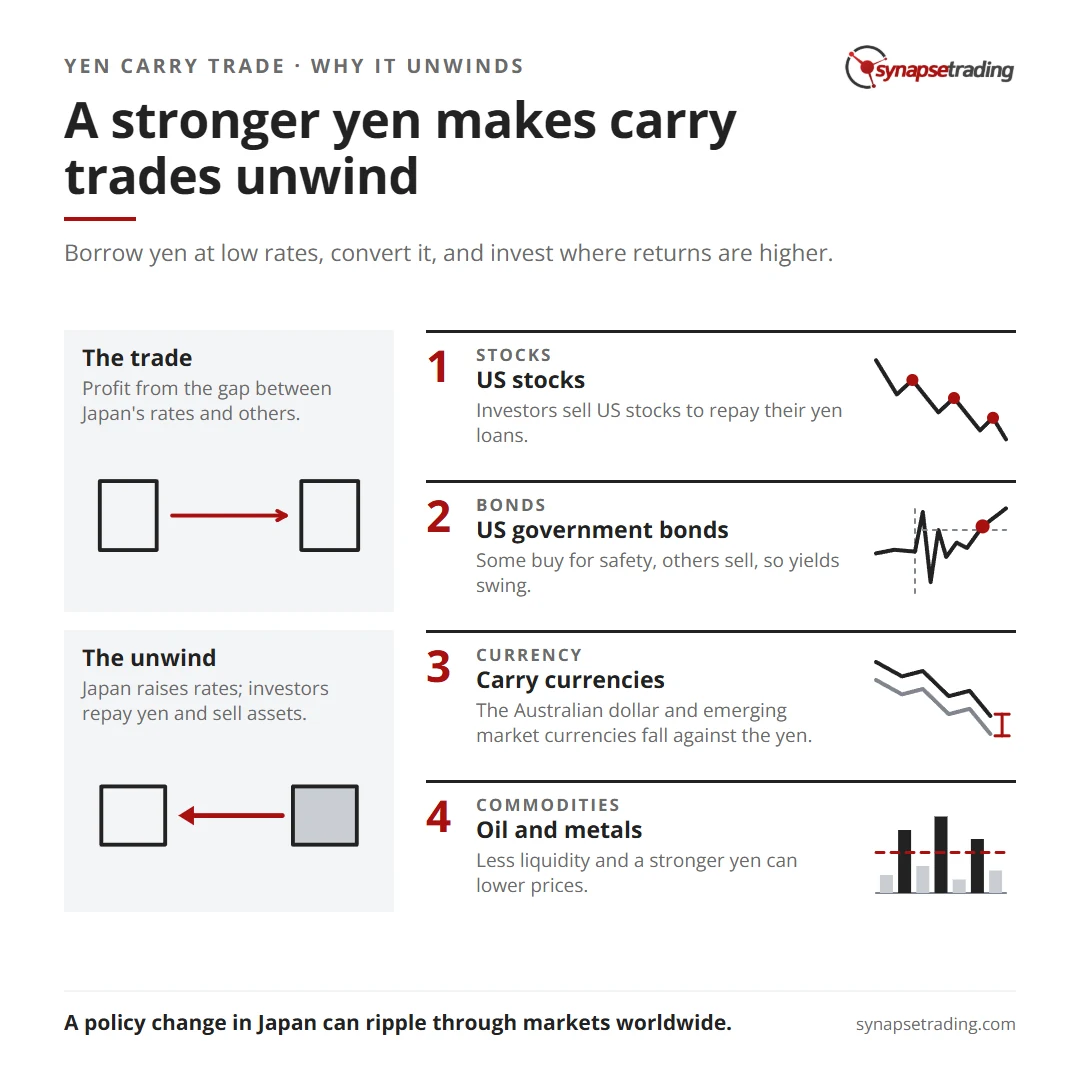
The yen carry trade means borrowing Japanese yen at a very low interest rate, investing the money somewhere that pays more, and keeping the difference. It unwinds when that difference shrinks or the yen gets stronger. Both make the yen loans dearer to repay, so investors sell what they bought, buy back yen, and push the yen up even further.
The best-known recent unwind came in the first week of August 2024, and this post first went up on 5 August 2024, right in the middle of it. In the Federal Reserve’s daily data, the US dollar bought 161.73 yen on 10 July 2024 and only 143.95 yen on 5 August. That is a yen gain of about 12% in under four weeks, which for a currency of that size is quite violent.
The story below is the 2024 one. Every “now” figure is dated, as at 26 October 2026.
What is the yen carry trade?
If you have ever changed money before a holiday, you already understand half of it. The other half is a loan.
Say a bank in Tokyo lends you 15 million yen at 0.25% a year, roughly where Japan’s policy rate sat in August 2024. At 150 yen to the dollar, you change it into USD 100,000 and buy a US government bond paying 5%. These are round, made-up numbers.
Interest you earn: USD 5,000 a year
Interest you owe: 37,500 yen, about USD 250
So you pocket about USD 4,750 a year for holding a loan and a bond, and that gap is called the carry. Now suppose the yen strengthens from 150 to 135 to the dollar, a gain of about 11%. Your loan is still 15 million yen, but repaying it now costs about USD 111,111.
The currency move has cost you around USD 11,100. That is more than two years of carry, gone in one move you did not control.
| Funding currency, what you borrow | Target currency, what you buy | |
|---|---|---|
| Example | Japanese yen | US dollar, Australian dollar |
| Interest rate | Low | Higher |
| What you need it to do | Stay weak or fall | Stay steady or rise |
| Where the profit comes from | The rate gap, plus any helpful currency move |
Hence the trade has two legs, and the second one is the dangerous one. The rate gap pays you slowly and politely. The exchange rate can take it all back in a week.
Why did the yen carry trade unwind in August 2024?
On 31 July 2024, the Bank of Japan raised its short-term rate to around 0.25%, in a 7 to 2 vote. Earlier that year, on 19 March, it had already ended the negative interest rate it had run since 2016.
So you might be thinking, how does a rise to 0.25% break anything? On the same day, the US Federal Reserve held its own rate at 5.25% to 5.5%. The gap was still about 5 percentage points. That is a very fat carry.
Well, the rate was never really the trigger. The yen was.
It had already started climbing from its low on 10 July, and the BOJ’s move told everyone the cheap loan would not stay cheap forever, so once enough holders began to close the trade, the unwinding fed on itself. Every investor who sold dollar assets and bought back yen pushed the yen higher, which raised the repayment bill for everyone still in the trade, and forced the next round of selling.
That loop turns a small policy change into a big market event, and it is also why the unwind tends to be fast. Nobody wants to be the last one repaying a yen loan after the yen has already risen 10%.
It has happened before. During the 2008 financial crisis, the dollar went from 110.48 yen on 15 August 2008 to 87.84 yen on 17 December. That is a yen gain of about 26% in four months, and the trigger then was a global panic rather than a rate rise.
If you trade around a full-time job and want a simple daily routine, the free 15-minute swing trader checklist is the one I use myself.
Which markets feel a carry trade unwind first?
On 31 July 2024, the VIX closed at 16.36. The VIX measures how much volatility traders expect from the S&P 500 over the next month. On 5 August it traded as high as 65.73 before closing at 38.57, and by 9 August it was back at 20.37.
So the fear arrived within days. It mostly left within a week, which is quite typical of forced selling. The markets that feel it first are usually the ones the borrowed yen had been sitting in.
- US stocks. A lot of carry money ends up in US equities. When investors need dollars to repay yen, they sell the most liquid things they own, and the S&P 500 is about as liquid as it gets.
- US government bonds. Treasuries get pulled two ways at once. Scared investors buy them as a safe place to hide, while carry traders may sell them to raise cash, so yields can whip around.
- High-yield currencies. The popular targets, like the Australian dollar and several emerging-market currencies, tend to weaken against the rising yen as positions close.
- Commodities. The unwind drains risk appetite in general, and commodities are usually part of what gets sold when everyone shrinks at once.
Do note that these are tendencies rather than laws. Other news can easily overpower any one of them.
Where does the yen carry trade stand now?
This is where the textbook runs into the real world. If the carry trade dies when Japanese rates rise, it should be quite dead by now. It looks very much alive.
As at 26 October 2026, the Bank of Japan has raised its rate four more times since that August. It went to 0.5% in January 2025, 0.75% in December 2025, 1.0% in June 2026, and around 1.25% on 18 September 2026. Two days earlier, the Fed raised its own target range to 3.75% to 4%, so the gap between the two has roughly halved, from about 5 percentage points in July 2024 to about 2.5 today.
And yet the yen did not get stronger. It got weaker. On 29 July 2026 the dollar bought 163.86 yen, more than at any point in 2024. On 16 October 2026, the latest day in the Fed’s data when I checked, it bought 158.00.
I talked about Japan in my weekly outlook on 17 December 2025, when Japanese stocks were at all-time highs. My read was that the rally was “partly due to their rate policies”, which were “driving the liquidity in their market”, so I would not take it as an accurate reflection. Two days later the BOJ raised rates again. The yen still did not turn.
Personally, I think the lesson is less about Japan and more about how carry works. The rate gap is the slow part, and it is public. The currency is the fast part, and nobody can tell you when the crowd will rush for the same exit.
Why does a trade that pays for years end in a week?
Philosophers were arguing about this long before anyone borrowed yen. Bertrand Russell told the story of a chicken that is fed every day, and Nassim Taleb retold it in The Black Swan as a turkey. Each morning the turkey grows more confident that the humans feeding it have its best interests at heart, and its confidence is at its highest on the day before Thanksgiving, which is exactly when it should be at its lowest.
Taleb’s line is that “a thousand days cannot prove you right, but one day can prove you to be wrong.” Philosophers call it the problem of induction. The carry trade is about the purest version of it in markets, because months of small, steady gains feel like proof that the trade is safe, when all they prove is that the bad day has not arrived yet.
So the real risk sits in the shape of the payoff, many small wins and then one large loss. A long run of calm data makes that shape harder to see. I wrote more about how Taleb thinks about this in my summary of The Black Swan.
You do not need a yen loan to own this shape. Anything that pays you steadily for holding still can have it. Checking for it is a habit, and habits are easier to keep with a routine, which is why I run the free 15-minute swing trader checklist every day.
Should you sell everything when the carry trade is in the news?
In January 2026, a trader on Reddit’s r/investing posted about the carry trade and asked the room what to do. They opened with “First time I feel genuinely scared and I’m not prepared”, then asked whether to jump into gold, silver or bitcoin.
That fear is very human, and it is a fair question. My honest answer is that the carry trade is a poor thing to make one big bet on. Nobody, central banks included, knows how much borrowed yen still sits in stocks, bonds and currencies around the world, so a headline about an unwind is really a headline about a risk that nobody can measure.
What you can control is how exposed you are when it hits. My own trading plan says to close or reduce positions before major central bank meetings, the BOJ included, and it treats correlated positions as one trade. That is the idea behind the 2% money management rule, where what you can afford to lose sets the size, rather than how confident you feel.
I will also concede a real limit. As at 26 October 2026, the textbook trigger for an unwind, a narrowing rate gap, has been building for over two years, and an unwind on the 2024 scale has not come back. The yen has mostly gone the other way. So I cannot tell you when the next one arrives. Anyone who claims they can is guessing.
FAQ
What is the yen carry trade in simple terms?
You borrow Japanese yen at a low interest rate, change it into a currency that pays more, and invest it there. You keep the gap between the two rates, as long as the yen does not rise too far against you.
Why did the yen carry trade unwind in August 2024?
The Bank of Japan raised its rate to around 0.25% on 31 July 2024, while the yen was already rising. Investors rushed to repay yen loans, which pushed the yen up further and forced more selling.
How much did the yen move in the 2024 unwind?
The dollar fell from 161.73 yen on 10 July 2024 to 143.95 yen on 5 August, in the Fed’s daily data. That is a yen gain of about 12%.
How does the yen carry trade affect US stocks?
A lot of borrowed yen ends up in US stocks. When the yen rises, investors sell some of those stocks to raise the dollars they need, which adds selling pressure.
Is the yen carry trade unwind the same as 2008?
The mechanism is the same, a rush to repay yen loans. The trigger differed. In 2008 it was a global panic, and the yen gained about 26% against the dollar in four months.
Is the yen carry trade still going on in 2026?
The gap has narrowed, with the BOJ at around 1.25% and the Fed at 3.75% to 4% as at 26 October 2026. The yen has stayed weak anyway, at 158.00 to the dollar on 16 October 2026.
Have you ever held a position that paid you steadily for months, then gave it all back in a week? And when the yen makes the news, do you cut your size or ignore it? Let me know in the comments.
If you want to understand the leverage behind trades like this, read What is Leverage in Forex. The rest of what I teach is in my free trading guides.
And if you want a routine that keeps you out of the headlines and in front of the chart for 15 minutes a day, grab the free 15-minute swing trader checklist.
About the author. Spencer Li is The 15-Minute Trader and the founder of Synapse Trading. He is a Certified Financial Technician (CFTe) with 15+ years of trading, run from 70+ countries. He holds a B.Acc and B.BM from SMU. Every trade he takes is public, dated, losses left in. He teaches rules-based swing trading in 15 minutes a day, one system for any market.
Education, not financial advice. Synapse Trading is not licensed by MAS to advise on investment products. Trading carries risk of loss, and past performance is not indicative of future results.
Want the daily routine? Enter your email for the free 15-Minute Swing Trader's Checklist.
Free 5-page PDF, then occasional trading emails. Education only, not financial advice. Unsubscribe anytime. Kit stores your email in the US: see our privacy policy.
Want to learn the full method? The Trading Mastery Program teaches the 4 strategies I have traded since 2011. It suits beginners and experienced traders.
Rather follow the trades as they happen? Daily Trading Signals is our Telegram channel: my trade ideas with entry, stop and exit, and every trade is public.
Questions about this post? Ask in the free Telegram channel →
Educational content only, not personalised financial advice. Trading carries risk, including loss of capital. Past performance is not indicative of future results. Synapse Trading is not licensed or regulated by MAS.

