

How to Trade the News When There Is Too Much Market News: Two Rules That Cut Through the Noise
Want the daily routine? Get the free 15-Minute Swing Trader’s Checklist. Get it free →
By Spencer Li, CFTe · Last updated: 26 October 2026
When there is too much market news, the answer is to stop trading the news and start filtering it with two rules. First, separate facts from opinions, so you anchor on the raw data and trust only a handful of analysts for the views built on top of it. Second, trade what you see on the chart, not what you think the market should do, because no headline makes you money until price actually moves. The news then becomes context, and the chart makes the call.
I first wrote this down in April 2020, in the middle of a pandemic that produced more headlines in a week than most years do. Six years and one war later, both rules still do the same job for me.
Why does more news make trading harder?
In the first week of April 2026, the war involving the US, Iran and Israel was still going, and the headlines changed by the hour. One day the US President said they were negotiating with Iran, and then Iran said they were not. In my weekly outlook on 2 April, I told viewers that “if you try to follow the news to trade, it’s gonna be very messy”, because you will always be chasing the last headline and you will always be behind.
That is the first problem with news trading. A central bank speech, an analyst note and a viral post all land in the same feed within the same minute, so you cannot tell the important from the trivial.
The second problem is worse. The experts disagree, and quite a few of them argue very well. Read enough of them and your own view swings from extremely bullish to extremely bearish and back, sometimes inside a week. You end up borrowing your conviction from whoever spoke last, which is a fairly expensive way to form an opinion.
What is the difference between a fact and an opinion?
If you have ever bought property in Singapore, you have already met this problem in its purest form. The agent tells you prices in the area can only go up. The price index from the government tells you what prices actually did. Both arrive with confidence, and only one of them is data.
Markets work the same way. A fact is raw data: an economic release, a statistic, a company’s reported earnings, research from a credible source. Facts are usually unbiased and come without a conclusion attached, and they give you the basis for forming your own view.
An opinion is a view built on top of those facts. Someone analysed the data and drew a conclusion, so the conclusion carries that person’s bias, and it may or may not turn out to be correct. There is nothing wrong with opinions. You just need to know when you are holding one.
| What it is | Bias | How to use it | |
|---|---|---|---|
| Facts | Raw data: economic releases, statistics, earnings, credible research | Usually unbiased | Anchor on these as your starting point |
| Opinions | A conclusion someone drew from the facts | Built in, and it may be wrong | Keep a short list of analysts you trust and discount the rest |
The trap is that a polished opinion feels like data. Hence the move I wrote about in 2020 still holds: zoom in on a handful of credible sources of good analysis, and treat the rest as background.
What does “trade what you see, not what you think” mean?
On 16 October 2025, I walked through one of my open positions in the weekly outlook. It was Walmart, which that same week had announced a deal with OpenAI to let people shop inside ChatGPT. Every stock with an OpenAI deal seemed to be going up at the time, and I said plainly that I was not sure how the deal itself would go. Then I explained why I was in the trade anyway: “I’m entering not because of the news”, and the reason I gave was the ascending triangle breakout on the chart.
That is the second rule in one trade. An opinion hands you a ready-made view, such as “this deal is bullish, so the stock should go up”. But the market owes your opinion nothing, and quite often it does the opposite.
The only reality in the market is what shows up on the chart, which is the price action. No matter how bullish you think the market is, you will not make money unless price actually moves up. So your strategy, your setups and your reading of the chart take precedence over your opinion, every time.
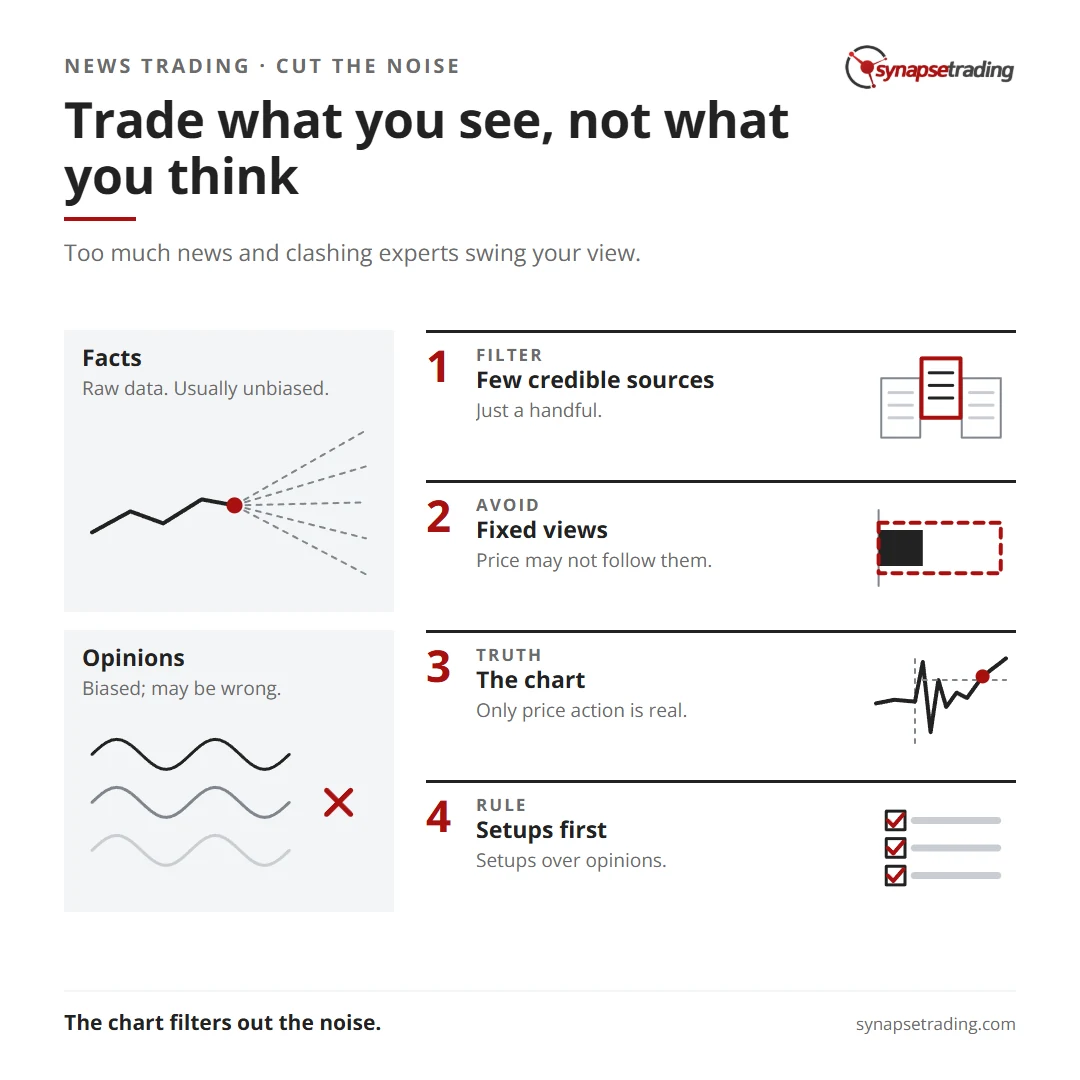
I have said a shorter version of this to my community for years: “Read less news, focus on the charts. There are only 1–2 news items a week that move the market. The rest is noise. Price leads news.” The last three words matter most. Quite often the chart moves before the headline does, because some traders expect the news, or hear it early, and start buying or selling ahead of time. By the time you read the story, much of the move can already be done.
So the chart also filters the news. You stop asking whether a headline is bullish and ask whether your setup appeared, which has a yes or no answer.
If you would rather not read the news all day to stay on top of the market, my free 15-minute swing trader checklist is the daily routine I use myself.
Why does checking the news more often show you more noise?
There is a statistical reason that reading more news can leave you knowing less, and Nassim Taleb puts it in rough numbers in Antifragile. Look at a set of data once a year, he suggests, and it is roughly half signal and half noise. Look at the same data every day and it becomes about 95% noise. Look every hour and it is about 99.5% noise, or 200 times more noise than signal.
Do note that his ratios are illustrations rather than measurements, with no study behind them. The direction is sound arithmetic, though. A real trend builds slowly while random wiggles show up at every frequency, so the more often you look, the more of what you see means nothing.
He pairs it with a story from medicine that I find more unsettling. In New York in the 1930s, 389 children were shown to doctors, and 174 were recommended to have their tonsils removed. The remaining 215 were shown to a second group of doctors, who recommended surgery for 99 of them. The 116 left over went to a third group, who recommended it for 52. Each fresh look found new reasons to operate. Taleb’s conclusion is that “access to data increases intervention”.
The same thing happens in trading. Every headline is another look at the patient, and every look tempts you to do something, while the trend you were following has usually not changed at all. That is why, in my 2 April outlook, I suggested focusing on the medium-term trend instead of chasing the swings the news creates.
Does big news ever override the chart?
On 4 February 2025, a trader on Reddit’s r/swingtrading asked: “I feel like TA is not reliable when you have big news/events back to back.” They had been sitting on the sidelines for a week, unsure of the direction after a dip triggered by a news event.
It is a fair question, and I will concede that news does move markets, sometimes violently. In the days before my 2 April 2026 outlook, the market rallied on a presidential address about how the war might end, and no chart pattern could have told you that speech was coming. A company that disappoints on earnings can gap down overnight, straight through any stop you placed, and the chart gives no warning of that either.
So I do respect one kind of news, the scheduled kind. My trading plan says to close or reduce positions before major releases, and I do not hold a stock through its earnings. As I said in my outlook on 27 April 2026, “you never know when the earnings could disappoint”, and if it gaps down hard, it becomes very hard to manage your risk.
But the trader on Reddit was half right about something else. Waiting until things settle down is often the correct answer, and it is the chart that tells you when they have. On 14 January 2026, I pointed out that the S&P 500 had kept steadily creeping up “despite all the news and the volatility”, with no sign at all from the price action that the market was about to reverse. The headlines were loud and the trend was quiet, and the trend was the one paying.
How do you filter market news in practice?
Put the two rules together and a simple way of working falls out of them, with four aspects.
- Sort every input. When news lands, ask whether it is a fact or an opinion. Facts shape your context. Opinions get held loosely.
- Shrink your sources. Pick two or three analysts you trust and mute the rest. More voices make you easier to sway, and rarely better informed.
- Let the chart decide. If price has not done what your rules need, there is no trade, however good the story sounds.
- Respect the scheduled shocks. Know when earnings and the big releases are due. My guide to the Non-Farm Payroll report shows how one of them works, and how to use Forex Factory shows how to find the one or two that matter each week.
You still read the world. You just stop trading it headline by headline, and I compare the two approaches properly in technical analysis vs fundamental analysis.
A routine helps more than willpower here, which is why the free 15-minute swing trader checklist is the one I run every day.
FAQ
Should I trade based on the news?
For most swing traders, the news works better as context than as a trigger. The volume of it and the disagreement between experts make pure news trading very hard, so let your chart setup decide whether you trade.
What is the difference between facts and opinions in trading?
A fact is raw data, such as an economic release, a statistic or a company’s reported earnings. An opinion is a conclusion someone drew from that data, so it carries their bias and may be wrong.
What does “trade what you see, not what you think” mean?
It means your decisions come from the price action on the chart, not from your view of where the market should go. You only make money when price moves, so the chart overrules your opinion.
Can big news override technical analysis?
Yes, for a while. A speech or an earnings miss can move price hard and gap it through a stop. That is why I do not hold a stock through its earnings, and why I wait for the chart to settle after a shock.
How many news sources should a trader follow?
A handful at most. Two or three analysts you trust, plus the scheduled economic releases, cover what most swing traders need. Everything else adds noise faster than it adds signal.
When the feed is overflowing and the experts are shouting past each other, which do you trust more, the headline or the chart? And has a piece of news ever talked you out of a trade your chart was telling you to take? Let me know in the comments.
If you want to learn to read the chart the news cannot read for you, start with my guide to trading price chart patterns, and my free trading guides collect the rest.
And if you want a routine that keeps you trading the chart in 15 minutes a day instead of chasing headlines all day, grab the free 15-minute swing trader checklist.
About the author. Spencer Li is The 15-Minute Trader and the founder of Synapse Trading. He is a Certified Financial Technician (CFTe) with 15+ years of trading, run from 70+ countries. He holds a B.Acc and B.BM from SMU. Every trade he takes is public, dated, losses left in. He teaches rules-based swing trading in 15 minutes a day, one system for any market.
Education, not financial advice. Synapse Trading is not licensed by MAS to advise on investment products. Trading carries risk of loss, and past performance is not indicative of future results.
Want the daily routine? Enter your email for the free 15-Minute Swing Trader's Checklist.
Free 5-page PDF, then occasional trading emails. Education only, not financial advice. Unsubscribe anytime. Kit stores your email in the US: see our privacy policy.
Want to learn the full method? The Trading Mastery Program teaches the 4 strategies I have traded since 2011. It suits beginners and experienced traders.
Rather follow the trades as they happen? Daily Trading Signals is our Telegram channel: my trade ideas with entry, stop and exit, and every trade is public.
Questions about this post? Ask in the free Telegram channel →
Educational content only, not personalised financial advice. Trading carries risk, including loss of capital. Past performance is not indicative of future results. Synapse Trading is not licensed or regulated by MAS.

