

Up Gap and Down Gap Side-by-Side White Lines: How to Read Both Versions
Want the daily routine? Get the free 15-Minute Swing Trader’s Checklist. Get it free →
By Spencer Li, CFTe · Last updated: 26 October 2026
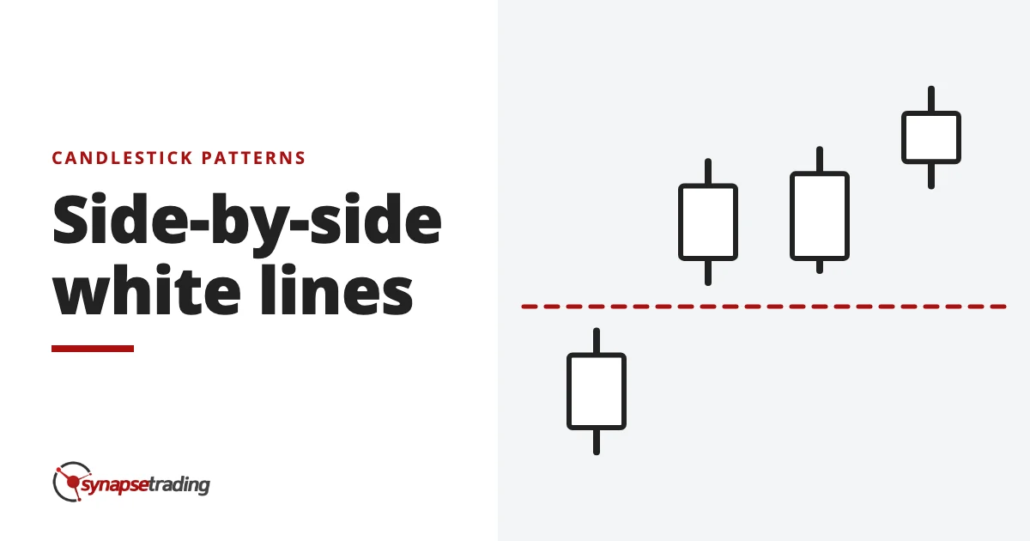
Side-by-side white lines is a rare three-candle continuation pattern. In the up gap version, a market in an uptrend prints a white candle, gaps higher, and then prints two white candles of about the same size that open at almost the same price. The down gap version does the same thing in a downtrend, after a black candle and a gap lower, and the two white candles both close below the black candle’s body. Both versions say the existing trend is likely to resume. The tests behind that claim are thin, so it is worth knowing what the pattern says, where it comes from, and how often it has actually done its job.
Why is the bearish version made of white candles?
Most candlestick patterns can be guessed from their colours, since black candles tend to warn of a fall and white ones hint at a rise.
This pattern breaks the habit. In the down gap version, a falling market gaps lower and then prints two white candles in a row, which looks like buyers fighting back. Yet the pattern is read as bearish.
Steve Nison, whose 1991 book Japanese Candlestick Charting Techniques brought candlesticks to most Western traders, explains it in one phrase. In a falling market, he writes, “these white lines are viewed as short covering”.
Short covering needs a quick definition. A short seller borrows shares, sells them, and hopes to buy them back cheaper later. When they buy back to close the trade, that buying lifts the price for a day or two, and it can print white candles. But it is buying by people who still think the market is going lower, and once they are done there is nobody left to keep pushing. So the white candles are a pause for breath inside the fall, and Nison expects prices to move lower once the short covering runs out.
The up gap version is simpler. Buyers gap the market higher and then push it up twice more from the same starting point, which is about as clear a vote for the uptrend as three candles can give.
What does each version need?
Gregory Morris, in Candlestick Charting Explained, describes the core of it as two white candles “of similar size” sitting “side-by-side after gapping”, with opening prices that “should be very close”. Thomas Bulkowski, who tested the pattern for his Encyclopedia of Candlestick Charts, adds the trend and the first candle.
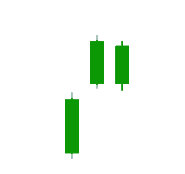
For the up gap side-by-side white lines, the checks run like this.
- The market is in an uptrend. With no trend before it, there is nothing for the pattern to continue.
- The first candle is white.
- The second candle gaps up. It opens above the top of the first candle’s body.
- The third candle is white and matches the second. Its body is about the same size, and it opens at almost the same price.
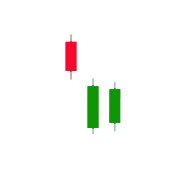
The down gap side-by-side white lines turns the first half upside down.
- The market is in a downtrend.
- The first candle is black.
- The second candle gaps down and is white.
- The third candle is white, about the same size, and opens near the second. Bulkowski adds that both white candles must close below the black candle’s body, so the gap is never filled.
The old version of this post said the third candle only had to open at or above the first candle’s body. That rule lets in candles the pattern was never meant to include, because what makes the two lines “side by side” is that they start from the same price.
Do note that a gap here can mean two things. Bulkowski only asks for a gap between the bodies. Nison and Morris talk about a gap the way they talk about a rising or falling window, where the whole candle, shadows included, clears the one before. The strict version is rarer still.
If you want a short daily routine for checking charts like these, my free 15-minute swing trader checklist is the one I use myself.
Why would two candles open at the same price?
Before the charts, it is worth asking why two sessions in a row would start from almost exactly the same price, because the answer may come from psychology rather than from charts.
In 1974, Amos Tversky and Daniel Kahneman ran an experiment that is still slightly embarrassing to read. They built a wheel of fortune numbered 0 to 100, rigged so that it only ever stopped at 10 or 65. Students spun it, wrote down the number, and were then asked what percentage of United Nations members were African countries. The students who saw 10 guessed 25% on average. The students who saw 65 guessed 45%. A number everyone knew was random still dragged their answers towards it, and the effect got a name, anchoring.
Morris treats the open in a similar way. It is where the overnight emotion gets priced in, and it becomes the reference point the day’s decisions are made from. So when a market gaps to a new level and the next session opens right back at that same level, one plausible reading is that traders have accepted the new price as the anchor. Nobody is fighting the gap any more. They are just trading from it.
I should be honest that this is a guess about the mechanism, and I know of no test of anchoring on candle opens. But it would explain why the matching opens matter more than the colour.
What do side-by-side white lines look like on a real chart?
They are rare, so here are two clean ones, both from daily prices pulled from Yahoo Finance on 26 October 2026.
The up gap version, JPMorgan, May 2025. JPMorgan Chase had climbed more than 20% from its low on 7 April 2025, after the April sell-off. On 1 May it printed a white candle. On 2 May it gapped up, and the whole day traded above the 1 May high, which made it a true window. It closed higher. On 5 May it opened just 8 cents away from the 2 May open and printed another white candle of almost the same size. On 12 May it gapped up again and closed above the top of the pattern. By 19 May, ten sessions after the pattern finished, it had closed about 5% above the 5 May close.
The down gap version, gold, September 2026. GLD, the fund that tracks the gold price, had fallen about 7% from its high of 24 August 2026 when it printed a black candle on 11 September. On 14 September it gapped down, with the whole day below the 11 September low, and closed white. On 15 September it opened about 0.3% away from the 14 September open and closed white again, with a body almost the same size. Then 16 September did something the textbooks rarely show. GLD opened above the window, which looked at first like the bears had lost, and then sold off to close below both white candles’ opens. The fall resumed, and on 28 September GLD closed about 4% below its 15 September close.
So the gold example worked, eventually. But anyone who read the 16 September open as a failed pattern had a fair case at the time, and a pattern that needs that much patience is a hard one to sit through.
How often does the pattern actually work?
In November 2024, a beginner on Reddit’s r/technicalanalysis posted a chart and asked, “am I right in saying this is a bullish continuation?” They added that they did not want to lose their money.
It is the right worry, and the honest answer is that a continuation pattern is a lean rather than a promise. Bulkowski’s figures, read off his site on 26 October 2026, put numbers on how much of a lean.
| Up gap, bullish | Down gap, bearish | |
|---|---|---|
| Continued the trend | 66% of the time | 56% of the time |
| How common, out of 103 candle types | 73rd | 86th |
| Best average move 10 days later | a fall of 6.07%, after breaking down in a bear market | a rise of 7.86%, after breaking up in a bear market |
Read the bottom row slowly, because it says something odd. For both versions, the biggest moves came when the pattern failed. The bullish pattern’s best showing was a fall, and the bearish pattern’s best showing was a rise. Bulkowski says so himself about the bullish version: “reversals (downward breakouts) tend to be more powerful”.
The old version of this post got this backwards. It said that “a little over 60%” of patterns made a 6% average move in 10 days as a downtrend continuation. In Bulkowski’s numbers, the 61% is the share of patterns that reached a price target, and the 6% fall comes from bullish patterns that broke down, which is a reversal.
Then there is the sample. Bulkowski found 984 bullish patterns in more than 4.7 million candles, and of the bearish version he writes that “the sample count is too small” to judge it properly. He calls its 56% “near random”, and that is close enough to a coin toss that it says very little on its own.
Even the better figure, 66%, means one bullish pattern in three did not continue.
If you would rather do this kind of checking once a day than all day, the free 15-minute swing trader checklist is my own routine.
Why is a gap hard to trade, even when the pattern is clean?
On 8 November 2025, I was going through Datadog in my weekly outlook. It had just gapped up hard, and I said that “after such a strong gap up, it’s a bit dangerous to buy it because… it’s hard to put a good stop loss”.
The daily prices show why. On 6 November, Datadog opened about 15% above the previous close, and the whole day traded above the 5 November high. By the close on 7 November, the bottom of that gap sat about 17% below the price. If the gap is where you would admit you were wrong, then being wrong costs 17%, which is a lot to risk on one idea.
That is the hidden cost of every up gap pattern, side-by-side white lines included. The gap is what makes the pattern, and the gap is also what pushes the natural exit a long way from the price. I said at the time that a pullback “might present an opportunity”. Over the following week Datadog gave back about 10% from its 10 November close, and by 17 November it had come back to within 1% of the top of the gap without filling it.
Where do side-by-side white lines go wrong?
- It is rare. You will not find many, and a pattern you meet a few times a year is hard to build a habit around.
- The trend has to be real. A continuation pattern has nothing to continue in a sideways market.
- It gives no target. Like most candle patterns, it says which way the next move should go, and nothing about how far.
- It is easy to confuse. Three outside up also ends in two white candles, but it starts with a black one engulfed by a white one, and it is a reversal pattern.
- The bearish version is barely better than a coin. At 56% on a thin sample, it is a reason to keep watching rather than a reason to act.
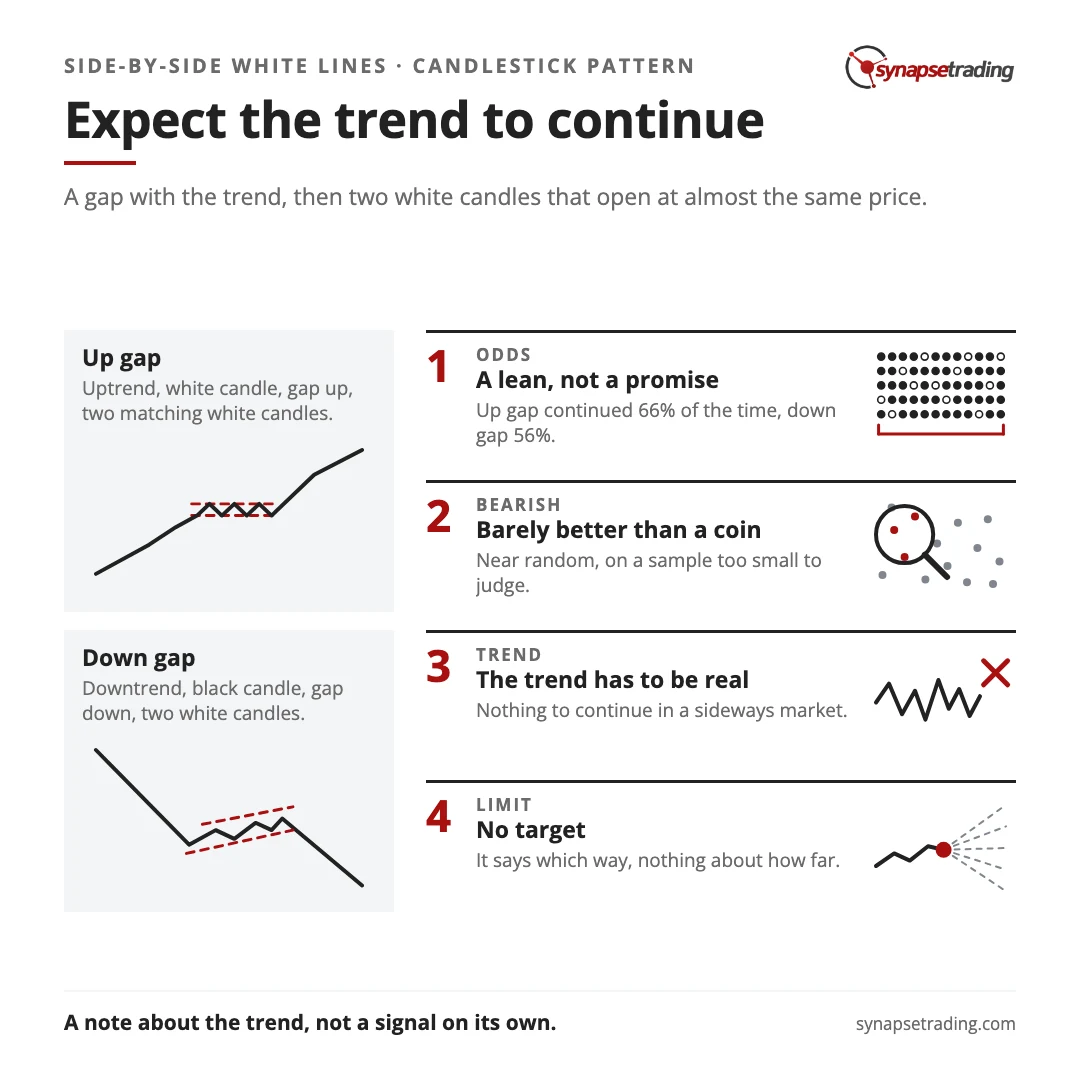
Personally, I read side-by-side white lines as a note about the trend rather than a signal on its own. The trend and the level it sits near tell me far more than the three candles do. For a pattern that also sits on a gap and also says “keep going”, the upside tasuki gap is a close cousin, and for one that says an uptrend is tiring, read the stalled pattern.
FAQ
What is the up gap side-by-side white lines pattern?
It is a bullish continuation pattern. In an uptrend, a white candle is followed by a gap up and two white candles of about the same size that open at almost the same price.
Is the down gap side-by-side white lines bullish or bearish?
It is bearish, even though two of its three candles are white. Nison reads the white candles as short covering inside a downtrend, which fades and lets the fall resume.
How reliable is the side-by-side white lines pattern?
In Bulkowski’s tests, the bullish version continued the trend 66% of the time and the bearish version 56% of the time. He calls the bearish figure near random, and both samples are small.
What is the difference between side-by-side white lines and three outside up?
Side-by-side white lines is a continuation pattern that needs a gap and two matching white candles. Three outside up is a reversal pattern that starts with a black candle engulfed by a white one.
Does the gap have to stay open?
Between the bodies, yes. Both white candles sit beyond the first candle’s body, so the gap stays open by definition. If a later close fills it, Nison’s reading of gaps says the trend behind it is in trouble.
Have you ever spotted side-by-side white lines on a live chart, and did the trend carry on? And would you trust a bearish pattern made of white candles? Let me know in the comments.
For every candle pattern in one place, read The Definitive Guide to Candlestick Patterns. For the wider picture, start with my free trading guides.
And if you want a routine that spots patterns like this without hours at the screen, grab the free 15-minute swing trader checklist.
About the author. Spencer Li is The 15-Minute Trader and the founder of Synapse Trading. He is a Certified Financial Technician (CFTe) with 15+ years of trading, run from 70+ countries. He holds a B.Acc and B.BM from SMU. Every trade he takes is public, dated, losses left in. He teaches rules-based swing trading in 15 minutes a day, one system for any market.
Education, not financial advice. Synapse Trading is not licensed by MAS to advise on investment products. Trading carries risk of loss, and past performance is not indicative of future results.
Want the daily routine? Enter your email for the free 15-Minute Swing Trader's Checklist.
Free 5-page PDF, then occasional trading emails. Education only, not financial advice. Unsubscribe anytime. Kit stores your email in the US: see our privacy policy.
Want to learn the full method? The Trading Mastery Program teaches the 4 strategies I have traded since 2011. It suits beginners and experienced traders.
Rather follow the trades as they happen? Daily Trading Signals is our Telegram channel: my trade ideas with entry, stop and exit, and every trade is public.
Questions about this post? Ask in the free Telegram channel →
Educational content only, not personalised financial advice. Trading carries risk, including loss of capital. Past performance is not indicative of future results. Synapse Trading is not licensed or regulated by MAS.

