

FIRE in Singapore: the Investing Engine Behind Financial Independence
Want the daily routine? Get the free 15-Minute Swing Trader’s Checklist. Get it free →
Retiring early is a portfolio problem before it is a lifestyle choice. Here is the arithmetic, where CPF fits, and the 3 stages that build the engine
Published: 17 October 2026 · Last updated: 17 October 2026 · By Spencer Li, CFTe
FIRE stands for financial independence, retire early. The idea is simple. You build a portfolio large enough that what it can safely pay out each year covers your spending, so work becomes optional.
The common target is 25 times your yearly spending. It comes from the 4% rule: take out 4% of the portfolio in year 1, then raise that amount with inflation. As an example, if you spend SGD 48,000 a year, the target is SGD 1.2 million.
In Singapore there is a twist. CPF LIFE pays a monthly income from 65 for as long as you live. So the real job of a Singapore FIRE portfolio is to carry you from the day you stop working until CPF takes over part of the load, and then to top it up for life.
The investing engine has 3 stages. The first runs on your savings rate. The second is the portfolio that compounds. The third is the withdrawal phase.
Where does the 25 times rule come from?
It comes from US research in the 1990s. The best-known version is the Trinity study, published in 1998. It tested stock and bond portfolios against market data “covering the period from 1925 to 1995,” over payout periods of 15 to 30 years. The test was whether a portfolio lasted the full period while withdrawals rose with inflation.
At around 4% a year, a mix with a large share of stocks lasted in most of the historical periods tested. That is where 25 times comes from, since 1 divided by 4% is 25.
Do note 2 things before you lean on it. First, the study was built on US data, and the longest period it tested was 30 years. Someone retiring at 40 may need the money to last 50 years or more. Second, the authors themselves warned that “mid-course corrections likely will be required.” A lower withdrawal rate, or a willingness to spend less in bad years, gives you more room.
How does CPF change FIRE in Singapore?
CPF gives you a floor that most FIRE plans abroad do not have. The 2 rules that matter most for timing come straight from the CPF Board.
First, from 55: “You can apply to withdraw your CPF savings from age 55 onwards.” How much you can take out depends on whether you have set aside your retirement sum.
Second, from 65: CPF LIFE “provides you with monthly payouts no matter how long you live.” You can start payouts “any time from 65 to one month before you turn 80.” And for each year you defer up to age 70, “your payouts will increase by up to 7%.”
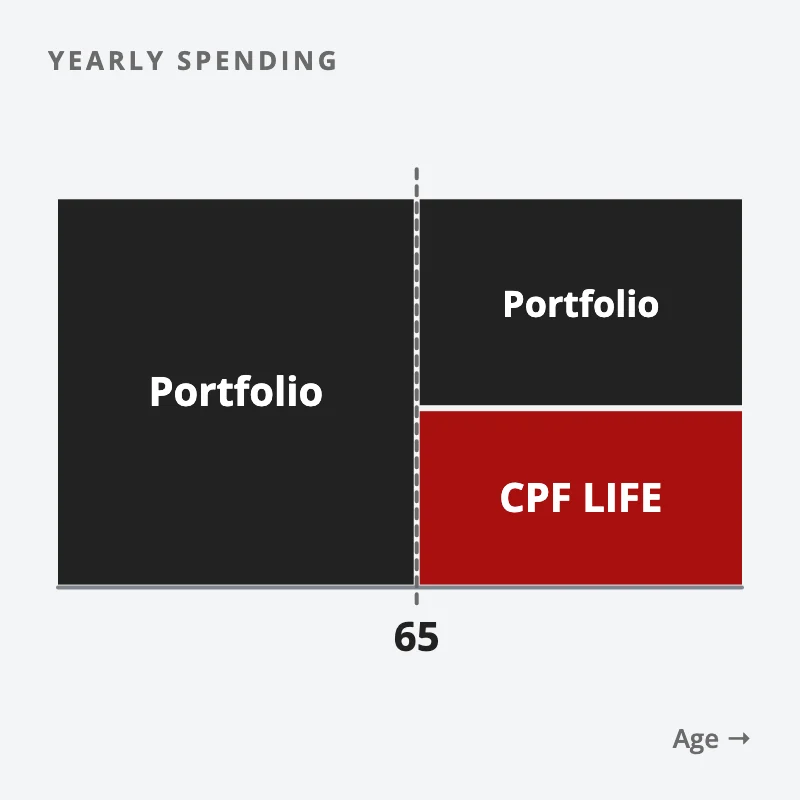
So a Singapore FIRE plan has 2 phases. Before 65, your own portfolio does all the work. After 65, CPF LIFE covers part of your spending, and your portfolio only needs to cover the gap. That can shrink the number you need, sometimes a lot.
The details of using CPF and SRS money inside a portfolio are covered in our post on CPF and SRS in a DIY portfolio, including the hurdle each account sets.
What are the 3 stages of the investing engine?
Each stage has a different main lever. Pulling the wrong lever at the wrong stage is where most plans stall.
Stage 1: Your savings rate is the main lever. When the portfolio is small, returns barely matter. For example, a 10% year on SGD 20,000 is SGD 2,000. Saving an extra SGD 500 a month beats that by a wide margin. Nick Maggiulli makes this point in Just Keep Buying: saving is the lever when you have little, and investing is the lever when you have a lot.
As a rule of thumb, the long-term portfolio becomes the main event somewhere around SGD 100,000 of capital. Below that, your energy is better spent raising the cash coming in, from a job, a side income or a skill, because you cannot compound money you do not have yet.
Stage 2: The portfolio becomes the main lever. Once the portfolio is large, a single good or bad year can move it more than a full year of saving. This is where the choices that look boring start to matter most: what you own, what it costs, and whether you hold on when it falls. For most people, a low-cost, broad index core does the heavy lifting. Our guide on how to choose an index ETF from Singapore covers the index and the wrapper.
Stage 3: Getting the money out without breaking the engine. Withdrawals bring a new risk. A big fall in the first few years of withdrawing hurts far more than the same fall 15 years in, because you are selling shares at low prices to fund your spending. Planners call this sequence risk. A cash buffer for a few years of spending, and the flexibility to cut spending in a bad year, are the common defences.
If you want a short weekly routine that keeps your investing decisions planned rather than rushed, our free 15-Minute Swing Trader’s Checklist covers the habits behind it. Get the free checklist →
How does the number change with your spending and CPF?
The table below shows the arithmetic for 3 spending levels. The SGD figures are example figures only, a simple illustration using the 25 times rule, before tax, fees, inflation assumptions or CPF.
| Yearly spending | Target at 25x (4%) | Target at 30x (about 3.3%) | What the portfolio must cover before 65 |
| SGD 36,000 | SGD 900,000 | SGD 1,080,000 | All of it, from the portfolio |
| SGD 48,000 | SGD 1,200,000 | SGD 1,440,000 | All of it, from the portfolio |
| SGD 72,000 | SGD 1,800,000 | SGD 2,160,000 | All of it, from the portfolio |
After 65, the portfolio only needs to cover what CPF LIFE does not. Your own CPF LIFE estimate, from the CPF website, is the number that turns this table into your plan.
Two things stand out. Spending sets the target directly: every extra SGD 1,000 a year of spending adds SGD 25,000 to the 25 times number. And the gap between 25 times and 30 times is large, which is why the withdrawal rate deserves real thought, especially for an early retiree.
Is FIRE realistic on a normal Singapore income?
A post on a Singapore personal finance forum put the objection plainly: “FIRE is a privilege and most of us are just hustling for crumbs.”
There is truth in that. A high income makes the saving stage much shorter, and a low one makes it much longer. The arithmetic does not care how hard you work. It cares about the gap between what you earn and what you spend, and about how many years that gap gets to compound.
But FIRE is a spectrum. Reaching half your number still buys real options: a lower-paid job you like, a part-time year, or less fear of losing your current job. The 25 times target is the far end of a road with useful stops along the way. Our list of 10 financial milestones sets out some of those stops.
What are the biggest mistakes in a FIRE plan?
From the arithmetic above, 4 mistakes cause most of the damage.
Chasing returns in the saving stage. On a small portfolio, a risky bet that doubles adds little, and one that fails costs years. The savings rate is the safer lever early on.
Treating 4% as a guarantee. It came from 30-year US periods. A longer retirement, or a weak first decade, can break it.
Selling in a crash. Compounding only works if you are still holding when markets recover. Investing a fixed amount on a schedule, through dollar-cost averaging, takes much of that choice out of your hands.
Saving so hard there is no life left. The aim of financial independence is a better life. A plan that skips the life along the way misses its own aim. Our summary of Die with Zero makes that case well.
For the full picture of building a portfolio from cashflow to compounding, see our DIY guide to building your investment portfolio.
So which stage are you in right now? And is your effort going into the lever that matters most at that stage?
FAQ
How much do I need to retire early in Singapore?
A common starting point is 25 times your yearly spending, based on the 4% rule. In Singapore, CPF LIFE payouts from 65 can lower the amount your own portfolio must cover after that age.
What is the 4% rule?
It is a guideline from US retirement research, best known from the 1998 Trinity study. Withdraw 4% of your portfolio in the first year, then raise the amount with inflation. In the historical US data tested over 15 to 30 years, portfolios with a large share of stocks usually lasted.
Can I use CPF for FIRE?
Partly. You can apply to withdraw CPF savings from 55, subject to the retirement sum, and CPF LIFE pays monthly from 65 for life. Before 55, your own portfolio has to carry you.
Is the 4% rule safe for early retirees?
It is less safe for longer retirements. The Trinity study tested periods up to 30 years. Someone retiring at 40 may want a lower withdrawal rate or the flexibility to spend less in bad years.
Should I invest or save more to reach FIRE faster?
It depends on your stage. When the portfolio is small, raising your savings rate usually matters more. Once it is large, investment returns and costs take over as the main lever.
Go deeper
Reaching financial independence takes a routine you can keep for years, through good markets and bad. The free 15-Minute Swing Trader’s Checklist has the daily routine, the questions to ask before every trade, and the five rules that protect your account. Enter your email and we’ll send it over:
We use your email address to send you the checklist, then emails about trading and our courses. Unsubscribe in one click, any time. Privacy policy.
About the author. Spencer Li is The 15-Minute Trader and the founder of Synapse Trading. He is a Certified Financial Technician (CFTe) with 15+ years of trading, run from 70+ countries. He holds a B.Acc and B.BM from SMU. Every trade he takes is public, dated, losses left in. He teaches low-risk swing trading in 15 minutes a day, one system for any market.
Educational content only, not personalised financial advice. Trading carries risk, including loss of capital. Past performance is not indicative of future results. Synapse Trading is not licensed or regulated by MAS.
Want the daily routine? Enter your email for the free 15-Minute Swing Trader's Checklist.
Free 5-page PDF, then occasional trading emails. Education only, not financial advice. Unsubscribe anytime. Kit stores your email in the US: see our privacy policy.
Want to learn the full method? The Trading Mastery Program teaches the 4 strategies I have traded since 2011. It suits beginners and experienced traders.
Rather follow the trades as they happen? Daily Trading Signals is our Telegram channel: my trade ideas with entry, stop and exit, and every trade is public.
Questions about this post? Ask in the free Telegram channel →
Educational content only, not personalised financial advice. Trading carries risk, including loss of capital. Past performance is not indicative of future results. Synapse Trading is not licensed or regulated by MAS.

