This is the last video in this tutorial series, which means, it’s now time to put into practice what we’ve learned so far.
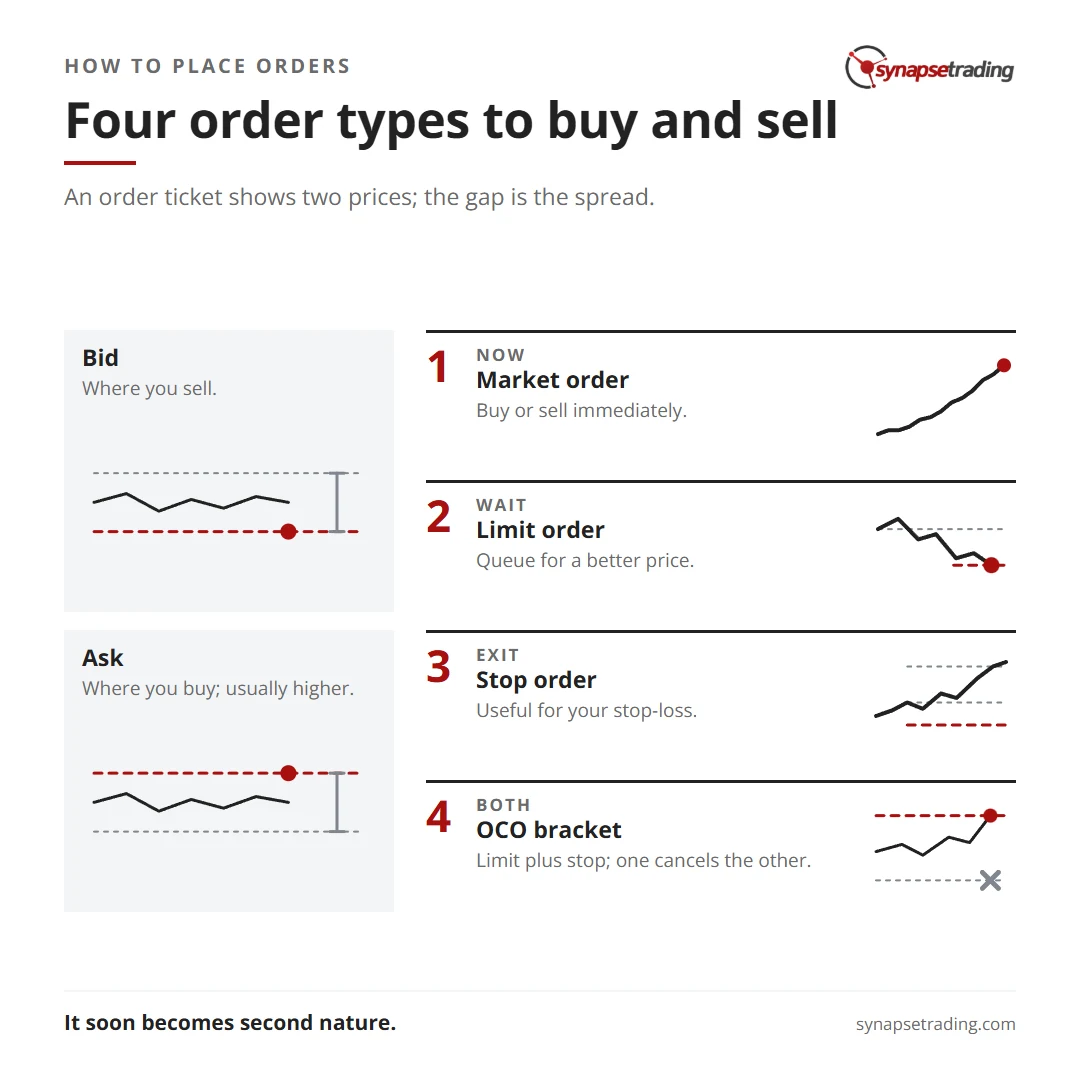
So, let’s explore how to place your first trade and the different ways you can do it. This is an order ticket. When you look at the order ticket, you’ll usually see two prices: the bid price on the left and the ask price on the right. The ask price is usually higher than the bid price, and the difference between the two prices is known as the spread. If you want to buy a stock, you’ll have to buy at the ask price, and if you want to sell, you’ll have to sell at the bid price.
There are four main types of orders which traders use to buy and sell stocks in the market.
The first is the market order, commonly referred to by traders as hitting the market. This means that you buy or sell immediately using the bid ask price that is currently offered by the market.
The next order is the limit order, which means you queue to buy at a better price or queue to sell at a better price. For example, if you think that this stock is going to drop to $3.70, then instead of buying at the current ask price of $3.80, you can place a limit buy order at $3.70, which will kick in once the stock reaches that price and make the purchase.
Next up, we have the stop order, which as its name suggests, is useful for placing your stop-loss and very important for applying the 2% money management rule. For example, if you have bought this stock at $3.80 and you want to cut your losses once the stock drops below $3.70. You can place a stop sell order at $3.70, which will kick in once the stock reaches that price and sell off the stock.
Lastly, we have the OCO, or one cancels the other bracket order, which is basically a combination of one limit order and one stop order, which will cancel the other when either is triggered. This is commonly used when traders place their stop-loss and target profit.
These order types might seem confusing at first, but once you’ve placed a few trades, it’ll soon become second nature, and you’ll stick to the order types that suit your trading style and gives you the best results. That’s it!
Congratulations on completing the video tutorial series. We hope you’ve had an enjoyable and enlightening journey into the world of trading, but remember this is just the first step to becoming a successful trader. We encourage you to read up more, attend some workshops and most importantly, put what you have learned into practice. Good luck!
https://synapsetrading.com/wp-content/uploads/2026/10/free-video-tutorials-making-your-first-trade-5c-how-to-place-orders-card.webp6301200Spencer Lihttps://synapsetrading.com/wp-content/uploads/2026/10/synapse-logo-horizontal-light.pngSpencer Li2016-04-25 08:00:102026-09-14 14:59:23How to Place Orders and Enter Trades
We all know that the goal of trading is to make money and so far we’ve learned that as long as you have an edge in the market you will be profitable in the long run.
So the next question is how do you maximize your profitability without blowing up your account?
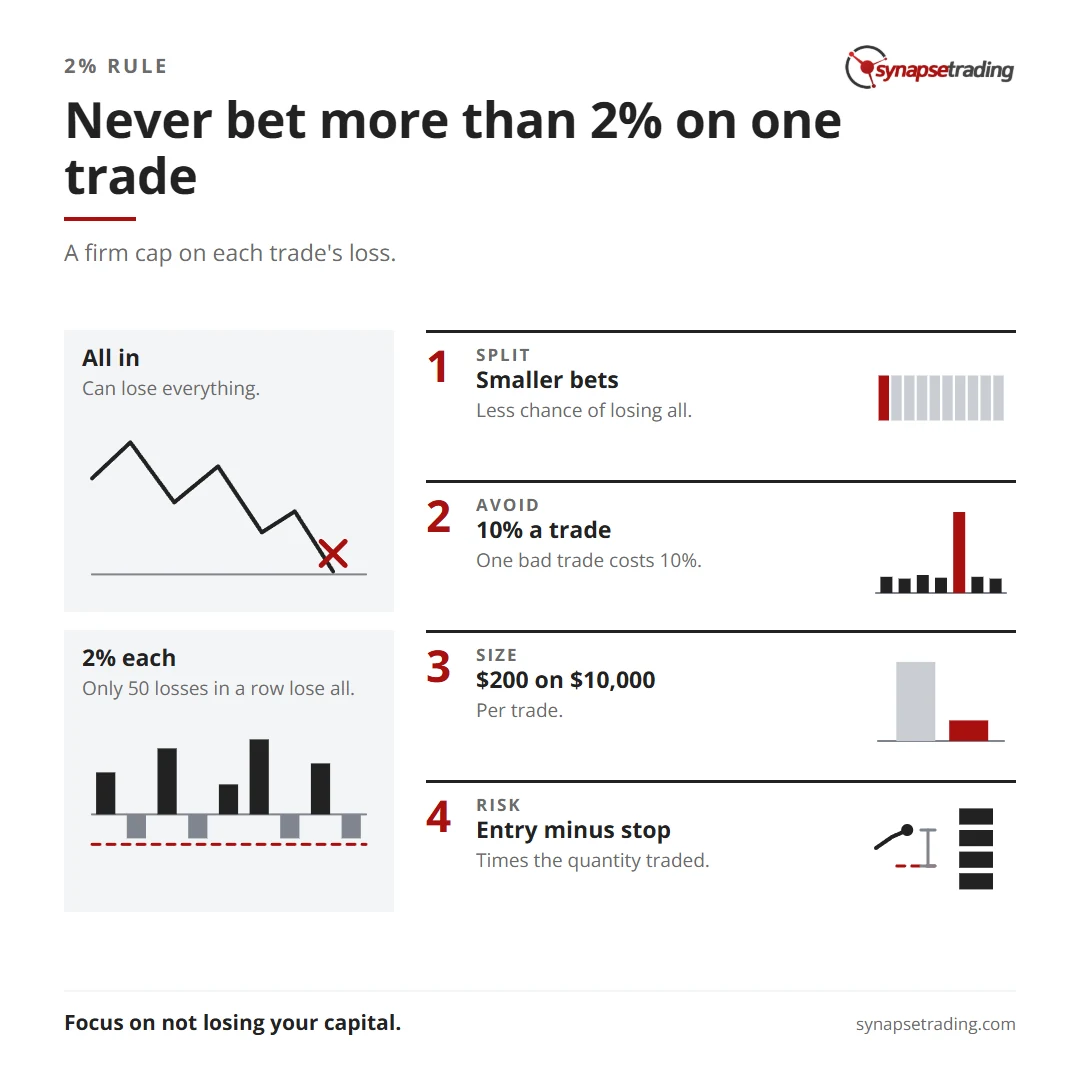
This rule states that you should never commit more than 2% of your available capital on a single trade.
Let’s say you have $10,000 to bet and you’re considering a particular trade with a hit rate of 60%.
How much should you bet?
If you bet the whole $10,000, you have a 60% chance of doubling your money.
But you also have a 40% chance of losing everything.
That’s pretty exciting if you’re a gambler but not ideal if you want to remain profitable in the long run.
Let’s say you split your $10,000 into two bets of $5,000 each your probability of losing two bets in a row is only 16 percent or 40% x 40% which means your chances of losing everything are much less.
Sounds good?
Well if you took it one step further and split your $10,000 into ten bets of $1,000 each, your odds of losing everything would drop to just 0.01%.
However, the amount you’re betting each time would still be pretty high.
10% of your total capital.
That means if one of your trades goes sour, you lose 10% of your money.
If you stuck with the 2% rule you’d only bet $200 per trade.
Not only does this put a firm manageable cap on how much money you can lose for each trade, it virtually eliminates your chance of losing everything. If you remember from our previous video, the risk of a trade is calculated by taking the difference between the entry price and stop-loss price and multiplying by the quantity traded. That means with the 2% money management rule, the only way to lose all your trading capital is to lose 50 times in a row. With a 40% chance of losing each trade, the probability of that happening is about 1 in 79 quintillion.
Now those are sound odds!
After all, as a money manager, your focus shouldn’t be on making the most money; that’s what a gambler does.
Your focus should be on ensuring that you do not lose your capital.
It’s like Warren Buffett once said the number-one rule is to not lose money and while there will always be stories of traders blowing up their account, if you stick to the 2% money management rule, it is virtually impossible for you to do the same and not only that, it’ll also help you improve your trading results across the board.
That’s it!
For our next video we’ll look at how to place orders and enter trades.
Before making your first trade, you need to understand the mathematical logic behind trading.
This will allow you to balance risk versus reward.
Determine when to enter and exit a trade and ensure that you win in the long run.
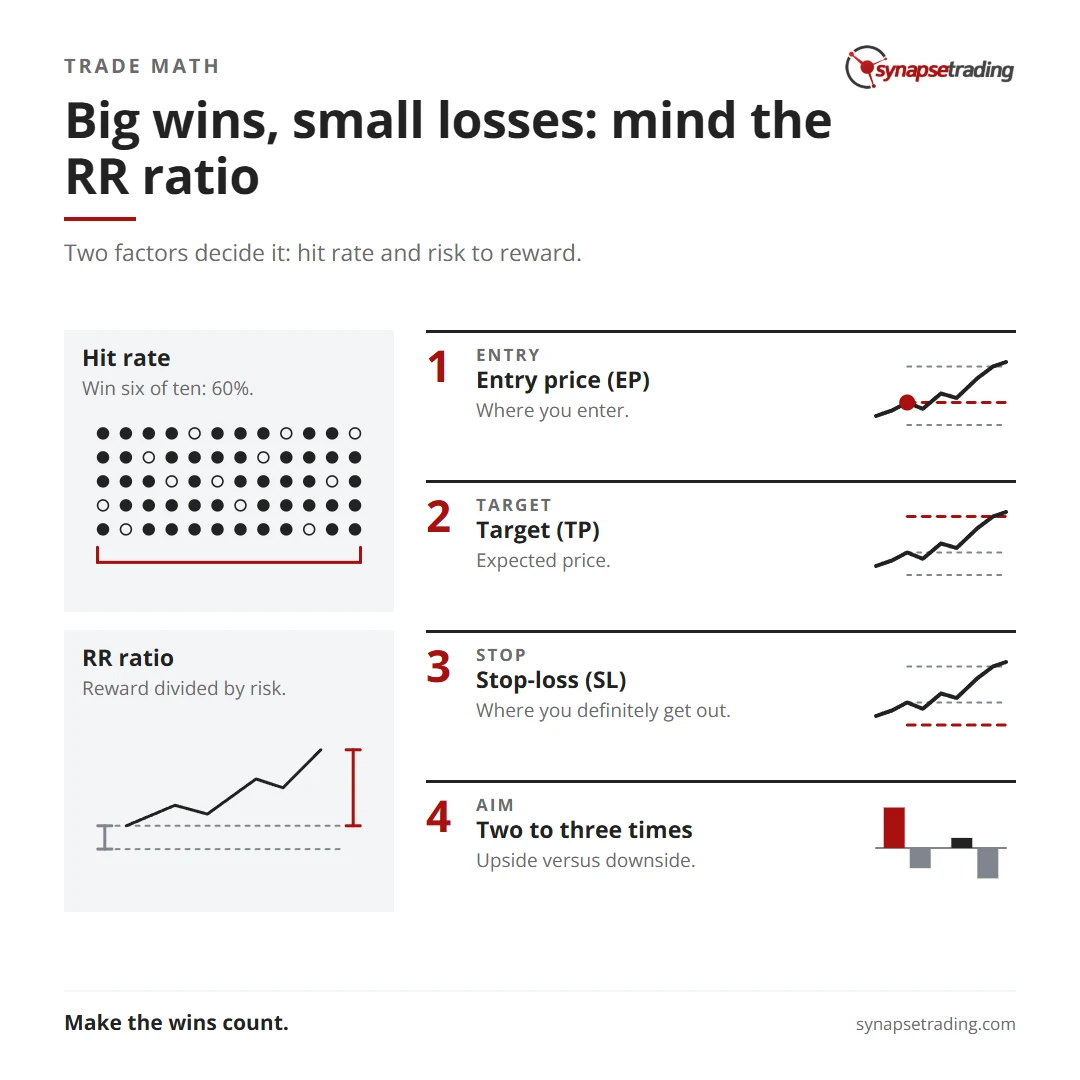
In general, the profitability of your investment account depends on two factors: your hit rate and the risk to reward ratio of each trade.
Your hit rate is the percentage of winning trades, so if you make ten trades and win six, your hit rate is 60%.
Now, your hit rate doesn’t factor in how much money you made or lost in those trades, just whether or not you won.
If you trade using good setups and solid strategies, you should achieve a hit rate of about forty to sixty percent.
The next thing to look out for is the risk to reward ratio of a trade, otherwise known as the RR ratio.
This will help you achieve big wins, while keeping your losses low.
After all, like the famous financier George Soros once said, it’s not how often you’re right or wrong, but rather how much you make when you’re right and how much you lose when you’re wrong.
So if you only get it right 40 percent of the time, you want to make sure those trades make way more than all the losing trades.
The RR is calculated using three numbers. First, the EP or entry price: this is the price at which you enter the trade.
Next, the TP or target profit: this is the price you expect the stock to reach.
Finally, the SL or stop-loss: this is the price at which you will definitely get out of the position.
To calculate reward, you take the difference between the TP and the EP; while the risk is the difference between the EP and the SL.
The RR ratio is then calculated by taking the reward and dividing by the risk. Hence, the higher the reward, the better the RR, and the lower the risk, the better the RR.
Generally, you should be aiming for an RR of at least two to three, this means that your potential upside is two to three times your potential downside on some trades.
It might even be possible to get an RR of seven to ten.
Risk management is such an important part of trading and has such a huge impact on your profit and loss.
For instance, if you have a hit rate of only 40% but an RR of two, you’ll still end up profitable in the long run because remember, success isn’t about winning every trade, it’s about making those wins count.
In our previous videos, we’ve learned the importance of tracking the big market cycles and how fundamental and economic forces drive those movements in this video. We’re going to look at the top three economic indicators to look out for. In the past, only experienced professionals and economists received this data in a timely fashion, but in the Internet age everyone has access to dozens of economic surveys and indicators every week.
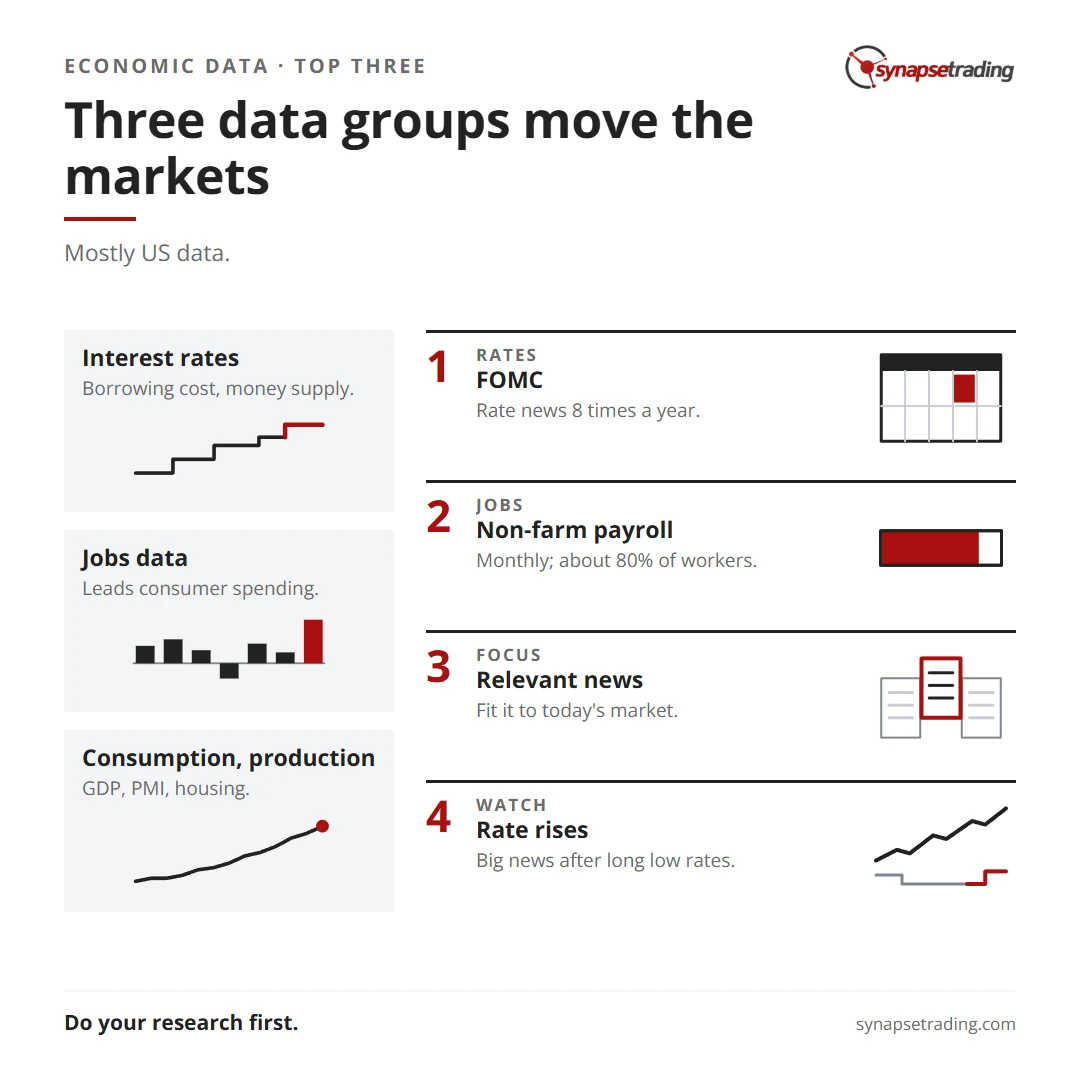
This data can be divided into three main groups: interest rate and monetary policy, employment and jobs data, and consumption and production data.
Now, keep in mind most of this data is based on the US economy since it’s the biggest financial powerhouse that moves global markets.
So, first let’s look at interest rate and monetary policy. For the US, the Federal Open Market Committee or FOMC makes scheduled announcements 8 times a year regarding interest rate or monetary policy. This can have a major impact on the markets because it affects the cost of borrowing and the money supply in the market. Other economies such as the eurozone, China, Australia, Japan and Switzerland have their own scheduled announcements where they set their interest rate and monetary policy.
Next, employment and jobs data. This data is very important because job creation is a leading indicator of consumer spending, which accounts for a majority of overall economic activity. The most important figure is the non-farm payroll which accounts for approximately 80% of the workers who produce the entire gross domestic product of the United States. This vital piece of economic data is released monthly usually on the first Friday after the month ends. The combination of importance and earliness makes for hefty market impacts. Other indicators include the Employment Cost Index (ECI), the Employment Situation report and the weekly jobless claims report.
Finally, there’s consumption and production data. There are various reports that measure different aspects of consumption and production, so it’s up to the savvy investor to piece it all together. Some examples include the Gross Domestic Product or GDP, Purchasing Managers Index or PMI, Philly Fed Report, Consumer Confidence Index, Producer Price Index, Consumer Price Index and the existing home sales report and housing starts. In general, the key is to look out for the kind of news that’s relevant to the current market climate.
For example, when the stock market has been bullish for many years and interest rates are really low, astute investors will keep their eyes peeled for any indication about interest rate increases as these will have a major impact on the market.
So remember, do your research and always make informed investment decisions.
Warren Buffett’s Dividend Investing Strategy: 7 Rules He Actually Uses
Last updated: 26 August 2026 · By Spencer Li, CFTe
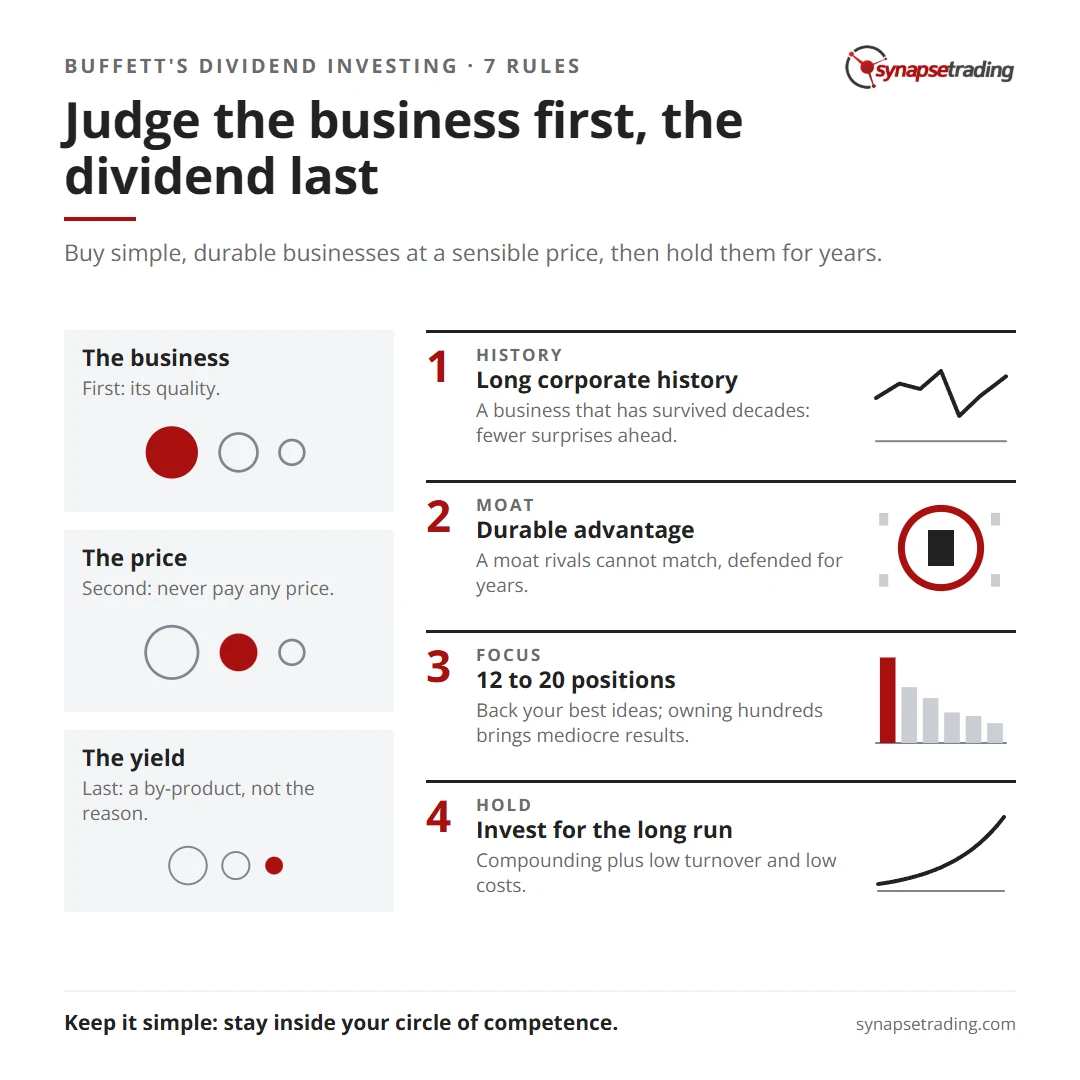
Warren Buffett’s dividend investing strategy comes down to buying a handful of simple, durable businesses cheaply and holding them for years while they compound. He is not chasing high yields. He is buying companies with long track records, wide competitive moats (advantages competitors cannot easily copy), at a sensible price, then letting time and reinvested cash flow do the heavy lifting. In practice that is seven rules: buy businesses with long histories, with durable competitive advantages, while they are undervalued; keep a focused portfolio of your best ideas; hold for the long run; favour shareholder-friendly management; and keep everything inside your circle of competence (the area you genuinely understand). The dividends are a by-product of owning great businesses, not the reason to own them.
Here is each rule, why it works, and where most people get it wrong.
What is Warren Buffett’s approach to dividend stocks?
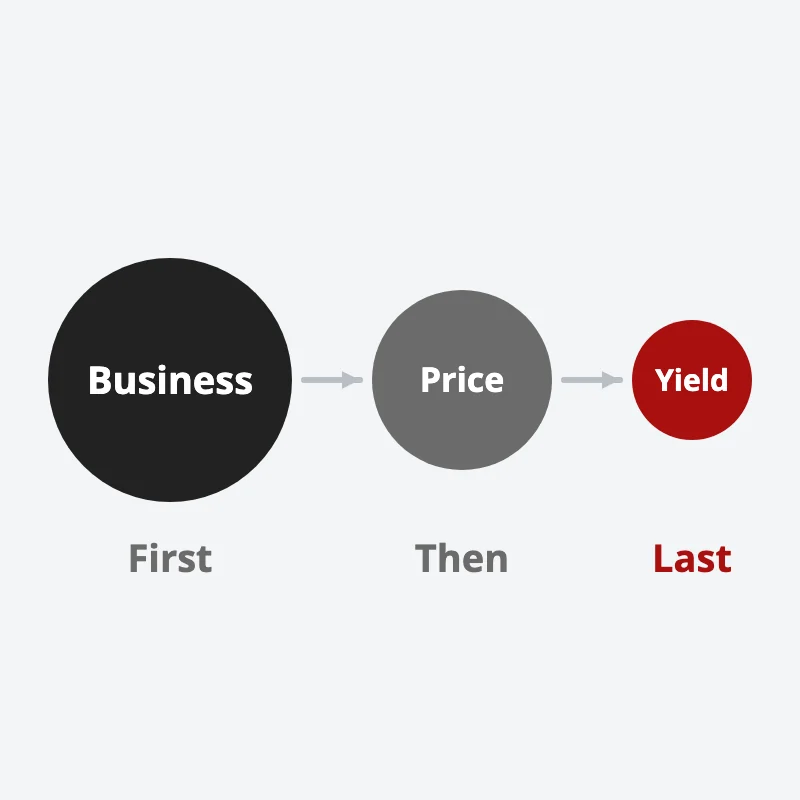
Buffett does not buy a stock because it pays a fat dividend. He buys a wonderful business at a fair price, and a growing dividend tends to come with the territory. The order matters. Quality of the business first, valuation second, the yield last. Get that order backwards and you end up holding a high-yield trap, a company paying you out of borrowed money while the business quietly rots.
Judge the business first, the price second, and the dividend yield last.
Below are the seven rules, side by side, before we go through each one.
#
The rule
What you are really looking for
The common mistake
1
Long corporate history
A business that has survived decades, so fewer surprises ahead
Buying an unproven story stock and calling it “the next big thing”
Owning hundreds of stocks and guaranteeing mediocrity
5
Long holding period
Compounding plus low turnover and low costs
Trading in and out, bleeding fees and tax
6
Shareholder-friendly management
Buybacks when cheap, dividends when no better use exists
Ignoring how management actually spends the cash
7
Keep it simple
Easy-to-understand businesses in your circle of competence
Buying complex things you cannot explain
Rule 1: Buy businesses with long corporate histories
Companies with long histories give you fewer surprises. They know exactly what they do, and they do it well.
Very few businesses stay successful for decades. Technology moves, industries shift, and what people want to buy changes too. For a business to thrive across that long a stretch, it either reinvents itself again and again, or it lives in an industry that barely changes. Either way, a long history is evidence.
The longer a business has been around, and the slower its industry changes, the more likely it has a real competitive advantage that survives into the future. This is the conservative way to invest. Buffett wants far more than a few good years before he believes a company has genuine staying power.
Rule 2: Look for a durable competitive advantage (a moat)
To do well in stocks, think like a business owner. As an owner, you would want your business to beat the competition. More than that, you would want something that stops competitors from ever matching you. That something is a durable competitive advantage, the moat.
Here is the hard part. Finding a competitive advantage that lasts a few years is easy. Finding one that lasts decades is rare. Only a handful of businesses earn above-average returns on capital year after year, then reinvest that capital to grow or hand it back to shareholders. Those are the ones worth owning.
Rule 3: Look for undervalued businesses
Value usually hides where nobody wants to look. The most beaten-down and unloved stocks are where it lives, not the glamorous high-flyers everyone is already crowding into.
A couple of practical places to start. Stocks with low price-to-earnings ratios (the share price divided by annual earnings per share, a rough gauge of how cheap a stock is relative to its profits) are a good hunting ground. So are quality businesses hit by a one-off bad event that does not actually threaten the company’s future. The market overreacts to the headline, and you buy the recovery.
A common mistake is to find a wonderful business, then pay any price for it, and then wonder why the returns disappoint for a decade.
Rule 4: Keep a focused portfolio
The higher your conviction in a stock, the larger the slice of your portfolio it should get. If you are genuinely confident that a stock is undervalued, the business has a strong moat, growth should persist, and management is shareholder-friendly, then you should put more into it than into a merely okay idea.
A portfolio of 12 to 20 positions is the sweet spot. You get to back your best ideas, the ones with a real shot at standout returns, while still capturing most of the benefit of diversification. Owning hundreds of stocks does the opposite. It all but guarantees mediocre, index-like results, so you may as well buy the index.
Rule 5: Invest for the long run
Holding good businesses for years does several things at once.
First, it lets a genuinely exceptional business compound your wealth while you do nothing. Second, rarely buying and selling keeps your portfolio turnover low. Low turnover means lower frictional costs: brokerage fees, slippage, and the rest. The less you pay in costs, the more money stays invested and working.
Hence the simple maths. Holding for the long run lets your money compound in your best ideas, it is tax-efficient, and it cuts costs. That is a win on three fronts at once for an individual investor.
Rule 6: Favour shareholder-friendly management
From a shareholder’s seat, a great management team is one that creates real value for you, the owner. The best managers buy back shares when the price is low and hold off when it is high. And when the business has no great way to reinvest its profits, good management pays the excess out as dividends instead of empire-building.
Watching what managers actually do tells you their motives. As a rule of thumb, businesses with a long dividend history and a record of sensible buybacks are shareholder-friendly, and they tend to make good investments. Finding the truly exceptional manager, the next Buffett, is very hard. Reading the moves management has already made is the first step.
Rule 7: Keep things simple
Buffett is an investing genius, and he still looks for simplicity. Think of the complicated blow-ups, Enron, Long-Term Capital Management. Complexity is where portfolios go to die. It is far better to own easy-to-understand, high-quality businesses inside your circle of competence.
Your circle of competence is the part of the market you actually understand. If you are a doctor working with health-care companies every day, you may be unusually well placed to judge the best of them. Most of us know consumer products well enough to judge those. Sticking to businesses whose products you understand cuts your risk of a foolish call.
The point is not to invest because everyone else is. Invest because you understand why a company has been successful, and why it is likely to stay successful for years.
Where the human edge comes in
A screener will hand you a list of low price-to-earnings dividend stocks in seconds. That part is now free. What it will not do is tell you which “cheap” stock is a value trap, how much conviction a position actually deserves, or whether you genuinely understand the business or just think you do. The list is the easy part. The judgment to size it, hold it through three scary years, and skip the ones outside your circle is the work. That is the first of the Five Edges, and no tool trades it for you.
A note for traders
This is a buy-and-hold investing framework, not a swing-trading method, and the two are not in conflict. Many people run a long-term Buffett-style core (the businesses they hold for years) alongside a separate tactical book they trade with a defined system. If you do both, just keep them in separate buckets with separate rules, so a long-term conviction never quietly becomes an excuse to ignore a stop on a trade.
FAQ
What is Warren Buffett’s dividend investing strategy?
Buy simple, durable businesses with long track records and wide moats at a sensible price, keep a focused portfolio of your best ideas, and hold for years. The growing dividend is a by-product of owning great businesses, not the reason to buy them.
Does Warren Buffett actually like dividends?
He likes businesses that generate so much cash they can pay growing dividends, but he prizes management that reinvests well first and only pays out excess cash when there is no better use for it. Quality of the business comes before the size of the yield.
How many stocks should a focused portfolio hold?
Around 12 to 20 high-conviction positions. That lets you back your best ideas while still getting most of the benefit of diversification. Owning hundreds of stocks tends to lock in mediocre, index-like results.
What is a “circle of competence”?
It is the part of the market you genuinely understand, the industries and businesses whose economics you can explain. Staying inside it lowers your risk of a foolish investment, because you are judging on understanding rather than hype.
How do you spot an undervalued dividend stock?
Look where others are not: beaten-down, unloved, quality names, often with a low price-to-earnings ratio, or good businesses hit by a one-off event that does not threaten their future. The market overreacts to the headline, and the recovery is the opportunity.
Which of these seven rules is hardest for you to follow in practice? For most people it is Rule 3, paying the right price, or Rule 5, actually sitting still for years. Let me know in the comments.
Want a repeatable system instead of guesswork? Grab the free 15-Minute Swing Trading Starter Kit. It is the exact routine I use to scan once a day and trade any market in 15 minutes. Long-term investing and short-term trading are different jobs, and a clear system keeps them from blurring.
About the author. Spencer Li is The 15-Minute Trader and the founder of Synapse Trading. He is a Certified Financial Technician (CFTe) with 15+ years of trading, run from 70+ countries. He holds a B.Acc and B.BM from SMU. Every trade he takes is public, dated, losses left in. He teaches rules-based swing trading in 15 minutes a day, one system for any market.
Education, not financial advice. Synapse Trading is not licensed by MAS to advise on investment products. Trading carries risk of loss; past performance is not indicative of future results.