• Link to Facebook
  • Link to X
  • Link to Instagram
  • Link to Youtube
  • Link to LinkedIn
  • Link to Mail
Free PDF: The 15-Minute Swing Trader's Checklist, the daily routine of a trader since 2007
Synapse Trading
  • Mentoring
    • Trading Mastery Program
    • All mentoring options
  • Signals
    • Daily trading signals
    • Signals trade log
  • Results
    • Student results and testimonials
    • Public trade log, losses left in
  • Free guides
    • Start here
    • Trading foundations
    • Technical analysis
    • Strategies and systems
    • Risk and money
    • Trading psychology
    • Markets and products
    • Free trading guides
    • Tools and resources
    • Blog
  • About
    • My background
    • My trading journey
    • Media and interviews
    • Travel log
  • Contact
    • Contact me
    • Partnerships
  • Start free
  • Click to open the search input field Click to open the search input field Search
  • Menu Menu
Spencer Li

Best Trading Tips & Quotes from Jesse Livermore

Trading Strategies & Systems
Jesse Livermore's trading lessons - trader lessons

Jesse Livermore’s Trading Rules: His Best Tips and Quotes, Explained

Last updated: 24 September 2026 · By Spencer Li, CFTe


Jesse Livermore’s trading rules come down to five ideas: trade the main trend not the daily noise, wait for confirmation before you act, cut losses fast and never average down, sit tight once you are right, and control your emotions above everything. Livermore (1877 to 1940) was the trader portrayed in Edwin Lefèvre’s Reminiscences of a Stock Operator (1923), famous for shorting the 1907 panic and the 1929 crash. He made and lost millions several times over, which is exactly why his rules are worth reading: they are written by someone who learned them the expensive way. His single most quoted line says it best: “It never was my thinking that made the big money for me. It always was my sitting.” The lesson is that finding a good trade is the easy part. Holding it, and surviving the bad ones, is where the money is actually made or lost.

Below are his best tips and quotes, grouped into the lessons they teach, with what each one means in practice.
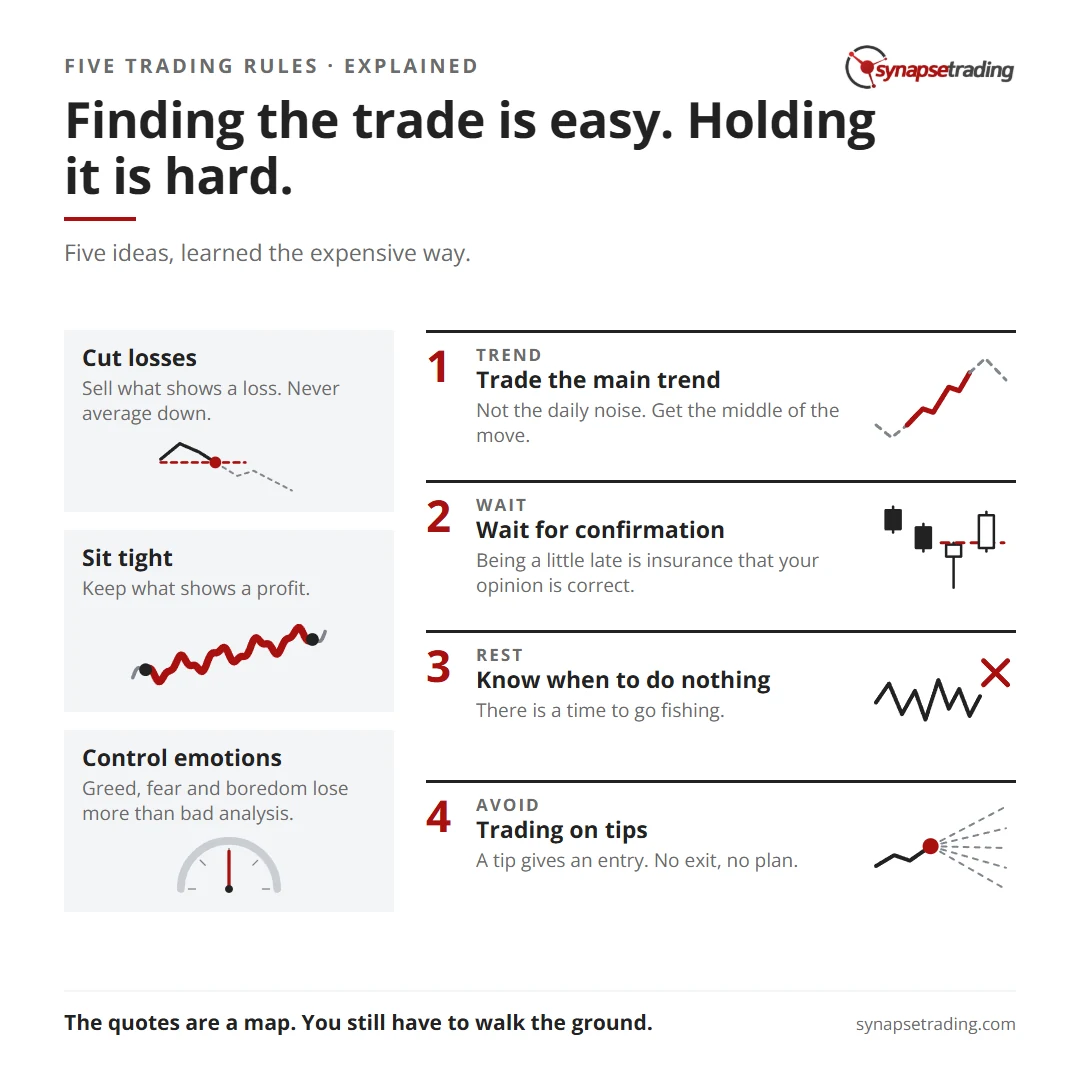
Finding the trade is easy. Holding it is hard. Summary card for the post: Best Trading Tips & Quotes from Jesse Livermore.

What are Jesse Livermore’s most important trading rules?

If you only take five things from Livermore, take these. The quotes below are his own words; the “what it means” column is the practical translation.

RuleLivermore’s wordsWhat it means in practice
Trade the trend“The big money was not in the individual fluctuations but in the main movements.”Stop scalping the noise. Position for the larger move and let it run.
Wait for confirmation“Don’t take action with a trade until the market itself confirms your opinion. Being a little late is insurance that your opinion is correct.”Let the market prove you right before you commit. Late and correct beats early and wrong.
Cut losses, never average down“Always sell what shows you a loss and keep what shows you a profit.”Take the small loss immediately. Adding to a loser is the fastest way to a big one.
Sit tight when you are right“Men who can both be right and sit tight are uncommon.”The hard part is not the entry. It is doing nothing while a winner works.
Control your emotions“Emotional control is the most essential factor in playing the market.”Greed, fear, and boredom lose more money than bad analysis ever does.

Everything else he wrote is a variation on one of these five. Here they are in full.

Trade the trend and ignore the daily noise

Livermore’s core insight is that the real money is in the main movement.

“The big money was not in the individual fluctuations but in the main movements, that is, not in reading the tape but in sizing up the entire market and its trend.”

This is the famous “Mr. Partridge” lesson from Reminiscences. An old trader kept telling everyone “this is a bull market,” and what he meant was: stop fussing over every up-tick, you are in a bull market, so be long and stay long.

“Nobody can catch all the fluctuations. In a bull market your game is to buy and hold until you believe that the bull market is near its end.”

He also told traders to stop chasing perfection at the edges:

“One of the most helpful things that anybody can learn is to give up trying to catch the last eighth, or the first. These two are the most expensive eighths in the world.”

An eighth was the old fractional price tick (stocks used to trade in eighths of a dollar). His point: trying to nail the exact top and exact bottom costs more than it ever earns. Get the middle of the move and you have done your job.
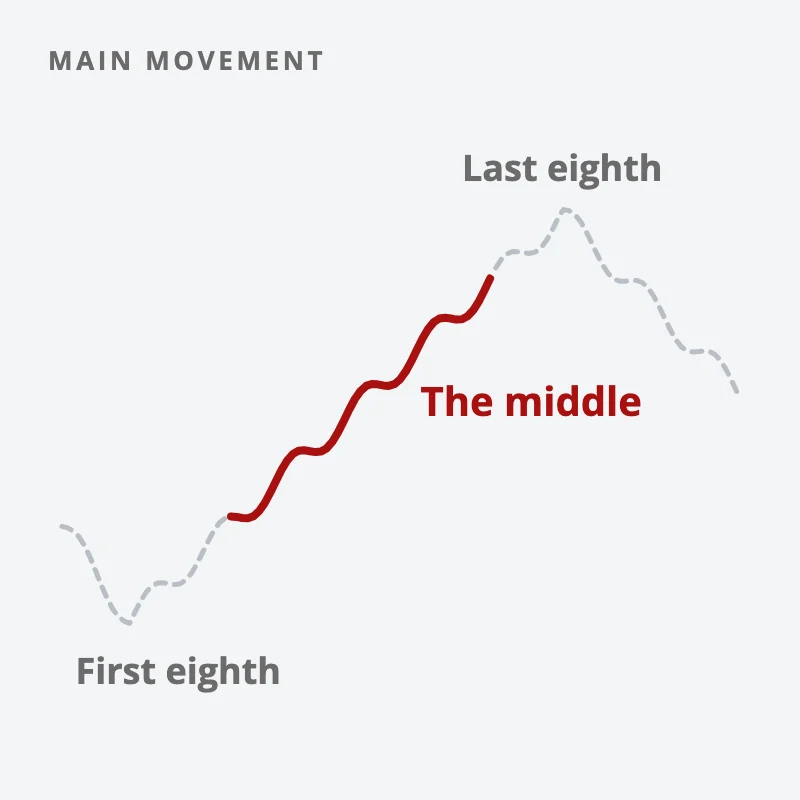
A price move rises from a bottom to a top and falls; the bottom and top stretches are grey and dashed, the middle of the rise is red
Give up the first and last eighth; getting the middle of the move is the job.

Personally, this is the Livermore lesson I lean on most. A lot of new traders confuse activity with progress. The chart moves, so they feel they should be doing something. Livermore’s answer is that the chart moving is not a reason to trade. The trend changing is.

Wait for the market to confirm you

Livermore drew a hard line between guessing and waiting.

“To anticipate the market is to gamble. To be patient and react only when the market gives the signal is to speculate.”

“Don’t take action with a trade until the market itself confirms your opinion. Being a little late in a trade is insurance that your opinion is correct. In other words, don’t be an impatient trader.”

He had a name for the spot where he would finally act: the Pivotal Point (his term for a key price level where the trend’s direction gets confirmed, the same idea we now call support, resistance, or a breakout level).

“Whenever I have had the patience to wait for the market to arrive at what I call a Pivotal Point before I started to trade, I have always made money in my operations.”

And in a sideways market, his rule was simply to wait for the range to break:

“In a narrow market, when prices move within a narrow range, there is no sense in trying to anticipate what the next big movement is going to be. The thing to do is to watch the market, determine the limits of the get-nowhere prices, and make up your mind that you will not take an interest until the price breaks through the limit in either direction.”

Do note that “being a little late” is not the same as being slow or lazy. He is saying: give up the first sliver of the move in exchange for proof the move is real. That trade is worth making every time.

Cut losses fast, and never average down

If there is one rule Livermore repeats more than any other, it is this one.

“It is foolhardy to make a second trade if your first trade shows you a loss. Never average losses. Let this thought be written indelibly upon your mind.”

“Of all the speculative blunders there are few greater than trying to average a losing game. Always sell what shows you a loss and keep what shows you a profit.”

He even confessed his own version of the mistake, the one almost every trader makes:

“I did precisely the wrong thing. The cotton showed me a loss and I kept it. The wheat showed me a profit and I sold it out.”

That is loss aversion in one sentence: we hold our losers hoping they come back, and we sell our winners to lock in a small gain. Livermore is telling you to do the exact opposite. And the loss itself is not the problem:

“A loss never bothers me after I take it. I forget it overnight. But being wrong, not taking the loss, that is what does the damage to the pocketbook and to the soul.”

Hence the order of operations he is really teaching: decide where you are wrong before you enter, write it down, and obey it without arguing. The stop is not a guess about the future. It is the line where your idea is disproven.

Sit tight when you are right

Cutting losses is half the job. The other half is the opposite skill, and Livermore thought it was rarer.

“It never was my thinking that made the big money for me. It always was my sitting. Got that? My sitting tight!”

“Men who can both be right and sit tight are uncommon. I found it one of the hardest things to learn. But it is only after a stock operator has firmly grasped this that he can make big money.”

“The market does not beat them. They beat themselves, because though they have brains they cannot sit tight.”

This is the part most people skip when they quote Livermore. Everyone loves “cut your losses.” Far fewer can run a winner without flinching out at the first pullback. He is explicit that the second skill is harder, and that it is where the big money actually lives.

“Experience has proved to me that real money made in speculating has been in commitments showing a profit right from the start.”

In other words: a good entry tends to work quickly. If a trade is dragging from the open, that is information worth acting on.

Control your emotions, and know when to do nothing

Livermore was blunt that the market is mostly a psychology test.

“Emotional control is the most essential factor in playing the market. Never lose control of your emotions when the market moves against you. Don’t get too confident over your wins or too despondent over your losses.”

“Instead of hoping he must fear, and instead of fearing he must hope. He must fear that his loss may develop into a much bigger loss, and hope that his profit may become a big profit.”

That line is worth re-reading. Most traders feel hope on their losers (it will come back) and fear on their winners (I had better take this before it vanishes). Livermore says flip both.

He was equally clear that not trading is a position.

“There is a time to go long. There is a time to go short. There is a time to go fishing.”

“Remember this: when you are doing nothing, those speculators who feel they must trade day in and day out are laying the foundation for your next venture. You will reap benefits from their mistakes.”

“Play the market only when all factors are in your favour. No person can play the market all the time and win.”

The enemy he names is the urge to act for the sake of acting:

“The desire for constant action irrespective of underlying conditions is responsible for many losses on Wall Street, even among the professionals, who feel that they must take home some money every day, as though they were working for regular wages.”

This is the single most useful idea for a part-time trader. You do not get paid for screen time. Sitting on your hands through a market with no edge is not laziness. It is the discipline that funds the trades that do have an edge.

Think for yourself, and don’t believe in tips

Livermore had no patience for traders who outsource their decisions.

“A man must believe in himself and his judgement if he expects to make a living at this game. That is why I don’t believe in tips.”

“If I buy stocks on Smith’s tip I must sell those same stocks on Smith’s tip. I am depending on him. Suppose Smith is away on a holiday when the selling time comes around?”

That second quote is the whole problem with tips in one image. A tip gives you an entry and nothing else. No exit, no plan, no way to manage the trade when it moves. He was just as hard on people who read about trading and confused it with doing it:

“The semi-sucker had read books about trading, usually written by yet higher grade suckers, but he did not realise that reading books was not the same as trading experience.”

Yes, that includes posts like this one. Reading Livermore is not trading Livermore. The quotes are a map. You still have to walk the ground.

Where the human edge comes in

A scanner will find Livermore’s Pivotal Point for you in a second. An algorithm can flag the breakout, draw the trend, and even size the position. What no tool will do for you is sit tight through a winner you are itching to close, take the small loss without arguing with the screen, or go fishing in a market that offers you nothing. Every rule Livermore wrote is about behaviour. The price action is just where the behaviour shows up. The pattern is the easy part. The discipline to follow your own plan when fear and hope are both pulling at you is the judgment, and it is the first of the Five Edges no machine can trade for you. Livermore figured that out a century ago, with a pencil and a ticker tape.

FAQ

What is Jesse Livermore’s most famous trading quote?
“It never was my thinking that made the big money for me. It always was my sitting.” It captures his core lesson: holding a good position is harder, and more profitable, than finding one.

What were Jesse Livermore’s main trading rules?
Trade the main trend rather than daily noise, wait for the market to confirm your opinion before acting, cut losses quickly and never average down, sit tight while a winner runs, and keep tight emotional control. He also refused to trade on tips, insisting traders rely on their own judgement.

What did Livermore mean by a “Pivotal Point”?
A Pivotal Point was Livermore’s term for a key price level where the trend’s direction is confirmed. He would wait for price to reach that level before entering, which maps onto what modern traders call support, resistance, and breakout levels.

Did Jesse Livermore really say “sell down to the sleeping point”?
The line comes from a story he tells of a trader who could not sleep because of an oversized cotton position. The advice was to “sell down to the sleeping point.” The lesson: if a position is too big to let you rest, it is too big, so cut it until you can.

Are Livermore’s rules still relevant today?
Yes, because they are about human behaviour, which has not changed. As he put it, “There is nothing new on Wall Street. What has happened in the past will happen again, because human nature does not change.” Greed, fear, and impatience still move markets the same way.


Now that you have his rules in one place, which one is hardest for you to follow? For me it is sitting tight on a winner. Let me know in the comments.

If you want to see how these timeless ideas turn into a repeatable modern method, start with the pillar: The Definitive Guide to Trading Psychology and Discipline.

Want the system behind the discipline? Grab the free 15-Minute Swing Trading Starter Kit. It’s the exact routine I use to scan once a day and trade any market in 15 minutes, stop-loss written before I enter, just like Livermore taught.


About the author. Spencer Li is The 15-Minute Trader and the founder of Synapse Trading. He is a Certified Financial Technician (CFTe) with 15+ years of trading, run from 70+ countries. He holds a B.Acc and B.BM from SMU. Every trade he takes is public, dated, losses left in. He teaches rules-based swing trading in 15 minutes a day, one system for any market.

Education, not financial advice. Synapse Trading is not licensed by MAS to advise on investment products. Trading carries risk of loss; past performance is not indicative of future results.


Related

Definitive Guide to Trading Psychology and Discipline · Best Trading Tips and Quotes from Legendary Top Traders · How to Cut Losses and Let Winners Run · Reminiscences of a Stock Operator: Book Summary
by Spencer Li
https://synapsetrading.com/wp-content/uploads/2026/10/trading-tips-jesse-livermore-card.webp 630 1200 Spencer Li https://synapsetrading.com/wp-content/uploads/2026/10/synapse-logo-horizontal-light.png Spencer Li2022-07-24 01:17:302026-10-22 13:26:59Best Trading Tips & Quotes from Jesse Livermore
Spencer Li

How to Profit from a Short Squeeze (aka. Bear Trap)?

Trading Strategies & Systems
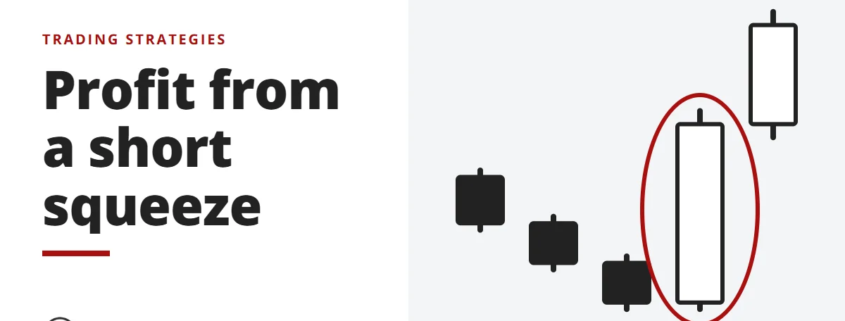
Profit from a short squeeze - trading strategies

What is Short Selling?

Before talking about what a short squeeze or bear trap is, we first need to understand the concept of short selling a stock.

Normally, investors buy stocks when they expect prices to go up, so that as the stock prices increase, they can then sell the stocks they own at a higher price, and make a profit.

However, what if they expect the stock price to go down?

For example, they might think that the stock price is over-valued, or that the fundamentals are in shambles, and thus feel that in the long-run the stock price should decrease.

How then would they profit from this?

Besides using financial derivatives such as stock options or CFDs, one common method traders use is to borrow the stocks from someone (an investor who owns the stocks), and then sell those stocks in the market.

By selling stocks they do not own (the borrowed stocks), they will need to buy the stocks back to return the stocks to the person who lent it to them.

The idea is that when the time comes to buy back those stocks, the price of the stocks would have fallen, so it would be cheaper for them to buy it back.

Effectively, by “selling high” and then “buying low”, they are able to profit from the difference.

Of course, there are risks involved, like if the stock prices goes up instead going down, then they would be forced to cover (buy back) those borrowed shares at a higher price.

And if a short squeeze happens, they could potentially lose a lot of money.

When you buy a stock, the price cannot go below zero, so the maximum you can lose is your investment.

But with a short position, there is no limit to how high the stock can continue climbing, which means the losses can snowball to more than your original investment, hence the short squeeze (bear trap).


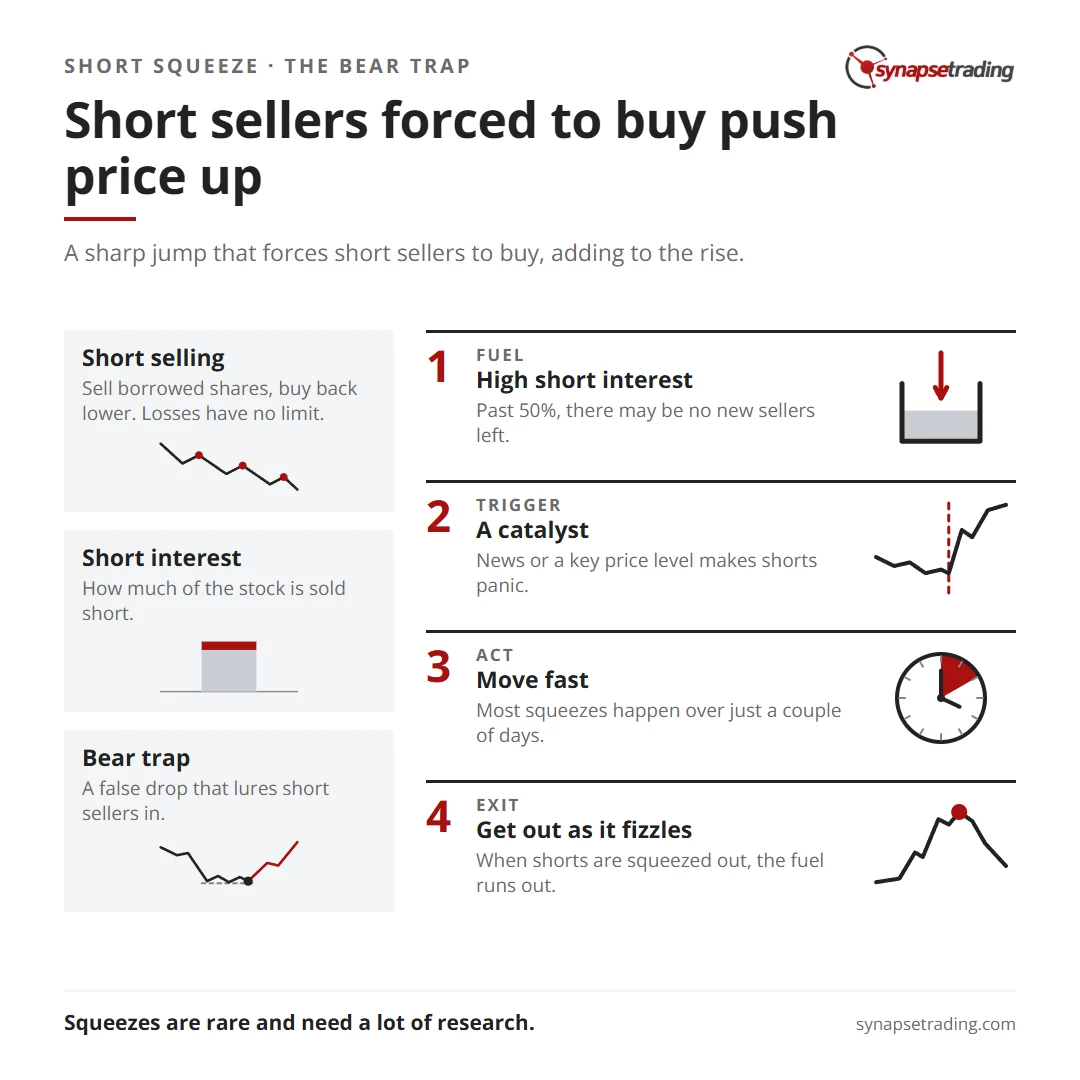
Short sellers forced to buy push price up. Summary card for the post: How to Profit from a Short Squeeze (aka. Bear Trap)?.

What is Short Interest?

Now that we understand the concept of short selling, how do we know which stocks are being heavily shorted? (And have potential for a short squeeze?)

We can look at this statistic called the short interest, which shows the quantity of shares outstanding that are currently sold short, which means the short sellers will need to buy these stocks back at some point of time, or if there is a short squeeze (bear trap).

This number can either be expressed as the absolute number of shares that are currently short, or if it is expressed as a percentage, then it shows how many percent of the total outstanding shares are short.

For example, 5 million shares out of 100 million outstanding shares, or 5% if it is expressed as a percentage.

In general, the short interest gives you a benchmark of the market sentiment for this stock.

If there is a lot of short interest, it means people are generally bearish about this stock, so the fundamentals might be bad or hedge funds are heavily building short positions.

If the short interest reaches an extreme point, such as short interest percentage exceeding 50%, then it could signal that “everyone who has wanted to short has shorted”, and lead to a lack of new sellers.

This could also mean that the stock is ripe for a short squeeze, because if there are little new sellers, all it takes is for new buyers to come in to tips the scales and cause a snowball effect.

If you are looking for this data, stock exchanges usually report short interest monthly for the stocks they list. The NASDAQ publishes a short interest report in the middle and also at the end of every month.


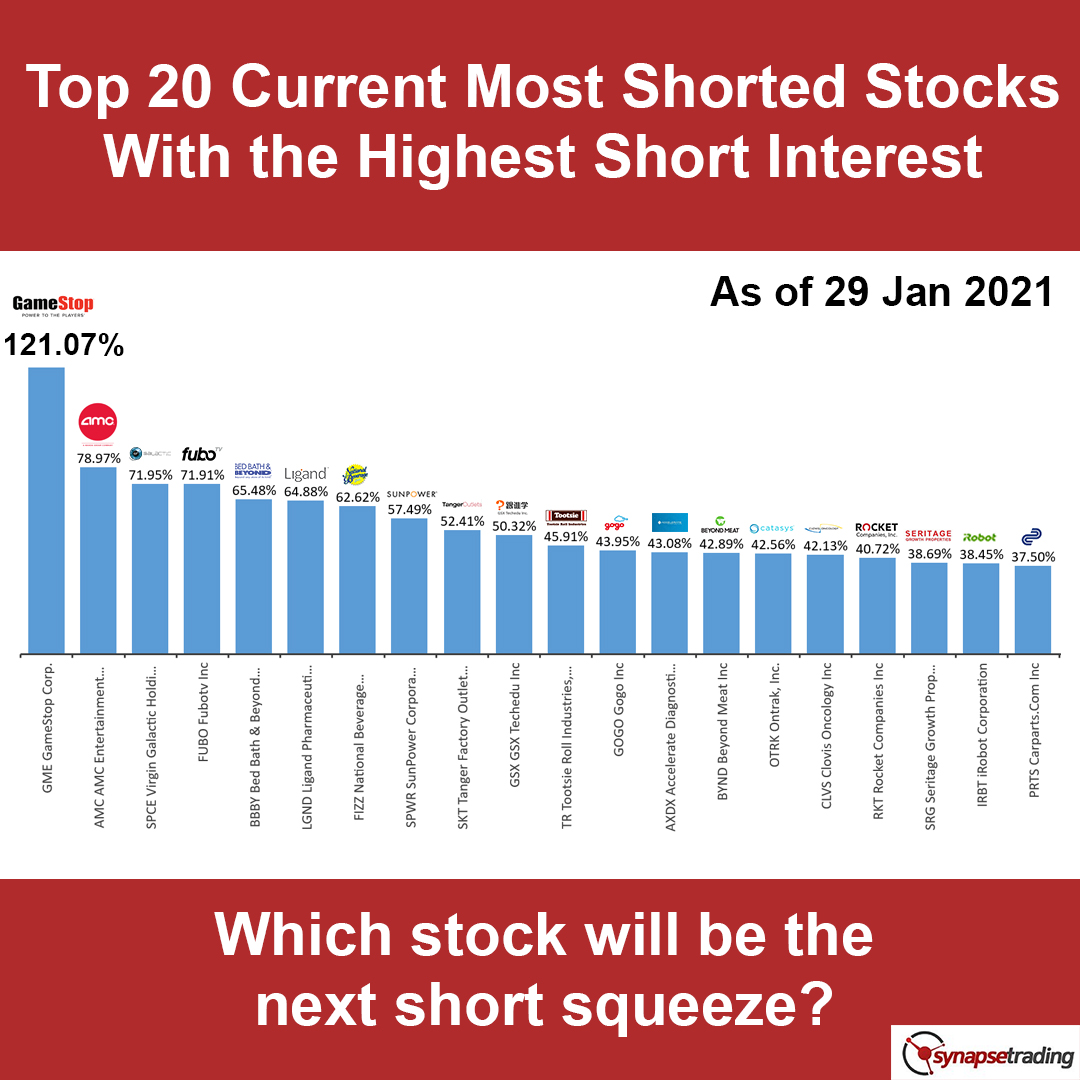
What is Short Interest


For example, these stocks with a very high short interest make them more susceptible to a short squeeze (bear trap), which was what happened when traders on r/wallstreetbets decided team up to push some stocks (Gamestop, AMC, etc) up, triggering a short squeeze on them.

What is a Short Squeeze (Bear Trap)?

A short squeeze happens when a stock jumps sharply, forcing short sellers to buy it in order to prevent even greater losses. Their scramble only adds to the upward pressure on the stock’s price.

A bear trap is a false technical bearish signal for price to continue falling in a down swing on a chart to new lower prices that lures in short sellers. Bear traps catch short sellers chasing a price lower which reverses causing shorts to cover and leads to more buying and momentum to the upside.

A bear trap usually starts with price moving lower sharply and creates expectations of a continued downtrend on the chart. Instead, the price of the chart can go sideways in a range and eventually rally higher causing short sellers to be trapped on the wrong side of the move and to incur losses.

Bear traps are usually short squeezes, when a big rally to the upside happens during a downtrend in a market due to a lack of sellers at lower prices. This combines with the need for short sellers to buy to cover due to the reversal in the market trend creating heat on their positions.

Short squeezes gain momentum as more short sellers are forced to buy to cover their positions at higher prices resulting in increased trading volume on the reversal. The pressure on the short sellers to buy back their positions can be amplified by margin calls, trailing stops, and stop losses being triggered on their trades. The short sellers create buying pressure because they have to buy back the shares or contracts they are short to cover during the swing higher in price. Most short squeezes that are bear traps result in very fast and powerful moves to the upside.

If a stock has a high short interest ratio, and large amounts of shares outstanding as short interest, then a bear trap is more likely to occur. The probability increases further if the market has an extremely bearish sentiment and a large amount of a stock’s float is short.

If sellers get exhausted after a long downtrend, and the market reaches maximum bearish sentiment, and if all these happens at a price level where traders and investors prefer to hold their positions instead of selling, then it could become a strong support level, where a bear trap could be set.

Catalysts for a Short Squeeze (Bear Trap)

As we mentioned earlier, a high short interest will provide the fuel for a short squeeze, but to ignite the flames, we need a trigger, or a catalyst.

This can be a fundamental catalyst like a management change, or a launch of a new product, an expansion, etc, or it could be a technical catalyst like price hitting a key price support level or breaking a new 52-week high, etc.

Either way, the gains triggered by the catalyst need to be significant enough so that the short sellers will panic and race to cover their short positions. Depending on the history of the stock and its volatility, this “critical mass” gain can be as small as 1-2%, or can go up to 5-10% for more volatile stocks.

One way to find fundamental catalysts is to browse newspaper or online sources for press releases, or scheduled events. These could be things like a new product launch, a product safety test report, a transition of management, etc.

The key thing is to look for events that can potentially move the stock price significantly in a short period of time, especially if based on your research, the outcome could turn out very different from what everyone else is expecting.

In short, we are looking for a potential large deviation from the consensus expectations.

Trading the Short Squeeze

Trading a short squeeze or bear trap is not a simple set-it-and-forget-it strategy. This is because short squeezes happen fast.

A short squeeze doesn’t take place over the course of months or years. Most happen over just a couple of days, so if you want to trade the short squeeze, you need to act fast once you see the opportunity, or you could miss the whole event entirely.

The moment the short squeeze starts happening, you need to watch the price movements of the stock very carefully. The idea is to ride the momentum of the price movement for as long as possible.

There might be small pullbacks from profit-taking along the way, and eventually as most of the short sellers are squeezed out, the fuel for the movement runs out, and the momentum will start to fizzle. This is the point where you want to get out as fast as possible before the party ends.

Though trading short squeezes or bear traps can be very profitable, they are also some downsides:

  • The right confluence of events, fuel and catalysts do not happen often
  • The squeeze might not happen if your research is wrong
  • You might miss the move or might not sell out in time

Ultimately, you will need to do a lot of research to find these rare opportunities, but if you get good at it, a handful of such trades a year is all you need to make decent returns.

by Spencer Li
https://synapsetrading.com/wp-content/uploads/2026/10/short-squeeze-bear-trap-card.webp 630 1200 Spencer Li https://synapsetrading.com/wp-content/uploads/2026/10/synapse-logo-horizontal-light.png Spencer Li2021-03-05 00:47:132026-10-04 12:38:46How to Profit from a Short Squeeze (aka. Bear Trap)?
Spencer Li

5 Biggest Day Trading Mistakes that Beginners Make

Trading Strategies & Systems
Five beginner day trading mistakes - day trading

Day Trading for Beginners: The 5 Mistakes That Blow Up New Traders

Last updated: 12 August 2026 · By Spencer Li, CFTe


New day traders lose to professionals for five repeatable reasons, and none of them is a lack of talent. They trade without a written plan, they skip the practice reps, they hold losers and overtrade and revenge-trade, they scale up their size too fast out of greed, and they go it alone with no mentor or community. Fix those five and you remove most of the ways a beginner blows up an account. The pros I sat next to in a private equity fund, traders moving millions with 20 and 30 years behind them, were not faster or smarter on any single trade. They were just disciplined on all five of these at once, every day, without drama. That consistency is the entire edge.

Here is each mistake, why it kills accounts, and the specific fix I teach.

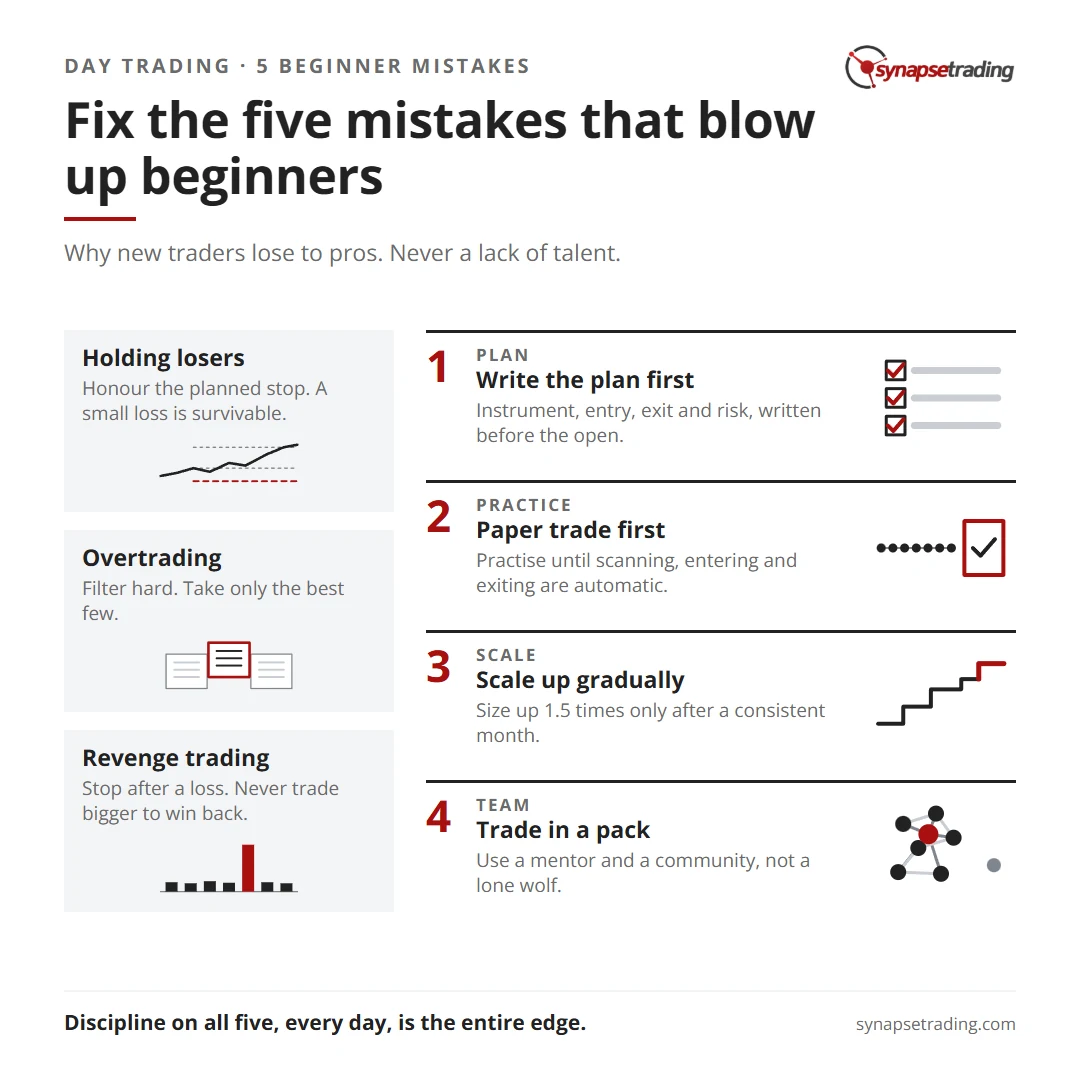
Fix the five mistakes that blow up beginners. Summary card for the post: 5 Biggest Day Trading Mistakes that Beginners Make.

Why do beginners lose to professional traders?

Back when I was trading professionally in a private equity fund, I sat next to veteran traders with decades of experience moving millions of dollars. I also watched a lot of new traders come and go. The losers were not unlucky. They made the same handful of mistakes, in the same order, over and over.

The difference was never one brilliant trade. The professionals had a plan before the open, took only their best setups, cut losses without arguing, sized up slowly, and shared ideas in a team. The beginners did the opposite on all five counts. So the question is not “how do I find the perfect strategy.” It is “which of these five am I still doing, and can I stop.”

Mistake #1: trading with no solid trading plan

The trading plan is the foundation of everything else. Once the market opens and prices are moving and the charts are flashing, it gets emotional fast. In that state you should be doing one thing only: executing. All your focus and energy goes into clean execution, not deciding what to do.

That only works if the deciding is already done. Before the market opens, before your first trade, your plan should already answer four questions:

  • What you are going to trade (the instrument and the strategy).
  • Where you enter (your trading style and entry trigger).
  • Where you exit (both your stop and your target).
  • How much you risk per trade.

Write those down before the open. Then the moment a trade sets up, there is no fresh decision to make under pressure. You are just executing a plan you wrote when you were calm.

Mistake #2: not enough practice before going live

Think back to learning to drive. You did not get in the car and pull onto the highway. You first learned what each button and lever does, because you cannot steer through traffic and figure out the controls at the same time.

Trading is the same. When the market is in session you want full attention on executing the plan, not on “how do I key in this order” or “which button submits.” If you are fumbling the mechanics, you will fumble the trade.

So get the reps in before real money is at risk. Paper trade or use a virtual account until the whole process, scanning, entering, setting the stop, exiting, is automatic. You are buying familiarity without paying for it in losses. The market will still be there when you are ready.

Mistake #3: the wrong psychology

This is the big one, and it has three faces.

You cannot cut losses. Most of us carry loss aversion, a cognitive bias where losing money hurts more than the equivalent gain feels good. So new traders hold a losing trade even when they know they are wrong. Your plan already has a stop loss level. If you honour it, a loss is small and survivable. If you do not, the loss snowballs and one position can take the account.

You overtrade. Beginners see an opportunity in every wiggle. They are afraid of missing out, so they take everything. Professionals do the opposite: they deliberately filter out as many bad trades as possible and zoom in on only the very best ones. Fewer trades, higher quality, is the professional mentality.

You revenge-trade. You take a loss, and instead of stopping for the day, you try to win it straight back. Now you are not executing a plan, you are trying to “teach the market a lesson.” Every decision after that gets worse. The market does not know you exist, and it will happily take the rest of your account while you are angry at it.

Here is the amateur-versus-professional split laid out plainly:

SituationAmateur reactionProfessional reaction
Trade goes against youHold and hope, move the stopCut at the planned stop, no debate
Many setups on the screenTake most of them (FOMO)Filter hard, take only the best few
Just took a lossTrade bigger to win it backStop, rest, fight another day
A winning streakFeel like a genius, size up fastStay the same size, trust the process

Notice that none of the professional reactions require a better forecast. They require holding your rules when emotion says break them.

Mistake #4: being too greedy and scaling up too fast

Every skill in life is learned step by step. You learn to swim in the shallow end, not by jumping into the deep end. Trading is no different, but greed pushes people to skip the steps.

The pattern is familiar. A new trader makes a little money and starts to feel like a genius. Every trade turns to gold, so they think: if I can make $50 a day, why not size up and make $500, then $5,000? So they keep scaling aggressively.

A veteran trader once told me the thing that stuck with me most: all it takes is one bad trade. It does not matter if you have traded for 10, 20, or 30 years. Break your rules on one oversized position and that single trade can blow up the whole account. You hear these stories all the time, someone makes a fortune, ignores their rules once, and gives it all back.

Do not let greed run the show. You stay in control of the size, not the other way around.

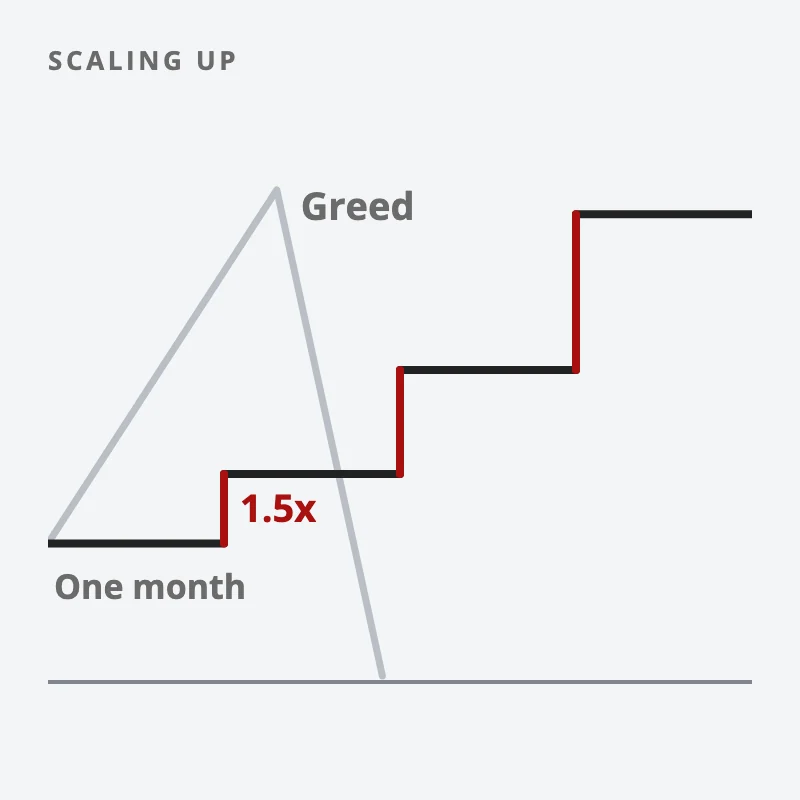
The fix is to scale gradually. A simple rule: scale up by 1.5 times only after a full month of consistency. Trading a $10,000 account and consistent for a month? Move to $15,000. Consistent for another month? Scale by 1.5 again. If your consistency drops, scale back down (say to $10,000) until your confidence returns. The point is gradual, earned increases, not arbitrarily multiplying your size because you had a good week.

Position size climbs in steps of 1.5 times, one step per consistent month, while a greedy jump shoots straight up and crashes
Scale up 1.5 times only after a consistent month, never out of greed.

Mistake #5: the lone wolf mentality

The last one is going it completely alone. Movies sell you the solo genius trader who ignores everyone, trades alone, makes a fortune, and makes a lot of enemies. It looks great on screen.

Nature tells a different story. Watch any wildlife documentary and wolves hunt in a pack, because that is when they are most effective. The lone wolf, in reality, gets eaten.

Trading in a community works the same way. If you have a mentor and a group of traders, there is no reason to be selfish about it. If you spot a good opportunity and share it, you do not earn less, everyone can take the same trade, and when others find a setup they share it back. When I traded on a professional team, we shared ideas constantly and everyone ended up with more good trades, not fewer. You also learn from each other’s mistakes, which means you avoid making them yourself.

Think in terms of abundance, not scarcity. The market is big enough for everyone at your table.

Where the human edge comes in

A scanner will flag setups for you all day, and these days an AI can summarize any strategy you like in seconds. What none of that supplies is the discipline to cut the loser at your stop, the restraint to skip the trade you want to take, or the patience to scale up over months instead of weeks. The information was never the hard part. Sizing, psychology, and discipline are, and that is the part of trading no tool can do for you. It is why I frame trading around the Five Edges a machine cannot trade on your behalf.

The 5 mistakes, summed up

  1. Trade with a solid plan written before the open.
  2. Practice (paper trade) until the mechanics are automatic.
  3. Build the right psychology: cut losses, do not overtrade, never revenge-trade.
  4. Scale up gradually (1.5x per consistent month), never out of greed.
  5. Trade in a pack, not as a lone wolf. Use a mentor and a community.

FAQ

Why do most beginner day traders lose money?
Not from bad luck or low intelligence. They lose for five repeatable reasons: no written trading plan, too little practice before going live, poor psychology (holding losers, overtrading, revenge-trading), scaling up size too fast out of greed, and trading alone with no mentor or community.

What is the single biggest day trading mistake?
The inability to cut losses. Loss aversion makes new traders hold a losing trade even when they know they are wrong, and an uncut loss can snowball until it takes the whole account. Honour the stop loss in your plan, every time.

Should beginners paper trade before using real money?
Yes. Paper trading or a virtual account lets you make the process, scanning, entering, setting stops, exiting, automatic without risking money. Like learning the car’s controls before driving in traffic, you do not want to learn the mechanics and manage a live trade at the same time.

How fast should I scale up my trading account?
Slowly. A practical rule is to increase your account or position size by 1.5 times only after a full month of consistency, then repeat. If your consistency drops, scale back down until your confidence returns. One oversized trade that breaks your rules can blow up an account no matter how experienced you are.

Do I need a trading community or mentor to succeed?
You do not strictly need one, but going it alone is the harder road. A mentor and a community give you more ideas, faster feedback, and a way to learn from other people’s mistakes instead of paying for every lesson yourself. Sharing a setup does not mean you earn less; everyone can take the same trade.


So those are the five mistakes that take out most beginners before they get going. Which one were you still making? Let me know in the comments.

And if you want the full starting roadmap, read the pillar: The Beginner’s Guide to Trading and Technical Analysis.

Want the system, not just the warnings? Grab the free 15-Minute Swing Trading Starter Kit. It is the exact routine I use to scan once a day and trade any market in 15 minutes, with the plan and risk rules built in.


About the author. Spencer Li is The 15-Minute Trader and the founder of Synapse Trading. He is a Certified Financial Technician (CFTe) with 15+ years of trading, run from 70+ countries. He holds a B.Acc and B.BM from SMU. Every trade he takes is public, dated, losses left in. He teaches low-risk swing trading in 15 minutes a day, one system for any market.

Education, not financial advice. Synapse Trading is not licensed by MAS to advise on investment products. Trading carries risk of loss; past performance is not indicative of future results.


Related

The Beginner’s Guide to Trading and Technical Analysis · Trading psychology and discipline · How to build a trading plan · Risk management and position sizing

by Spencer Li
https://synapsetrading.com/wp-content/uploads/2026/10/day-trading-beginner-card.webp 630 1200 Spencer Li https://synapsetrading.com/wp-content/uploads/2026/10/synapse-logo-horizontal-light.png Spencer Li2021-02-27 22:15:382026-10-22 13:33:075 Biggest Day Trading Mistakes that Beginners Make
Spencer Li

How to Pick the Market Bottom (As Well As Market Tops)

Trading Strategies & Systems
Picking tops and bottoms - market timing

There is a common fallacy amongst many investors that because you cannot time the exact market tops and market bottoms in the stock market, therefore you cannot time the market at all, and market timing should be avoided.

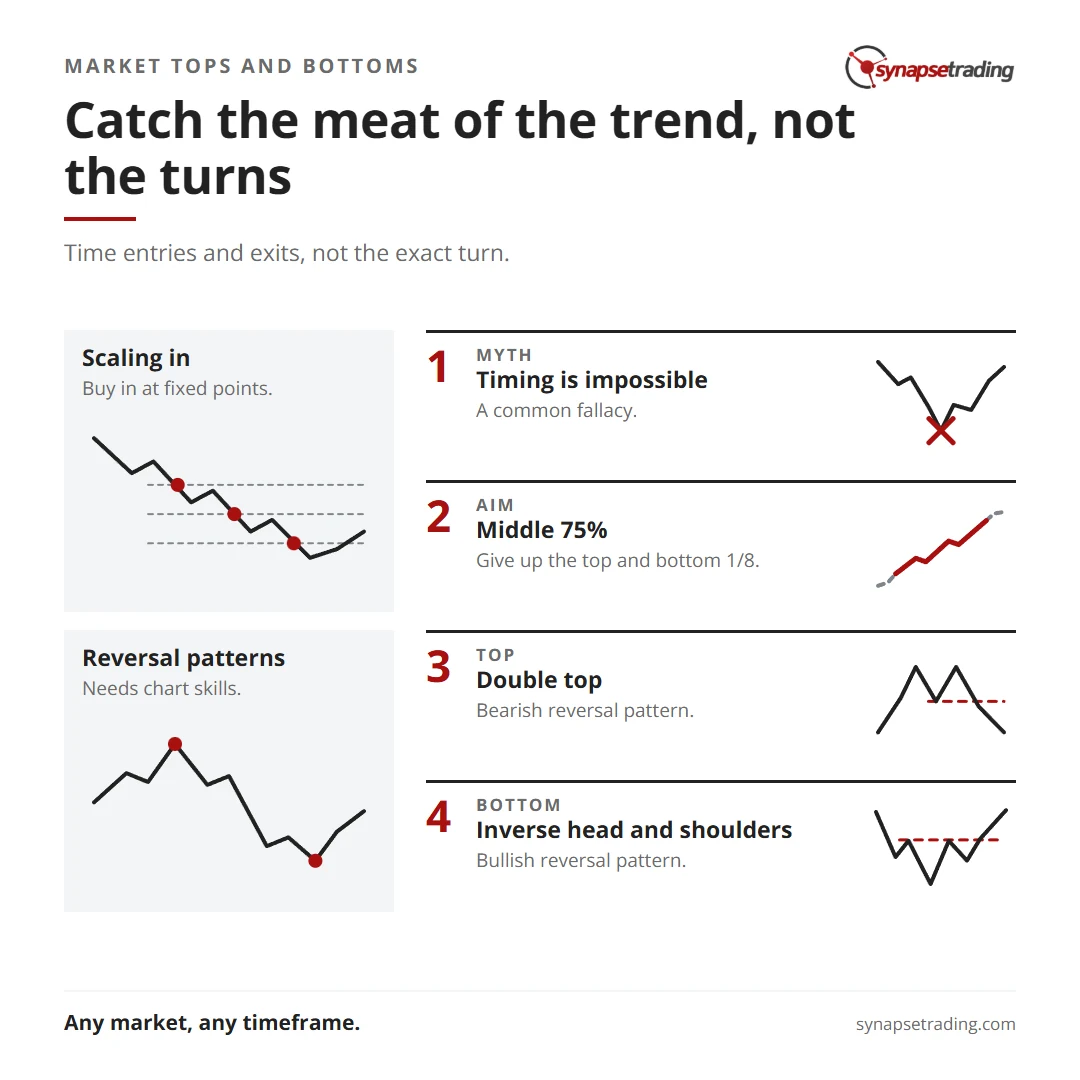
Catch the meat of the trend, not the turns. Summary card for the post: How to Pick the Market Bottom (As Well As Market Tops).

This is simply not true.

While it is impossible to buy at the exact market bottom and sell at the exact market top, it is definitely possible to time your entries and exits to minimise your risk and maximise your returns.

A wise trader once told me that if you want to time the market, you must be willing to give up the top 1/8 and the bottom 1/8 of any move.

This means that instead of trying to capture the precise turning points in the market, we should focus on capturing the remaining 75% of the move, which forms the meat of every trend.

This is true not just for the stock market, but also very relevant to any market, like forex, commodities, etc. It also works on any timeframe, such as swing trading, intraday trading, position-trading, etc.

In this video, I share 2 simple strategies that a new investor or trader can use to pick tops and bottoms easily.

The first method has to do with scaling in, which is similar to dollar-cost averaging.

By studying how much stock markets usually decline (30-60% during corrections, you can allocate your capital to buy in at certain fixed points, such as the 30% mark, the 40% mark, the 50% mark, etc.

This allows you a low-risk way to buy in near the bottom, and the best part is that you do not even need any knowledge about how to read charts or how to analyse price trends.

The second method requires a bit more skill, as you will need to be familiar with technical analysis and reversal chart patterns.

By identifying bearish reversal chart patterns (such as the double top at the 2008 top), as well as bullish reversal chart patterns (such as the inverse head and shoulders pattern at the 2009 bottom), you will be able to time your trade near the top and bottom of every major move.

Enjoy the video, and remember to “like” and “subscribe”!

by Spencer Li
https://synapsetrading.com/wp-content/uploads/2026/10/pick-market-bottom-card.webp 630 1200 Spencer Li https://synapsetrading.com/wp-content/uploads/2026/10/synapse-logo-horizontal-light.png Spencer Li2020-05-06 21:59:522026-09-09 07:32:42How to Pick the Market Bottom (As Well As Market Tops)
Spencer Li

How to Trade the News (Especially When There is Too Much Market News)

Trading Strategies & Systems
Trading when news floods in - trading strategies

Quite often, when we dive into the financial market, we find that there is simply too much market news. When we try to trade the news, we have no idea what is important or trivial, because we are so overloaded with information. This makes news trading quite an impossible task.

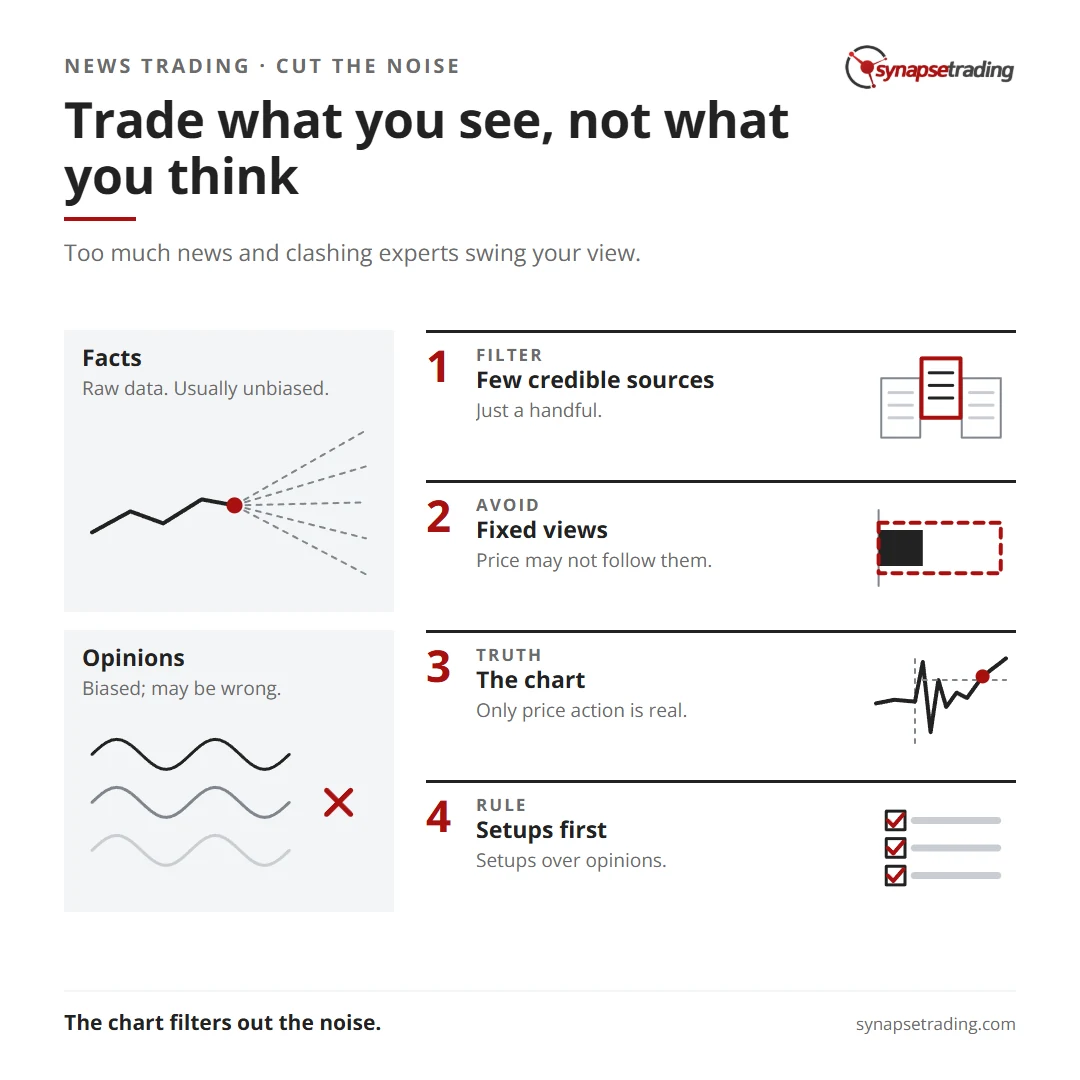
Trade what you see, not what you think. Summary card for the post: How to Trade the News (Especially When There is Too Much Market News).

To make matters worse, we often get conflicting views from experts, with some being bullish all the time, while others are bearish all the time. And because some of them have pretty convincing arguments, we easily get swayed and our own opinions tend to fluctuate from extremely bullish to extremely bearish.

So what is the way around this?

The first thing you need to know as a trade relying on market news is to be able to differentiate between FACTS and OPINIONS.

Facts are like raw data, statistics, research from credible sources, economic data, etc. These are usually unbiased and come without opinions, and provide the basis for you to form your opinion.

Opinions, on the other hand, are views formed based on the analysis of facts/data, so there is inherent bias, and the conclusions drawn from the data may or may not be correct. Hence as a trader or investor, we need to zoom in on a handful of credible sources of good analysis.

The second thing you need to know when doing news trading is to “trade what you SEE, not what you THINK”.

Opinions often give you preconceived notions or views on the market, for example you might think that the market is bullish, and hence it should go up. However, in reality, the market may not move according to your opinion.

The only reality in the market is what we see on the charts, which is the price action of the market.

No matter how bullish you think the market is, the truth is that you will not be able to make money unless the price actually moves up. So when it comes to trading, your strategies, setups and analysis of the chart should take precedence over your opinions.

And that will help you filter out all the unnecessary noise in the market to zoom in on the best trading opportunities.

Enjoy the video, and remember to “like” and “subscribe”!

by Spencer Li
https://synapsetrading.com/wp-content/uploads/2026/10/too-much-news-card.webp 630 1200 Spencer Li https://synapsetrading.com/wp-content/uploads/2026/10/synapse-logo-horizontal-light.png Spencer Li2020-04-30 14:54:072026-09-07 14:18:50How to Trade the News (Especially When There is Too Much Market News)
Page 6 of 12«‹45678›»

Free checklist

The 15-Minute Swing Trader’s Checklist

The daily and weekly routine I use to find, manage and review trades in about 15 minutes a day, trading since 2007.

Get the free checklist

Topics

  • Trading foundations
  • Technical analysis
  • Strategies and systems
  • Risk and money
  • Trading psychology
  • Markets and products

Synapse Trading

Swing trading for busy professionals, in 15 minutes a day.

Start free

Learn

  • Start here
  • Free trading guides
  • Blog
  • Tools and resources

Programs

  • Trading Mastery Program
  • Daily trading signals
  • Student results
  • Public trade log

Company

  • About
  • Contact me
  • Partnerships
  • Disclaimer
  • Privacy policy
  • Terms & Conditions

Synapse Trading Pte Ltd
Registration No. 201316168H
WhatsApp +65-8897-1204
info@synapsetrading.com

Contact Us

Synapse Trading Pte Ltd
Registration No. 201316168H

Whatsapp: +65-8897-1204
Telegram: @iamrecneps
Email: info@synapsetrading.com

Links

Disclaimer
Privacy policy
Terms & Conditions
Contact us
Partnerships

© 2012-2026 Synapse Trading | All rights reserved. Educational content only, not personalised financial advice. Trading carries risk, including loss of capital. Past performance is not indicative of future results. Synapse Trading is not licensed or regulated by MAS.
  • Link to Facebook
  • Link to X
  • Link to Instagram
  • Link to Youtube
  • Link to LinkedIn
  • Link to Mail
Scroll to top Scroll to top Scroll to top