

Atomic Habits Summary: James Clear’s Four Laws, Applied to Trading
Want the daily routine? Get the free 15-Minute Swing Trader’s Checklist. Get it free →
Tiny habits, repeated, beat big goals. Here is how the book’s 4 laws turn into a trading routine you will actually keep
Published: 17 October 2026 · Last updated: 17 October 2026 · By Spencer Li, CFTe
What is Atomic Habits about? James Clear’s book argues that real change comes from small habits repeated every day, far more than from big goals or bursts of motivation. A 1% improvement looks like nothing on the day. Compounded over a year, it adds up to a different person.
His most quoted line sums up the approach: “You do not rise to the level of your goals. You fall to the level of your systems.” The book then gives 4 laws for building a good habit: make it obvious, make it attractive, make it easy, and make it satisfying. Turn each one around, and you have 4 ways to break a bad habit.
For traders, the book is unusually practical. Trading results come from the same few actions done well, day after day: a routine, a checklist, a journal entry, a stop that stays where it was placed.
What is the big idea of Atomic Habits?
Clear opens with the British cycling team. For decades it had almost nothing to show. Then a new performance director set out to improve every small thing by 1%: seats, tyres, recovery, even how riders washed their hands. Within a few years, the team was winning Olympic gold medals and Tour de France titles.
The arithmetic behind it is simple. Getting 1% better every day for a year leaves you about 37 times better. Getting 1% worse every day leaves you close to zero. In Clear’s words: “Habits are the compound interest of self-improvement.”
He adds a warning that every trader will recognise. Progress is invisible for a long time. His image is an ice cube in a cold room. The room warms from 25 degrees to 26, 27, 28, and nothing happens. Then at 32 degrees the ice starts to melt. “All the action happens at thirty-two degrees.”
That is the trader’s experience too. A new routine shows nothing for weeks, because a few trades tell you almost nothing about a method. It takes 100 to 200 trades before results say much, which our post on the law of large numbers in trading explains.
Why does Clear say systems beat goals?
Because winners and losers have the same goals. Every trader wants to be profitable. So the goal cannot be what separates them. The system can.
Clear does not say goals are useless. He says: “Goals are good for setting a direction, but systems are best for making progress.” His issue is with where the effort goes.
For a trader, a goal is “make 20% this year.” A system is the routine that produces the trades: when you scan, how you check a setup, where the stop goes, how you record the result. You cannot control the first. You can control the second every single day.
He also ties habits to identity. “Every action you take is a vote for the type of person you wish to become.” Each time you honour a stop, you cast a vote for being a disciplined trader. Each time you move it, you cast a vote for the other kind.
What are the 4 laws of behaviour change?
Here are Clear’s 4 laws, each with its inversion for breaking a bad habit, and a trading example of both.
| Law | To build a good habit | Trading example | To break a bad habit | Trading example |
| 1st | Make it obvious | Checklist printed and placed beside the screen | Make it invisible | Trading app moved off the phone’s home screen |
| 2nd | Make it attractive | Journal entry paired with the morning coffee | Make it unattractive | A written note of what the last revenge trade cost, in R |
| 3rd | Make it easy | Watchlist saved, so the scan starts in 1 click | Make it difficult | 1-minute charts removed from the default layout |
| 4th | Make it satisfying | A tick on the calendar for every day the rules were followed | Make it unsatisfying | A trading partner who sees every rule break |
Two tools from the book do most of the work.
Implementation intentions. Clear’s formula is one sentence that names the behaviour, the time and the place you will do it. He cites a 2001 study of 248 people in Britain. Among those who wrote down when and where they would exercise, 91% exercised at least once a week. In the other groups it was 35% to 38%. A plan with a time and place works far better than good intentions.
Habit stacking. You tie the new habit to one you already do, in the form “after this, I will do that.” For example: after I pour my first coffee, I will open the trading checklist.
If you want a ready-made routine to stack your trading habits onto, our free 15-Minute Swing Trader’s Checklist lays one out. Get the free checklist →
What is the Two-Minute Rule?
“When you start a new habit, it should take less than two minutes to do.” The point is to master the habit of showing up before you worry about doing it well.
Clear also says habits form “based on frequency, not time.” The number of days matters less than how often you repeat the action.
Here is a small example from my own week. One Monday in June 2026, I was tired and short on time, with tennis that evening. The full workout was not going to happen. So instead of skipping it, I did 2 of the roughly 5 exercises I had planned, logged them, and left.
That smaller session kept the habit alive. Trading works the same way. On a day when you are not at your best, run the short version of the routine: the scan, the checklist, one line in the journal. The 80% version beats the zero version.
Why should you never miss twice?
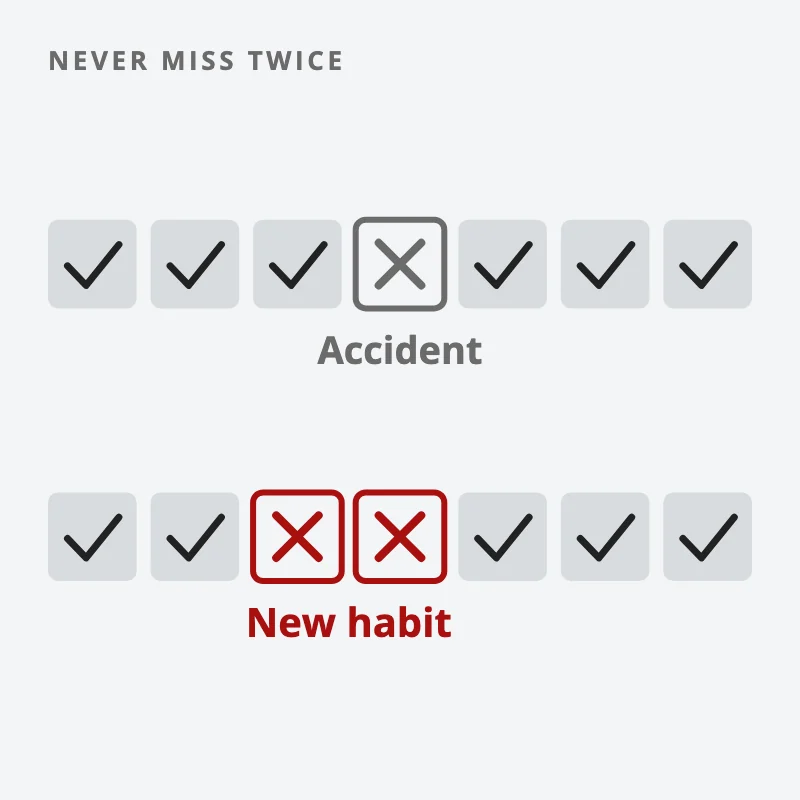
This is the part of the book traders need most. A trader posted this year: “I keep repeating the same trading psychology mistake.” Clear’s answer: “Missing once is an accident. Missing twice is the start of a new habit.”
Everyone breaks a rule sometimes. The damage comes from the second and third break, when one bad trade turns into a bad week. So after a rule break, the only job is to make the very next trade by the book.
Clear even uses a trader’s arithmetic to make the point. Start with 100. A 50% gain takes you to 150. But a loss of only 33% takes you back to 100. So avoiding a 33% loss is worth as much as making a 50% gain. In trading, that is why the small losses you keep small matter as much as the winners.
He adds one warning about tracking: Goodhart’s Law, “When a measure becomes a target, it ceases to be a good measure.” For a trader, daily P&L is a poor habit to track. Whether you followed your rules is a better one.
How do you put Atomic Habits to work as a trader?
The book’s tools fit into 3 plain steps.
Shrink the habit. Make it so small it is hard to skip. One line in the journal after every trade. One look at the checklist before every order.
Give it a time and a place. Write down when and where. Stack it onto something you already do, like the first coffee or the market open.
Never miss twice. When you miss, make the next one count. A broken rule is one data point. Two in a row is a new habit forming.
One more example from my own weeks fits here. A demanding early workout one morning in May 2026 did more than tick off the exercise for me. The rest of the day went better too: what I ate, how well I focused. One fixed habit early in the day raised the floor on everything after it. For traders, a short routine before the market opens does the same job for every decision that follows.
For 5 more habits aimed at the mental traps of trading, see our post on habits to improve trading psychology. And for building trust in your own process, read how to build confidence in trading.
Concluding thoughts
Atomic Habits is easy to read and easy to underestimate. Its tools are small on purpose. For a trader, the book’s value is that it moves your attention from the result you want to the routine you can run today.
For the wider mindset side of trading, see our guide to trading psychology. And more books worth your time are in our list of the best investing and trading books.
So which trading habit would you shrink to 2 minutes, starting tomorrow?
FAQ
What is the main idea of Atomic Habits?
Small habits, repeated consistently, compound into large results over time. Clear argues that systems matter more than goals, and gives 4 laws for building good habits and breaking bad ones.
What are the 4 laws of Atomic Habits?
Make it obvious, make it attractive, make it easy, and make it satisfying. To break a bad habit, invert them: make it invisible, unattractive, difficult and unsatisfying.
What does “never miss twice” mean?
Missing a habit once is normal. Missing it twice in a row is how a new, unwanted habit starts. So after a slip, the priority is getting back on track the very next time.
How can traders use Atomic Habits?
By turning the trading routine into small, fixed habits: a checklist before each order, a journal line after each trade, and a scan at the same time each day. And by tracking rule-following rather than daily profit.
Is Atomic Habits worth reading?
For most people, yes. It is practical, short on theory and full of tools you can use the same day. Traders get extra value from its ideas on systems, identity and never missing twice.
Go deeper
Good trading habits need a routine to hang on. The free 15-Minute Swing Trader’s Checklist has the daily routine, the questions to ask before every trade, and the five rules that protect your account.
About the author. Spencer Li is The 15-Minute Trader and the founder of Synapse Trading. He is a Certified Financial Technician (CFTe) with 15+ years of trading, run from 70+ countries. He holds a B.Acc and B.BM from SMU. Every trade he takes is public, dated, losses left in. He teaches low-risk swing trading in 15 minutes a day, one system for any market.
Educational content only, not personalised financial advice. Trading carries risk, including loss of capital. Past performance is not indicative of future results. Synapse Trading is not licensed or regulated by MAS.
Want the daily routine? Enter your email for the free 15-Minute Swing Trader's Checklist.
Free 5-page PDF, then occasional trading emails. Education only, not financial advice. Unsubscribe anytime. Kit stores your email in the US: see our privacy policy.
Want to learn the full method? The Trading Mastery Program teaches the 4 strategies I have traded since 2011. It suits beginners and experienced traders.
Rather follow the trades as they happen? Daily Trading Signals is our Telegram channel: my trade ideas with entry, stop and exit, and every trade is public.
Questions about this post? Ask in the free Telegram channel →
Educational content only, not personalised financial advice. Trading carries risk, including loss of capital. Past performance is not indicative of future results. Synapse Trading is not licensed or regulated by MAS.

